Search This Blog

Showing posts with label Alignment. Show all posts

Friday, August 19, 2016

The Deed of Paksenarrion by Elizabeth Moon

I'm ashamed to admit that I had not heard of Elizabeth Moon until just last year. In an effort to get actual blog readers and to meet more like minded people, I kept hearing her name in relation to foundational fantasy literature: genre defining stuff. A new friend had some of her books, and I took her up on her generous "deed."  Having done some further research it is much clearer to me now, that Moon did much of her writing in the mid-to-late 80s and was merely part of the explosion of new fantasy at that time. 

The quotes on the back of the book don't help.  "This is the first work of high heroic fantasy that has taken the work of Tolkien, assimilated it totally, and deeply, and absolutely ..." Judith Tarr. (Whose life has taken a depressing turn for the worst, it seems.)

Still, I think Elizabeth Moon's reputation is based on a delightful though traditional approach to fantasy, and her works are certainly part of the firmament of the fantasy galaxy.  And if you've never read any Moon, you need to get yourself to your Indie bookstore and buy The Deed of Paksenarrion.  What makes fantasy, what really takes it from mere swords and sorcery, from plot-based fiction like Stephen Grisham, and much worse, the $2-3 ebook with 500 five-star amazon ratings, and turns it into something with impact, is it's ability to opine almost unerringly on what it is good, and right.  And this is something that Paksenarrion does exceedingly well.

Typically sold now as one volume, the book was released in three parts, the first of which is really the Deed.  After which the second and third book titles are almost meaningless, though they are where the true meat of the trilogy rests.  The book has sort of a slow start, and the first entire section if it, is devoted to a rather un-fantasy like treatise on the training of a mercenary company.  But fear not, if you can get past the first book, Paksenarrion truly blossoms.

Character:  The title character, Paksenarrion starts the novel as a teenage girl running away from home, and an arranged marriage, to join a mercenary company.  There are a few things that jar about this from the get go, but I think it important to note that an important act of fantasy is the concept of creating an equal world.  Not a world where everyone is equal, but one where equality is fundamentally valued by the author.  All manner of awful things may happen in such a world, but when it is apparent that the author believes this, the worldview is upheld by a kind, just, and generous spirit.  Such individuals create characters like them.  And it is these characters who teach us, who show us (by their acts of unspeakable giving, love and faith) that humans are fundamentally capable of good--that despite our flaws, we are redeemable:  that hope exist.
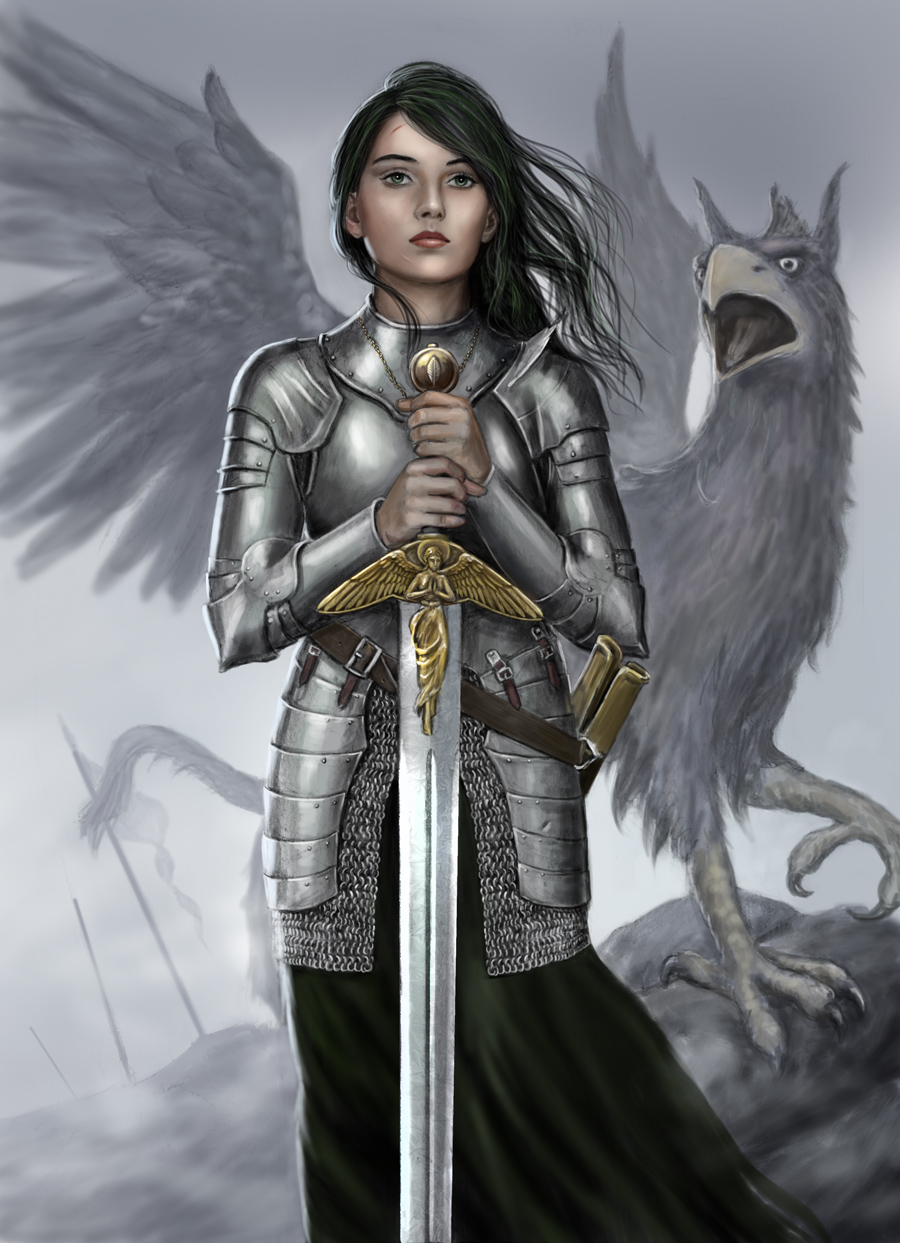
Paksenarrion is such a character.  She's not the sharpest tool in the shed.  She's uncurious, easily led, blind to her own talents, and blind to the shortcomings of others, and these qualities make her a frustrating heroine, though a real one.  Paksenarrion joins a mercenary company, and yet is surprised when the causes she is committed to are not always just.  This seems inherent to we, so wise in the world.  But she's a farm girl, fed on stories of soldiers, and living in a land far from the borders of any cohesive state.  Her actions are charmed, touched by the divine, and one thing she learns, quickly enough is that while she loves to fight, and indeed possesses no qualms about killing, will not fight for causes that are not just.  She loves her companions, and indeed never feels anything approximating lust or desire.  She is asexual, though never termed so.  I have mixed feelings about this, though I think it functions well for a paladin character--though the choice to abstain is in most churchy literature, it is not a consequence of disinterest, the choice to abstain is given as a sacrifice in god's name.  In Islam, it is the greater jihad, the fight to deny one's baser instincts.  Though more dark fantasy has embraced women as fully in-the-world, capable of desire as much as men (and not just mere foils to men's desires', trophies and patsies to the hero) Moon's beautiful rose is truly white. To wit, a modern asexual woman, is itself a massive break with stereotype.  
No author caption here: fell down the rabbit hole
However, the Deed of Paksenarrion is about paladins, and their becoming. In my Forgotten Realms readings, I have uncovered a few characters of priests, such as Adon from the Avatar trilogy.  Even the the Knights of Solamnia from the DragonLance series.  Or also from the Malazan epic, Shield Anvil's, the most devout servants of the gods of war.  Priests are a difficult caste in fantasy literature.  Indeed, books like Harry Potter, and others before it were shunned and castigated by religious organizations like the Catholic Church.  It's interesting to note that fantasy tackles religious matters, and religious organizations all the time, and yet issues of faith, issues that come close to proselytizing are almost always handled at arms-length.

But in a story about paladins, such discussions become central to the plot.  Let us not forget that original of all paladins, was also a female, Joan of Arc.  I found myself becoming uncomfortable at times by the direction Deed was taking. Ultimately, however, I feel that The Deed holds to what is True in fantasy while avoiding the snarls of dogma. And for most of the series, Paks is at best agnostic in her faith.

Artist Unknown.  Seriously, he probably died in a mass grave.


There are some difficulties.  For example, killing even if it is only killing for right is glorified, and there is never a moment of horror, a moment of self-recrimination for the slaughter of enemy combatants.  This is one of the reasons that I began to feel that Paks was not the brightest protagonist.  By the end of the third book, something happens to Paks, and she is broken, a cliche we will discuss later, but her personal struggle is caused by something external to her, something evil that takes root in her, and is then rooted out.  She emerges from the process in rough shape, but her main crisis is that she will be unable to wield a sword again, unable to fight, unable to kill.  Now of course, there are certain aspects of feminism at play.  For example, when Paks finds herself in a barn at night when two churls approach her.  Her inability to fight would have left her in poor straits had not the gods intervened on her behalf.  Now ultimately, the conversion, the self-examination that we want Paks to have, does happen.  But there again, it happens because a druid explains a few things to her.  It's difficult to parse, Elizabeth Moon may be one of those few, rare writers who does not write herself as the main character (not even Steven Erikson can say this).  Moon is a brilliant writer, and obviously a very smart person, but Paks is not.  Writing a dumb character, is I can say with all honesty, absolutely impossible for me.  It's not that I'm so smart, it's that as an intellectual I am constantly assailed by self-doubt and recrimination, things which make a character by nature introspective and thoughtful.  So let us at least say this:  Moon proves her writing chops not in the detail of her world, in the pique of her characters (that's all there) but in that she is able to do what so few writers even attempt to do, to write characters that do not exist within the range of her own "voice."

Cliche:This is 80s fantasy, so cliches abound.  We will touch briefly upon the obvious ones, elves, dwarves, orcs, magic. The first book of the trilogy mentions the other races in passing, as well as gnomes, and a few other beasties. However, unusual to fantasy, the first book is almost entirely devoid of extra races. That said, elves and to a lesser extent dwarves, play a crucial role in the overall arch of the story.  As usual, elves fulfill the usual Tolkien stereotypes.  Immortal, tall, otherworldly, slim, beautiful, musical, etc.  One neat thing about the elven component of The Deed is that it references something that other earlier fantasy works maintain, namely that the faerie dwell in a sort of shadow kingdom, a world within a world, different and similar to ours. Though Tolkien's elves left the plane of Middle Earth, during their time in it, they were squarely involved "in the shit" as it were.  Moon changes the Dwarven cliche nicely.  Instead of the beer swilling, anvil hefting, gold digging, creatures we have come to know and love, the Dwarves are very fond of ceremony, and have a peculiar dialect.  Unfortunately, we don't learn much more than that.  Orcs only really emerge as combatants, quickly slain, and with no real reason for being in the story, merely as a side effect of Evil Influence.

However, Moon, may have been one of the first to embrace the Dark Elf cliche, perhaps not even a cliche at the time. Tolkien's world explored the idea of the corrupted elf, Sauron, the ostensible reason for his long lasting evil.  However, Sauron was an exception, there was no race of like minded long-lived evil ones.  (I never did read the Simillarion though, so I can't speak to the whole of his work). Regardless, Moon's Dark Elves are unusual compared to the ones that the Dungeons and Dragons cliche embraced.  They have the fine elven features, pointy ears, are long lived, etc. that all elves have.  But they stink, and they intentionally corrupt all that is beautiful.  I thought this was a really great detail, Dark Elves are the anti-elf in EVERY way in this series.  The Dark Elves end up being a critical plot point for the series, though they make no appearance in the first book at all.
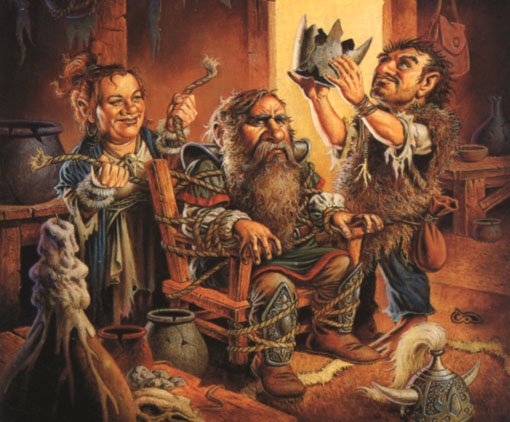
By Gerald Brom

There are dwarves as well, though they play only a minor role.  They fulfill some stereotypes, while trumping others.  Moon's dwarves are different they have a formal speech, though they are boisterous by nature.  A gnome stereotype exists which is quite interesting, though not much explored.  The gnomes of Moon's writing aren't the slightly silly, less strong version of dwarves that you often see in the Dungeons & Dragon Realms.  Their gnomes are fierce like Terry Brook's gnomes, but are strict adherents to order.  Like many creatures faerie (another cliche) they do not believe in gift giving, only in fair exchange.  It's an interesting dynamic, and explored more in later books.

Some of the cliche pages, like TV Tropes, point out that the Lawful Good cliche is in full effect here.  I honestly don't think that's enough of a cliche to pursue.  I do think Lawful Good characters are however, very interesting.  It takes a lot of willful blindness to the world to always follow the law and still be good.  Even a poor execution of a Lawful Good character can show this dialectic.

Adventure Time Cliche:  So in writing this post, I lost an earlier draft, wherein I noted how very much like classic swords and sorcery, dungeons and dragons gaming parts of this book were.  I have no problem with that overall, I've been trying to do the same for some time.  Real drama is created in such games (the good ones) and a story-teller's polish of such events can create real lasting value.  It worked for R.A. Salvator and Margaret Weiss afterall.  I noted that one of the scenarios was Paks meeting of a certain half-elf of ill-repute on the road.  The two join-up, explore a dungeon, and slay a wizard.  But I'd forgotten that they do almost the same thing later on, in Brewers Bridge, the TVTropes site pointed out that it is almost the complete scenario for AD Module 1.  For a more thorough listing of Paks cliches, check out this TV Tropes site.

Completeness: The Deed looks and feels like a complete world.  Throughout the novels, we explore a good portion of the world, and the interconnectedness of nations is well-demonstrated.  The wars of the south, for example, are in large part trade wars, defending various routes to various ports, and various choke points like the castle Dwarfwatch.  These are the sorts of things that real wars are fought over, and I appreciate that detail.  Moon has some military experience, and the battles are drawn in painstaking detail.  Some readers are turned off by this, it seems, but strong detail is never a problem for me.
>

The religious aspect is well-developed without choking, and was not offensive for an old-time atheist like myself.  I've played a few paladins myself, and like I said, I find the character type pretty interesting.  The Gods are real, and come across that way--unlike the idiocy and petty squabling of the Forgotten Realms gods, and still ineffable and mysterious, unlike the gods of the Malazan epic.

There are a few untied threads.  Now, life is a series of untied threads held together by place, time, and financial obligation.  However, those things are tenuous at best in fiction, and untied threads can always be blamed on the author.  That said, many of these threads seem to be tied to these one off AD and D adventure modules that occur throughout the books. Mini-stories, that are engrossing, but ultimately have little to do with the arc as a whole.

The arc is a long one, and many readers get turned off by the slow start.  When Paks soul searching takes it's darker turn, and where it receives it's finest answer is where the book really starts to shine.  It's also where Moon takes the gloves off and shows us some of what evil is truly capable of.  In the end, I quite enjoyed The Deed.  I did find some of its characters to be in part unrealistic, but wasn't ultimately turned off by it.  The Deed of Paksenarrion is worth a read, and doesn't quite deserve some of the heated criticism its received.

Monday, March 23, 2015

Dragons of Autumn Twilight by Margaret Weiss and Tracy Hickman

So, Dragons of Autumn Twilight, and indeed the DragonLance Saga was one of those formational books in my career as a fantasist.  The timing was apocryphal, 80s fantasy was proliferating, and the fantasy section of Waldenbooks (remember them?) was expanding from four shelves to an entire section.

But the writing was still in its infancy, it was a simpler time in fantasy.  Which is not to say that there weren't complex characters or narratives, merely that the expectation was merely swords and sorcery, not quality. Just about anything with a sword or dragon could qualify back then.

I say all of this because Tor has commenced its own DragonLance reread, and both bloggers, Jared and Muvesh, point out the text is simplistic and rife with cliche.  They're not wrong, but they started their reread with the creme de la creme. I started my reread with the dreck that is the first five novels of the Forgotten Realms books.

The Tor bloggers also point out what I have mentioned in my Forgotten Realm reviews, namely that these novels are limited by the fantasy rules of Dungeons & Dragons. Jared and Muvesh come from two different backgrounds, Jared obviously played the game "way to roll a 1 beardy!", and Muvesh came to the novels fresh, having grown up far far away from the kitsch of American consumerism in the 80s.

I actually purchased the DragonLance module for the D&D world, intending to Dungeon Master it for my friends. Unfortunately, my friends "grew up" before I did, and so I never got the chance. But I've actually seen the stats for the story's heroes. If you recall, or if you were born after 1985, the stats were rolled with a six-sided die. That I even had to qualify the number of sides for you is pretty indicative of the type of geek I'm talking about. All of this to say, the highest number you could get, at least in the original rules, was 18. The better your stats, the better your character's chance of hitting, dodging, casting spells, attracting followers, etc.  All of this was rolled into those first computer games, D&D and 4-bit Heroes of Might and Magic. Except for the fact that the game developers learned pretty quickly that if the same number of missed swings continued in battle, they would kill their market pretty quickly.

I bring this up because I remember being slightly puzzled by how low the stats of all the DragonLance Heroes had actually been, except for Raistlin whose intelligence was a stunning 17. As a young teen none of us wanted our heroes to be ordinary, so we gamed our dice until we came up with a number we felt comfortable with. The Realms computer game Baldur's Gate came up with a clever way of bypassing this, let the computer roll your stats, and then get a few flex points to tailor your character as you wish. Point is, the Heroes of the Lance were rather ordinary.

Anyway, Dragons of Autumn Twilight was published before even the first Realms book came out, so there was some real trailblazing here.

Character: Tanis, Raistlin, Caramon, Sturm, Flint and Tas. Need I say more? The figurehead, the leader,
and the character we all loved unequivocally, was Tanis Half-Elf. The product of rape, a dichotomy of elf and human, long and short lived, noble and peasant, lustful and pure, courageous but filled with self doubt and inner torment.  And a love triangle!  In Jared's reread week #2, he points out that DragonLancers fall into two categories, Raistlin or Tanis fans.  If this is true, then I confess I am probably a Tanis fan.  Though I do love the character of Raistlin, his all-consuming thirst for power was less interesting to me then the painfully torn personal anguish that Tanis felt.  In retrospect though, the writing of Tanis' inner torment is of a lower quality then that of Raistlin's.  That said, Tanis is the story's main hero, its leader, and there is just more detail regarding his thoughts and feelings.

The Twins, Raistlin and Caramon, darkness and light, Mage and warrior, ambition and loyalty. These two were so beloved that Weiss and Hickman wrote an entirely different series for them! I recall an interview with Margaret Weiss where she told us that Raistlin was her favorite character. The dynamic of the Twins told us so much of human nature.  The desire to protect and help our lesser brother, as the warrior Caramon so often did with Raist. The desire to be free from physical constraint and independent, as Raistlin personified. And ambition, oh, so much about ambition.  And it's converse.  Caramon's greatest desire, his most fundamental ambition is to make lots of babies with Tika Waylan, and live on a farm with his kooky brother as one big family. In stark contrast to Raistlin, who would one day challenge a god with his magic, not to vanquish her evil, but to consume and supplant it!

Then we had Sturm, himself a conundrum.  A boy aspiring to the past glories of knighthood. Trying to live the code, My Honour is my Life, yet knowing that he was no knight in truth, and the organization he worshiped, the Solamnic Knights had grown petty and powerless. As a teen, it was Sturm who captured my imagination.  I had the Death of Sturm, that famous Larry Elmore painting, taped to my college dorm room wall. His courage and his sacrifice were symbolic to me of all that men were meant to be. On my reread, I realize now that Sturm was also incredibly angry and intolerant.   Something
that probably appealed to me then.

Then there were Flint and Tas, the crusty dwarf and the irascible kender.  As a side note, I learned last month that in those early days, TSR the owner of Dungeons & Dragons was involved in a number of disputes with the the owner of the Tolkien merchandising, one Saul Zaentz. Possession of the term Hobbit was one of them, and by 1978 per Sacnoth's Scriptorium the most obvious terms, Ent, Hobbit, Nazgul, etc. were gone from the franchises. TSR compensated in a variety of ways, creating Halflings and Gnomes in the Forgotten Realms, Kender, Gully Dwarves, and Gnomes in the DragonLance series. While all dwarves seem to assume fairly typical clichéd attributes, and Flint is no exception, the splinter races of Hobbit take on a variety of different tropes. Gnomes are tiny but ingenious and industrious, Gully dwarves are filthy, uneducated and the lowest caste, and kender are the fun loving scamps of the tiny person world. Tas was one of these, and it's the relationship between these two that grants Flint a life beyond mere Dwarf cliches. To be sure, even Flint's fury at the kender's antics is fairly cliched, but the Death of Flint still brings tears to my eyes.

There are others, great loves and great heroes, but these are the essential Heroes Party.  Itself a cliche, a group of five or six heroes who compliment each other's skill sets and agree to quest together.

Cliche:  Where to begin?  Let's skip the obvious ones.  Dungeons and Dragons was all about cliche.  In fact, the original rules didn't even have a Dwarf class, the Dwarf was simply a fighter, the Elf, simply an Archer.  I mentioned one above, the Heroes Party cliche.  I note this because the cliche has certainly changed over time.  In the D&D world, the characters were very failable, your heroes died all the time.  You could get them resurrected without too much trouble, but only if someone in your party survived and was able to haul your keister back. To wit, the parties were larger.  You could have as many as seven or eight people to a party.  More with a good DM.  Parties are smaller these days, and videogames blazed that particular trail, parties are typically three now, with more characters waiting in the background.

Fan art, tried to find all three together. by Autumn-Sacura
I mentioned the Love Triangle earlier, a cliche but not one native to fantasy.  Tanis grew up in love with an elf maid, a princess of his people.  She loved him back with childlike naivety. But Tanis left because Elves are intolerant to the extreme, big on social purity.  And though humans are no better, human society is much less structured than the that of the long-lived elves.  And his other lover is a human woman who isn't even "good!"

Which calls to mind another D&D creation, the Character Alignment Cliche.  So when creating your character you had to choose two of six attributes, one from a set of three.  Good, Neutral, Evil, Chaotic, Neutral, Lawful.  For a great listing of character of alignments in D&D click here.  Why bother you ask?  Well, despite the massive amounts of rules, D&D attempted to create real story telling.  Which necessitated real characters, which necessitated real thought.  Choosing an alignment was a way of thinking about your character.  In effect, it made the game more fun.  "I will kill this murderer!" says the Paladin, "because I am the arbiter of justice, and because the rule of law says that this man must die!"  "I'm sorry," says the ex-soldier now adventurer, who continues "Though he is guilty of murder, he is also deserving of kindness.  He murdered only to protect his kin!"  Part of what made the Party system so interesting was that you had to have your six or seven heroes all get along together!  You don't see this cliche too often anymore.

As the Tor blog pointed out, the book begins in an Inn, a symbolic setting for the Dungeons & Dragons meme. And the Inn certainly manifests itself often enough in fantasy to warrant its own cliche. the jovial innkeeper, warm fire, large bosomed barmaids. Or it's the Evil Inn cousin, think shifty innkeeper, slatterns, and nefarious doings in the corner.  But in Dragons, it's the Inn of the Last Home, where friends gather to eat Otik's famous potatoes and flirt with the luscious Tika Waylan. And so the epic starts as Friends gather after a long absence.

Completeness: I talk sometimes about scope, and in this simple thematic device, that of old friends meeting, the book establishes a complicated history from page one. Why did the friends part? Where did they go? Why are some together, and some separate? Were there mixed feelings, old dramas, triumphs of old? What about that sensation we've all had about life: that the past is dead, never to be felt again.  That you can't go home, and that memory is always different then what was.  I actually can't think of another fantasy book that begins quite this way. The Eddings' Belgariad had old friends meeting up along the road, but off hand that's it.  For all it's tropism in the Dungeon & Dragons world, it is fairly novel.

"Dragons" suffers from a very obvious and perfectly explainable completeness issue: much is purposely left unexplained. The back story to the characters is only alluded to within the trilogy.  Other authors were contracted to pick up the yarn and finish these quests.  This was frustrating in the 80s, as the other authors were never as strong as Weiss & Hickman.  In some cases entire chapters seem to be left out.  That said, Dragons was a pretty thick book for back then.  Particularly given that the average "game module book" probably ran about 250 pages.  It might well be that some of the missing content was merely cut for size.
Flint the King, what Flint did during his 5 year trip

There are a few interesting points I wish to make here.  In almost all fantasy genres of the 80s and early 90s, the basic baddy, the foot soldier of evil was more or less incomprehensible, the other, alien and bestial (orcs, trollocs, demons.  Not so in DragonLance.  Hobgoblins and Draconians are fully sentient, frequently speak the common tongue, and are sometimes even playable races within the games.  So when, in that first chapter of Dragons, Tanis and Flint have a conversation with Fewmaster Toede (a hobgoblin comic-relief villain) it's almost shocking.  Usually when orcs appear, swords are drawn, and orc blood rains black from the heavens.  There is no discussion, no capacity for empathy.  It's just kind of a neat thing.  For all that Jordan advanced the genre, the only conversation he ever had with a Trolloc was one where it was being tortured for information, or attempting to trick its human target.

Fewmaster Toede, almost all of these images are Elmore originals
Last, what Dragons lacks in completeness, the game module, the other books in the series, and the other books in DragonLance as a whole compliment and fill utterly.  Though the book itself seems riddled with holes, you can rest assured that everything is explainable with reference to some rule in the Player's Handbook or in the lore of the series, or even in the fanverse that has, in the intervening years given these books a completely new life.

Having completed my reread of the first novel, I still love the Heroes of the Lance.  My admiration for Weiss and Hickman remains, though it is tempered by the amazing writing of what the future of fantasy would soon hold.