Search This Blog

Showing posts with label Assassin Cliche. Show all posts

Monday, October 5, 2015

Halfling's Gem by R. A. Salvatore

Given the empire of Forgotten Realms fiction that R.A. Salvatore has put upon this earth (nearly 22 novels), you'd think the first three novels of his would be classics. Forbes did a great interview with the author, and in it Salvatore gives us a plausible reason for this:


“You don’t have to start at the beginning,” he tells me. “Contrast that with George Martin or Robert Jordan and the way they did their series. You couldn’t pick up the sixth book of Wheel of Time and read it, I don’t think, if you hadn’t read the first five. With the Drizzt books you could pick up the 6th book, the 10th book, the 15th book, the 20th book. It’s more like Sherlock Holmes or James Bond.”

Of course, that is the very definition of pulp fiction, and why Martin and Jordan are hailed as serious authors who shook up the world of fantasy fiction.

Halfling's Gem was an atrocious train wreck that I barely feel deserves a review. Not as bad perhaps as Spellfire, but up there.

Halfling's Gem concludes the Icewind Dale Trilogy. The plot continues the drama between the Calishite assassin Artemis Entieri and the dark elf Drizzt Do'Urden, as they fight over possession of a Halfling thief. Also appearing for the first time, the man who put the price on the halfling's head, Pasha Pook.
Artemis Entreri


The plot ... is ok. Where this book repeatedly fails is in the juvenile level of the text. Juvenile isn't quite correct because even teen literature is often more nuanced.

Character: Halfling characters get the worst treatment. At least Douglas Niles and Kate Novak used female dwarves and halflings. The D and D rules made these characters pretty limited but creating an interesting back story could have at least made Bruenor more palatable. So SPOILER: Bruenor is assumed dead at the start of the novel having ridden a flaming dragon into the abyss. And a neat part of the book is the discovery and fight through the abandoned city, but for whatever reason Salvatore spoils the surprise for his characters and has the all knowing and all powerful Drizzt realize long before the reveal that Bruenor may yet live. Salvatore had a chance for his characters to explore the very real emotions of raw grief, and he shied away from it to point out, yet again, how cool Drizzt is.


Wulfgar is also pretty terrible. We discussed in my review of The Blade Itself the Barbarian cliche. Wulfgar is that cliche, no twist, no subtlety, if you wanted to describe the Barbarian cliche in one word, that word is Wulfgar. The emotions that Wulfgar feels are simple: love, anger and grief. About as skin deep as you can imagine. Grief is not the mere absence of that which is held dear, it is the cacophony of successive failures, missed opportunities and piercingly poignant memories replayed continually within a mind unwilling or incapable of stopping itself.

I guess what I'm saying is that Salvatore keeps telling us when he should be showing us. A classic writing criticism.  This was 20 years ago, I'm hopeful that Salvatore's technique has been honed by 20+ books.

Last, we have Drizzt, in the second novel in the trilogy we learned that he felt his meeting with Entrieri to be a fateful one. That there was a strange connection through skill of arms with the assassin. While this morbid curiosity might have added a dimension to Drizzt's personality, it fails as Drizzt is forced to utter trite truism after trite truism.  It's sad because I've begun to suspect that Drizzt is actually a fairly deep character. For example Drizzt is offered a magic mask that makes him white. And he uses it because people fear the drow. But he comes to quite enjoy the anonymity and access the mask allows him. The notion of "passing" is an extremely loaded one for African Americans and its place in this banal fantasy novel is notable. Another moment has Drizzt stealing a kiss from the unconscious Cattie-Brie. A kiss which is never addressed again. 

As a general rule: If you were to strike every single line of dialog from the book, it would be immeasurably improved.

Cliche: all the usual D and D cliches apply, so I won't waste any time but to list them: Dwarves, halflings, elves, Dungeons and Dragon's Race Cliche, barbarian.

Some new ones include The Kidnapping, the Middle East and the Thieves Guild.  The Kidnapping is pretty self explanatory: it's a common fiction cliche, helpless child/girl/Halfling taken by force on a long journey, vengeful heroes hot on the trail, always close, but never quite catching until the final pages. One difference here is that the Heroes give up catching the assassin fairly early on and simply make for the final destination. One famous example of the Kidnapping motif would be from Tolkien's Two Towers when Pippin and Merry get taken by the Orcs.
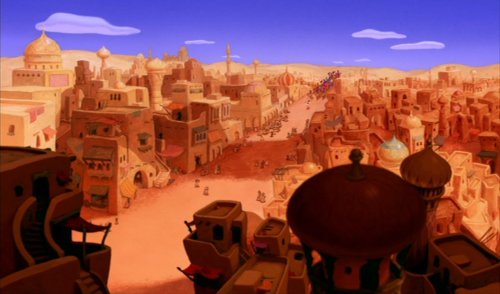
Agrabah, or Calimport by Disney
The Middle East cliche  is a common one as well, Calimport is clearly a middle eastern city, and it's denizens, though magical (halflings, humans and wererats follow the same dress and speech patterns. This type of Orientalism would be offensive to some, but the point of the cliche is to save time and space. Calling to mind a westerner's idea of a 1300th century Middle Eastern city provides leagues of description without straining the readers imagination.  As I get older, and my anthropologist wife teaches me to be more sensitive to and less tolerant of micro aggressions that form the undercurrent to overt racism, I begin to wonder about such tropes, and I begin to understand why so many authors have attempted to create whole new worlds, absent of these cliches.
The internets are loaded down with Skyrim images.  Best I could come up with.

The Thieves Guild cliche is an incredibly common one in fantasy.  One the one hand it gives voice to a real world occurrence in a fantasy world, that of organized crime, and on the other hand, it speaks to the shadow economy that likewise exists in every city and state, the sale of untaxable, untrackable, and unregulated goods.  One thing that the Thieves Guild cliche does frequently in fantasy, however, is to neuter the more dangerous and pyschopathic elements of such a community.  To Salvatore's credit, his thieves guild is pretty despicable.  Pasha Pook the crime boss of Calimsport runs the guild with the aid of three henchmen, a dark wizard (fairly servile, as evil wizards go) the deadly assassin Entrieri, and a runaway pack of were-rats.  Though the subplot in Halfling's Gem of trouble in Pasha Pook's organization is never really explored or prevailed upon in any major way, it does give voice to the fact that such an organization would be almost impossible to govern.  But If you're looking for fantasy mafia stories to thrill and awe you, leave Halfling's Gem on the penny shelf, and pick up Scott Lynch's Gentleman Bastard trilogy.


Completeness:  Sadly, I think Halfling's Gem is not the end of this pitiful story.  As the action closes and the heroes sail away righteous and victorious, we know a larger battle is on the horizon as the dwarves of clan Battle Hammer are massing to retake the mines of Bruenor's father.  Still, this story does wrap up the unexplained nature of the halfling's powers and the mystery of how he obtained his magical gem.  It also sheds further light on several new areas of the Realms.

As I become more home in the world of the Realms, I see that there is very little overlap or common knowledge.  Virtually none of the stories I've read or reviewed so far even occur within the same thirty year period.  While, this excites me on some level to know that the breadth of the history of this place is huge, it also feels sloppy and haphazard in the retelling.  I have attempted to follow the date of publication for these books rather than take a timeline version of the books approach.  I chose that route because I want to see the vision of the realms as its actual creation was occurring, not as a second-guessed, revised version.  However, this choice has lead to some frustration on my part.  Right now the only common element is Elminster, and he's kind of crotchety and fallible for an Old Wizard type. 

On the whole, I'd say feel free to skip the Icewind Dale Trilogy.

Tuesday, January 18, 2011

Brent Weeks - The Night Angel Trilogy

Sorry for the long silence my fine friends.  I've been busy at work, grad school, and other blogging projects.  This post is about only two of Brent Week's books in the Night Angel Trilogy:  The Way of Shadows, and Shadow's Edge.  Nearly finished with the second, I can say that I am definitely intrigued enough to finish the series.  Still, I have some hang-ups with the story, the main character, and the style.  But the ending of both books is exciting with some novel surprises which make the series a worthwhile read, if not a shelf stuffer.  A shelf stuffer, I define, is a book worth keeping to reread.

On to the Five Factors
1)  Character.  There are some great and memorable characters in both books, however they suffer, in my opinion from some structural flaws.  As you may have guessed from the titles of the books, which say very little about the books individually and really only make for good book jackets, this is a series about assassins.  Assassins are romantic favorites for many young fantasists.  They're dark, ruthless, and mysterious, and these things can make them appear sexy.  In popular fiction, assassins are good fodder for paperback drivel, think Jason Bourne and such.  Or historical works like the assassins in Munich would also be a good example.  Femme Fatales are famously sexy assassins, beautiful, broken, dead dolls who are either totally despicable, or have hearts of gold buried deep in their lithe sexy bodies.  Week's works take a more fantasy approach of the genre, with bladework and poisions, traps and such.  But our main character, Kylar Stern, is no typical assassin.  He's neither ruthless, nor for much of the novels, is he a particularly effective killer, botching many of the jobs he's sent on.  In short, he's a highly likeable assassin.  However, there's a disconnect, because his repute in the book, is the repute of a cold hearted killer, feared by many.  Though he kills, and is extremely well trained, Brent fails to convince me that this character is actually an assassin.  Far more interesting of course, is his mentor, Durzo Blint (Week's names for his two main protagonists are terrible.  Durzo Blint, sounds like a Polish pastry.)  but more of this troph later.  Another failing of Weeks in this novel is that new characters who will actually make a difference in the plot are introduced two or three hundred pages into the novel.  While this technique is used in other more successful pieces of fantasy, Weeks introduction of these characters is arbitrary and unnecessary.  Characters like Dorian, Solon, and Feir are barely explained, fulfil several nearly inscrutable purposes in the plot and then disappear until they are next needed to grease the wheels of narrative fiction.

2) Cliche.  I've already touched on the main cliche, use of an Assassin as a main character.  There have been some great fantasy assassins on my shelves.  Hugh the Hand is an old favorite, from Margaret Weiss and Tracy Hickman's Deathgate Cycle, a truly phenomonal series.  The assassin cliche is this:  Embittered embodiment of death, ninja-like stealth, a vast array of dainty killing instruments, Ruthless Assassin ("RA") whose soul has been so destroyed by his evil work, killing innocents/killing in coldblood, loneliness and disconnection, finally meets the gig he can't deliver on and finds that he is afterall a human being.  In The Way of Shadows, the RAs deviate from this model in that they have friends, loves, even children.  Moreover, a lot of their jobs are won through blunt force.  One man against twenty palace guards, fighting with British long swords in open passageways.  Stealth is only occasionally applied, and is even more rarely successful.  Steven Erikson does a better job with his assassin, Kalaam in the Malazan Book of the Fallen series.  Kalaam, is a cold hearted killer, who is at the same time imensely intriguing and a hero of the series.  There is never a question about his tempermant, where Durzo Blint is prone to massive episodes of excessive drinking and disorderly conduct.  Disorderly assassins are dead assassins.  But not in the Night Angel Trilogy.  Robin Hobb made a similar mistake in the Assassin's Apprentice, in which the main character never really gets mean enough to be believed.

Look, I don't have a problem with deviations from the cliche, but this rational divide is never adequately explained.  Coldblooded killers can't have regular lives.  If they did, they'd be constantly asking themselves the questions that would surely undermine their work.  To be sure, Kylar and Durzo have a host of emotional issues, but neither of them are cold blooded enough to be entirelely believable as assassins.  Perhaps this was Week's intention, modern fantasists attempt to break through cliches rather than use them.  But in this case, the attempt was not executed well.  Only two of the stories assassins, both minor characters, really fit with the cliche, and both are evil, blood thirsty menaces. 

Assassin's Apprentice (The Farseer Trilogy, Book 1)The second cliche, which is executed fairly well, is a Coming of Age cliche.  Before becoming an assassin, Kylar is a gutter boy named Azoth, who joins the netherworld to protect his two friends, one of whom becomes his girlfriend in later years from a local tyrant.  He becomes apprenticed to Durzo Blint, and learns the trade from the older killer.  This section of the book is about fifty pages too long, and doesn't really move the plot along all that much.  Moreover, it makes Kylar even more likeable.  Even so, Kylar's likeability and struggle with his impoverished background makes him a character worthy of following, and provides the story with a basic thematic outline.  I think this might be why Weeks and Hobb failed where Erikson and Weiss succeeded, Erikson and Weiss came into the story in the middle of their assassin's lives.  You never saw the foibles and trips along the way to deadliness for Hugh the Hand or Kalaam.  They started the series unrepentant monsters and were redeemed through valorous, selfless acts.  Weeks and Hobb's characters are flawed humans forced to an ugly trade, who are indeed redeemed, but never really damned.

A third cliche, begun in the second book, The Shadow's Edge, is the concept of a sisterhood of magic users, very much like Jordan's Aes Sedai or Goodkind's Sisters of the Dark.  There's not much substance to it, so I won't waste your time.

3) Scope:  Few novels pack the scope of The Wheel of Time.  I should get used to that.  In my own half-hearted attempts at fiction I can recognize the same problem in my work, but its difficult to get the mind around.  You have to hint at the world beyond, you have to hint at ages of history, but you can't bludgeon your audience with it, and you can't waste time describing it when you should be illustrating it.  LOTR and Wheel of Time do this primarily through the use of ancient ruins and old sages.  But honestly, its something I struggle with and I can't provide much guidance for authors. 

There are at least three, four nations in The Night Angel Trilogy, though the action in the first book takes place almost entirely in one city.  They are "modern nations" in that little history of the warring nations is discussed save for the most recent.  The encroaching empire of the evil GodKing, is one nation, and is pivotal to the story.  To be sure, The Night Angel series has a myth structure, centered around one character who I can't name without spoiling the first book.  There's a wide world out there in Week's Night Angel, but its still sketchy.  I can only describe it with the use of a poor metaphor.  Worlds like these are like reading about other countries in a newspaper, vague and impersonal unless you know a lot about them already.  World's like the Wheel of Time, are like holding up a lantern in a darkened room.  Everything out there is hinted at by vague shapes in the darkness, and yet,  has a reality which is undeniable and fascinating.  Hobb's world was similar to the Night Angel's save that her second series The Liveship Traders started out entirely different characters in the same world, granting authority to some of the places on the map in the first series.  Judging by Weeks' prolific nature, I assume that many of these lands will be defined in later works.  But it's an awful risk to assume that I'm interested enough to keep going.

4)  Magic.  Week's system of magic is poorly defined.  But it doesn't really detract from the action.  For most of the characters, magic is used as assassins would use it, for stealth, crawling up walls, disappearing, charming, etc.  There are brief descriptions.  It's rechargable by sunlight in most cases, and it's also called Vir.  And magic users who are "Talented" usually join various schools of magic which irrevocably shape the direction of their skills.  The GodKing and his minions have it in spades, and his Vurdmeisters are formidable killers.  There seems to be an endless supply of mages in both books for Kylar to kill.  And then of course, there are magic swords, and magical stones, which are the source of The Night Angel's power.  However, Weeks does an excellent job of creating horrors like the Ferrali in Shadow's Edge.  I won't bother to describe, it's pretty gross, and you should read it and find out.  Click on the amazon associates logos above and I'll get cents for your efforts!  These things require magic to function, and even if the technique is never explained, the images Weeks creates are worth discovering on your own.

5)  Theme.  This is a fantasy for city boys and girls.  All of the action takes place in busy cities which are ruled by a criminal underworld which is known to be cruel, and yet is at the same time benevolent (don't get me started on that contradiction).  The settings are rooftops and ceilings, corridors and passage ways.  If this series has a theme at all, it's a sort of proletariat pick yourself up by the bootstraps and kick ass feel.  Even so, it's a fairly cosmopolitan tale involving child abuse, both sexual and physical, holy rollers, insane killers ignorant nobles, and the types of poverty that are more common in early industrial cities, not preindustrial societies like the Night Angel world.  Kylar's struggle to be a good human being, to find love and happiness, to grow up and "be a mensch" fit with the above mentioned cliche, and provide a cluttered story a stable protaganist to follow.

On the whole, these books are worth a read.  Borrow them if you can, but if not they're in paper back and the whole series is fairly cheap.  Or go E-book, the cover art is pretty lame so you won't be missing much.  None of the weaponry wielded by the photographed model on the cover are used by Kylar or Durzo, who predominantly kill with sword and daggers, so you definitely can't go by my earlier suggestion of buying based on the cover.

Note to Publishers:  Avoid trilogies.  I never get through them anymore. Go big or go home.