Search This Blog

Showing posts with label femme fatale. Show all posts

Monday, August 20, 2018

Academ's Fury by Jim Butcher

 I haven’t posted in awhile. Kids man, no time to write and when I do, I try to work on original fiction to further my dream of being an actual writer. As I'm jotting this down on my iphone, my 17 month old is singlemindedly slapping clothing on a doll and a stuffed animal

So, this is the second book in the Codex Alera. Part of a six book series. I like that he calls it a Codex, not too many of those—though to be frank unlike a lot of fantasy that creates fake literature to illuminate and foreshadow each chapter, this is noticeably absent from Butcher’s work. I enjoyed this book quite a bit. The plot is complex and full of intrigue, Jim Butcher continues to create a realistic fantasy world. If you are fan of Jim Butcher, check out his fansite, paranetonline!

Character: I think the main reason to read the Codex books is because of his main character, Tavi. He’s just a sunny, tough little guy who never feels sorry for himself and makes things work without all the special gifts that literally every other person in this land has. I just like him, and he’s a joy to read. His Aunt, is a bit of a drag, spoiler alert not really a spoiler alert, we begin to understand a bit more about her personal history. While we are on the topic: a person I respect at work told me her feelings on this book. Namely that a lot of the big reveals are pretty obvious, Tavi’s parentage being the most obvious. While I can see what she's saying, I'd say two things in reprisal: one, this does not detract at all from the excitement of the plot, or overall book enjoyment.  Two, what's interesting is just how long these reveals take.  By the end of this book you are some 800 pages in, and only one major reveal has taken place.  That sort of tension is interesting, and I thought planned.  The villains are also quite interesting, all returning from the first book. The sexy Lady Aquitaine, the dangerous and pragmatic spy Fidelious. And of course we get more acquainted with another High Lord, Kalare. Of course my continued sore spot for these novels is the romance and sex between The heroine Amara and the stalwart Bernard—it just doesn’t do anything for me and the intimacy is gratuitous. Both characters and their relationship fall into stereotypes and while I myself am proponent and supporter of cliche, I still find, as per my original review, these displays unpalatable.

Varg, the Canim Ambassador
Cliche: So, new Cliche's in this book that weren't in the first book of the series, Furies of Calderon. Well, Butcher does a good job of steering clear of most of the fantasy cliches. The first I can think of is less obvious. A minor new enemy introduced in the book is a species of half Dog, half Man, called the Canim. They are enormous though, and quite frankly, seem almost like Minotaurs, including the fury and menace that Minotaur mythology is said to encapsulate. These furry foes certainly share little with dogs as we know them. Lady Aquitaine fullfils a nice Femme Fatale role, beautiful, sexy, horny, brainy, and powerful as fuck. She was briefly outlined in the first book, but we get to witness full use of her power as she (SPOILER) takes charge in the final chapters of this tale. It's a good use of the cliche, and her #openmarriage with Lord Aquitaine allows her to be free from some of the sexist baggage of the cliche as it is traditionally written. She might also get herself filed under the Lady Wife cliche, as she and her husband are deeply united on their goal of usurpation, if not of marital fidelity. Of course, we must repeat the Coming of Age cliche, as Tavi, now in his late teens, is still very much finding himself. That said, the use of this cliche is not quite so heavy here. While certain acts of incipient manhood are definitely reached in this volume, Tavi is already such a confident main character, that I do not really find his growth in this regard to be a major plot point. I guess the last cliche, a new one for this post, would be the Giant Spider cliche.  We are terrified of bugs, creepy, annoying, as well as deadly.  So there is a lot packed into a story where giant bugs are the main baddy.  I think some people are probably turned off by this story because of it.  The Giant Bug cliche is a common one for fantasy, think Shelob from LOTR, Lloth from The Forgotten Realms and Aragog from Harry Potter. What's a jauntin the  Enchanted Forest without an encounter with a nest of gigantic arachnids? But this Giant Spider cliche is at the heart of this series, which makes it a bit different. For instance these spider creatures have a queen, and are not in fact ALL spiders!  Anyway, I found it refreshing, and this new installment introduces a terrifying new insect called the Taker.  Which leads us to another new cliche!
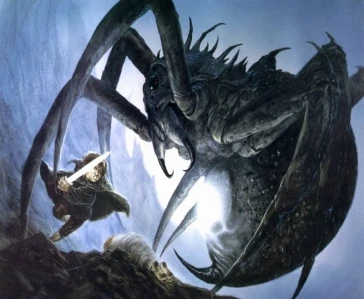
Shelob
The Zombie cliche.  Of course, zombies got their start in horror, but have had their own lackluster existence in fantasy.  See my review of the Walking Dead.  Without spoiling too much, think of the two most terrifying things, bugs and zombies, and poof, you have Academ's Fury. The strength of zombie's of course is that they do not feel physical pain, they are utterly relentless, and utterly tireless.  These zombies are a tad different.  Read it, you'll see.


Completeness: This for me is where Codex Alera, while great plot driven fantasy does fall down from its ultimate potential as genre busting fantasy. While the plot is complex, and fully realized, as I mentioned earlier, it still lacks the depth and ancient history of Jordan's Wheel of Time, or even Martin's Game of Thrones.  These books have histories that go back hundreds and thousands of years.  While this is alluded to in the books, as in they are a splinter colony of an ancient Roman legion, the history is really too general to be of interest.  It's a pity too because, there is a real opportunity in this book to do so.  Tavi is in school, he even has a history exam where he discusses one scholar's old work about furies!  Alas, Butcher is many great, great things, but an academic he is not.  His scholarly discussion between Tavi and a cantankerous old buffoon is very disappointing.  Tavi's best defense of his point of view, is that "many scholars agree".  Tavi, this is not how you cite, even in an oral exam! Sigh, but that's my particular bias. Other than that, the realm of enemies and plagues facing Alera are very real, and very complete.  This aspect of this very plot driven series is absolutely intact and fascinating.

To sum it all up, I definitely recommend this book, and if you do decide to buy it, click on the opening link and help a guy out!

Thursday, July 22, 2010

The Books of the South by Glen Cook

So before I go any further I have the following corrections to make.  In some of my earliest posts, I referred to Glen Cook as a new fantasy author.  He is new to me.  His wikipedia page shows that he wrote his first fantasy novel, The Black Company in 1984!!  He worked at GM and produced three novels a year as an auto worker!  The man was also a soldier, and you can definitely tell.  So my apologies to Glen Cook, and my hats off.  The Black Company is a truly awesome fantasy series.  Cook's writing was miles ahead of his time.  The back of my copy even has a shout out by Steven Erikson saying "Glen Cook single-handedly changed the face of fantasy--something a lot of people didn't notice and maybe still don't."  I used to think Erikson's originality was unparalleled.  Now I can see that he took much of his style from Glen Cook's work.

Anyway, is it too late to do a review of books that were published in the 80s?  Absolutely not!  They've been rereleased in anthologies and their beautiful covers by Raymond Swanland are sleek and modern.  Starting with the cover this book was a great investment.  I remember seeing a comic book when I was a kid, that had the picture of a massive warrior, completely covered in blocky slabs of black enameled, spiked steel.  The warrior carried a wicked halberd with a blade a foot and a half long.  The image was so deeply foreboding and exhilarating that it burned itself inexorably into my mind.  Swanland's cover art reminds me of that image--I just had to pick it up.  And man am I glad.

The Books of the South takes up where the Black Company ended, in the volume called The White Rose.  The anthologist, Tor, made a slightly odd decision in publishing the series in one book.  They chose not to bind them in order of publication.

The six original book of the Black Company were published between 1984 to 1990 in this order
1.  The Black Company
2.  Shadows Linger
3.  The White Rose
4.  Shadow Games
5.  The Silver Spike
6.  Dreams of Steel

The new anthology, Books of the South, reverses the order of The Silver Spike and Dreams of Steel.  Personally, I don't think this was a great choice.  Regardless, the stories are beautiful.  I recommend you read the stories in the original order of publication.

The Five Factors
Character
Cook's works are definitely about characters.  And, joy of joy, the names are simple, and there aren't too many to remember.  The leading man of the series, is a cynical mercenary surgeon called Croaker.  Croaker is the story's viewpoint.  Unlike some central storytelling characters he is neither ancillary, nor banal.  If you're unfamiliar with the series than you should know, the Black Company books are supposedly the Annals, written records, of the mercenary company for which it's named.  Cook's characters are the types of people that you want to know more about.  Their moniker's are army nicknames.  Cook himself served in the military, and their banter and gallows humor is exactly what you might have seen in books or in films.  In fact, Cook's dialogue overall is excellent.  He doesn't bother with any medieval flourishes, or made up oaths, a major plus in contemporary fantasy fiction.  Medieval English, even accurately portrayed, only distances the story from the reader.

Cliche
This is the rare fantasy novel that doesn't use any standard cliches.  I don't read much military literature, so I can't honestly say that soldier's banter has become a cliche.  Certainly the only other author I've seen use it, is Steven Erikson, who probably borrowed much of his tone from Cook.  One of the central characters in this tome and the last, was Lady, the evil empress of the first three Black Company novels.  She represents a sort of femme fatale cliche.  But there again, femme fatale isn't really a fantasy cliche.  To be sure there are dangerous women in fantasy, think Galadriel the elf queen in the Lord of the Rings, who almost takes the ring from Frodo.  Femme fatale's have to be sexy, mysterious, and ultimately, fatal or would-be fatal to the protagonists.  Cook's lady absolutely is a femme fatal in the first triumvirate of Black Company novels, but not in Books of the South.  She progressively becomes more human, more fallible, and less fatal.  And Croaker's attraction to her has always been tempered with disgust at the heinous deeds of which she is capable.  Cook also skirts another famous fantasy cliche, which I'll call, the Dungeons & Dragons cliche.  That means, elves, dwarves, goblins, and dragons.  This story doesn't have of those archetypes.  It has people and demons.  And those demons aren't Buffy the Vampire style either.

Scope:
There is no map to this series.  Several ardent fans have created maps for it, but the books themselves do not come with maps.  This is both freeing and limiting to the novel.  When there's no map, your imagination is free to envision, but if your imagination isn't doing much for you, than it becomes a small and dimly lit world, where peoples and places come out of the gloom unexpectedly and disappear just as unexpectedly.  Cook manages to escape this trap.  Even though his descriptions are sparse, the names of places remains very consistent with local geography throughout all the novels.  Given the break he took between novels, this is all the more impressive.  Another contributor to scope is the view point of the main character.  The mercenary captain, Croaker, is a bit player in a large world.  He's no king, or prince, nor is he destined to fight one, at least not without his crew of murderers.  This was more true in the first three series novels, where Croaker isn't even the captain of the outfit, but the medic.  As annalist to the company, Croaker indicates constantly to volumes and volumes of the Black Companies adventures.  These allusions to a wider world grant scope to the work.

Magic:
So the magic in Books of the South, is really interesting.  This is again, a cliche breaking book because absolutely no effort is made to explain how the magic works.  You have vast magics, powers dark and dangerous, and magics and creatures of a size that is monumental, and no explanation for them.  Normally, this would tick me off.  Some things are detailed, but never explained.  The most powerful figures in the plot (spoiler alert) need to be hacked to pieces to be killed.  And even then, frequently come back together. (Spoiler alert over).  I think the only reason this is bearable, is because the novel isn't really about magic at all.  It's not really properly a fantasy book.  This might be the reason I never saw it until recently, it may well have been sitting elsewhere.  The magic becomes a dramatic foil for the complex relationship of the characters, and not an end to itself, as it is in so many fantasy novels.  All in all, though unexplained, the magic of Glen Cook's Black Company series is thoroughly enjoyable.  Not because it makes sense in any meaningful way, but because it is unpredictable, with a certain degree of wow factor.

Theme:
Which leads us to the final factor.  The Black Company is all about theme.  Not magic, not fighting, nor fantasy.  It's about the brotherhood of soldiers, and a dissemination on the nature of evil.  The Black Company is a mercenary band.  They don't fight for a cause, they fight for causes.  And some of those causes have been black indeed.  This moral ambiguity works itself out in the physical description of the universe.  For example, there is a general lack of description to the series.  The Lady's fortress is described, as are various bars and melee's, but the majority of the prose describes conversations and dramatic conflicts.  In the end, theme comes down to sensory descriptions, collections of words, so here is what I felt about The Books of the South: darkness, parchment, blood, sweat, dirt, wicked, the grave, desolation, canteens, long marches.

Without a doubt, I recommend this series heartily.