Search This Blog

Showing posts with label Margaret Weiss. Show all posts

Monday, March 23, 2015

Dragons of Autumn Twilight by Margaret Weiss and Tracy Hickman

So, Dragons of Autumn Twilight, and indeed the DragonLance Saga was one of those formational books in my career as a fantasist.  The timing was apocryphal, 80s fantasy was proliferating, and the fantasy section of Waldenbooks (remember them?) was expanding from four shelves to an entire section.

But the writing was still in its infancy, it was a simpler time in fantasy.  Which is not to say that there weren't complex characters or narratives, merely that the expectation was merely swords and sorcery, not quality. Just about anything with a sword or dragon could qualify back then.

I say all of this because Tor has commenced its own DragonLance reread, and both bloggers, Jared and Muvesh, point out the text is simplistic and rife with cliche.  They're not wrong, but they started their reread with the creme de la creme. I started my reread with the dreck that is the first five novels of the Forgotten Realms books.

The Tor bloggers also point out what I have mentioned in my Forgotten Realm reviews, namely that these novels are limited by the fantasy rules of Dungeons & Dragons. Jared and Muvesh come from two different backgrounds, Jared obviously played the game "way to roll a 1 beardy!", and Muvesh came to the novels fresh, having grown up far far away from the kitsch of American consumerism in the 80s.

I actually purchased the DragonLance module for the D&D world, intending to Dungeon Master it for my friends. Unfortunately, my friends "grew up" before I did, and so I never got the chance. But I've actually seen the stats for the story's heroes. If you recall, or if you were born after 1985, the stats were rolled with a six-sided die. That I even had to qualify the number of sides for you is pretty indicative of the type of geek I'm talking about. All of this to say, the highest number you could get, at least in the original rules, was 18. The better your stats, the better your character's chance of hitting, dodging, casting spells, attracting followers, etc.  All of this was rolled into those first computer games, D&D and 4-bit Heroes of Might and Magic. Except for the fact that the game developers learned pretty quickly that if the same number of missed swings continued in battle, they would kill their market pretty quickly.

I bring this up because I remember being slightly puzzled by how low the stats of all the DragonLance Heroes had actually been, except for Raistlin whose intelligence was a stunning 17. As a young teen none of us wanted our heroes to be ordinary, so we gamed our dice until we came up with a number we felt comfortable with. The Realms computer game Baldur's Gate came up with a clever way of bypassing this, let the computer roll your stats, and then get a few flex points to tailor your character as you wish. Point is, the Heroes of the Lance were rather ordinary.

Anyway, Dragons of Autumn Twilight was published before even the first Realms book came out, so there was some real trailblazing here.

Character: Tanis, Raistlin, Caramon, Sturm, Flint and Tas. Need I say more? The figurehead, the leader,
and the character we all loved unequivocally, was Tanis Half-Elf. The product of rape, a dichotomy of elf and human, long and short lived, noble and peasant, lustful and pure, courageous but filled with self doubt and inner torment.  And a love triangle!  In Jared's reread week #2, he points out that DragonLancers fall into two categories, Raistlin or Tanis fans.  If this is true, then I confess I am probably a Tanis fan.  Though I do love the character of Raistlin, his all-consuming thirst for power was less interesting to me then the painfully torn personal anguish that Tanis felt.  In retrospect though, the writing of Tanis' inner torment is of a lower quality then that of Raistlin's.  That said, Tanis is the story's main hero, its leader, and there is just more detail regarding his thoughts and feelings.

The Twins, Raistlin and Caramon, darkness and light, Mage and warrior, ambition and loyalty. These two were so beloved that Weiss and Hickman wrote an entirely different series for them! I recall an interview with Margaret Weiss where she told us that Raistlin was her favorite character. The dynamic of the Twins told us so much of human nature.  The desire to protect and help our lesser brother, as the warrior Caramon so often did with Raist. The desire to be free from physical constraint and independent, as Raistlin personified. And ambition, oh, so much about ambition.  And it's converse.  Caramon's greatest desire, his most fundamental ambition is to make lots of babies with Tika Waylan, and live on a farm with his kooky brother as one big family. In stark contrast to Raistlin, who would one day challenge a god with his magic, not to vanquish her evil, but to consume and supplant it!

Then we had Sturm, himself a conundrum.  A boy aspiring to the past glories of knighthood. Trying to live the code, My Honour is my Life, yet knowing that he was no knight in truth, and the organization he worshiped, the Solamnic Knights had grown petty and powerless. As a teen, it was Sturm who captured my imagination.  I had the Death of Sturm, that famous Larry Elmore painting, taped to my college dorm room wall. His courage and his sacrifice were symbolic to me of all that men were meant to be. On my reread, I realize now that Sturm was also incredibly angry and intolerant.   Something
that probably appealed to me then.

Then there were Flint and Tas, the crusty dwarf and the irascible kender.  As a side note, I learned last month that in those early days, TSR the owner of Dungeons & Dragons was involved in a number of disputes with the the owner of the Tolkien merchandising, one Saul Zaentz. Possession of the term Hobbit was one of them, and by 1978 per Sacnoth's Scriptorium the most obvious terms, Ent, Hobbit, Nazgul, etc. were gone from the franchises. TSR compensated in a variety of ways, creating Halflings and Gnomes in the Forgotten Realms, Kender, Gully Dwarves, and Gnomes in the DragonLance series. While all dwarves seem to assume fairly typical clichéd attributes, and Flint is no exception, the splinter races of Hobbit take on a variety of different tropes. Gnomes are tiny but ingenious and industrious, Gully dwarves are filthy, uneducated and the lowest caste, and kender are the fun loving scamps of the tiny person world. Tas was one of these, and it's the relationship between these two that grants Flint a life beyond mere Dwarf cliches. To be sure, even Flint's fury at the kender's antics is fairly cliched, but the Death of Flint still brings tears to my eyes.

There are others, great loves and great heroes, but these are the essential Heroes Party.  Itself a cliche, a group of five or six heroes who compliment each other's skill sets and agree to quest together.

Cliche:  Where to begin?  Let's skip the obvious ones.  Dungeons and Dragons was all about cliche.  In fact, the original rules didn't even have a Dwarf class, the Dwarf was simply a fighter, the Elf, simply an Archer.  I mentioned one above, the Heroes Party cliche.  I note this because the cliche has certainly changed over time.  In the D&D world, the characters were very failable, your heroes died all the time.  You could get them resurrected without too much trouble, but only if someone in your party survived and was able to haul your keister back. To wit, the parties were larger.  You could have as many as seven or eight people to a party.  More with a good DM.  Parties are smaller these days, and videogames blazed that particular trail, parties are typically three now, with more characters waiting in the background.
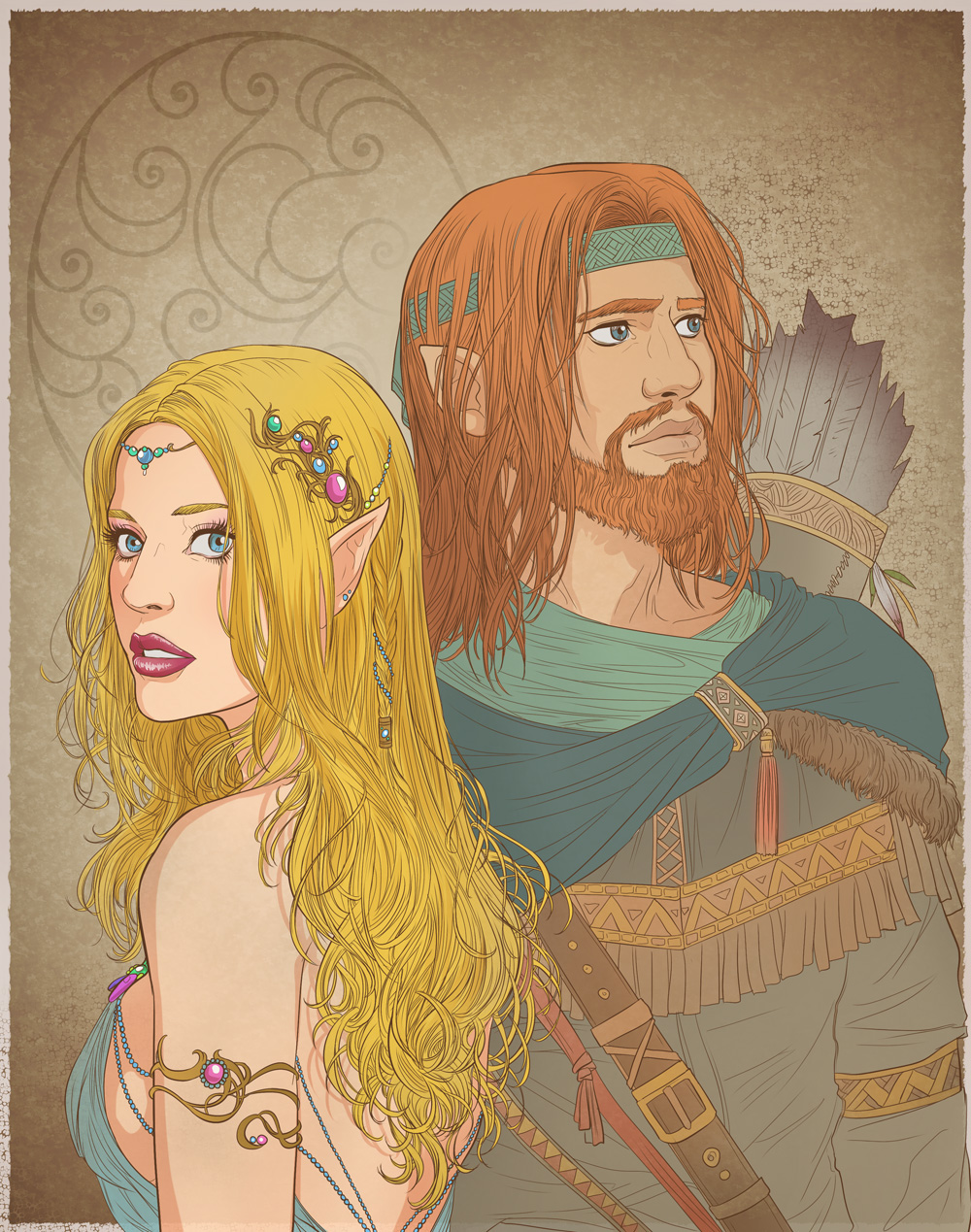
Fan art, tried to find all three together. by Autumn-Sacura
I mentioned the Love Triangle earlier, a cliche but not one native to fantasy.  Tanis grew up in love with an elf maid, a princess of his people.  She loved him back with childlike naivety. But Tanis left because Elves are intolerant to the extreme, big on social purity.  And though humans are no better, human society is much less structured than the that of the long-lived elves.  And his other lover is a human woman who isn't even "good!"

Which calls to mind another D&D creation, the Character Alignment Cliche.  So when creating your character you had to choose two of six attributes, one from a set of three.  Good, Neutral, Evil, Chaotic, Neutral, Lawful.  For a great listing of character of alignments in D&D click here.  Why bother you ask?  Well, despite the massive amounts of rules, D&D attempted to create real story telling.  Which necessitated real characters, which necessitated real thought.  Choosing an alignment was a way of thinking about your character.  In effect, it made the game more fun.  "I will kill this murderer!" says the Paladin, "because I am the arbiter of justice, and because the rule of law says that this man must die!"  "I'm sorry," says the ex-soldier now adventurer, who continues "Though he is guilty of murder, he is also deserving of kindness.  He murdered only to protect his kin!"  Part of what made the Party system so interesting was that you had to have your six or seven heroes all get along together!  You don't see this cliche too often anymore.

As the Tor blog pointed out, the book begins in an Inn, a symbolic setting for the Dungeons & Dragons meme. And the Inn certainly manifests itself often enough in fantasy to warrant its own cliche. the jovial innkeeper, warm fire, large bosomed barmaids. Or it's the Evil Inn cousin, think shifty innkeeper, slatterns, and nefarious doings in the corner.  But in Dragons, it's the Inn of the Last Home, where friends gather to eat Otik's famous potatoes and flirt with the luscious Tika Waylan. And so the epic starts as Friends gather after a long absence.

Completeness: I talk sometimes about scope, and in this simple thematic device, that of old friends meeting, the book establishes a complicated history from page one. Why did the friends part? Where did they go? Why are some together, and some separate? Were there mixed feelings, old dramas, triumphs of old? What about that sensation we've all had about life: that the past is dead, never to be felt again.  That you can't go home, and that memory is always different then what was.  I actually can't think of another fantasy book that begins quite this way. The Eddings' Belgariad had old friends meeting up along the road, but off hand that's it.  For all it's tropism in the Dungeon & Dragons world, it is fairly novel.

"Dragons" suffers from a very obvious and perfectly explainable completeness issue: much is purposely left unexplained. The back story to the characters is only alluded to within the trilogy.  Other authors were contracted to pick up the yarn and finish these quests.  This was frustrating in the 80s, as the other authors were never as strong as Weiss & Hickman.  In some cases entire chapters seem to be left out.  That said, Dragons was a pretty thick book for back then.  Particularly given that the average "game module book" probably ran about 250 pages.  It might well be that some of the missing content was merely cut for size.
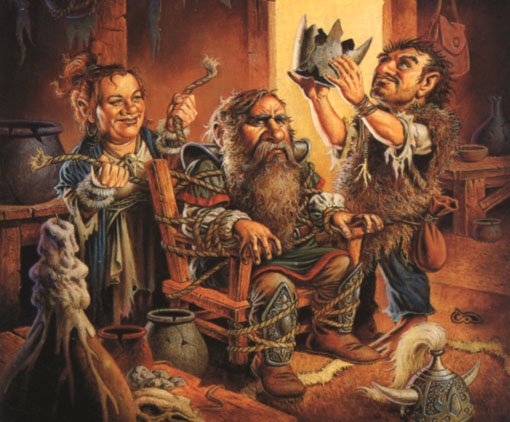
Flint the King, what Flint did during his 5 year trip

There are a few interesting points I wish to make here.  In almost all fantasy genres of the 80s and early 90s, the basic baddy, the foot soldier of evil was more or less incomprehensible, the other, alien and bestial (orcs, trollocs, demons.  Not so in DragonLance.  Hobgoblins and Draconians are fully sentient, frequently speak the common tongue, and are sometimes even playable races within the games.  So when, in that first chapter of Dragons, Tanis and Flint have a conversation with Fewmaster Toede (a hobgoblin comic-relief villain) it's almost shocking.  Usually when orcs appear, swords are drawn, and orc blood rains black from the heavens.  There is no discussion, no capacity for empathy.  It's just kind of a neat thing.  For all that Jordan advanced the genre, the only conversation he ever had with a Trolloc was one where it was being tortured for information, or attempting to trick its human target.

Fewmaster Toede, almost all of these images are Elmore originals
Last, what Dragons lacks in completeness, the game module, the other books in the series, and the other books in DragonLance as a whole compliment and fill utterly.  Though the book itself seems riddled with holes, you can rest assured that everything is explainable with reference to some rule in the Player's Handbook or in the lore of the series, or even in the fanverse that has, in the intervening years given these books a completely new life.

Having completed my reread of the first novel, I still love the Heroes of the Lance.  My admiration for Weiss and Hickman remains, though it is tempered by the amazing writing of what the future of fantasy would soon hold.

Thursday, November 21, 2013

Women in SFF

Tor.com recently sent out their weekly email with its attendant blogs, stories and news.  And Liz Bourke wrote an interesting column and interview following a piece I did not read.  There seem to be several points to her post, and the one previous, which I will first sum up.

1) There is a bias against female SFF writers
2) There are fewer new female SFF than male authors each year because of it
3) There is a bias amongst reviewers that indicates the same
4) Does it matter?

I wanted to add my own two cents here.  I'm going to make a little list.

My feelings:
  1. If I am guilty of reviewer's bias, it is certainly not a conscious one.  Unfortunately, that doesn't make it any less of a bias. 
  2. I certainly am guilty of reader's bias.
  3. I like central male characters, a bias that has nothing to do with the sex of the author, but my own preconceptions about viewpoint have, in ignorance, played to that point.
  4. Publishers have to play to their audiences.
  5. Yes, it matters, and yes we should at least make the occasional effort to expand our horizons.
1. To start, that there is a bias amongst reviewers clearly holds with me as well.  I have reviewed only Dragonsdawn by Anne McCaffrey, and Azure Bonds, by Kate Novak and Jeff Grub.  Both of which are at least twenty years old.  So, keep in mind, I don't review "new" titles.  My reviews are long-winded, seldom read, and I have no particular following to keep up with.  When I find a book particularly bad or good, or thought provoking, I write a review.  If I have time.  Publishers don't send me books hot off the presses (please do publishers! I've been using the friggin' Library for the past six months!) The selection process is random at best, and stilted, heavily leaning to books already in my collection at worst.  So I don't have the same kind of operators that Stefan Raets, or Renay, neither of whom I had ever heard of before today.  As all three of the bloggers, Raets, Bourke and Renay point out, the fact that I'm not consciously choosing titles according to author sex is still a bias, and a grievous one.

2.  I had to think, in my history, what else have I read by female fantasists?  Certainly almost the entirety of Margaret Weis's collection.  Raistlin Majere is certainly one of my favorite fantasy characters of all time, and he was her creation.  Recently, I read Robin Hobb's series, Assassin and Magic Ship, and Fool, or whatever the three series are called together.  And, I just found out that C.S. Friedman was a female, and I loved her Coldfire Trilogy.  All three of these women wrote incredibly strong, very detailed, and very interesting male central characters.  Did I think them less genuine because of that?  Not at all.  I was impressed by Robin Hobb's epic, but I confess, it wasn't my cup of tea.  I don't know if that had anything to do with the sex of the author.  It was a problem, or question of the theme.  I just left feeling somehow disastisfied.  I also read some C.J. Cheryh back in the 90s.  That's about it.  As I confessed years ago, I typically pick out books by the covers.  So if the publisher laid out for a good bookcover, and the book was at least four-hundred pages... there was a pretty good shot I'd try it. 

3.  Even though I quite like Jim Butcher's Furies series, I find the parts with Amara and her husband Bernard saccharine to the point of distaste.  I am a man, and the story has to appeal, find common ground with me.  I know a number of people who hated Rand al'Thor and the Ta'veren Trio, but his story always had a great deal of appeal to me.  Particularly as the 'nice' boy began to fade, and rage began to consume him in the ladder half of the series.  And I've spoken to some female fandom who find all three of them, Rand, Mat and Perrin inherently boring.  Still given what I pointed out above at the capacity of female authors to write excellent male characters, I suppose this bias really must end.

4.  I had this conversation with a female anthropology professor (not my wife) once, regarding the sexualization of female body parts in comic book characters.  And she showed me this image:
It is a pretty funny image, but she looked thoughtful when I told her that most of the readership of comic books are men, and that they wouldn't sell much if their characters all had bubble butts like this!  I also said, to say that male characters aren't over sexualized is ridiculous.  They don't frequently have gratuitous butt shots like those above, sure, but they all have tight abs, large shoulders, strong chins, cheekbones, large packages, and let's not forget, tight asses.  Interestingly, that's not to sell to women.  That is to play to men's insecurities about our own bodies.  I told her that if she were to look at any of the comicbooks from the eighties, their pages are filled with ads for muscle enlargement, how to get women, etc.  Their consumers were skinny, weak white dudes, and that was why you saw covers like this!  Still though, if you don't know about the HawkEye Initiative, check this out.
 

To apply that to fantasy authors, I honestly don't know what the breakdown is.  I was told about five years ago that men are reading less and less.  That was true then, of the overall market.  But SFF is a genre, and can the same be said?  If the majority of the consumer market is male, than publishers and reviewers choosing titles that best reflect their clients needs, is pretty if not fair, than standard practice.  I have lately seen more women than men reading in the genre, but that might also be a product of a completely different bias.  I didn't have the courage to be seen reading a fantasy book all through Highschool.  I kept them in my bag, and went off to secluded corners of the library to read them.  I frequently had my books stolen and ripped up.  I even had to chase them through the cafeteria from time to time because it just wasn't cool.  I'm not sure women and girls had to face the same bias in fantasy, though they certainly had to face a number of other ones.

5.  None of that matters.  The critics are right.  An effort must be made, it is simply the right thing to do.  I have three library books in my possession right now, all male authors.  But my next review, I promise will be by a female author.

Tuesday, September 13, 2011

Homeland, R.A. Salvatore, Forgotten Realms

I was always a DragonLance man, so for many years I figured reading Forgotten Realms books would be treason.  How silly is that?  Of course, they never made a DragonLance videogame worth its salt, though attempts were made on the 386!  Did I date myself or what?!

So my first Forgotten Realms experience was actually through the truly excellent videogame, Baldur's Gate (which is really a precursor to DragonAge Origins.) And I loved it.  Years later, after seeing R.A. Salvatore books on the shelf, and being suitably intrigued.  I finally decided to go for it.  If you want a phenomenal history of the Realms go to Wertzone site

Since I'm taking a break from Memories of Ice to read this, it's interesting to note the stark differences in contemporary fantasy with fantasy from two decades ago.  Salvatore did not invent the Realms.  Far from it--Ed Greenwood did.  I actually a did some research for this post, something I rarely do, but the Realms have a complex history.  And unlike DragonLance whose seminal volumes were all penned by Margaret Weis and Tracy Hickman, the Realms were created by a collective of writers drawing on the maps and notes of an accomplished Dungeon Master.  The Realms were designed to be free floating, more loose than DragonLance which took place in the middle of a continent spanning total-war.

Anyway, the point of all this is to show, once again, that good fiction does not have to be genre busting.  In fact, it can draw on cliche's so overdone as to be boring and repugnant, and still make a good yarn.

Let me say from the outset, I thoroughly enjoyed Homeland, and intend to immerse myself in the Realms, 20 years after their creation.  I have one caveat.  The book, though an absorbing and fun read, is no poetic work of genius.  It's a good romp through an interesting world.

1.)  Character.  Drizzt Do'Urden is the name of the main character for this volume.  I grew up with this cat, though I didn't know it.  I saw his picture on shiny hardcover novels all over the Barnes & Nobles of my youth.  Homeland is definitely a plot based story, nonetheless its characters are compelling.  The story begins with a race of dark elves called the Drow, dwelling in lightless caverns called the Underdark.  I've always found evil races to be an interesting study.  How can such a society function?  All societies are based on trust and cooperation--which is a flat impossibilty for the genetically evil.  And of course, this is a central conflict in Homeland.  The Drow worship the spider Goddess Lolth, who believes in corruption and greed, and encourages her priestesses to war with one another.  However, Drizzt, and his father Zak are different, possessing an inate innocence that puts them at conflict with the larger drow society.  They don't like to kill, yet both of them are singularly gifted fighters.  So the natural conflict set up here is between Drizzt and his entire race, his entire culture, and closer to home, his mothers, sisters and brothers.  Which brings us to cliche.


Mindflayer from FR wiki

2)  Cliche.  Elves, Dark Elves, Coming of Age, Dungeons & Dragons, are all cliches used by Salvatore.  Elves figure only as a distant enemy to the Drow, but as the Dark Elf cliche is built off the Elven cliche, much of the same is true about both.  Elves are long-lived, beautiful artisans, dwelling in nature, strong, yet slight, natively good, and are beautiful to look upon, and inherently magical. All this is true for the Drow, save the natively good part.  The city of Menzoberranzan is carved from stalagtites, and the buildings and temples are designed to look like spiders.  A thoroughly disgusting concept, yet one requiring a degree of skill in art and engineering to execute.  The drow live as long as elves, except for the fact that they keep on killing each other.  This means that despite the native difficulty of breeding (elven females ovulate infrequently, like every 50 years or so) a concentrated effort is made to breed, since family strength is a direct and certain route to power.  This culminates in some interesting breeding practices practiced by female drow. The drow is likewise beautiful to look upon, but they have black skin and pure white hair.  Like elves, the drow is capable of casting spells from an early age, and all drow are capable of casting certain spells, regardless of caste.  Which brings up the Dungeons & Dragons cliche.  Every single item or monster in this entire novel has a series of stats to back it up, from the adamantine twin scimitars which are Drizzt's hallmark, to the tentacular mindflayers who dwell in the Underdark.  Anyone who ever played Dungeons & Dragons knows the mindflayer intimately, even those who didn't ever have to fight one, the picture was just so frickin cool you had to look at it.  These cliche's for the most part are informative.  However, for a non D&Der, and we're dying out, some of the cliches are just obscure.  Halfling and Gnomes.  All manner of small people.  Halflings are familiar because of the Lord of the Rings, but most people are familiar with the term hobbits instead.  There are no hobbits in Dungeons & Dragons.  Just halflings.  Gnomes are another one.  We're all familiar with garden gnomes, those cone hatted, blue skirted small creatures, but just how are they different from dwarves?

3)  Scope.  The scope is immense and confined all at once.  The Realms are hard and fast.  Ed Greenwood's world is all mapped out, its creatures are decided, it's politics analyzed.  It's open ended in terms of story telling, but the world, like ours has a physics that is entirely determined by the roll of six, eight, twelve and twenty sided dice.  This makes for a very interesting fantasy setting.  Half of the joy of fantasy is discovery, does the comprehensive mapping elminate this joy?  It turns out, no.  I look at they world map, and I wonder what famous warriors have traveled to Cormyr?  Who is the greatest wizard in Waterdeep?  All this and more, after reading Homeland, I intend to find out.  Now of course, I wonder, how should I read these books?  Drizzt wasn't a character started in Homeland, far from it--he was first mentioned in the Crystal Shard, (again, hat tip to the Wertzone).  I have determined that the best way to do this is to read the books in order of publication, though I may drop off after the first ten books or so.  I always found that the splinter novels in the DragonLance series were of a drastically lower quality, and that the events that occurred in these books had no play in any of the more central literature.  Even so, the more limited scope is Menzoberanzan, the drow city.  And in this Salvatore is the acknowledged champion.

4)  Magic.  Dungeons & Dragons magic.  After having spent a lot of time with more complex brands of magic.  Sanderson's Allomancy, Jordan's The One Power, Erikson's Warrens, the system of magic in the Realms is reassuringly simple.  Most spells require ingredients, and must be memorized to be cast.  They can only be cast once or twice, depending on the sophisitcation and "level" of the wizard, and then they must be re-memorized.  Magic is important, of course, but having owned the 2nd edition Players Handbook, I know most of them already.  There is no magic to devastate an entire city here.

5)  Theme.  As stated above, this novel is no scintillating work of genius.  It's fast moving, absorbing, with interesting characters and a fun, unpredictable plot line.  It's candy, it's beach reading, even more so than most fantasy is considered to be.  That said, the writing isn't poor by any means--it's just there to communicate a story, not to edify.  There is a tone to Salvatore's writing, but its businesslike and not self-reflective.

This book is definitely worth a read, and it has definitely inspired me to read further.  Unfortunately, my wife has decreed an end to all fantasy books, and so I can't buy anymore of them unless they're grand slams.  (It's not the money so much as it is the space on our shelves)  I think I see a Kindle in my future.

Tuesday, January 18, 2011

Brent Weeks - The Night Angel Trilogy

Sorry for the long silence my fine friends.  I've been busy at work, grad school, and other blogging projects.  This post is about only two of Brent Week's books in the Night Angel Trilogy:  The Way of Shadows, and Shadow's Edge.  Nearly finished with the second, I can say that I am definitely intrigued enough to finish the series.  Still, I have some hang-ups with the story, the main character, and the style.  But the ending of both books is exciting with some novel surprises which make the series a worthwhile read, if not a shelf stuffer.  A shelf stuffer, I define, is a book worth keeping to reread.

On to the Five Factors
1)  Character.  There are some great and memorable characters in both books, however they suffer, in my opinion from some structural flaws.  As you may have guessed from the titles of the books, which say very little about the books individually and really only make for good book jackets, this is a series about assassins.  Assassins are romantic favorites for many young fantasists.  They're dark, ruthless, and mysterious, and these things can make them appear sexy.  In popular fiction, assassins are good fodder for paperback drivel, think Jason Bourne and such.  Or historical works like the assassins in Munich would also be a good example.  Femme Fatales are famously sexy assassins, beautiful, broken, dead dolls who are either totally despicable, or have hearts of gold buried deep in their lithe sexy bodies.  Week's works take a more fantasy approach of the genre, with bladework and poisions, traps and such.  But our main character, Kylar Stern, is no typical assassin.  He's neither ruthless, nor for much of the novels, is he a particularly effective killer, botching many of the jobs he's sent on.  In short, he's a highly likeable assassin.  However, there's a disconnect, because his repute in the book, is the repute of a cold hearted killer, feared by many.  Though he kills, and is extremely well trained, Brent fails to convince me that this character is actually an assassin.  Far more interesting of course, is his mentor, Durzo Blint (Week's names for his two main protagonists are terrible.  Durzo Blint, sounds like a Polish pastry.)  but more of this troph later.  Another failing of Weeks in this novel is that new characters who will actually make a difference in the plot are introduced two or three hundred pages into the novel.  While this technique is used in other more successful pieces of fantasy, Weeks introduction of these characters is arbitrary and unnecessary.  Characters like Dorian, Solon, and Feir are barely explained, fulfil several nearly inscrutable purposes in the plot and then disappear until they are next needed to grease the wheels of narrative fiction.

2) Cliche.  I've already touched on the main cliche, use of an Assassin as a main character.  There have been some great fantasy assassins on my shelves.  Hugh the Hand is an old favorite, from Margaret Weiss and Tracy Hickman's Deathgate Cycle, a truly phenomonal series.  The assassin cliche is this:  Embittered embodiment of death, ninja-like stealth, a vast array of dainty killing instruments, Ruthless Assassin ("RA") whose soul has been so destroyed by his evil work, killing innocents/killing in coldblood, loneliness and disconnection, finally meets the gig he can't deliver on and finds that he is afterall a human being.  In The Way of Shadows, the RAs deviate from this model in that they have friends, loves, even children.  Moreover, a lot of their jobs are won through blunt force.  One man against twenty palace guards, fighting with British long swords in open passageways.  Stealth is only occasionally applied, and is even more rarely successful.  Steven Erikson does a better job with his assassin, Kalaam in the Malazan Book of the Fallen series.  Kalaam, is a cold hearted killer, who is at the same time imensely intriguing and a hero of the series.  There is never a question about his tempermant, where Durzo Blint is prone to massive episodes of excessive drinking and disorderly conduct.  Disorderly assassins are dead assassins.  But not in the Night Angel Trilogy.  Robin Hobb made a similar mistake in the Assassin's Apprentice, in which the main character never really gets mean enough to be believed.

Look, I don't have a problem with deviations from the cliche, but this rational divide is never adequately explained.  Coldblooded killers can't have regular lives.  If they did, they'd be constantly asking themselves the questions that would surely undermine their work.  To be sure, Kylar and Durzo have a host of emotional issues, but neither of them are cold blooded enough to be entirelely believable as assassins.  Perhaps this was Week's intention, modern fantasists attempt to break through cliches rather than use them.  But in this case, the attempt was not executed well.  Only two of the stories assassins, both minor characters, really fit with the cliche, and both are evil, blood thirsty menaces. 

Assassin's Apprentice (The Farseer Trilogy, Book 1)The second cliche, which is executed fairly well, is a Coming of Age cliche.  Before becoming an assassin, Kylar is a gutter boy named Azoth, who joins the netherworld to protect his two friends, one of whom becomes his girlfriend in later years from a local tyrant.  He becomes apprenticed to Durzo Blint, and learns the trade from the older killer.  This section of the book is about fifty pages too long, and doesn't really move the plot along all that much.  Moreover, it makes Kylar even more likeable.  Even so, Kylar's likeability and struggle with his impoverished background makes him a character worthy of following, and provides the story with a basic thematic outline.  I think this might be why Weeks and Hobb failed where Erikson and Weiss succeeded, Erikson and Weiss came into the story in the middle of their assassin's lives.  You never saw the foibles and trips along the way to deadliness for Hugh the Hand or Kalaam.  They started the series unrepentant monsters and were redeemed through valorous, selfless acts.  Weeks and Hobb's characters are flawed humans forced to an ugly trade, who are indeed redeemed, but never really damned.

A third cliche, begun in the second book, The Shadow's Edge, is the concept of a sisterhood of magic users, very much like Jordan's Aes Sedai or Goodkind's Sisters of the Dark.  There's not much substance to it, so I won't waste your time.

3) Scope:  Few novels pack the scope of The Wheel of Time.  I should get used to that.  In my own half-hearted attempts at fiction I can recognize the same problem in my work, but its difficult to get the mind around.  You have to hint at the world beyond, you have to hint at ages of history, but you can't bludgeon your audience with it, and you can't waste time describing it when you should be illustrating it.  LOTR and Wheel of Time do this primarily through the use of ancient ruins and old sages.  But honestly, its something I struggle with and I can't provide much guidance for authors. 

There are at least three, four nations in The Night Angel Trilogy, though the action in the first book takes place almost entirely in one city.  They are "modern nations" in that little history of the warring nations is discussed save for the most recent.  The encroaching empire of the evil GodKing, is one nation, and is pivotal to the story.  To be sure, The Night Angel series has a myth structure, centered around one character who I can't name without spoiling the first book.  There's a wide world out there in Week's Night Angel, but its still sketchy.  I can only describe it with the use of a poor metaphor.  Worlds like these are like reading about other countries in a newspaper, vague and impersonal unless you know a lot about them already.  World's like the Wheel of Time, are like holding up a lantern in a darkened room.  Everything out there is hinted at by vague shapes in the darkness, and yet,  has a reality which is undeniable and fascinating.  Hobb's world was similar to the Night Angel's save that her second series The Liveship Traders started out entirely different characters in the same world, granting authority to some of the places on the map in the first series.  Judging by Weeks' prolific nature, I assume that many of these lands will be defined in later works.  But it's an awful risk to assume that I'm interested enough to keep going.

4)  Magic.  Week's system of magic is poorly defined.  But it doesn't really detract from the action.  For most of the characters, magic is used as assassins would use it, for stealth, crawling up walls, disappearing, charming, etc.  There are brief descriptions.  It's rechargable by sunlight in most cases, and it's also called Vir.  And magic users who are "Talented" usually join various schools of magic which irrevocably shape the direction of their skills.  The GodKing and his minions have it in spades, and his Vurdmeisters are formidable killers.  There seems to be an endless supply of mages in both books for Kylar to kill.  And then of course, there are magic swords, and magical stones, which are the source of The Night Angel's power.  However, Weeks does an excellent job of creating horrors like the Ferrali in Shadow's Edge.  I won't bother to describe, it's pretty gross, and you should read it and find out.  Click on the amazon associates logos above and I'll get cents for your efforts!  These things require magic to function, and even if the technique is never explained, the images Weeks creates are worth discovering on your own.

5)  Theme.  This is a fantasy for city boys and girls.  All of the action takes place in busy cities which are ruled by a criminal underworld which is known to be cruel, and yet is at the same time benevolent (don't get me started on that contradiction).  The settings are rooftops and ceilings, corridors and passage ways.  If this series has a theme at all, it's a sort of proletariat pick yourself up by the bootstraps and kick ass feel.  Even so, it's a fairly cosmopolitan tale involving child abuse, both sexual and physical, holy rollers, insane killers ignorant nobles, and the types of poverty that are more common in early industrial cities, not preindustrial societies like the Night Angel world.  Kylar's struggle to be a good human being, to find love and happiness, to grow up and "be a mensch" fit with the above mentioned cliche, and provide a cluttered story a stable protaganist to follow.

On the whole, these books are worth a read.  Borrow them if you can, but if not they're in paper back and the whole series is fairly cheap.  Or go E-book, the cover art is pretty lame so you won't be missing much.  None of the weaponry wielded by the photographed model on the cover are used by Kylar or Durzo, who predominantly kill with sword and daggers, so you definitely can't go by my earlier suggestion of buying based on the cover.

Note to Publishers:  Avoid trilogies.  I never get through them anymore. Go big or go home.

Tuesday, June 8, 2010

The Briar King by Greg Keyes

Why did I pick this book up?  It was a series, plain and simple.  I saw that there were at least six novels by Keyes on the shelf.  Usually a good sign of staying power.  I've said it before and I'll say it again, anything that's reached a certain level of syndication has to have some aspect of quality.  This does mean that I'm liable to miss some good fiction, so please go ahead and point them out if I do.  I'm open to suggestion.  But I will say this.  When I find a fantasy realm I love--I want to live in it.  I want to immerse myself in it.  A phenomenal one book novel doesn't really allow for this, not because of any lack of quality, simply a lack of words.

But not all books made into series catch my interest.  When I was a teenager I read almost the entire DragonLance series.  I was in love with the characters established by Weiss and Hickman.  When those characters were co-opted by new authors, they still lived in my mind.  The quality was less true, and the Fifth of the Fantasy Five always fell short, but junkies will live on fumes when that's all they can get.

Let's get to it:

Characters:  The lead character in this novel is a gruff, ranger type, with a problem with commitment.  I can't say I really liked him, even when he softened up a bit and admitted that he cared for the leading lady.  One of the nice things about "The Coming of Age" cliche is that it allows a relatively bland character to grow over time.  But our Ranger, was pretty set in his ways.  Hardbitten characters can be fascinating, I was willing to give him a try.  He did seem to grow over the course of the book--but then again, I almost felt that he grew too quickly.  Unbelievably.  I could tell that Keyes was trying to give the characters depth.  None of them were simple, each had complicated motives for their actions.  But sometimes complex motivations aren't enough to create deep characters.  An empathic connection must be drawn to the reader.  And the only character I began to feel that connection with was killed off by the end of the book.

Cliche:  There isn't a central cliche to draw on.  The Briar King is one of those newer fantasy type novels that relies on a political environment that is supposed to modernize and enliven the drama.  One of the more interesting characters is the King, who has a mistress and an evil brother.  The evil brother is a cliche, and his character's motivations appear to be complex, but his evil is also of the benal sort.  One cliche the Briar King most definitely does NOT use, is a central villain.  There were many characters, in many dramas, and it wasn't clear, even by the end of the first novel who the real villain was.  That's not necessarily a problem, but leaving your reader confused is completely different from leaving your reader with compelling mysteries to contemplate.

Scope:  The Briar King's scope is difficult to ascertain.  There is evidence of a largish kingdom, with allies and opponents that are on the brink of war.  I like politics, but I've only really ever found one or two authors who do a good job of creating fantasy worlds with meaningful political disputes.  It's very easy to create nations.  It's very easy create wars and borders.  But only a really terrific writer can make those disputes come alive.  George R.R. Martin did a really great job with this in the Fire and Ice Series, magic and mystery come second in that world.  In The Briar King there's evidence of an ancient enemy, and other races, but the references to these mysteries are clumsy at best.  A personal pet peeve of mine is creating new races that look identical to races that exist in the minds of fantasy readers already.  What's the point?  An elf is an elf is an elf.  Calling him a Scregyar doesn't change the fact that he's an elf.  What are elves?  Thin, longlived, with point ears, and an affinity with nature.  That hasn't changed since Tolkien, nor has the archetype.  It's grown, it's contracted, but it remains essentially the same.  To be sure--the fantasy greats can create new races with impunity.  But amateurs and new authors have to be really careful.  Caveat:  I am in no way qualified to call Keyes an amateur.  My only credential is I read a lot and I know what I like.

Magic:  I'm not really clear what, if anything the magical system in The Briar King is, the ancient enemy, the Briar King, is sort of cool.  I mean the concept of a malignant force of nature is relatively unused in fantasy novels.  Usually the operative cliche is urbanization v. nature.  Ents have a long history in contemporary fantasy of being creatures of good intent, shepards of the forest.  Although, thinking back, the Ents were the good equivalent of the nasties who dwelt in the Fangorn forest of Middle Earth.  It reminds me of the Heidegger's concept of The Black Forest.  It's an old mythic concept that harkens back to an age that is completely inconceivable to the modern reader, a time when towns and cities were literally swallowed whole by vast swathes of dark wilderness.  The only thing man needs shelter from now is the cold, and other men--another perfect allegory for the Fire and Ice series.  In the first book of The Briar King, a priest like character shows a certain penchant for magical activities, but the system though described, isn't fleshed out entirely.  If the character were less weak and idiotic, I may have been intrigued enough to learn more about him in the next book.

Theme:  I could detect very little theme in this book, which was probably the ultimate reason for why I was turned off of the series.  Maybe Keyes hits his stride in the next book, but is it worth another inch on my crowded bookshelves, meh.  There are motifs of political intrigue, war with neighboring countries, betrayal and lust, good nature v. evil nature.  But to tell you the truth, no single one of those really commands the whole novel.  Compare that with a book like The Black Company, by Glen Cook.  I'm desperate to buy the next book--but it's 16 bucks!

Overall, I wasn't so interested in Keyes.  I'd like to give him another try.  The prolific nature of his works indicates that I'm missing something.  But I can't be bothered.  I don't want just another fantasy world, just another sword fight, or love affair.  I need to get sucked in like a dark whirlpool.  And despite having a great title, The Briar King, just didn't suck me.

heh.

Monday, June 7, 2010

The Fantasy Post

In a further attempt to make all of my time productive, behold, The Fantasy Post.  Here I intend to write reviews of fantasy novels as I read them.  Some of these novels will be contemporary, some older novels reread. 

My credentials:  I read my first fantasy novel when I was ten or eleven, it was The Sword of Shannara, a novel by Terry Brooks.  Since then I've been hooked.  I've gone through all of the greatest series by Brooks, Eddings, Jordan, Donaldson, Martin.  In college I gave up fantasy for chicks and booze.  This turned out to be a grave mistake.  I've been back for a couple of years now and I've discovered some great new authors in my absence.

I am also a big fan of fantasy art.  I once wanted to be a fantasy painter. My favorite at the time was Larry Elmore who did much of the painting in the DragonLance Series for TSR.  Though a reasonable painter and artist, I always needed models to do my best work.  When I saw that many of my friends, painted and drew from their imaginations, I decided to move on.  It wasn't until fairly recently when I started following Tor's rerelease of the Jordan novels in eBook format that I saw that real fantasy artists use models too!

Alas.  Anyway, below is an Elmore painting from the DragonLance series, Time of the Twins, by Margaret Weiss and Tracy Hickman.