Search This Blog

Showing posts with label The Dwarves. Show all posts

Friday, August 19, 2016

The Deed of Paksenarrion by Elizabeth Moon

I'm ashamed to admit that I had not heard of Elizabeth Moon until just last year. In an effort to get actual blog readers and to meet more like minded people, I kept hearing her name in relation to foundational fantasy literature: genre defining stuff. A new friend had some of her books, and I took her up on her generous "deed."  Having done some further research it is much clearer to me now, that Moon did much of her writing in the mid-to-late 80s and was merely part of the explosion of new fantasy at that time. 

The quotes on the back of the book don't help.  "This is the first work of high heroic fantasy that has taken the work of Tolkien, assimilated it totally, and deeply, and absolutely ..." Judith Tarr. (Whose life has taken a depressing turn for the worst, it seems.)

Still, I think Elizabeth Moon's reputation is based on a delightful though traditional approach to fantasy, and her works are certainly part of the firmament of the fantasy galaxy.  And if you've never read any Moon, you need to get yourself to your Indie bookstore and buy The Deed of Paksenarrion.  What makes fantasy, what really takes it from mere swords and sorcery, from plot-based fiction like Stephen Grisham, and much worse, the $2-3 ebook with 500 five-star amazon ratings, and turns it into something with impact, is it's ability to opine almost unerringly on what it is good, and right.  And this is something that Paksenarrion does exceedingly well.

Typically sold now as one volume, the book was released in three parts, the first of which is really the Deed.  After which the second and third book titles are almost meaningless, though they are where the true meat of the trilogy rests.  The book has sort of a slow start, and the first entire section if it, is devoted to a rather un-fantasy like treatise on the training of a mercenary company.  But fear not, if you can get past the first book, Paksenarrion truly blossoms.

Character:  The title character, Paksenarrion starts the novel as a teenage girl running away from home, and an arranged marriage, to join a mercenary company.  There are a few things that jar about this from the get go, but I think it important to note that an important act of fantasy is the concept of creating an equal world.  Not a world where everyone is equal, but one where equality is fundamentally valued by the author.  All manner of awful things may happen in such a world, but when it is apparent that the author believes this, the worldview is upheld by a kind, just, and generous spirit.  Such individuals create characters like them.  And it is these characters who teach us, who show us (by their acts of unspeakable giving, love and faith) that humans are fundamentally capable of good--that despite our flaws, we are redeemable:  that hope exist.
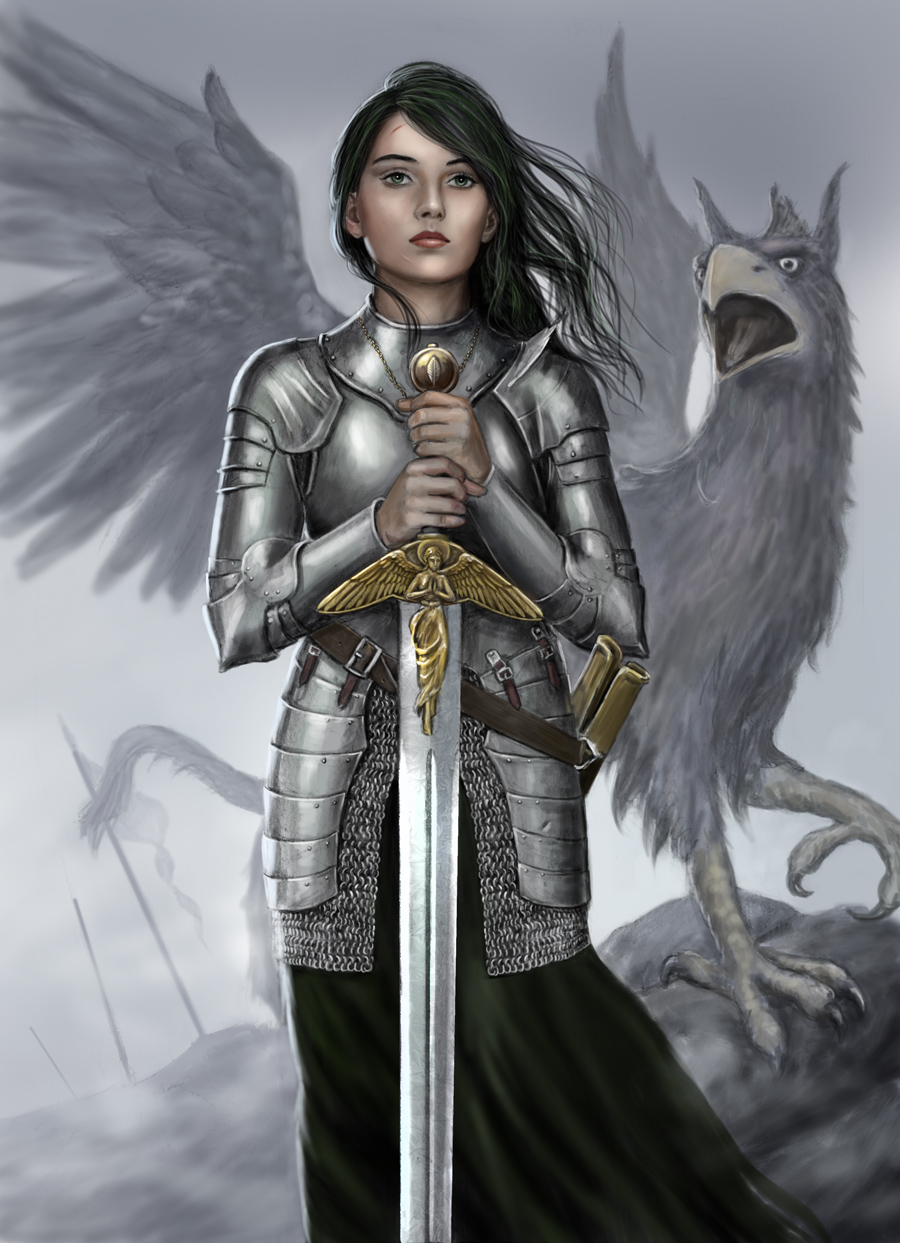
Paksenarrion is such a character.  She's not the sharpest tool in the shed.  She's uncurious, easily led, blind to her own talents, and blind to the shortcomings of others, and these qualities make her a frustrating heroine, though a real one.  Paksenarrion joins a mercenary company, and yet is surprised when the causes she is committed to are not always just.  This seems inherent to we, so wise in the world.  But she's a farm girl, fed on stories of soldiers, and living in a land far from the borders of any cohesive state.  Her actions are charmed, touched by the divine, and one thing she learns, quickly enough is that while she loves to fight, and indeed possesses no qualms about killing, will not fight for causes that are not just.  She loves her companions, and indeed never feels anything approximating lust or desire.  She is asexual, though never termed so.  I have mixed feelings about this, though I think it functions well for a paladin character--though the choice to abstain is in most churchy literature, it is not a consequence of disinterest, the choice to abstain is given as a sacrifice in god's name.  In Islam, it is the greater jihad, the fight to deny one's baser instincts.  Though more dark fantasy has embraced women as fully in-the-world, capable of desire as much as men (and not just mere foils to men's desires', trophies and patsies to the hero) Moon's beautiful rose is truly white. To wit, a modern asexual woman, is itself a massive break with stereotype.  
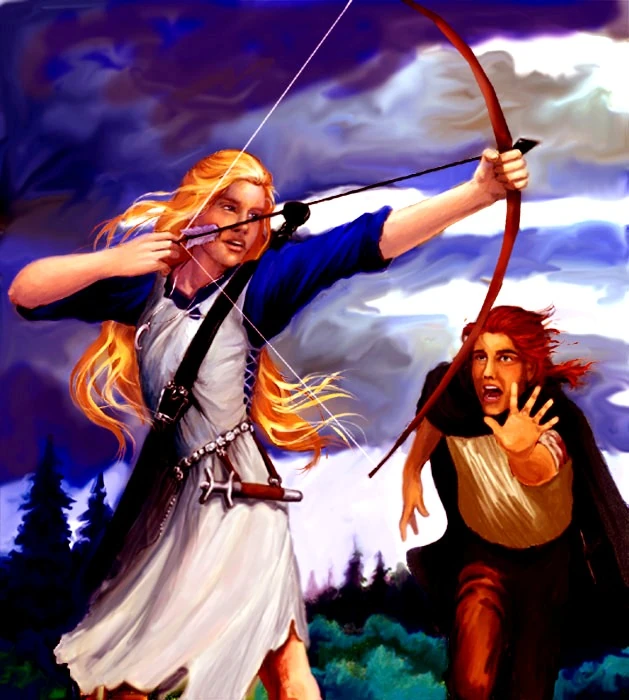
No author caption here: fell down the rabbit hole
However, the Deed of Paksenarrion is about paladins, and their becoming. In my Forgotten Realms readings, I have uncovered a few characters of priests, such as Adon from the Avatar trilogy.  Even the the Knights of Solamnia from the DragonLance series.  Or also from the Malazan epic, Shield Anvil's, the most devout servants of the gods of war.  Priests are a difficult caste in fantasy literature.  Indeed, books like Harry Potter, and others before it were shunned and castigated by religious organizations like the Catholic Church.  It's interesting to note that fantasy tackles religious matters, and religious organizations all the time, and yet issues of faith, issues that come close to proselytizing are almost always handled at arms-length.

But in a story about paladins, such discussions become central to the plot.  Let us not forget that original of all paladins, was also a female, Joan of Arc.  I found myself becoming uncomfortable at times by the direction Deed was taking. Ultimately, however, I feel that The Deed holds to what is True in fantasy while avoiding the snarls of dogma. And for most of the series, Paks is at best agnostic in her faith.

Artist Unknown.  Seriously, he probably died in a mass grave.


There are some difficulties.  For example, killing even if it is only killing for right is glorified, and there is never a moment of horror, a moment of self-recrimination for the slaughter of enemy combatants.  This is one of the reasons that I began to feel that Paks was not the brightest protagonist.  By the end of the third book, something happens to Paks, and she is broken, a cliche we will discuss later, but her personal struggle is caused by something external to her, something evil that takes root in her, and is then rooted out.  She emerges from the process in rough shape, but her main crisis is that she will be unable to wield a sword again, unable to fight, unable to kill.  Now of course, there are certain aspects of feminism at play.  For example, when Paks finds herself in a barn at night when two churls approach her.  Her inability to fight would have left her in poor straits had not the gods intervened on her behalf.  Now ultimately, the conversion, the self-examination that we want Paks to have, does happen.  But there again, it happens because a druid explains a few things to her.  It's difficult to parse, Elizabeth Moon may be one of those few, rare writers who does not write herself as the main character (not even Steven Erikson can say this).  Moon is a brilliant writer, and obviously a very smart person, but Paks is not.  Writing a dumb character, is I can say with all honesty, absolutely impossible for me.  It's not that I'm so smart, it's that as an intellectual I am constantly assailed by self-doubt and recrimination, things which make a character by nature introspective and thoughtful.  So let us at least say this:  Moon proves her writing chops not in the detail of her world, in the pique of her characters (that's all there) but in that she is able to do what so few writers even attempt to do, to write characters that do not exist within the range of her own "voice."

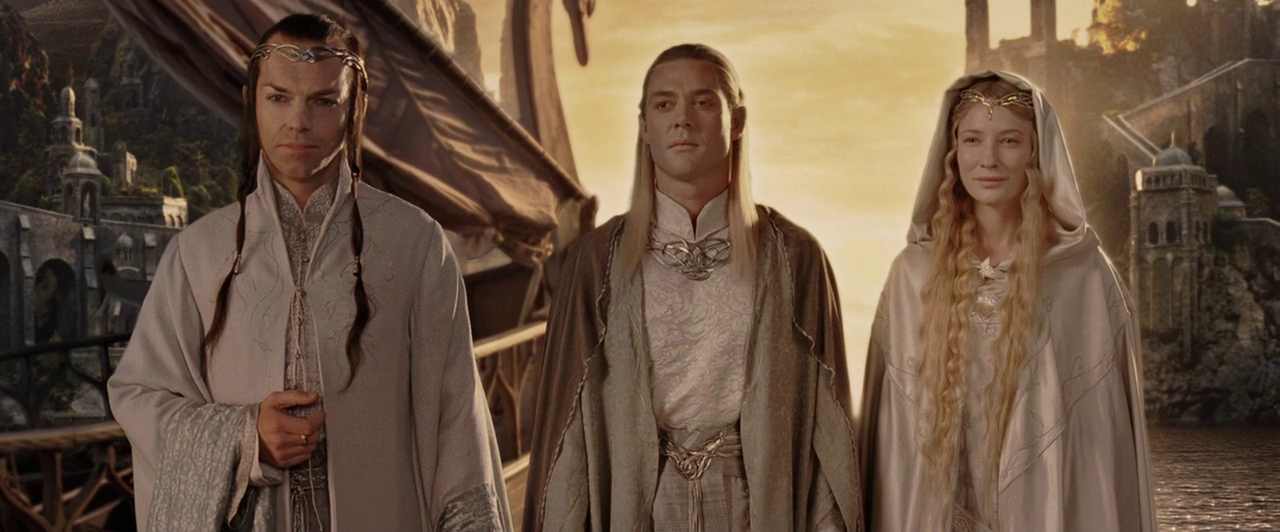
Cliche:This is 80s fantasy, so cliches abound.  We will touch briefly upon the obvious ones, elves, dwarves, orcs, magic. The first book of the trilogy mentions the other races in passing, as well as gnomes, and a few other beasties. However, unusual to fantasy, the first book is almost entirely devoid of extra races. That said, elves and to a lesser extent dwarves, play a crucial role in the overall arch of the story.  As usual, elves fulfill the usual Tolkien stereotypes.  Immortal, tall, otherworldly, slim, beautiful, musical, etc.  One neat thing about the elven component of The Deed is that it references something that other earlier fantasy works maintain, namely that the faerie dwell in a sort of shadow kingdom, a world within a world, different and similar to ours. Though Tolkien's elves left the plane of Middle Earth, during their time in it, they were squarely involved "in the shit" as it were.  Moon changes the Dwarven cliche nicely.  Instead of the beer swilling, anvil hefting, gold digging, creatures we have come to know and love, the Dwarves are very fond of ceremony, and have a peculiar dialect.  Unfortunately, we don't learn much more than that.  Orcs only really emerge as combatants, quickly slain, and with no real reason for being in the story, merely as a side effect of Evil Influence.

However, Moon, may have been one of the first to embrace the Dark Elf cliche, perhaps not even a cliche at the time. Tolkien's world explored the idea of the corrupted elf, Sauron, the ostensible reason for his long lasting evil.  However, Sauron was an exception, there was no race of like minded long-lived evil ones.  (I never did read the Simillarion though, so I can't speak to the whole of his work). Regardless, Moon's Dark Elves are unusual compared to the ones that the Dungeons and Dragons cliche embraced.  They have the fine elven features, pointy ears, are long lived, etc. that all elves have.  But they stink, and they intentionally corrupt all that is beautiful.  I thought this was a really great detail, Dark Elves are the anti-elf in EVERY way in this series.  The Dark Elves end up being a critical plot point for the series, though they make no appearance in the first book at all.
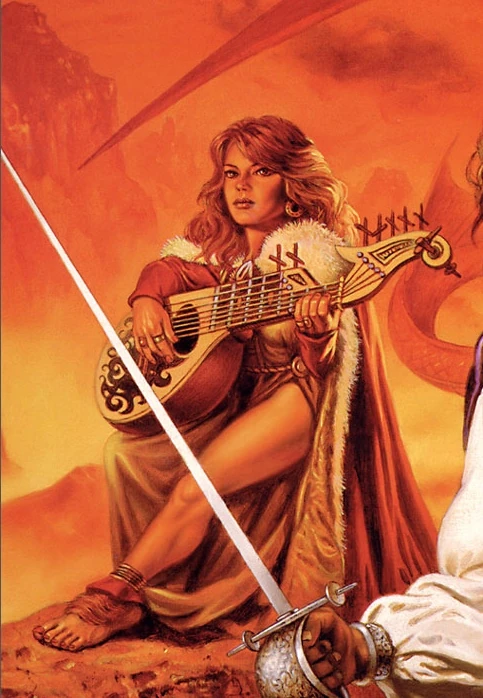
By Gerald Brom

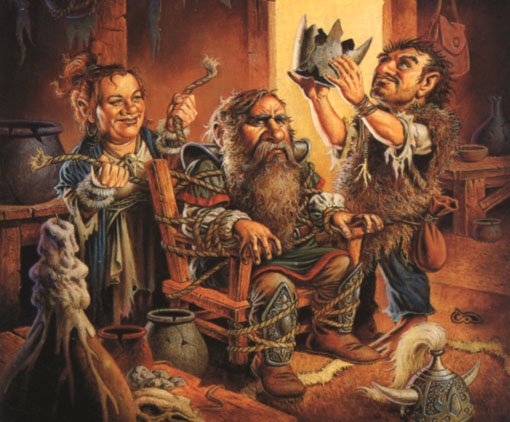
There are dwarves as well, though they play only a minor role.  They fulfill some stereotypes, while trumping others.  Moon's dwarves are different they have a formal speech, though they are boisterous by nature.  A gnome stereotype exists which is quite interesting, though not much explored.  The gnomes of Moon's writing aren't the slightly silly, less strong version of dwarves that you often see in the Dungeons & Dragon Realms.  Their gnomes are fierce like Terry Brook's gnomes, but are strict adherents to order.  Like many creatures faerie (another cliche) they do not believe in gift giving, only in fair exchange.  It's an interesting dynamic, and explored more in later books.

Some of the cliche pages, like TV Tropes, point out that the Lawful Good cliche is in full effect here.  I honestly don't think that's enough of a cliche to pursue.  I do think Lawful Good characters are however, very interesting.  It takes a lot of willful blindness to the world to always follow the law and still be good.  Even a poor execution of a Lawful Good character can show this dialectic.

Adventure Time Cliche:  So in writing this post, I lost an earlier draft, wherein I noted how very much like classic swords and sorcery, dungeons and dragons gaming parts of this book were.  I have no problem with that overall, I've been trying to do the same for some time.  Real drama is created in such games (the good ones) and a story-teller's polish of such events can create real lasting value.  It worked for R.A. Salvator and Margaret Weiss afterall.  I noted that one of the scenarios was Paks meeting of a certain half-elf of ill-repute on the road.  The two join-up, explore a dungeon, and slay a wizard.  But I'd forgotten that they do almost the same thing later on, in Brewers Bridge, the TVTropes site pointed out that it is almost the complete scenario for AD Module 1.  For a more thorough listing of Paks cliches, check out this TV Tropes site.

Completeness: The Deed looks and feels like a complete world.  Throughout the novels, we explore a good portion of the world, and the interconnectedness of nations is well-demonstrated.  The wars of the south, for example, are in large part trade wars, defending various routes to various ports, and various choke points like the castle Dwarfwatch.  These are the sorts of things that real wars are fought over, and I appreciate that detail.  Moon has some military experience, and the battles are drawn in painstaking detail.  Some readers are turned off by this, it seems, but strong detail is never a problem for me.
>

The religious aspect is well-developed without choking, and was not offensive for an old-time atheist like myself.  I've played a few paladins myself, and like I said, I find the character type pretty interesting.  The Gods are real, and come across that way--unlike the idiocy and petty squabling of the Forgotten Realms gods, and still ineffable and mysterious, unlike the gods of the Malazan epic.

There are a few untied threads.  Now, life is a series of untied threads held together by place, time, and financial obligation.  However, those things are tenuous at best in fiction, and untied threads can always be blamed on the author.  That said, many of these threads seem to be tied to these one off AD and D adventure modules that occur throughout the books. Mini-stories, that are engrossing, but ultimately have little to do with the arc as a whole.

The arc is a long one, and many readers get turned off by the slow start.  When Paks soul searching takes it's darker turn, and where it receives it's finest answer is where the book really starts to shine.  It's also where Moon takes the gloves off and shows us some of what evil is truly capable of.  In the end, I quite enjoyed The Deed.  I did find some of its characters to be in part unrealistic, but wasn't ultimately turned off by it.  The Deed of Paksenarrion is worth a read, and doesn't quite deserve some of the heated criticism its received.

Tuesday, April 19, 2016

Iron Helm by Douglas Niles

This was the second Forgotten Realms offering by The Moonshae Trilogy's author, Douglas Niles, published in 1990. And again, the novel details a land that isn't even on the map.  Or maybe it's on some weird extended map. The novel was chiefly  interesting because of a very obvious parallel to the discovery of the Americas by the Spanish Conquistadors. While this transparent comparison was so blatant that the cover featured a Spanish Comb Morion (Spanish infantry helmet) I enjoyed the comparison because I too, as a fantasy writer am interested in the time period because of the Spanish gold rush of the 15th century.  Overall, it was an exciting yarn, with lots of room to expand, (and it did) as the Maztica Trilogy.  Don't expect earth shattering character development, but for a summer read, it's not bad.

Character: Though the characters are leaps and bounds ahead of Moonshae's simplistic Tristan, Robyn, and Daryth love triangle, and the moronic impulses of the God of Murder, Bhaal, the characters are still not terribly sophisticated.  This is not necessarily a bad thing, the plot moves quickly and a number of unseen plot twists make the novel unpredictable (except for that which we know--the Spanish conquer America, and it seems likely that the Amnish mercenary company will do the same thing.
Yes, this is a Spanish Comb Morion
The hero's name is Halloran, a first level mage turned warrior in Captain Cordell's Golden Legion.  He's loyal to Cordell, a man of iron ambition with a drow lover.  However, events transpire to separate Hal from the legion and his loyalties are sorely tested, particularly when he begins to fall for Pocohontas, err, I mean Erixl, the female protagonist.  Erixl's story is rather interesting.  She begins as a girl, gathering magical feathers for her father, a craftsman of the local magic.  By the story's end, she has been a slave, escaped, enslaved, and released to become an unwilling priestess of Coexycoetl.  Possibly the most interesting character is Captain Cordell, the strongest one certainly.  A general of a mercenary legion, but one who inspires great trust and loyalty among his subordinates.  And yet, we're lead to believe he is capable of being quite cold, and then there is the mystery of his elf girlfriend, a sorceress of great power.

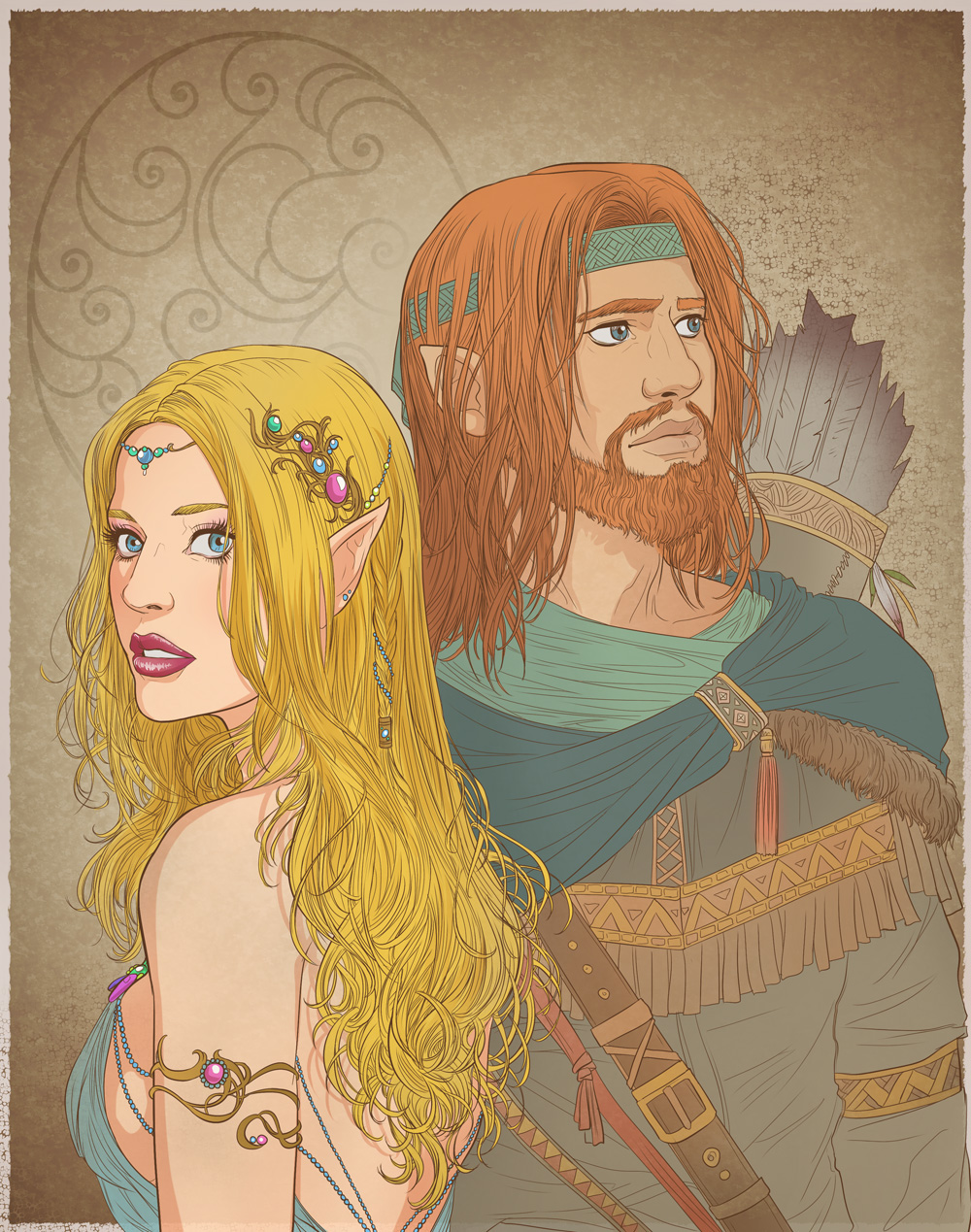
Hot elfess, that is completely unrelated
Cliche: The most obvious, and previously discussed cliche, not really a cliche per se, is the obvious parallel to history.  I enjoy such parallels in my own writing, and I feel that as a technique, you can unpack a lot of learning in a fun and novel way.  That said, while it deserves mention, it is by no means a traditional cliche.

Of course, like any Forgotten Realms book it uses enough of the Dungeons & Dragons Cliches.  Although, as this book takes place away from a more traditional fantasy scape, it has far fewer cliches.  Even so, it does have a dwarf and elf, and the dwarf at least conforms to all the usual stereotypes, tough, stalwart, grumpy, gruff, hard bitten warrior-type with a heart of gold.

Completeness:  Well... yes, and no.  This is the first book that touches on the City State of Amn, a place that is near and dear to my heart from my Balder's Gate days.  However, the introduction, again, of a completely new section of the map, seems premature.  I know all of these guys were friends, and that they all sat around the gaming table and talked this stuff over, but the map of the Realms is enormous, why did they feel compelled to write in this story a mere four years from the start of this completely new fantasy realm?

Overall, this was not the worst installment in the Forgotten Realms books.  Surprisingly, or not, the internet has not saturated this story or this book.  There may be only a handful of reviews of this book on the entire internet.  Which seems a shame, because it's not a bad book.  I suppose it's possible that some have found it distasteful because of the historical subject matter, shunning it because of its possible racial and demographic gauchness.  Still, if you're doing a Douglas Niles reread, this book ought to make it to your list.


Sunday, March 20, 2016

The Book of Three by Lloyd Alexander

The cover I got from the Long Lots Book Fair
Lloyd Alexander penned The Book of Three in 1964. It is a children's book, and I picked up my copy in the second grade bookstore. It was a formative book for me, but it was written in a time when fantasy was still almost exclusively written for children. It is a beautiful, simple book and it is without a doubt a classic. A lot of the cliches that I write about in this blog are present in this work as well, which gives rise to the possibility that many of the traditional fantasy cliches are much more generalized cliches adjusted slightly to a new medium.

Character: though a plot driven story, Alexander's characters are eloquently and completely drawn. The text is sparse, the sentences refreshingly simple. Not uncomplicated, just short and sweet. So character descriptions are to the point, yet cast a long shadow. Our main character is Taran the Assistant Pig-Keeper. This title is cute, amusing and novel, however hidden in that gem is one of Fantasy's oldest cliches, the Diamond in the Rough cliche: namely the hero is a boy of dubious means and no prospects. Now the pig he keeps is an oracular pig named Hen Wen, and he lives in a village with an old wizard, and he's an orphan--all things which point to a less than ordinary heritage. That said he does at some point in the story, unsheathe a sword meant for kings and the blade's curse backfires on him. So there is some proof that he is not a Benighted Prince. Taran is stubborn and pig headed, however he does admit when he's wrong, and the boy does know how to apologize.
Dalben and Taran, beautiful illustration by Tim Probert
Another fantastic character is the girl Eilonwny. You could think of her as a precursor to Hermione, sort of a cross between her and Luna Lovegood. For you non-Harry Potter fans: read strong willed independent, quirky to borderline odd. That is admittedly a male perspective: she does fall prey to certain stereotypes, namely that of expecting Taran to speak to her in a decidedly female way.  For example when Taran asks her to stay with him he does so by merely assuming her interest and instead of asking he directly. Still her quirkiness makes her a very enjoyable character that certainly lives in her own right.
And who can forget Ffewdur the Flamm, a fulfillment of the Bard cliche, though of an unusual variety. Ffew has a magic harp that pops a string whenever Ffewddur lies, and strains the boundaries of credulity. Why is a twenty something former King, yes he gave up his kingdom to travel and live as an itinerant musician, ceding authority to Taran, a fourteen year old boy? He gives a reason, several times, but it still seems unlikely.  Regardless, he is a fun, stalwart addition to the team.

Eilonwy and Taran, no credit
Cliche:  one thing to note about all the cliches in this book: The Chronicles of Prydain were written in the early 60s, while Lord of the Rings was published in  1954. So at the time, these cliches were not cliches at all. The notion of dwarves and fair folk have been part of European lore for hundreds of years, but as writing tropes their existence was not nearly as well defined.  The Diamond in the Rough cliche is in pretty heavy use here. Taran is literally the lowest of the low, a pig-keeper. To be sure, he cares for a magical, world famous pig.  That ain't exactly nothing--but he knows nothing about that. Only that Hen-wen, the pig, is wise beyond her pig years and has the knowledge of the ages at its cloven feet. Still we know that Taran is destined for greatness.

Eilowny is a good example of the Quirky Girl cliche, and is probably a precursor for some of J.k. Rowling's characters. A quirky girl is slightly odd, she may be pretty but her youth obscures that fact. Usually quite clever and witty, quirky girls are good foils for over serious young men.  Eilowny's aunt fulfills another stereotype, that of the Ice Queen. An ice queen, harkening to one of Tolkien and C.S. Lewis originals, is a female magic user. Though there is no ice magic necessary to this stereotype, the coldness of the evil that animates their actions is palpable. It's interesting to note that evil male magic users like Sauron, are more often represented by fire. The ice queen breaks, or has a breaking point where her reserve flies into apoplectic rage. This is a common female stereotype.

Fflewddur represents the Bard cliche, though he is not your typical sort of bard, shrouded in mystery and a born lady-killer.  He is part of the story's comic relief and he fills another cliche in Humorous Sidekick.

The Big Bad, or Evil King cliche is also heavily prevalent. Alexander admits from the first that he has borrowed heavily from Welsh cliche, but he doesn't really get specific. Arawn and the evil realm of Annuvin seem direct analogs to Sauron and Mordor, but perhaps these cliches themselves were borrowed from an earlier mythology (I thought that Tolkien had adapted his Christian mythos--Fallen Angel, etc.) We don't see Arawn in this book, he is merely indicated. Alexander had intended to write a trilogy, so there is time to develop this plot. However the story has a more local Big Bad, The Horned King. Unfortunately there is very little character development for this enemy.
Another cliche would be the Animal Sidekick. Disney took full advantage of this when they adapted the second in the series, The Black Cauldron. Gurgi is a vaguely ape like creature loveable and hairy. He has hands and feet and can walk and ride. For example, in later books he even wields a sword. So a bit unusual for this cliche in that Gurgi is almost human. Alexander himself described Gurgi as on the awkward cusp between human and animal.

The Welsh cliche, King Arthur was a Welsh legend, and it's from him that we have the High King cliche. I spent an afternoon in Cardiff when I was a young man, and though in some respects it was a disappointment, owing to the fact that the castle is in a relatively modern town, but it did remind me of all those tales of King Arthur and King Math. The Welsh cliche, like the Irish cliche takes on a variety of naming standards like Gywdion, and Fflewddur, etc.  Thirty years later these cliches were used by ElIzabeth Haydon in her Rhapsody quintet: lots of unnecessary ys ls and cs. There is also, rather than the more modern divisions between elves and dwarves, simply a fair folk that encompasses all the strange and wonderful creatures of the natural world: including something of a Mother Nature cliche.
There is a powerful Druid-like humanoid who heals and protects the creatures of the forest. While he doesn't sprout leaves out of his ass or look like a giant tree, he serves as a popular fantasy link to a cult of nature worship present in most fantasy.

One interesting note: while there are no elves, per se, there is most definitely (spoiler alert) a link between the high King and his get, The Sons of Don and the Elvish summer kingdom, that is the concept, of a higher race of man, leaving the realms of earth for more commonplace men like Taran. This is evident by the end of the Chronicles, in The High King. There are many more cliches in the Chronicles, but I should probably save more of this material for the next book!

Completeness: this book represents an earlier era of fantasy. As such it's completeness factor stems more from good writing then from good world building. Alexander manages to pen, in very few words a world both convincing and complex. However, in retrospect it doesn't feel as deep as we've come to expect from even teen lit. There is no world map, nations are mentioned but not given a history. We know that the world of Prydain has many wondrous things: magical swords, baubles, old sages, fair folk (who appear to be dwarves) and an ancient evil, but in this first installment very little depth is given. Modern fantasy is very different. Now, I know that there are four other novels in this series, and that the world will grow with every installment, but this novel could really use an additional 150 pages; and if it had been written now, and not in the sixties, I am sure Alexander would have provided it.

For now, enjoy and treasure this piece of traditional and historical fantasy lit. Remember that so much of what we read today has Taran, Gwydion, Eilowny and Arawn at its great, warm, heart.

Wednesday, January 13, 2016

The Wyvern's Spur by Kate Novak and Jeff Grub

This was one of the best Forgotten Realms novels yet. Not only did it occur within the standard realms, a fortified town in Cormyr, it had some truly loveable characters.

It was not a complex novel by modern standards, but after the sanctimonious and cliched writing of the Ice Wind Dale trilogy it was a great relief. The novel continues the events of the Curse of the Azure Bonds, popularized by the SSI one of the earliest PC games in history.  However it takes as it main character a complete nonentity, as we used to say in the biz an NPC, or non-player-character, a drunk partygoer who mimicked the King and nearly died when Alias tried to kill him. But before we get any further let me state simply and for the record: The Curse of the Wyvern's Spur is a thoroughly enjoyable novel.

Character: so the harmless partygoer is named Giogini Wyvernspur, and he's a delight. Foppish and insecure, but undeniably good natured, he returns from the mission that the King sent him on and his apartments in the city suddenly seem too small. He's been bitten by the adventure bug and for the first time in his life he's doing things for himself. His manservant is astonished! When he comes home, he returns just in time to find out that the Wyvernspur family, of which he is the primary heir, has just lost the magical artifact that gave the family it's name. Meanwhile his Uncle, an old but powerful wizard has a very important message for him. The novel is almost written as a mystery novel, which is a nice twist for fantasy, unusual too.

There are only two other characters of note: and one of them is a mystery. The other is Olive Ruskettle. If you remember Azure Bonds at all, you"ll remember the Halfling bard, Olive Ruskettle, whose desire to create a lasting melody provided the foil for The mystery of the azure bonds and the nature of Alias. In this novel, she finds herself back to her thieving roots, having taken on an apprentice. Her apprentice is Alias! But not really, apparently this area of the realms is chock full of Alias copies. Each a different class, none of whom has any idea of her mysterious parentage or fabricated nature. But back to Olive: she is probably the most interesting Halfling character I've read: in general I find them sort of boring.  Like dwarves, they tend to be very one-sided, in the opposite way. They are carefree, disloyal, low level fighters, or thieves. Olive exhibits these tendencies of course, what good a cliche if it's use is completely dissociative. But she also displays real leadership, particularly in Spur, given Giogini's befuddled nature. She seems to have a genuine history if not particularly well explicated, there is a third volume in the series: which if she plays a part will make the Alias trilogy really the Ruskettle Trilogy. Of course there are disappointments, Olive is "spurred" (haha) to help Giogi because of grief over her apprentice's sudden demise, but that grief, though referenced often enough is just not written convincingly.  In part because we do not know much about her slain friend: which brings us to the third character of note, the Alias look alike.

I don't even remember her name, an indication of how soft this part of the story is. Like so many love interests she is a soft amorphous blob, not saccharine, she displays rare moments of pique, but is just not very interesting. That said, this is often true in narrative fiction so maybe it's unrealistic to expect in pulp fantasy.

Cliche: we've mentioned the Halfling cliche, what's interesting about this is that what really made the Halfling cliche were Tolkien's hobbits. The hobbits of the Shire are really very charming, quaint and amusing details abound them really bring such characters to life. Unfortunately this charm almost never translates to D and D.
Hobbits everyone knows and loves


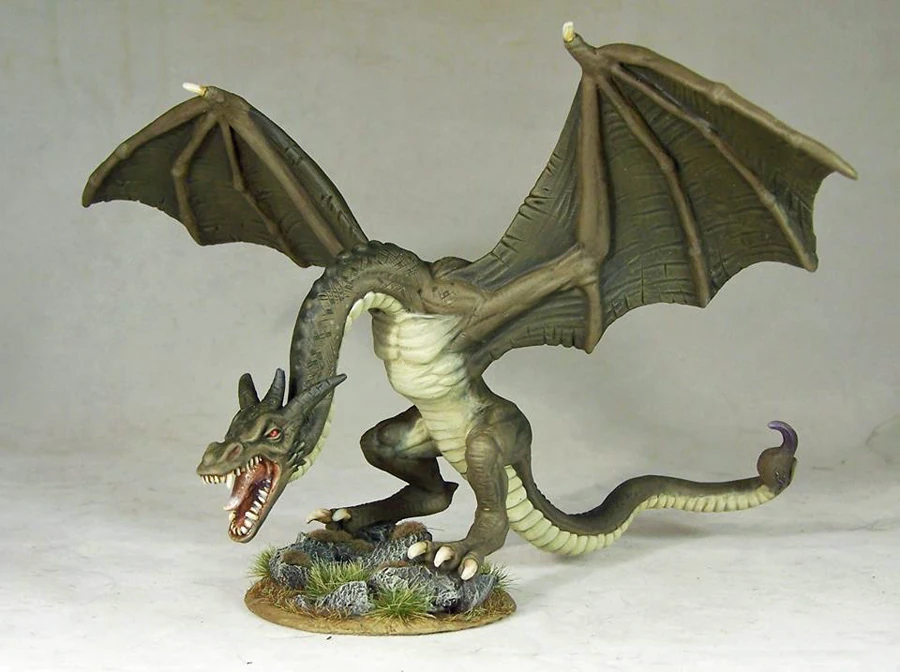
The Wyvern cliche is a relatively minor one, possibly not even worth mentioning other than the fact that they are smaller, armless dragons of lower intelligence. They do translate across fantasies, notably Erikson's Malazan epic has a small if memorable place for them.

Obviously all the D and D cliches apply. One cliche that sticks out a bit in this book is the magic-user D and D cliche, including: the mechanics of spell book casting, magical properties of spell components, scrolls, memorization etc.  It reminds me that aside from historical accuracy (relative accuracy) the main reason for such contrivances was to impose limitations on characters that would otherwise be far too powerful in a game setting. Compare that with the sweeping powers of Anomander Rake or Rand al'Thor. The limitations provided an additional layer of strategy. Fighters went forward to cover the firepower of spell casters. Spell casters could exert enormous force on massive monsters or provide a distraction to beleaguered fighters. I still remember the Fall of Pale from Gardens of the Moon and how it shattered my spell casting memes.


Another cliche explored in this novel, a more generalized cliche is the Whose Yer Daddy cliche. Given the preponderance of this cliche in literature I'm sure there must be some more technical name, but I can't resist it: who's your daddy? The cliche for children with mysterious parentage. Rand al 'Thor, Garion from the Belgariad. In this case, Giogi's father was a great adventurer whom the Crown relied on for certain dangerous tasks. Of course, Giogi's Aunt Dorath, herself a colorful, if minor character, hides the secret of Giogi's parentage.

Which brings us to Completeness. This novel is a tightly polished miniature puzzle and all of the pieces fit together extremely well. It has drama, love, high magic, the undead,and best of all a genuine warmth and sense of humor. It is self contained and there is no sense that the third novel in the Alias series will have anything to do with Giogi (more's the pity.).  We did learn a bit more about the Realms, about the nation of Cormyr. King Azoun, part of a long running dynasty is a relatively fair ruler. There is an interesting form of patronage at work: successful adventurers can be given land and title as governors of the land though they are not granted nobility and the title does not pass through the family  line, unless the governor marries into the local nobility.  One nice thing about the story is that since it stays in the same locality a few nice details have time to come about.

So, on the whole, this is a decent novel and might even be with a reread a few years from now. High praise indeed for a Forgotten Realms novel.

Monday, October 5, 2015

Halfling's Gem by R. A. Salvatore

Given the empire of Forgotten Realms fiction that R.A. Salvatore has put upon this earth (nearly 22 novels), you'd think the first three novels of his would be classics. Forbes did a great interview with the author, and in it Salvatore gives us a plausible reason for this:


“You don’t have to start at the beginning,” he tells me. “Contrast that with George Martin or Robert Jordan and the way they did their series. You couldn’t pick up the sixth book of Wheel of Time and read it, I don’t think, if you hadn’t read the first five. With the Drizzt books you could pick up the 6th book, the 10th book, the 15th book, the 20th book. It’s more like Sherlock Holmes or James Bond.”

Of course, that is the very definition of pulp fiction, and why Martin and Jordan are hailed as serious authors who shook up the world of fantasy fiction.

Halfling's Gem was an atrocious train wreck that I barely feel deserves a review. Not as bad perhaps as Spellfire, but up there.

Halfling's Gem concludes the Icewind Dale Trilogy. The plot continues the drama between the Calishite assassin Artemis Entieri and the dark elf Drizzt Do'Urden, as they fight over possession of a Halfling thief. Also appearing for the first time, the man who put the price on the halfling's head, Pasha Pook.
Artemis Entreri


The plot ... is ok. Where this book repeatedly fails is in the juvenile level of the text. Juvenile isn't quite correct because even teen literature is often more nuanced.

Character: Halfling characters get the worst treatment. At least Douglas Niles and Kate Novak used female dwarves and halflings. The D and D rules made these characters pretty limited but creating an interesting back story could have at least made Bruenor more palatable. So SPOILER: Bruenor is assumed dead at the start of the novel having ridden a flaming dragon into the abyss. And a neat part of the book is the discovery and fight through the abandoned city, but for whatever reason Salvatore spoils the surprise for his characters and has the all knowing and all powerful Drizzt realize long before the reveal that Bruenor may yet live. Salvatore had a chance for his characters to explore the very real emotions of raw grief, and he shied away from it to point out, yet again, how cool Drizzt is.


Wulfgar is also pretty terrible. We discussed in my review of The Blade Itself the Barbarian cliche. Wulfgar is that cliche, no twist, no subtlety, if you wanted to describe the Barbarian cliche in one word, that word is Wulfgar. The emotions that Wulfgar feels are simple: love, anger and grief. About as skin deep as you can imagine. Grief is not the mere absence of that which is held dear, it is the cacophony of successive failures, missed opportunities and piercingly poignant memories replayed continually within a mind unwilling or incapable of stopping itself.

I guess what I'm saying is that Salvatore keeps telling us when he should be showing us. A classic writing criticism.  This was 20 years ago, I'm hopeful that Salvatore's technique has been honed by 20+ books.

Last, we have Drizzt, in the second novel in the trilogy we learned that he felt his meeting with Entrieri to be a fateful one. That there was a strange connection through skill of arms with the assassin. While this morbid curiosity might have added a dimension to Drizzt's personality, it fails as Drizzt is forced to utter trite truism after trite truism.  It's sad because I've begun to suspect that Drizzt is actually a fairly deep character. For example Drizzt is offered a magic mask that makes him white. And he uses it because people fear the drow. But he comes to quite enjoy the anonymity and access the mask allows him. The notion of "passing" is an extremely loaded one for African Americans and its place in this banal fantasy novel is notable. Another moment has Drizzt stealing a kiss from the unconscious Cattie-Brie. A kiss which is never addressed again. 

As a general rule: If you were to strike every single line of dialog from the book, it would be immeasurably improved.

Cliche: all the usual D and D cliches apply, so I won't waste any time but to list them: Dwarves, halflings, elves, Dungeons and Dragon's Race Cliche, barbarian.

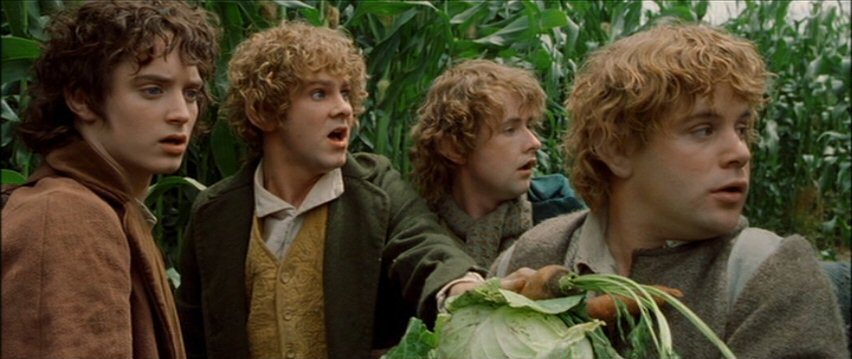
Some new ones include The Kidnapping, the Middle East and the Thieves Guild.  The Kidnapping is pretty self explanatory: it's a common fiction cliche, helpless child/girl/Halfling taken by force on a long journey, vengeful heroes hot on the trail, always close, but never quite catching until the final pages. One difference here is that the Heroes give up catching the assassin fairly early on and simply make for the final destination. One famous example of the Kidnapping motif would be from Tolkien's Two Towers when Pippin and Merry get taken by the Orcs.

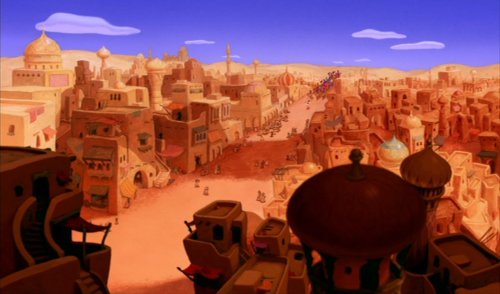
Agrabah, or Calimport by Disney
The Middle East cliche  is a common one as well, Calimport is clearly a middle eastern city, and it's denizens, though magical (halflings, humans and wererats follow the same dress and speech patterns. This type of Orientalism would be offensive to some, but the point of the cliche is to save time and space. Calling to mind a westerner's idea of a 1300th century Middle Eastern city provides leagues of description without straining the readers imagination.  As I get older, and my anthropologist wife teaches me to be more sensitive to and less tolerant of micro aggressions that form the undercurrent to overt racism, I begin to wonder about such tropes, and I begin to understand why so many authors have attempted to create whole new worlds, absent of these cliches.
The internets are loaded down with Skyrim images.  Best I could come up with.

The Thieves Guild cliche is an incredibly common one in fantasy.  One the one hand it gives voice to a real world occurrence in a fantasy world, that of organized crime, and on the other hand, it speaks to the shadow economy that likewise exists in every city and state, the sale of untaxable, untrackable, and unregulated goods.  One thing that the Thieves Guild cliche does frequently in fantasy, however, is to neuter the more dangerous and pyschopathic elements of such a community.  To Salvatore's credit, his thieves guild is pretty despicable.  Pasha Pook the crime boss of Calimsport runs the guild with the aid of three henchmen, a dark wizard (fairly servile, as evil wizards go) the deadly assassin Entrieri, and a runaway pack of were-rats.  Though the subplot in Halfling's Gem of trouble in Pasha Pook's organization is never really explored or prevailed upon in any major way, it does give voice to the fact that such an organization would be almost impossible to govern.  But If you're looking for fantasy mafia stories to thrill and awe you, leave Halfling's Gem on the penny shelf, and pick up Scott Lynch's Gentleman Bastard trilogy.


Completeness:  Sadly, I think Halfling's Gem is not the end of this pitiful story.  As the action closes and the heroes sail away righteous and victorious, we know a larger battle is on the horizon as the dwarves of clan Battle Hammer are massing to retake the mines of Bruenor's father.  Still, this story does wrap up the unexplained nature of the halfling's powers and the mystery of how he obtained his magical gem.  It also sheds further light on several new areas of the Realms.

As I become more home in the world of the Realms, I see that there is very little overlap or common knowledge.  Virtually none of the stories I've read or reviewed so far even occur within the same thirty year period.  While, this excites me on some level to know that the breadth of the history of this place is huge, it also feels sloppy and haphazard in the retelling.  I have attempted to follow the date of publication for these books rather than take a timeline version of the books approach.  I chose that route because I want to see the vision of the realms as its actual creation was occurring, not as a second-guessed, revised version.  However, this choice has lead to some frustration on my part.  Right now the only common element is Elminster, and he's kind of crotchety and fallible for an Old Wizard type. 

On the whole, I'd say feel free to skip the Icewind Dale Trilogy.

Monday, March 23, 2015

Dragons of Autumn Twilight by Margaret Weiss and Tracy Hickman

So, Dragons of Autumn Twilight, and indeed the DragonLance Saga was one of those formational books in my career as a fantasist.  The timing was apocryphal, 80s fantasy was proliferating, and the fantasy section of Waldenbooks (remember them?) was expanding from four shelves to an entire section.

But the writing was still in its infancy, it was a simpler time in fantasy.  Which is not to say that there weren't complex characters or narratives, merely that the expectation was merely swords and sorcery, not quality. Just about anything with a sword or dragon could qualify back then.

I say all of this because Tor has commenced its own DragonLance reread, and both bloggers, Jared and Muvesh, point out the text is simplistic and rife with cliche.  They're not wrong, but they started their reread with the creme de la creme. I started my reread with the dreck that is the first five novels of the Forgotten Realms books.

The Tor bloggers also point out what I have mentioned in my Forgotten Realm reviews, namely that these novels are limited by the fantasy rules of Dungeons & Dragons. Jared and Muvesh come from two different backgrounds, Jared obviously played the game "way to roll a 1 beardy!", and Muvesh came to the novels fresh, having grown up far far away from the kitsch of American consumerism in the 80s.

I actually purchased the DragonLance module for the D&D world, intending to Dungeon Master it for my friends. Unfortunately, my friends "grew up" before I did, and so I never got the chance. But I've actually seen the stats for the story's heroes. If you recall, or if you were born after 1985, the stats were rolled with a six-sided die. That I even had to qualify the number of sides for you is pretty indicative of the type of geek I'm talking about. All of this to say, the highest number you could get, at least in the original rules, was 18. The better your stats, the better your character's chance of hitting, dodging, casting spells, attracting followers, etc.  All of this was rolled into those first computer games, D&D and 4-bit Heroes of Might and Magic. Except for the fact that the game developers learned pretty quickly that if the same number of missed swings continued in battle, they would kill their market pretty quickly.

I bring this up because I remember being slightly puzzled by how low the stats of all the DragonLance Heroes had actually been, except for Raistlin whose intelligence was a stunning 17. As a young teen none of us wanted our heroes to be ordinary, so we gamed our dice until we came up with a number we felt comfortable with. The Realms computer game Baldur's Gate came up with a clever way of bypassing this, let the computer roll your stats, and then get a few flex points to tailor your character as you wish. Point is, the Heroes of the Lance were rather ordinary.

Anyway, Dragons of Autumn Twilight was published before even the first Realms book came out, so there was some real trailblazing here.

Character: Tanis, Raistlin, Caramon, Sturm, Flint and Tas. Need I say more? The figurehead, the leader,
and the character we all loved unequivocally, was Tanis Half-Elf. The product of rape, a dichotomy of elf and human, long and short lived, noble and peasant, lustful and pure, courageous but filled with self doubt and inner torment.  And a love triangle!  In Jared's reread week #2, he points out that DragonLancers fall into two categories, Raistlin or Tanis fans.  If this is true, then I confess I am probably a Tanis fan.  Though I do love the character of Raistlin, his all-consuming thirst for power was less interesting to me then the painfully torn personal anguish that Tanis felt.  In retrospect though, the writing of Tanis' inner torment is of a lower quality then that of Raistlin's.  That said, Tanis is the story's main hero, its leader, and there is just more detail regarding his thoughts and feelings.

The Twins, Raistlin and Caramon, darkness and light, Mage and warrior, ambition and loyalty. These two were so beloved that Weiss and Hickman wrote an entirely different series for them! I recall an interview with Margaret Weiss where she told us that Raistlin was her favorite character. The dynamic of the Twins told us so much of human nature.  The desire to protect and help our lesser brother, as the warrior Caramon so often did with Raist. The desire to be free from physical constraint and independent, as Raistlin personified. And ambition, oh, so much about ambition.  And it's converse.  Caramon's greatest desire, his most fundamental ambition is to make lots of babies with Tika Waylan, and live on a farm with his kooky brother as one big family. In stark contrast to Raistlin, who would one day challenge a god with his magic, not to vanquish her evil, but to consume and supplant it!

Then we had Sturm, himself a conundrum.  A boy aspiring to the past glories of knighthood. Trying to live the code, My Honour is my Life, yet knowing that he was no knight in truth, and the organization he worshiped, the Solamnic Knights had grown petty and powerless. As a teen, it was Sturm who captured my imagination.  I had the Death of Sturm, that famous Larry Elmore painting, taped to my college dorm room wall. His courage and his sacrifice were symbolic to me of all that men were meant to be. On my reread, I realize now that Sturm was also incredibly angry and intolerant.   Something
that probably appealed to me then.

Then there were Flint and Tas, the crusty dwarf and the irascible kender.  As a side note, I learned last month that in those early days, TSR the owner of Dungeons & Dragons was involved in a number of disputes with the the owner of the Tolkien merchandising, one Saul Zaentz. Possession of the term Hobbit was one of them, and by 1978 per Sacnoth's Scriptorium the most obvious terms, Ent, Hobbit, Nazgul, etc. were gone from the franchises. TSR compensated in a variety of ways, creating Halflings and Gnomes in the Forgotten Realms, Kender, Gully Dwarves, and Gnomes in the DragonLance series. While all dwarves seem to assume fairly typical clichéd attributes, and Flint is no exception, the splinter races of Hobbit take on a variety of different tropes. Gnomes are tiny but ingenious and industrious, Gully dwarves are filthy, uneducated and the lowest caste, and kender are the fun loving scamps of the tiny person world. Tas was one of these, and it's the relationship between these two that grants Flint a life beyond mere Dwarf cliches. To be sure, even Flint's fury at the kender's antics is fairly cliched, but the Death of Flint still brings tears to my eyes.

There are others, great loves and great heroes, but these are the essential Heroes Party.  Itself a cliche, a group of five or six heroes who compliment each other's skill sets and agree to quest together.

Cliche:  Where to begin?  Let's skip the obvious ones.  Dungeons and Dragons was all about cliche.  In fact, the original rules didn't even have a Dwarf class, the Dwarf was simply a fighter, the Elf, simply an Archer.  I mentioned one above, the Heroes Party cliche.  I note this because the cliche has certainly changed over time.  In the D&D world, the characters were very failable, your heroes died all the time.  You could get them resurrected without too much trouble, but only if someone in your party survived and was able to haul your keister back. To wit, the parties were larger.  You could have as many as seven or eight people to a party.  More with a good DM.  Parties are smaller these days, and videogames blazed that particular trail, parties are typically three now, with more characters waiting in the background.

Fan art, tried to find all three together. by Autumn-Sacura
I mentioned the Love Triangle earlier, a cliche but not one native to fantasy.  Tanis grew up in love with an elf maid, a princess of his people.  She loved him back with childlike naivety. But Tanis left because Elves are intolerant to the extreme, big on social purity.  And though humans are no better, human society is much less structured than the that of the long-lived elves.  And his other lover is a human woman who isn't even "good!"

Which calls to mind another D&D creation, the Character Alignment Cliche.  So when creating your character you had to choose two of six attributes, one from a set of three.  Good, Neutral, Evil, Chaotic, Neutral, Lawful.  For a great listing of character of alignments in D&D click here.  Why bother you ask?  Well, despite the massive amounts of rules, D&D attempted to create real story telling.  Which necessitated real characters, which necessitated real thought.  Choosing an alignment was a way of thinking about your character.  In effect, it made the game more fun.  "I will kill this murderer!" says the Paladin, "because I am the arbiter of justice, and because the rule of law says that this man must die!"  "I'm sorry," says the ex-soldier now adventurer, who continues "Though he is guilty of murder, he is also deserving of kindness.  He murdered only to protect his kin!"  Part of what made the Party system so interesting was that you had to have your six or seven heroes all get along together!  You don't see this cliche too often anymore.

As the Tor blog pointed out, the book begins in an Inn, a symbolic setting for the Dungeons & Dragons meme. And the Inn certainly manifests itself often enough in fantasy to warrant its own cliche. the jovial innkeeper, warm fire, large bosomed barmaids. Or it's the Evil Inn cousin, think shifty innkeeper, slatterns, and nefarious doings in the corner.  But in Dragons, it's the Inn of the Last Home, where friends gather to eat Otik's famous potatoes and flirt with the luscious Tika Waylan. And so the epic starts as Friends gather after a long absence.

Completeness: I talk sometimes about scope, and in this simple thematic device, that of old friends meeting, the book establishes a complicated history from page one. Why did the friends part? Where did they go? Why are some together, and some separate? Were there mixed feelings, old dramas, triumphs of old? What about that sensation we've all had about life: that the past is dead, never to be felt again.  That you can't go home, and that memory is always different then what was.  I actually can't think of another fantasy book that begins quite this way. The Eddings' Belgariad had old friends meeting up along the road, but off hand that's it.  For all it's tropism in the Dungeon & Dragons world, it is fairly novel.

"Dragons" suffers from a very obvious and perfectly explainable completeness issue: much is purposely left unexplained. The back story to the characters is only alluded to within the trilogy.  Other authors were contracted to pick up the yarn and finish these quests.  This was frustrating in the 80s, as the other authors were never as strong as Weiss & Hickman.  In some cases entire chapters seem to be left out.  That said, Dragons was a pretty thick book for back then.  Particularly given that the average "game module book" probably ran about 250 pages.  It might well be that some of the missing content was merely cut for size.
Flint the King, what Flint did during his 5 year trip

There are a few interesting points I wish to make here.  In almost all fantasy genres of the 80s and early 90s, the basic baddy, the foot soldier of evil was more or less incomprehensible, the other, alien and bestial (orcs, trollocs, demons.  Not so in DragonLance.  Hobgoblins and Draconians are fully sentient, frequently speak the common tongue, and are sometimes even playable races within the games.  So when, in that first chapter of Dragons, Tanis and Flint have a conversation with Fewmaster Toede (a hobgoblin comic-relief villain) it's almost shocking.  Usually when orcs appear, swords are drawn, and orc blood rains black from the heavens.  There is no discussion, no capacity for empathy.  It's just kind of a neat thing.  For all that Jordan advanced the genre, the only conversation he ever had with a Trolloc was one where it was being tortured for information, or attempting to trick its human target.

Fewmaster Toede, almost all of these images are Elmore originals
Last, what Dragons lacks in completeness, the game module, the other books in the series, and the other books in DragonLance as a whole compliment and fill utterly.  Though the book itself seems riddled with holes, you can rest assured that everything is explainable with reference to some rule in the Player's Handbook or in the lore of the series, or even in the fanverse that has, in the intervening years given these books a completely new life.

Having completed my reread of the first novel, I still love the Heroes of the Lance.  My admiration for Weiss and Hickman remains, though it is tempered by the amazing writing of what the future of fantasy would soon hold.

Tuesday, February 1, 2011

The Dwarves by Markus Heitz

Let me start this post with a disclaimer:

Anyone who can finish a novel, and get it published has my utmost respect.  And more, they are in at least this one way far superior to me: they've the will to see it through.

Criticisms of this book might also be inappropriate for this reason:  The Dwarves is one of those few fantasy novels that bridged the language gap.  Every single other fantasy book I've ever read, and I've read many, were in English.  Translating from German is hard, and my philosophy professors always assured me, particularly the Germans, that a great deal is lost in even the best translation.  One of my central criticisms of this book is that the prose is simple to the point of being for a much younger audience, twelve to thirteen.  I suggest that this is the publisher's fault.  German is an exceedingly colorful language, and each word is dense with meaning.  This was not a book to go Hemmingway on.  But Americans are thought by editors at large to be fairly simplistic in their reading level, and so perhaps there is a sensible reason for this fault.  Compare the prose of The Dwarves to the prose of Erikson's from The Malazan Book of the Fallen and you'll see what I mean.

Overall, I enjoyed this book.  There's enough going for it, that I'd consider reading the sequel.  As usual, I'd seen this title in the bookstore and admired its fine cover.  Not only that, but I was intrigued.  Dwarves are usually in the model of Gimli from LOTR, amusing sidekicks, or Flint from the Dragonlance Saga.  The implication, and truth of the title, is that this might be one of the first such fantasy novels where the hero is a dwarf.  The book had an interesting, relatively swift moving plot, some gruesome details, and an exciting conclusion.

Very well, let's get to the five.

1.  Character:  This is perhaps my primary complaint about the story.  The characters are very naive.  Naivety is only bearable when it proves a point, is a statement about the character, not the writer.  Rand Al'Thor starts out the Wheel of Time very naive.  But Jordan does this intentionally, to show that he's an eighteen year old boy from a farming village.  Every single character, except maybe one, the Maga Andokai are naive to the point of iritation.  And they say the lamest things to one another!  The main character Tungdil is the worst for this, but even the main vilain, the Nudin the Knowledge-Lusty (For real! Really, a better translation wasn't available?  Maybe Google translate did their translation) was exceptionally naive.  He ravages his own homeland, convinced that he's acting on the greater good.  This would be an interesting character development except that it's not really talked about much, save for one of the the story's modes: the play within the play.  And he has a good excuse, he's inhabited by a demon spirit.  Madness is intriguing, ethical decision making is intriguing, devil possession is passing the buck.  In this case, passing it to the sequel I imagine.

The other reason The Dwarves fell flat, is that the Dwarves themselves were remarkably bland.  There is an interesting mythology presented, five clans of dwarves, separated by their God, Vraccas. (*I was dismayed by the name Vraccas, in one of my own unfinished works of 2002, I'd chosen this exact name to be an evil god.)  The dwarven mythos is essential to the story, and is one of the most enjoyable elements.  But even so, detail regarding the lives of regular dwarves was incredibly sparse.  Worse, Heitz had an excellent vehicle for doing so, and since the main character is a foundling, every sentence between two dwarves would have added color.  It's like a six year old's coloring book, full of poorly colored shapes, many pages left entirely blank.  Worser:  There's millions of helpful dwarven cliches in other fantasy novels that could provide further description without dragging down the plot.  This is why cliche's are useful, they speak volumes.

2)  Let's talk about Cliche:  Heitz had two options here.  Use the old dwarven cliches laid down by Tolkien, and many since, or bust a nut and create something new.  Either would have worked well for me.  However, by using a familiar race, beloved of fantasy readers everywhere, Heitz had already consigned himself to a certain amount of necessary cliche.  Let's see here:  Dwarves are short: check.  Dwarves prefer underground mountainous lairs: check.  Dwarves hate magic: check.  Dwarves are long lived: check.  Dwarves prefer axes: check.  Dwarves are smiths: check.  Dwarves love gold: check.  Heitz had a subtle spin on the dwarven love of gold, he made it genetic.  By which I mean, Dwarves have the love of gold and gems intrinsically.  Men love gold too, but its generally admitted that we love it for the things, including sex and status, that it can get for us.  Dwarves just like how it looks, sort of like human women.  Heitz also used the dwarven cliche of using names that involve all of the above.  I enjoy this particular cliche quite a bit, so no problems here.  In fact, these standard fantasy cliche's held true for all of the races.  Let's coin a term, "LOTR Race Cliche" shall mean that Dwarves are short and bulbous, Elves are tall and fair, humans are enh, orcs are evil.

The Coming of Age cliche was also used to some degree, though somewhat inexplicalbly.  Tungdil is 60 years old when the story starts.  This is really only about a third of a dwarf's life.  But I'm at a third through my life, and I don't act like a twenty year old, so what's this guy's excuse?  Tungdil isn't immature, he's just completely innocent.  Naive, as stated above.  And it bugged the hell out of me.  At 60 years old, you've learned a lot about life, particularly when you've spent the entire time living among humans.  That's at least two generations of medieval humans he would have lived through.  Still there are some good reasons, he's never met a female of his race.  God knows, women give you gray hairs.  And he's never met a male of his race, so when he meets the story's comic relief, the warrior twins Boindil and Boendil, acting a bit childlike would be understandable.  This leads to a third cliche: Self-Actualization.

Coming of Age cliche's often become self-actualization cliches.  In the Eye of the World, Rand al'Thor becomes a man.  But through the remainder of the series, he continues to grow and change, leaving behind the Coming of Age cliche of the first book.  Tungdil has a problem: he knows nothing about his race, other than what he's read in books.  Fortunately for him, everything he ever learned in his books about dwarves was completely accurate.  This bothered me, again I felt like this book was aimed at thirteen year olds.  That would be fine, but good fantasy is aimed at a much broader audience, thirteen year olds included.  I don't need you to tell me that books are good, thank you very much. 

3.  Scope:  The scope of the novel was perfect.  The realm is called Girdlegard (again, an awful translation choice--literally, the land is wearing a girdle that guards it from evil.)  Still Girdlegard is small, with delineated borders, and the reader is not in any way made curious about what lies beyond those borders.  A common fantasy trope is to name off lands far distant without providing a purpose for these lands.  Such a trope is merely to show that that the story takes place in a larger land, not in space.  Personally, I prefer bounded lands because, well frankly, its easy to make up funny names and toss in a sentence about far away lands.  It's a bad writers trick (I know, I use it)  Heitz doesn't indulge.  That said, there are just too many lands for a fairly simple story.  Were six human kingdoms really necessary?  No.  Only two are relevant.  In contrast, the five dwarven realms are completely relevant, and tantalizingly explained.  I mentioned in my last post how difficult it is to indicate scope without falling into such tropes, but Heitz sidesteps the issue very nicely.

To the Blight (The Eye of the World, Book 2)4.  Magic:  The story starts out with there being six main Magi, male and female.  And they save the realm from another cliche, The Perished Land. Not unlike Jordan's Blight.  Nothing grows in the Perished Land, and anyone who dies in it is forced to walk the land as a revenant, enslaved to the will of some gaseous form of evil that is only hinted at.  Magic isn't really explained, and Heitz falls back on more cliches, spell books, runes, jars of ingredients, eye of newt, you know the deal.  One thing for sure about magic.  You can eat other Magi's magical power.  Guess how.  It's an important plot point, but Heitz doesn't bother to explain it.  And maybe he's right--Dwarves hate magic.  And if nothing else, The Dwarves, is about Dwarves.  One fairly interesting and enjoyable part of the story is that, much of the book is taken up with quests searching for magical artifacts.  This is something fairly rare in fantasy of the past twenty years which is primarily character driven.  I don't want to spoil the novel, but it becomes clear in the first fifty pages, that the big bad can't be killed with the usual assortment of weaponry.  Magical weapons are cool, and anyone who ever played a fantasy board game, videogame or the beknighted Dungeons and Dragons knows it.

5.  Theme:  It's hard to get a handle on the overall theme of The Dwarves.  It might be too basic.  If the prose were more detailed, or better translated, I could make a better stab.  The Perished Land isn't particularly dark or frightening, and the revenants can talk, and in some cases, even be completely normal.  So darkness as a theme is out.  I guess if I had to peg it, I'd say, unity.  There's a weird scene in the end, after the big bad is beat, where a minor character makes a speech about unity between the races.  Given the happy-go-lucky nature of the characters, this theme seems to be the most prevalent.  I can't complain, go Unity.  Go Peace.  But...again, I'm not thirteen.

If the cover weren't so groovy, I'd tell you to borrow a copy.  Want mine?