Search This Blog

Thursday, April 16, 2015

Half a King by Joe Abercrombie

This was my first Abercrombie novel, though he is the author of the best-selling First Law trilogy. Abercrombie came highly recommended to me, not by my peer group, of whom there are precious few fantasists, but by a blog post by Steven Erikson who mentioned the author in passing. Then, of course, the book jacket has George R. R. Martin praising the book as well. Now, Martin is a fame whore, so that could mean anything. But the man is obviously super intelligent, certainly enough to know his name means something, and that he ought not to abuse it.

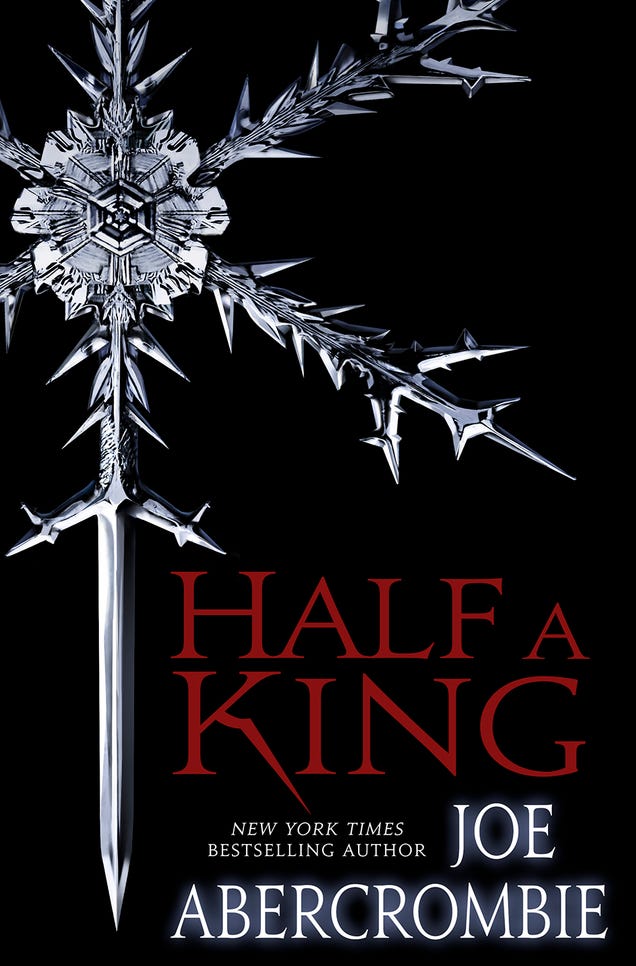
The cover isn't much. A book in the new style, I suppose to reach out to other markets. Those swords and sorcery covers of the 80s and 90s are a dying breed. While sleek, for all the inventiveness and relevancy of the cover art, the book could have been self published! I should note that more recent copies have rectified this oversight. The modern way to market fantasy novels appears to be with heavily stylized images on stark unicolour backgrounds.  It's a damn shame given the high quality of illustration out there today. If the 80s had deviantart.com publishers would have been peeing their pants.

Which leads me, finally, to a substantive critique.  I found this book enjoyable, and certainly page turning.  But, also very hard to read. The prose isn't difficult.  In fact it's the very opposite.  It's almost Hemmingway sparse.  After having completed a reread of Erikson's Midnight Tides, I found the prose rather simplistic.  But, it was also hard to read because it seemed almost grammatically incorrect.  Now, even a casual glance at my writing on this site would indicate that I am not a stickler for the rules of grammar.  As a former actor, I tend to write as I speak, or as I hear the words in my mind. So my prose is commatastic!

Abercrombie's prose is distinctly lacking in commas. I'm not saying he's wrong, or that the staff at Del Rey is either, just that I was frequently thrown for a loop by some of the descriptive sentences.  This is my major criticism of Half a King, there was something off-putting about the writing for me.  I think it is likely a matter of taste. Let me say simply, it is nothing like Erikson's.

That said, the story was decent. Not sweeping, like Jordan, Erikson, or Martin, but certainly a bonafide world sparsely but deftly described.

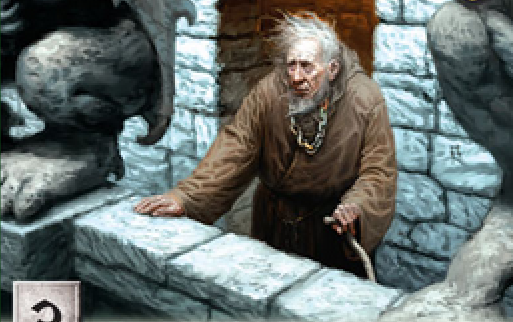
A Maester, from ASoIF
Character:  our main character is a teenage boy named Yarvi, the perspective from which the entire story is told. There is no switching of narratives, as there frequently is in epic fantasy. The novel is the start of at least a trilogy, according to Abernathy's website.  Yarvi starts off the novel a true anti-hero, a thirdson, a sniveling, cowardly, deformed wretch slated to become a king's counselor, a Minister, much like the Maesters of George R.R. Martin's world (Academics sworn to serve their king, yet members of a larger enlightened circle of scholars.). Yarvi is proud of his achievements and excited to take the final test.  But The day before he sets sail for the capital city he finds out that his elder brother and father are slain.  At first blush the novel seems a Coming of Age type where an enlightened king gains the respect of his people and leads them to greatness.  However, to Abernathy's credit, this is NOT the direction the novel takes.  SPOILER: The boy ends up a rowing slave on a merchant galley.  END SPOILER.  Yarvi's character development is decent and believable, and the Slave to Greatness cliche is used quite effectively here in his growth from boy to man.  Yarvi's companions are interesting and each is given a decent character sketch, though the best minor character is killed off before story's end.  But none are worth mentioning, telling. Half a King would have benefited immensely from an additional two hundred pages.  That would have given the sub-characters real time to grow.  In common fiction, brevity is highly laudable.  In epic fantasy, this really isn't so, and I feel disappointed that I will never learn more about them.

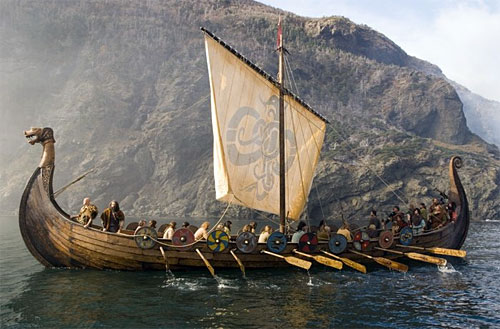
Cliches:  I've already mentioned a few of them.  The most obvious is the Coming of Age cliche.  Yarvi is a boy, weak, with little or no confidence in his ability to lead, and by story's end he is a leader and a man capable of killing in cold blood.  The Second Son cliche is a new one for this blog.  It's the idea that in a medieval kingdom, the first son becomes the heir to the throne, and the second is a spare, often sent to the priesthood.  Second Sons are not taught to rule, though though they are taught the same princely arts that first sons are.  As usual with my naming convention, I do not exclude daughters, though certainly it was a rare medieval kingdom that passed leadership onto women.  The Advisor Cliche, that of the trusted advisor taught at a central university, or passing certain certification tests, and then assuming a position as a hand of the king.  The Slave to Greatness cliche: where a person spends some time in the annealing fires of misery that only slavery can teach.  Inevitably, the hero escapes slavery and his derring-do, righteous rage, and astounding humility astonish the local nobility.  One interesting note: when Yarvi escapes slavery, he does not abolish or make slavery more palatable in any way.  In fact, he seems to give a mental shrug and say "someone has to row the boat."  That's a nice touch, certainly realistic, I suspect.  The Shattered Sea has much in common with the Norse medieval cliche.  Not so much the series of gods, or the serpentine dragon called the Nidhogg, but the idea of a warrior culture thriving in cold weather, crossing the sea with longships and raiding the neighboring kingdoms. All in all, I'd say the novel's use of cliche was effective, and this is one example where the cliche speaks a thousand words.  By using these cliche's Abercrombie is able to write a slightly shorter novel.
The Niddhogg, definitely not in this novel

Which leads us to completeness:  the Norse cliche gives the world a binding ambiance for the setting of the Shattered Sea, without delving into the complex relationships that must exist between the various kingdoms.  But the novel is billed by it's own advertising as a thriller of betrayal.  Several of these betrayals were startling, several were indeed quite obvious.  Some of these betrayals were made obvious by the lack of explanation occurring in the novel's set up.  The king and his brother were killed, and since everyone says its an ambush by a rival kingdom, the main character does too. But the story's narrator is Yarvi, a scholar, who should be asking these questions for us. He does, once, question the whole "who really killed my father and brother" thing, but only once and the question is ignored thereafter. But in the last ten pages you find out that in Yarvi's secret life, when he's not rowing, starving, freezing, or wheedling himself out of a sticky situation, he has thought about these things extensively and come up with a cruel, cold plan for revenge. Nonetheless, it seems an obvious and unfortunate fail on Abercrombie's part.  Rowing is tough work, and being chained night and day to a bench with an oar would make some higher thinking difficult, but he seems to accomplish enough whinging during this time to make it seem more like an oversight.
One last note on the subject. SPOILER: Given that this book is the first of a trio, it is difficult to say where the next two novels will go. This can be a good thing, if the groundwork for what comes was layed properly. What mysteries remain: who are the Elves? What is god, is he the shattered version post elf Apocalypse, or The One God of the High King? The High King is characterized as a silly, vain, weak-willed ruler. If so, who is pulling his strings?  Yarvi has relinquished his kingship to his other Uncle, who after a 15 plus year absence happily marries the widowed Queen, his moms. Will Yarvi ever be King? The a rule of law says no, when a man becomes one of these advisor types he relinquishes his title. But of course, there are always those who would change that. What about Yarvi's almost-girlfriend, will she prove a reoccurring character. Or now that Yarvi is sworn to celibacy will she become irrelevant. (Why these scholars are sworn to celibacy is beyond me.  Having been around academics for over a decade I can tell you they are anything but!)

Clearly there is much to go forward with, but what there is not at this point is a Big Bad, nor a coming Apocalypse. Unless its the concept of one currency.  The old Queen was beginning a plan to stamp her own currency and to proliferate it throughout her economic sphere as the only currency. As a Queen who "minted" money for her kingdom, it's not inconceivable that she could have the clout to do so. And, I must say, as an economic blogger, this would indeed be a sequel worth writing about.
.

Monday, March 23, 2015

Dragons of Autumn Twilight by Margaret Weiss and Tracy Hickman

So, Dragons of Autumn Twilight, and indeed the DragonLance Saga was one of those formational books in my career as a fantasist.  The timing was apocryphal, 80s fantasy was proliferating, and the fantasy section of Waldenbooks (remember them?) was expanding from four shelves to an entire section.

But the writing was still in its infancy, it was a simpler time in fantasy.  Which is not to say that there weren't complex characters or narratives, merely that the expectation was merely swords and sorcery, not quality. Just about anything with a sword or dragon could qualify back then.

I say all of this because Tor has commenced its own DragonLance reread, and both bloggers, Jared and Muvesh, point out the text is simplistic and rife with cliche.  They're not wrong, but they started their reread with the creme de la creme. I started my reread with the dreck that is the first five novels of the Forgotten Realms books.

The Tor bloggers also point out what I have mentioned in my Forgotten Realm reviews, namely that these novels are limited by the fantasy rules of Dungeons & Dragons. Jared and Muvesh come from two different backgrounds, Jared obviously played the game "way to roll a 1 beardy!", and Muvesh came to the novels fresh, having grown up far far away from the kitsch of American consumerism in the 80s.

I actually purchased the DragonLance module for the D&D world, intending to Dungeon Master it for my friends. Unfortunately, my friends "grew up" before I did, and so I never got the chance. But I've actually seen the stats for the story's heroes. If you recall, or if you were born after 1985, the stats were rolled with a six-sided die. That I even had to qualify the number of sides for you is pretty indicative of the type of geek I'm talking about. All of this to say, the highest number you could get, at least in the original rules, was 18. The better your stats, the better your character's chance of hitting, dodging, casting spells, attracting followers, etc.  All of this was rolled into those first computer games, D&D and 4-bit Heroes of Might and Magic. Except for the fact that the game developers learned pretty quickly that if the same number of missed swings continued in battle, they would kill their market pretty quickly.

I bring this up because I remember being slightly puzzled by how low the stats of all the DragonLance Heroes had actually been, except for Raistlin whose intelligence was a stunning 17. As a young teen none of us wanted our heroes to be ordinary, so we gamed our dice until we came up with a number we felt comfortable with. The Realms computer game Baldur's Gate came up with a clever way of bypassing this, let the computer roll your stats, and then get a few flex points to tailor your character as you wish. Point is, the Heroes of the Lance were rather ordinary.

Anyway, Dragons of Autumn Twilight was published before even the first Realms book came out, so there was some real trailblazing here.

Character: Tanis, Raistlin, Caramon, Sturm, Flint and Tas. Need I say more? The figurehead, the leader,
and the character we all loved unequivocally, was Tanis Half-Elf. The product of rape, a dichotomy of elf and human, long and short lived, noble and peasant, lustful and pure, courageous but filled with self doubt and inner torment.  And a love triangle!  In Jared's reread week #2, he points out that DragonLancers fall into two categories, Raistlin or Tanis fans.  If this is true, then I confess I am probably a Tanis fan.  Though I do love the character of Raistlin, his all-consuming thirst for power was less interesting to me then the painfully torn personal anguish that Tanis felt.  In retrospect though, the writing of Tanis' inner torment is of a lower quality then that of Raistlin's.  That said, Tanis is the story's main hero, its leader, and there is just more detail regarding his thoughts and feelings.

The Twins, Raistlin and Caramon, darkness and light, Mage and warrior, ambition and loyalty. These two were so beloved that Weiss and Hickman wrote an entirely different series for them! I recall an interview with Margaret Weiss where she told us that Raistlin was her favorite character. The dynamic of the Twins told us so much of human nature.  The desire to protect and help our lesser brother, as the warrior Caramon so often did with Raist. The desire to be free from physical constraint and independent, as Raistlin personified. And ambition, oh, so much about ambition.  And it's converse.  Caramon's greatest desire, his most fundamental ambition is to make lots of babies with Tika Waylan, and live on a farm with his kooky brother as one big family. In stark contrast to Raistlin, who would one day challenge a god with his magic, not to vanquish her evil, but to consume and supplant it!

Then we had Sturm, himself a conundrum.  A boy aspiring to the past glories of knighthood. Trying to live the code, My Honour is my Life, yet knowing that he was no knight in truth, and the organization he worshiped, the Solamnic Knights had grown petty and powerless. As a teen, it was Sturm who captured my imagination.  I had the Death of Sturm, that famous Larry Elmore painting, taped to my college dorm room wall. His courage and his sacrifice were symbolic to me of all that men were meant to be. On my reread, I realize now that Sturm was also incredibly angry and intolerant.   Something
that probably appealed to me then.

Then there were Flint and Tas, the crusty dwarf and the irascible kender.  As a side note, I learned last month that in those early days, TSR the owner of Dungeons & Dragons was involved in a number of disputes with the the owner of the Tolkien merchandising, one Saul Zaentz. Possession of the term Hobbit was one of them, and by 1978 per Sacnoth's Scriptorium the most obvious terms, Ent, Hobbit, Nazgul, etc. were gone from the franchises. TSR compensated in a variety of ways, creating Halflings and Gnomes in the Forgotten Realms, Kender, Gully Dwarves, and Gnomes in the DragonLance series. While all dwarves seem to assume fairly typical clichéd attributes, and Flint is no exception, the splinter races of Hobbit take on a variety of different tropes. Gnomes are tiny but ingenious and industrious, Gully dwarves are filthy, uneducated and the lowest caste, and kender are the fun loving scamps of the tiny person world. Tas was one of these, and it's the relationship between these two that grants Flint a life beyond mere Dwarf cliches. To be sure, even Flint's fury at the kender's antics is fairly cliched, but the Death of Flint still brings tears to my eyes.

There are others, great loves and great heroes, but these are the essential Heroes Party.  Itself a cliche, a group of five or six heroes who compliment each other's skill sets and agree to quest together.

Cliche:  Where to begin?  Let's skip the obvious ones.  Dungeons and Dragons was all about cliche.  In fact, the original rules didn't even have a Dwarf class, the Dwarf was simply a fighter, the Elf, simply an Archer.  I mentioned one above, the Heroes Party cliche.  I note this because the cliche has certainly changed over time.  In the D&D world, the characters were very failable, your heroes died all the time.  You could get them resurrected without too much trouble, but only if someone in your party survived and was able to haul your keister back. To wit, the parties were larger.  You could have as many as seven or eight people to a party.  More with a good DM.  Parties are smaller these days, and videogames blazed that particular trail, parties are typically three now, with more characters waiting in the background.

Fan art, tried to find all three together. by Autumn-Sacura
I mentioned the Love Triangle earlier, a cliche but not one native to fantasy.  Tanis grew up in love with an elf maid, a princess of his people.  She loved him back with childlike naivety. But Tanis left because Elves are intolerant to the extreme, big on social purity.  And though humans are no better, human society is much less structured than the that of the long-lived elves.  And his other lover is a human woman who isn't even "good!"

Which calls to mind another D&D creation, the Character Alignment Cliche.  So when creating your character you had to choose two of six attributes, one from a set of three.  Good, Neutral, Evil, Chaotic, Neutral, Lawful.  For a great listing of character of alignments in D&D click here.  Why bother you ask?  Well, despite the massive amounts of rules, D&D attempted to create real story telling.  Which necessitated real characters, which necessitated real thought.  Choosing an alignment was a way of thinking about your character.  In effect, it made the game more fun.  "I will kill this murderer!" says the Paladin, "because I am the arbiter of justice, and because the rule of law says that this man must die!"  "I'm sorry," says the ex-soldier now adventurer, who continues "Though he is guilty of murder, he is also deserving of kindness.  He murdered only to protect his kin!"  Part of what made the Party system so interesting was that you had to have your six or seven heroes all get along together!  You don't see this cliche too often anymore.

As the Tor blog pointed out, the book begins in an Inn, a symbolic setting for the Dungeons & Dragons meme. And the Inn certainly manifests itself often enough in fantasy to warrant its own cliche. the jovial innkeeper, warm fire, large bosomed barmaids. Or it's the Evil Inn cousin, think shifty innkeeper, slatterns, and nefarious doings in the corner.  But in Dragons, it's the Inn of the Last Home, where friends gather to eat Otik's famous potatoes and flirt with the luscious Tika Waylan. And so the epic starts as Friends gather after a long absence.

Completeness: I talk sometimes about scope, and in this simple thematic device, that of old friends meeting, the book establishes a complicated history from page one. Why did the friends part? Where did they go? Why are some together, and some separate? Were there mixed feelings, old dramas, triumphs of old? What about that sensation we've all had about life: that the past is dead, never to be felt again.  That you can't go home, and that memory is always different then what was.  I actually can't think of another fantasy book that begins quite this way. The Eddings' Belgariad had old friends meeting up along the road, but off hand that's it.  For all it's tropism in the Dungeon & Dragons world, it is fairly novel.

"Dragons" suffers from a very obvious and perfectly explainable completeness issue: much is purposely left unexplained. The back story to the characters is only alluded to within the trilogy.  Other authors were contracted to pick up the yarn and finish these quests.  This was frustrating in the 80s, as the other authors were never as strong as Weiss & Hickman.  In some cases entire chapters seem to be left out.  That said, Dragons was a pretty thick book for back then.  Particularly given that the average "game module book" probably ran about 250 pages.  It might well be that some of the missing content was merely cut for size.
Flint the King, what Flint did during his 5 year trip

There are a few interesting points I wish to make here.  In almost all fantasy genres of the 80s and early 90s, the basic baddy, the foot soldier of evil was more or less incomprehensible, the other, alien and bestial (orcs, trollocs, demons.  Not so in DragonLance.  Hobgoblins and Draconians are fully sentient, frequently speak the common tongue, and are sometimes even playable races within the games.  So when, in that first chapter of Dragons, Tanis and Flint have a conversation with Fewmaster Toede (a hobgoblin comic-relief villain) it's almost shocking.  Usually when orcs appear, swords are drawn, and orc blood rains black from the heavens.  There is no discussion, no capacity for empathy.  It's just kind of a neat thing.  For all that Jordan advanced the genre, the only conversation he ever had with a Trolloc was one where it was being tortured for information, or attempting to trick its human target.

Fewmaster Toede, almost all of these images are Elmore originals
Last, what Dragons lacks in completeness, the game module, the other books in the series, and the other books in DragonLance as a whole compliment and fill utterly.  Though the book itself seems riddled with holes, you can rest assured that everything is explainable with reference to some rule in the Player's Handbook or in the lore of the series, or even in the fanverse that has, in the intervening years given these books a completely new life.

Having completed my reread of the first novel, I still love the Heroes of the Lance.  My admiration for Weiss and Hickman remains, though it is tempered by the amazing writing of what the future of fantasy would soon hold.

Wednesday, February 18, 2015

The Name of the Wind, by Patrick Rothfuss

Weird cover clearly designed to attract non geeks
The Name of the Wind is a novel that came to me highly reviewed by several what I would call, junior faculty members of the fantasy intelligentsia, meaning those who dabble, or have only recently expressed a burgeoning interest in fantasy.  In other words: less geeky than I.  In addition, the Onion AV Club gave the novel the raviest review of all, "THE NAME OF THE WIND is quite simply the best fantasy novel of the past 10 years, although attaching a genre qualification threatens to damn it with faint praise. Say instead that THE NAME OF THE WIND is one of the best stories told in any medium in a decade." This from Rothfuss own website.  To those who recommended the novel to me, I can't thank you enough.  I'm always looking for a good read.  That said, I think the AV Club is singularly heavy handed with its praise, or, let's just say, flat out wrong.  Weirdly, in the review of the first book, the reviewer seemingly got some important elements of the plot just slightly wrong, which makes me wonder about whether or not she even read it.

I think this is fan art, but whose?  beautiful!
As usual, with new author breakouts, I confess to turning an uncomfortable shade of chartreuse.  Of course, I look at it and say, "I could do better."  But in this case, I can also say that the fantasy genre of the past 20 years is roundly the equal of The KingKiller Chronicle.  If not, frankly, superior.  I don't want to be a downer.  It is good.  It was just really unfortunately hyped.

Character:  One of the triumphs of The Name of the Wind, is that there are some excellent characters.  However, I am of two minds about the main character.  On the one hand I find him to be interesting, and humorous.  On the other hand, I find his extreme youth to be difficult to relate to, and I sometimes feel like his character has some major contradictions.  The framework for NotW is that a famous scribe named Chronicler has found Kvothe the Bloodless, a man of infamous repute, working as an innkeeper in a flyspeck town.  He tells Chronicler that he will need three full days to tell his story.  So Book One, marks the end of Day One, and so it goes.  He then proceeds to tell his entire life story.  My problem with Kvothe is that the man in the inn seems to be so completely different from the boy we see growing up.  While this is intentional, I do not find it convincing.

One of the things that the critics laud about NotW is that main character is an anti-hero, because his adventuring life ends in ignominy and despair. This is not as uncommon in fantasy as the reviewers seem to believe, but the innkeeper, Kote (he changed his name by two letters for anonymity) is particularly maudlin as compared to the rather flamboyant youth that Rothfuss describes.  This is the heart of the story, how a flamboyant boy/actor/musician type, becomes a weary, hardened, and embittered killer.  But so what? The Coming of Age cliche frequently ends in the Loss of Innocence cliche.
Smart lady with the watermark.  rohanelf, nice work!

That said there are a lot of wonderful characters.  I, too am in love with the love interest, the mysterious Denna (though their verbal sparring grows tiresome, "I think of you like the dew on a daisy petal at dusk."  (not a quote, just an example)).  I am also quite fond of the other students at the Arcanum, Kvothe's friends at the University.

Denna, unattributed
Cliche:  As I discussed in my post on Elizabeth Hayden's Rhapsody, NotW draws from many popular cliches.  The first and most obvious is that of the Bard.  Kvothe is an Edema Ruh, which is a cliche of it's own, the Traveling People (so named by Jordan's Tu'athan, who traveled in large wagons).  The Ruh however are players, actors and musicians too, but largely actors.  This is an interesting thing because many of the classic fantasy novels, including the Wheel of Time, eschew acting troupes as crass and foolish.  I honestly don't know what the historical basis for this would be, other than that a solo act is easier to pick up and move, and that since it lacks the bells and whistles of theatre, requires a larger imaginative investment.  Regardless Kvothe, for the most part fits the stereotype.  He's brash, he's colorful, and dramatic, and magical.  He is not particularly adept with women, but hey, he's only 15.
Jordan's Traveling People


Another cliche might be The University.  This is not too common a cliche in fantasy, but it certainly exists, as it does elsewhere in literature.  Though the opening pages of the book stress that Kvothe's time at the university is limited, it certainly seems to follow a year per year formula that the Harry Potter saga followed.  That said, it is a wonderful and useful cliche and adds a fair amount of depth to the medieval/renaissance world that birthed the concept of higher learning.

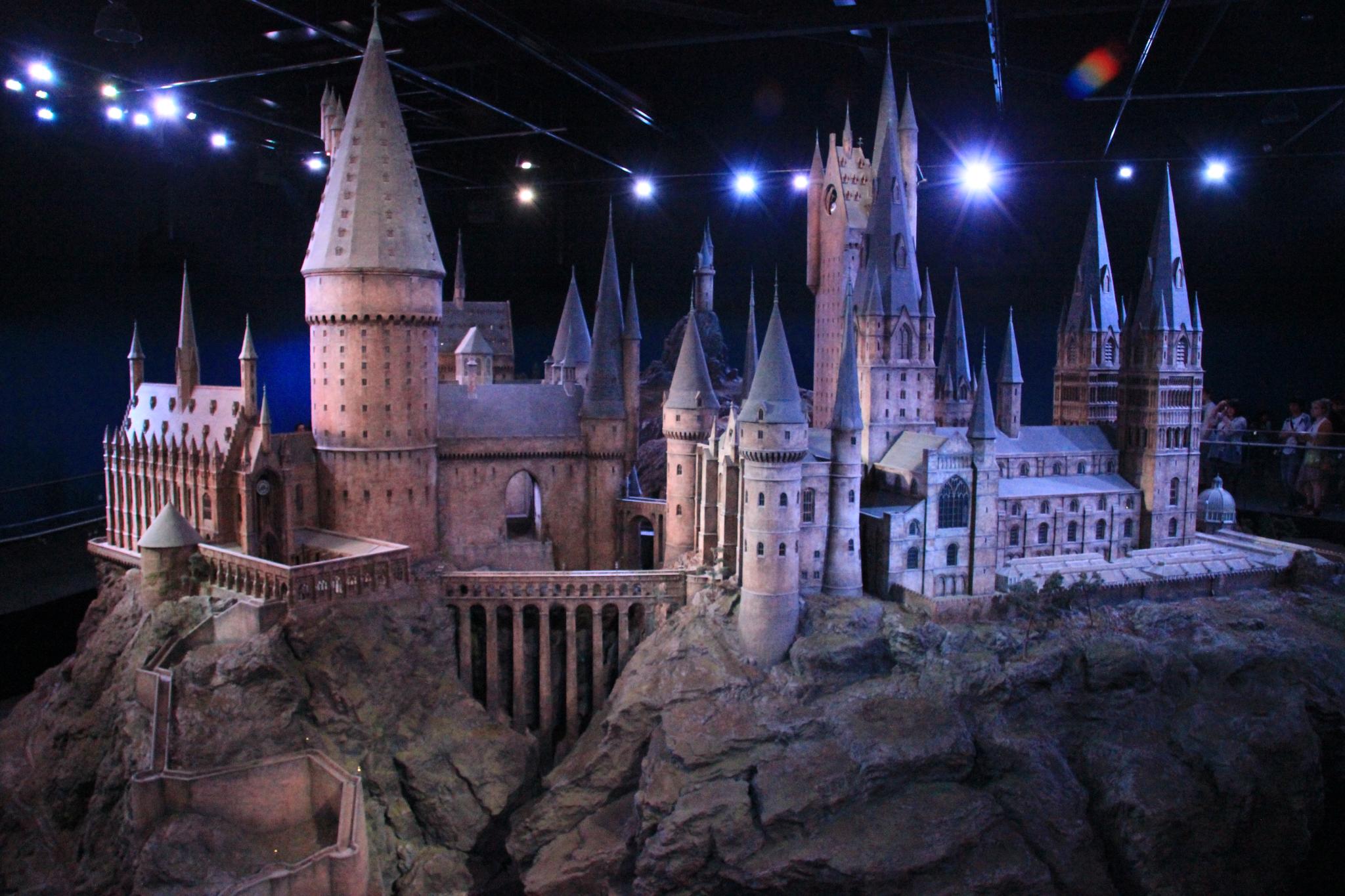
The Real Hogwarts
And along with the University Cliche, comes the City Cliche.  I imagine that this is the difference between authors who have dwelt in a major metropolitan area, and those that live in the sticks, or even in large sized towns.  This is another great and rare fantasy cliche.  After having lived in NYC for over a decade, I can tell you hundreds of details about the city that prove just how diverse and unusual each neighborhood.
The city of Camorr
Too often in fantasy, large cities are simply background to travelers passing through, and possibly getting mugged.  The idea is simple, in the midst of this fantasy world is a massive, sprawling city: the center of government, commerce, learning, music and art.  And a central part of this cliche is that the city is described as any normal city would be, with various quarters and districts, specializations and peoples of many nationalities and backgrounds.  Again, it adds a degree of realism that is very much missing in many fantasy epics.  Some examples from other worlds.  The Gentleman Bastard's city of Camorr, modeled off of medieval Venice.  Also, Darujhistan from the Malazan Book of the Fallen.  Jordan's cities each had its own character, and there were dozens of cities in which the characters spent time, but detail at this level was rarely provided.

I said in my last post that I wouldn't bother with this in the future, but I think a note must be made on the Name of the Wind's magic system.  Much time is spent describing this system called Sympathy, and it is pretty neat overall, described in the link above as pseudoscientific energy manipulation. Overlapped with it however, seems to be various other magics, The Power of Names cliche for one (hence the book's title), the power of demons, and the mysterious powers of the arch-enemy, the Chandrian.
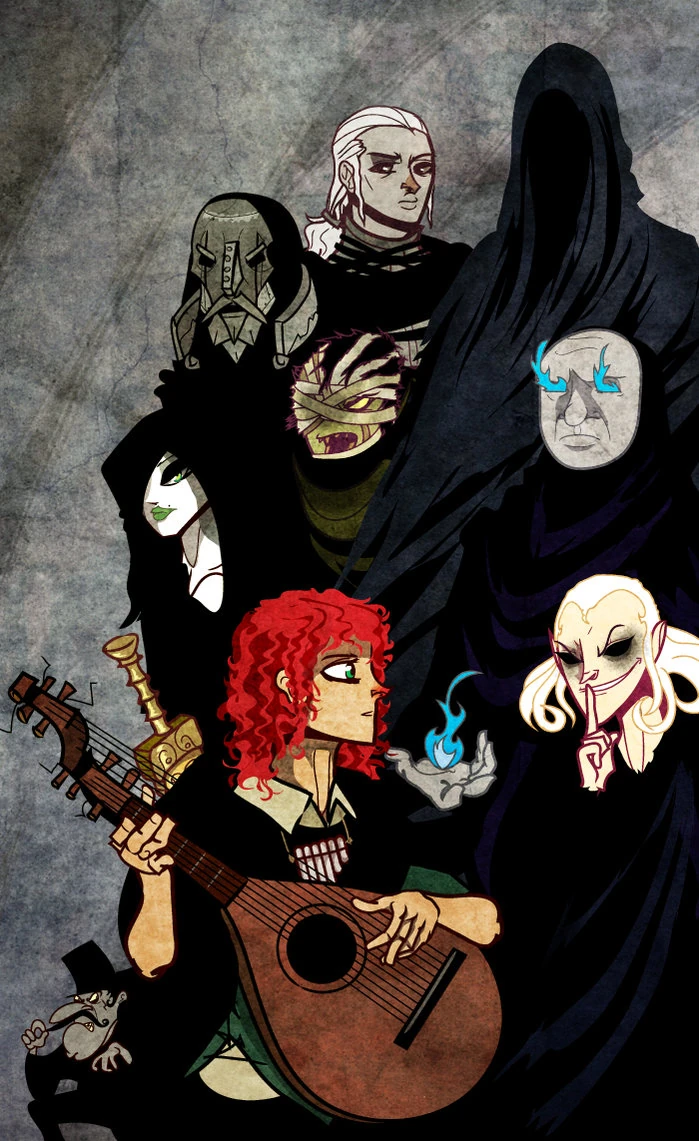
Kvothe and the Chandrian, by sir-hearts-a-lot

Completeness:  So... you get the sense that the world is indeed a large place, but so much of this first book takes place in one city that it can be easily forgotten.  That said, the denizens of the city are quite diverse, and Kvothe's family of friends are all foreigners.  Also, his people, the Adema Ruh, are traveling performers, and that in itself is suggestive of a wide scope.  More than anything, though the book is written believably enough that even though the world itself seems somewhat hazy at the end of this first book, you trust the author to make amends for this in later books.  I'd say it stands up.

However, there do seem to be plot holes, and this is a major flaw in the book as far as I am concerned.  The most obvious, and previously alluded to is the Szcherezade aspect of the story, in which Kvoth tells his story in three days.  By the end of the first story he's barely 17.  If the next book does a full four years (which it doesn't, he'd just barely be 21.  Leaving our embittered assassin killer bard a bare 25.  I'm sorry, you don't have the right to be bitter at 25.

There are others too: Rothfuss has a habit of telling stories within stories.  I love a good flashback, but when a flashback goes forty or fifty pages of a 350 page novel, and then gets interrupted to tell a 20 page parable within the middle of said flashback, enough is enough.  For another intelligent review of NotW, read Benjo's Books review.

At the end of the first book we are left with many questions.  This might be genius at work, maybe he's setting us up.  I'd like to believe that, but I just can't.  To me it seems too much like the TV show Lost.  Which was pretty much Lost after its first season.

Monday, February 16, 2015

The Three C's of Fantasy

So, for the past few years, I have sought to structure my reviews according to a 5 part matrix for assessing fantasy novels. The fantasy five I called them. They were: Character, Cliche, Scope, Magic and Theme. Unfortunately, this lead to massive reviews that take a long time to write, and that I suspect bore my readers to tears.
The Bridgeburners


So I am reducing the rubric.  I'm keeping the first two, Character and Cliche.  character speaks for itself, what is a story without great characters? And I find the cliche aspect of my work to be Very Important.  Many writers have taken a stab at identifying classic fantasy cliches but I have yet to find a really cohesive list.  And as I've said about a billion times, cliche in fantasy is necessary and good.  Why use a hundred words when one good cliche can suffice? Also, cliches are an excellent cross reference between and among the classics. They are almost like phylogenetic trees! Oh he uses halflings? Oh well, then the author probably played video games, or Dungeons & Dragons, which means that he's calling to mind the world of Tolkien. Or he uses absurd humor and zany anachronism? His work calls to mind Lewis Carol.

However, I had a bit of trouble deciding the third category.

 I love discussing magical systems in these works, but it turns out, in so many of the best novels these systems are anything but clear.  And while they may appear internally consistent, a rigorous discussion can be a dive into minutiae that just isn't necessary in a review.  I've also noticed over the last few years that i tend to discuss magic in other parts of the review, frequently when discussing characters.
Moretta, Dragonlady of Pern

Scope and Theme are important factors as well, but they are anything but clear.  What is clear is that a good novel has both in droves and that "you know it when you see it." Which leads us to the third factor: completeness.

The Eye of the World
I don't much care for the word, it leaves a lot to be desired and I may change it. But it does encapsulate a lot of important ideas: 1) the idea that the fantasy world is believable, detailed and coherent (scope) 2) that there are no major plot holes 3) that this completeness contains a palpable theme, a vision and artistic direction (theme).

So here are my reduced factors, three categories:

1) Character
2) Cliche
3) Completeness

My next review will either be Dragons of Autumn Twilight, or the sequel to Shadowdale, Tantras.

By the way, what are we thinking of my Forgotten Realms reviews? Am I bogging down on something that is ancient history? The fact of the matter is they seem to be generating a fair number of hits, so I'm inclined to continue.  But the phone lines are open, so call in!

Saturday, February 7, 2015

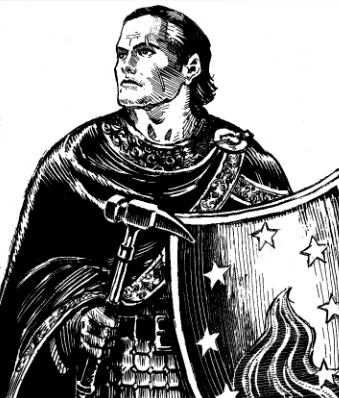
The Wise Words of Karsa Orlong, House of Chains, Steven Erikson

So, in the Malazan world, a favorite character of mine, and of fandom, is the Thelomon Toblakai, Karsa Orlong.  The character change this of this behemoth blade-master changes much over-time, but even at his most barbaric, he speaks with a gravitas, that is always stirring.  Even the author finds Karsa an interesting study.  For Erikson's treatise on Karsa and 'the other,' click here.

This quote, from Steven Erikson's House of Chains, occurs as the Teblor warrior muses on the rebellion known as The Apocalypse.  He has thrown in his lot with the Apocalypse, almost by chance.  He abhors the rebellion's avowed purpose, and by now has come to admire the Malazan Empire somewhat.  These are his musings on the War of the Apocalypse.

And if you read my other blog, RavingLeftatic, you'll see why I excerpted this here.  All credit goes to the author, again, Steven Erikson.

by shadaan
"The notion of a life spent tilling fields was repellent to the Teblor Warrior.  The rewards seemed to be exclusive to the highborn landowners, whilst the labourers themselves had only a minimal existence, prematurely aged and worn down by the ceaseless toil.  And the distinction between high and low status, was born from farming itself -- or so it seemed to Karsa.  Wealth was measured in control over other people, and the grip of that control could never be permitted to loosen.  Odd then, that this rebellion had nothing to do with such inequities, that in truth it had been little more than a struggle between those who would be in charge.

Yet the majority of the suffering had descended upon the lowborn, upon the common folk.  What matter the colour of the collar around a man's neck, if the chains linked to them were identical?

Better to struggle against helplessness, as far as he was concerned.  This blood-soaked Apocalypse was pointless, a misdirected explosion of fury that, when it passed, left the world unchanged."
by slaine69 at deviantart


Saturday, January 31, 2015

Shadowdale by Richard Awlinson

So this may be the first book in the Forgotten Realms series that I have really enjoyed, and have found to be a fairly mature story. It also was written in 1989, and while it still follows a fairly staid Dungeons & Dragons, hero's quest, type of format, it's characters have a great deal more depth, then even R. A. Salvatore's entry into the realms
over the same time period, (Streams of Silver). The troubled heroes actually have back story! Best of all, the story ends in a large, well detailed battle scene with gods, demons, and thousands of troops.

One thing I found troubling, if only in a vague way, was that the premise of this series of books is that the Gods have been banished from the planes by the über god Ao. And as such, they are sent to dwell as humans in the Realms. Now, alongside the release of these books, were actual campaign materials detailing the stats of everything that existed in these worlds.  So, when gods are killed in the  course of this story, were these gods listed in the materials? Or were they Awlinson's creation for the purpose of this particular tale.  The Arrival, as it is called, would have to be a pretty big deal in the worlds history, particularly in light of the fact that magic seems to stop working, and clerics spells only work in the physical presence of their god. So, is Shadowdale adding to the canon of the Realms, or is it just a one off? From this link, it turns out that the Realms Creator, Greenwood actually did conceive of Bane.

When I start reading the books written in 1990, I hope to see reference to the Arrival and the events that followed.  I know that the events that occur in Darkwell, and Streams of Silver are quite independent of this apocryphal event. Though, they could well have occurred prior (or long after) the events herein.

The most enjoyable attribute of Shadowdale is story's heroes, Midnight, Kelemvor, Cyric and Adon. The story begins as these unlikely adventurers skip town on a guard duty contract, although why you would want your city guarded by men on forced contracts enforceable by prison sentences is beyond me. Why? To aid a mysterious girl, whose mysterious mistress is trapped in an old ruined castle.

Kelemvor is ostensibly the most developed of the heroes. A fighter with a terrible curse laid upon him. This curse forces him to only engage in human relations on a contractual basis whereby he is promised a reward, and then actually receives it.  If he does not, (spoiler alert) he turns into a hideous beast. This makes him seem hard hearted. Now, if Awlinson had opted for a shallow character, the curse not withstanding, once removed, would allow Kelemvor to be the selfless hero we all want him to be. However, it turns out, that he is, as all real people are, much more complicated then this. He stays to defend Shadowdale against the Zhentarim, but not because he cares one whit for the people of Shadowdale. He stays because he loves Midnight, and is promised her love, as the basis for the contract. Imagine knowing, as a lover, that your partner may love you, but they can only be with you while under the terms of a very strict contract.  I quite like this twist, and it is in stark contrast to Salvatore's Drizzt Do Urden, the dark elf with the heart as big as the Realms itself.  As a note, if you are, as I am, reading these chronicles for the first time, DO NOT google Kelemvor.  I just inadvertently spoiled the next two books for myself!  Don't click on this.

Cyric is another interesting guy. A thief, turned multi-class, fighter. That's a term from the old days. At first in the D&D world, you had to choose, fighter, thief, or magic user. In later editions, more classes emerged, and in the advanced rules, your fourth level thief could choose to become a fighter. He would retain his thieving skills up to that level, but he would then have to level up as a fighter instead. You could also choose to level up both, but it'd take forever, so most people usually simply switched.  As a boy, I thought this was cheating (having your cake and eating it too. Don't like the paltry hit point scores of a thief? Multi-class him and have the best of both worlds). Now, as an old man, I know that we wear many hats in this lifetime, and we frequently put earlier chapters in our lives completely to bed.

I digress. Cyric was born in Zhentil Keep. First in Spellfire, and now in Shadowdale, we are introduced to Zhentil Keep, as a city that worships the evil gods of the Realms. I find this to be a really interesting concept. Say what you like about cities, but for them to exist, a certain amount of cooperation is required. A certain amount of trust. After all, a contract is a promise, and not all goods can be paid for up front. For a promissory note to hold value, you must trust its issuer to fulfill the obligations therein. And trust cannot exist in a city of Evil. Unless, of course, it's not all Evil. Which reminded me of my favorite St. Augustine quote, "And even when men are plotting to disturb the peace, it is merely to fashion a new peace nearer to the “heart'’ desire; it is not because they dislike peace as such.  It is not that they love peace less, but they love their kind of peace more."

So I was eager to learn more about Zhentil Keep, from the character of Cyric. He was a thief and a murderer, but his most ardent desire is to be free of his past. To be free from the shackles of the Thieves Guild that made him what he was. He too could care less about the people of Shadowdale, and in fact despises them for their apparent weakneses of trust, love, faith and optimism. And he too, opts to stay and defend it from the approaching army. He's also an atheist, which is pretty hard to be in a Realm where there are actually gods. Like I said, for a fantasy novel of the late eighties, this is pretty deep stuff.

My favorite character, is Adon. Adon is a cleric of the goddess Sune, the Realms' Aphrodite. He is incredibly vain, in a harmless, humorous way, and finds himself being chased out of town by a woman who somehow managed to resist his charms. Adon loves the ladies, and he is a firm believer in beauty. Which makes his devotion to Sune all the easier to believe. After all, to believe in beauty one must only know desire and possess eyes. This would all make Adon pretty one dimensional, save for the fact that as a cleric in a time where the gods have descended, he has lost his powers, and has made no effort to find the avatar of the goddess living within the Realms. Neither for his belief, nor for the powers it gave him.  Which, is, odd.  And then, in the last sixty pages, something happens to Adon which is definitely not expected. And he becomes a completely different person overnight. Who he is, we do not yet know. His tale will likely be continued in Shadowdale's sequel, Tantras.

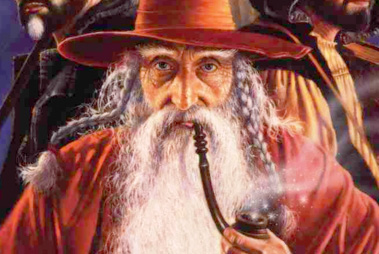
The last point I'd like to bring up is about that old sage, Elminster.  I've been hearing about Elminster for nearly two decades.  He's the Realms version of Gandalf, a long lived wizard of power to rival the gods.  Up till now we haven't learned much about him.  In Spellfire, we learned he had a dalliance with a student, who turned into an evil sorceress.  We also learned that he is short tempered, and humorous.  In my mind, I had always equated him with Dragonlance's Fizban, the bumbling old wizard who happens also to be the God Paladine.  But Elminster is definitely human.  This will probably make him a better character over all.  Though I must say, I rather miss old Fizban and his disastrous Fireball spells.

One last note. Shadowdale, Tantras, and Waterdeep were all released in the same year. Leading me to believe that they were written as one novel and broken up to sell more books, and to be more readable. It also suggests that Awlinson began these novels around the time that Niles, Greenwood, and Salvatore were composing their own founding works.

This was a good read, and if you're looking for some lite fantasy to get you through à lull, this would be a good choice.

Monday, January 19, 2015

Darkwell by Douglas Niles

This marks the final installment in the Moonshae Trilogy.  And, as I am going to start writing shorter blog posts, let me simply outline a few points about the series, about the Realms, and about this particular novel.

The Moonshae Trilogy are some of the first books published in the universe of the Forgotten Realms, published in 1987 to 1989.  And this was a period of great schlock in the fantasy genre.  And these books fit the bill.  They are pure swords and sorcery.  Dungeons and Dragons at its most obvious level.  In some ways, though the books were intended to help sell the games, and vice versa, the books are fairly limited by the universe of the D&D world.  Anyone who has ever read the Players Handbook has had their eyes glaze over with the sheer number of rules, dice roles, and mathematical calculations required for even the simplest of actions.

So when a level six druid casts the level three spell Plant Growth, what happens can be described anyway the dungeon master wants, but at the same time has to adhere to a very specific set of limitations.  And in many ways these stories of the Forgotten Realms are just that, well DM'd stories by a group of players fulfilling quest objectives.

Or the DM can break the rules entirely, as they sometimes do.  But breaking the rules is dangerous business and it can backfire on the author.  One nice thing about writing in a new, or less proscribed fantasy realm is that the limit is your own imagination, and the rules are yours.  Breaking your own rules creates problems too, but a re-envisioning of said rules, an enlarging of the paradigm, is a simple escape from these sorts of problems.

And in each of the Realms books I've read (and I've only read up to 1989) you can literally see spells being cast out of the Magic User's guide.  When the dark god Bhaal creates his evil champions to battle the heroes, they came straight of the Monster's Compendium.  And they have to, because the main rule of writing in an open series like this is a certain consistency.  Still, I'm not sure how I feel about a Displacer Beast being a big bad.  On the one hand, it recalls my egregiously misspent youth (playing with dice and pencils when I should have been out drinking and having sex) on the other hand, the sense of horror and intrigue created by the unveiling of a "new monster" is almost entirely mitigated.

Up until now, just three years into the history of the Forgotten Realms, the books have no inter connectivity, save for a few common city names.  The tales have begun at the far ends of the Realms and have involved relatively little geography.  Though R.A. Salvatore's Icewind Dale series has some decent travel.  Ed Greenwood's own first novel, the man behind the Realms,  taking place in his own world was simply atrocious.  Spellfire has to be one of the worst books I've ever read.

This was never the case in DragonLance, which had such a serious and continuous narrative of the War of the Lance to underscore the personal dramas within.  That said, the Realm of DragonLance was much less flexible, and probably why the Forgotten Realms have, I think, ultimately triumphed in the worlds of TSR.  Anyway, my next book in this series is Shadowdale.  A town first discussed in Spellfire.  I am looking forward, finally, to some crossover.

Last point, about Darkwell.  This book was a pleasant surprise.  The characters took some dark turns, and some of the most intrinsic characters actually died.  That said, the book would have been vastly improved if Niles had NOT decided to make it a happy ending.  Meaning boy gets girl, boy gets forgiven, atonement occurs, and they have many happy children together.  If Niles had not pulled his punches at the last minute, his characters could well have lived on to a fourth or fifth book.  The druid heroine, Robyn, having turned Cleric after the death of her god, the Earthmother, would not have forgiven the King's infidelities.  And Tristan would have actually grown for it.  If Tristan had been wracked by actual guilt over the death of his friend, then he would never have forgiven himself, and the sadness this engendered in him would have made him a far better King.

That said, until the last six pages this novel was difficult to put down.  And that makes it the best Realms novel in the series so far.

For a nice history of D&;D, look here.