
Reviews of Fantasy Novels--New and Old, Thoughts on Fiction, Theme and Philosophy, Magic and Horror, Abundance and Dearth, Depravity and Goodness
Thursday, March 23, 2017


Thursday, March 16, 2017
Monday, January 16, 2017
Forgotten Realms posts
It's weird to me that the most hits I get on my blog come from Forgotten Realms novels written in the 90s. Looking for vintage pictures? You tell me!
Saturday, January 14, 2017
The Hunger Games by Susan Collins

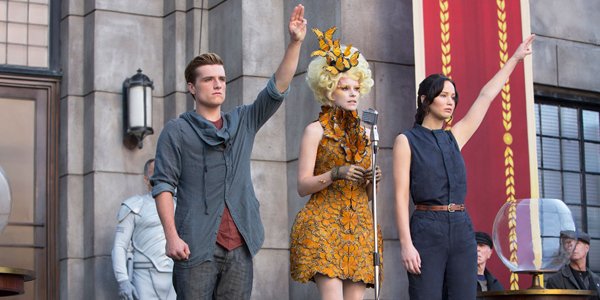
I recall, when Harry Potter came out, being late to get on that train as well. I had a conversation recently with a tenured anthropologist who shall remain nameless, wherein she basically encapsulated my feeling about Harry Potter, pre-reading: "I've been reading adult fantasy my entire life, why am I wasting my time on this kids stuff?" Of course, as anyone who has actually read the novels knows, the rewards are startling, immediate, and not at all vindicating for a former hater. So for Susan Collins (btw, while I do not understand the her reference, I know exactly where Susan Collins was standing in Central Park when that photo was taken--GOD I MISS NYC).

 |
| Katniss, bringing the bow and arrow back for the new millennium |
 The other elements that make teen drama: are an over emphasis on sexual tension, sexuality, hormones, and teen drama. Well, this book ain't that either. Katniss is a largely asexual creation. And none of the anecdotes of the story feature any overt sexuality. There is frankly a lot of kissing. But it is all in the context of duress, where the heroin feels that she must provide a show to save both her life and that of her compatriot. Therefore the uncomfortable romance of the novel is one driven by political expedience. I think this novel could even be called feminist lit as, the subject of Katniss' body becomes everyone's business, and the ideas of disinterest, individualism, power, and objectification are all explored in some very subtle ways, and other more direct approaches. I will read this book to my daughter one day, not all that long from now, either.
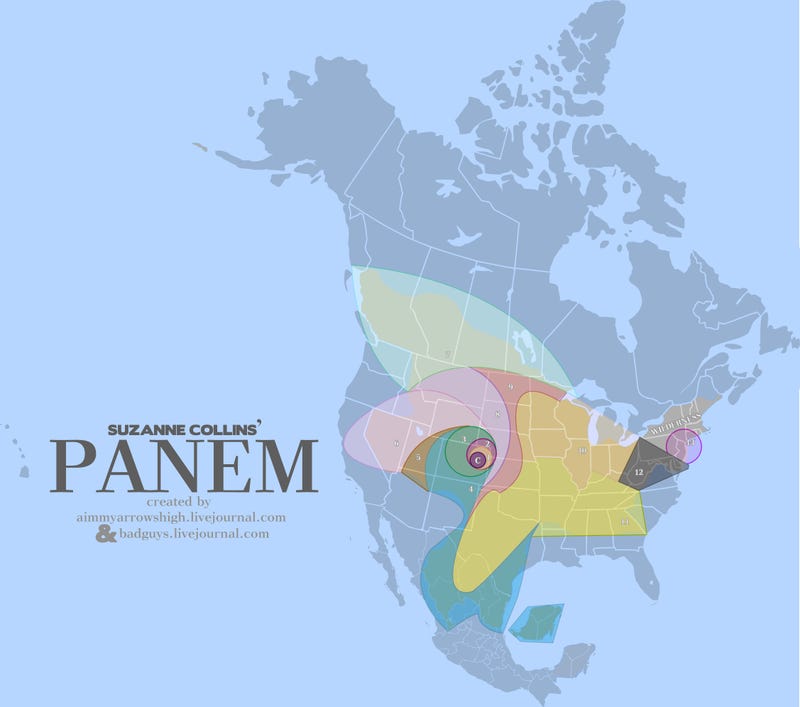 |
| A strange, but supposedly accurate map of Panem |
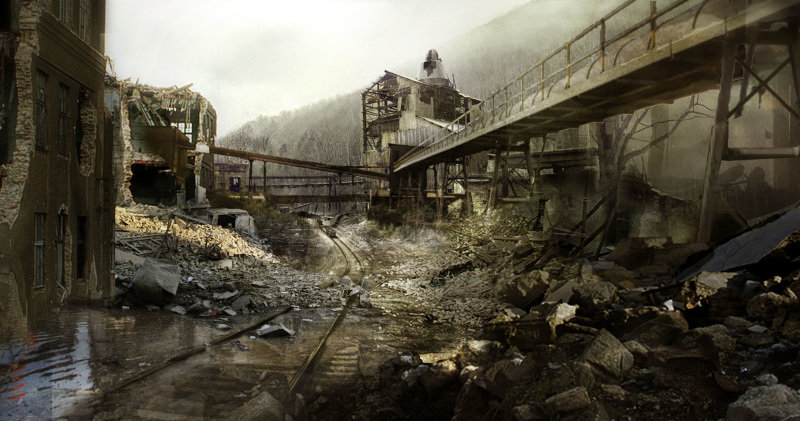
Even though everyone in the world has either read the books, I think I should provide some basic info. In this future, the world has largely destroyed itself (likely through Nuclear war/winter. A surviving remnant of humanity (though there may be others) has organized itself into 13 outlying districts and a major metropolitan area in the Rockies which feeds on the mercantile production of the outlying districts. Each district provides a different commodity, though that in itself is a very strange, unlikely economic reality. It does make things easy for young readers I suppose. While it is certainly true that there are regions of the world which provide principally one export (oil based economies for example) in any sophisticated economy, such single export based economies are unlikely. And if it were true, a coal based economy like District 12, would likely be a good deal richer, providing as it does a major energy export. (Adherents to the series might say that nuclear power, in District 13 might have done for the District 12 what nuclear power did to coal rich regions like Wyoming and West Virginia. My counter would be: what District 13, it was destroyed, even with nuclear facilities in District 2, the price of coal would have skyrocketed.) Regardless of how unlikely such a scenario would be, the districting provides a useful structure for the books, a lot like "races" in a fantasy book. At one point in this post democratic society, a 13th district rose up, complaining about the excesses of the megalopolis, and the unfair treatment of those in the districts. And of course, brutal war followed that, destroying the 13th district altogether.
Following the war, for whatever reason, the Capitol decided that a ritualistic killing of young people was the best way to keep the districts in line. While this invention can be debated, it really forms the crux of the book, so there's little point. What matters is that the contestants for these games are randomly selected, but they can volunteer if they want. They have no recourse for selection, and they know that all but one will be killed in the game's arena. Our heroine, an aggressive, ornery, teenager named Katniss Everdeen is not picked. Instead her sister is, and she rushes forward to take her sister's place. The early pages of this novel feel a lot like Shirley Jackson's famous short story, The Lottery, where winning means death.
The rest of the book is one brutal killing after another, mixed with harsh social commentary on life in the Capitol, describing the profligate, media-driven, obsequious and superficial 1% of Panem. These critiques are stinging, though as always with such platitudes, it is easy to point "to the other guy" as the one who lives in excess. Still, I had to admire the grittiness of the tale. These were hard-bitten cynical people who had endured real suffering: starvation, beatings, cold winters, mal-nutrition. These are real things and they are not frequently in adult fantasy, let alone young adult fantasy. To add to this, Katniss is not a particularly eloquent character. She is terse, and represents SELF-ALIENATION to a fault. She is really a very difficult character to like, which for fiction of this kind adds a great deal of charm. Her relationship with her sole surviving parent is sketched out in rather broad strokes, but her mother's depression following the death of her husband, caused Katniss to withdraw in a wonderfully original way. A parent's failure to parent, whether it be for mental illness, or even death, is nigh-unforgivable to a child.
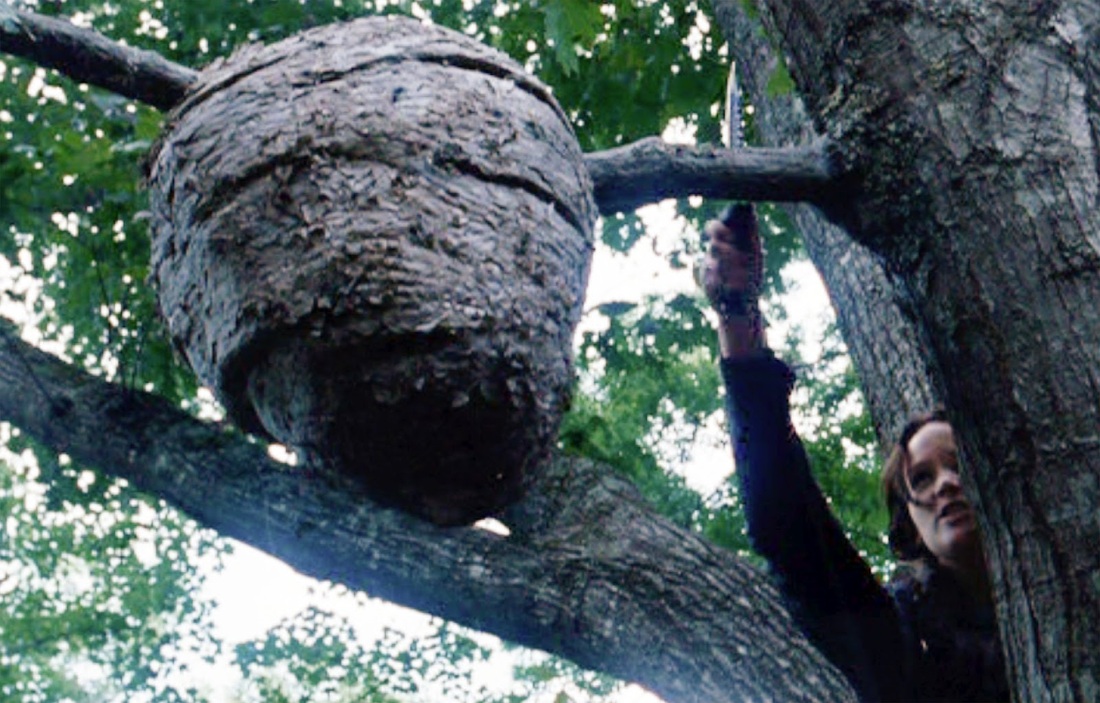 |
| The tracker jacker nest that kills one of the participants |
Perhaps one of the markers of real fiction, of fiction that actually makes the grade is the ability to show a character change. And Katniss does, and it is not the one that the reader wants--one more reason Hunger Games is a really phenomenal and unpredictable story. She does not get kinder, she does not fall in love, she does not turn into the Capitol's creature. Her personal growth is, to my opinion, a fairly subtle shade. She's very introverted, very in her-own-world, and as she becomes the media star of the Hunger Games, and then the wider symbol of a subversive movement she becomes if not a thrilled participant, certainly a willing one. Also, like many selfish people masquerading as selfless people, she begins to understand that people other than her sister depend on her.
One thing about Katniss which I find off-putting as a dyed in the wool liberal is her willingness to kill, and the ease with which she does so. That said, the other main character, her male counterpart in the games, Peeta has enough conscience for both of them.
SPOILER ALERT: I think the lack of love triangle with Peeta, Gale, and Katniss is an unusual one for a teen drama, and it drives the whole series forward. (A whole genre of fanfiction exists to explore this relationship) Katniss, who loved and revered her father, became emotionally crippled when he died in a mining accident. And with her mother's depression she was forced to assume too much responsibility for a child to have to endure. Perhaps as a consequence to this traumatic event her emotional growth really stopped at this time. There are two boys however, Gale and Peeta who have developed an abiding love for Katniss, and have multiple instances to prove said love. In all cases, Katniss rejects/or is completely ambivalent to this love. It's not that she can't choose, it's that she can't choose to not have either. This seems highly unusual for all fiction, let alone teen fiction. It also seems to be a pretty strong feminist interpretation of womanhood. The other important relationship, touched upon briefly, is the relationship Katniss has with her mother. It's a relationship described mostly by its absence. Our heroine does not crouch in the hard rain of the arena, desperately crying for her mommy, as any reasonable person would. But the anger and resentment against her mother is tangible in its absence. In some respects, I felt like this gaping hole was a problem, unbelievable. At other times, I felt that the absence spoke more eloquently than the pages of backstory would have.

The Hunger Games was such a good novel I read all three books in three weeks. Basically pushing off all other assignments. I think, ultimately, that is the highest review a bonafide reader can give.
Saturday, October 8, 2016
Horselords by David Cook, Forgotten Realms 1990

 This was a surprisingly good book for genre fiction of the time period. However two publication years into the forgotten realms books and still at the far outskirts of the world, places that haven't even heard of the great city of Baldur's Gate. Still with this, and the last Realms book I reviewed I'm seeing a pattern. The first two years of the Realms gave a snapshot of the interior of the realm. Now we are fleshing out the outskirts.
This book reminds me a tad of Raymond Feist and Janny Wurts Empire series. It however is most definitely a vintage example of Orientalism. As I discussed here, I am on the fence about such uses of fantasy. On the one hand, done well it provides a welcome relief to standard European fare fantasy, on the other it imposes it's own set of tropes, stereotypes and racist or otherwise bigoted commentary. On the whole, I think Cook skirts the worst things about Orientalism and concentrates on character development and story.
One last general note: as Iron Helm had been about the founding of the Americas, Horselords is about Genghis Khan and the The Great Wall of China. That is a history that I know nothing about. But it isn't hidden or hinted at, it is written very clearly as a parallel. Remember that Ed Greenwood's initial conception of The Realms was as a nexus or hidden world, a reflection of all worlds and a fairy realm to our own. Meaning that the epic history told in the Empires Trilogy is meant to mirror our own world. Viewed in that light it is kind of neat, and readjusts our expectations for cliches.
This was a surprisingly good book for genre fiction of the time period. However two publication years into the forgotten realms books and still at the far outskirts of the world, places that haven't even heard of the great city of Baldur's Gate. Still with this, and the last Realms book I reviewed I'm seeing a pattern. The first two years of the Realms gave a snapshot of the interior of the realm. Now we are fleshing out the outskirts.
This book reminds me a tad of Raymond Feist and Janny Wurts Empire series. It however is most definitely a vintage example of Orientalism. As I discussed here, I am on the fence about such uses of fantasy. On the one hand, done well it provides a welcome relief to standard European fare fantasy, on the other it imposes it's own set of tropes, stereotypes and racist or otherwise bigoted commentary. On the whole, I think Cook skirts the worst things about Orientalism and concentrates on character development and story.
One last general note: as Iron Helm had been about the founding of the Americas, Horselords is about Genghis Khan and the The Great Wall of China. That is a history that I know nothing about. But it isn't hidden or hinted at, it is written very clearly as a parallel. Remember that Ed Greenwood's initial conception of The Realms was as a nexus or hidden world, a reflection of all worlds and a fairy realm to our own. Meaning that the epic history told in the Empires Trilogy is meant to mirror our own world. Viewed in that light it is kind of neat, and readjusts our expectations for cliches. |
| Belive it or not, there is no fan art for Horselords |
The next character is Yamun, the great Khan. His character is fairly clichéd, forbidding barbarian King. If anything he's a little more cuddly then many such characters. One thing about Yamun's character, his desire to conquer the Dragonwall is inviolate. He is unable to even consider compromise, and never questions his own judgement. I feel this was a very deliberate choice by Cook, and I don't know, in the end if it reads as one-dimensional or as complex. After all not all characters have to be mealy mouthed and full of internal conflict to be interesting. Often in real life the most interesting people are the most blind. In many respects this novel surpasses the genre of stock swords and sorcery fiction. Much of the story is the interaction between Koja and Yamun, and it takes on the sort of oscar seeking biopic you might expect from Anna and the King. Koja is cut off from all he knows, but did not have too many ties to that world as it was, having lived as a monk. That said, there are many unanswered questions, why was he chosen as a negotiator, and what of his life before he is made captive by the Khan. We are never told, and while the book has many positive elements to it, the lack of background it evinces for its characters is a major failing.

Cliche: Orientalism is probably the worst, the book is replete with customs and inferences drawn from ancient China. As a white person, I don't feel overwhelmed by said stereotypes, but I'm sure I might feel differently had I even a jot of Ghengis Khan's DNA. That said, apparently, like 10% of the world's population has Genghis Khan's DNA so maybe I do have some claim there. Fun fact, the term Khan, used in many fantasies is a Mongolian word for King. Although the web link is silent on which came first Genghis, or the Khan. Another cliche, The Good Advisor cliche, is highly evident for obvious reasons. Koja's conflict over how to advise the Khan, particularly in light of the serious conflict of interest is only lightly delved into it. It's the sort of thing that all of the Forgotten Realms novels tends to fail at: none of the characters have history. We do learn of Yamun's ascent to power, and his relationship with his mother-in-law and first wife, Bayalun, but of the advisor we learn little beyond his cloistered life as a yogi of this temple. I hate to cite the Stockholm Syndrome cliche, over played and tired as it is, but any discussion of Horselords has to at least mention the fact that Koja's relationship to Yamun should be a hostile one. One cliche certainly not in evidence are the typical Dungeons and Dragons cliches. There is not a single dwarf or elf in the place.

Completeness: The world of Horselords is the outskirts of the traditional Forgotten Realms. Even in Iron Helm, there was mention of the standard Realms, characters and outside influence from the realms we've come to know and love. Not so Horselords, not even the gods are similiar, and the Shou Empire and the Tuigan hordes of Yamun seem to not take place in the same space at all. Inspite of this, the novel is written well enough that this subrealm seems entirely plausible. The Tuigan as a people are entirely tribal and believable as wandering marauders with little interest in outside realms, save war. The Khazari, a tributary nation conquered by the Shou Empire provides some depth to the political landscape.
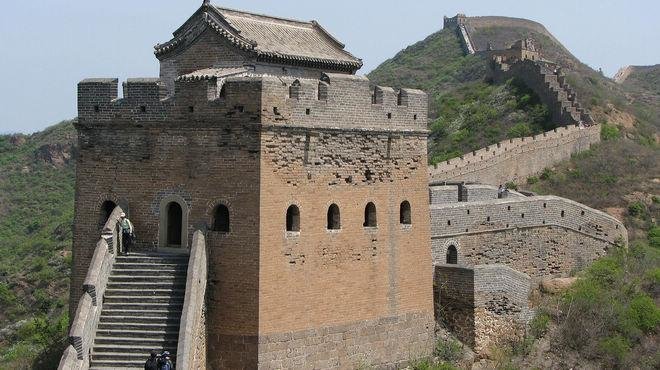 |
| The Great Wall of China, of which this book is about. |
One thing that disappoints about David Cook's Horselords is the ending. A sort of standard double cross is planned, and SPOILER ALERT is never hatched, but is discovered well before the trap is sprung. While the double-cross was standard stuff, it was the dramatic conclusion to the novel, and without it, the ending was sort of uninspiring. I wonder what happened there. It was all set up... The novel is the first of a trilogy, so perhaps it was hacked to death and given this rather contrived ending to pick up the drama in later novels. Regardless, the next in the series, Dragonwall is next on my FR list.
Saturday, September 24, 2016
The Chronicles of Shannara on MTV, Season 1
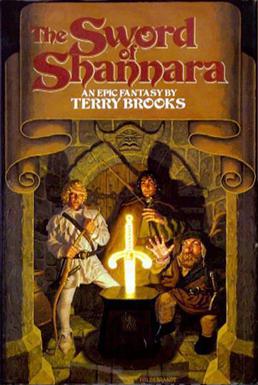
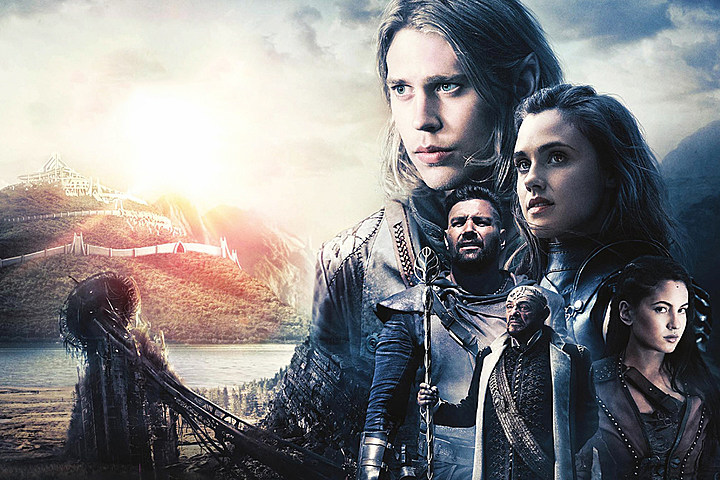
When I heard that the Chronicles of Shannara was being produced, I contained my excitement. It's a new dawn for fantasy, or at least, it is compared to what I grew up with. Given the success of Game of Thrones, it was no wonder really that classic fantasy was sought after to produce. In fact, a television friend of mine even asked me for some recommendations. That was back before I left the center of the universe, NYC.
When I saw that it was MTV that decided to produce it, unlike some fans, I wasn't perturbed. I liked "The 100." Now that I'm officially old, seeing teen melodrama doesn't irritate me, it amuses me, and I admit a certain enjoyment of the eroticism in shows filmed to titillate the chattering class. I'd been meaning to review the Sword of Shannara for eons, and I am now doing a reread. However, the Chronicles begin at the second book. There is an interesting history to that second book, given briefly by Wikipedia.

 |
| The Space Needle in Seattle |
 |
| Poppy Drayton. Just gorgeous. |
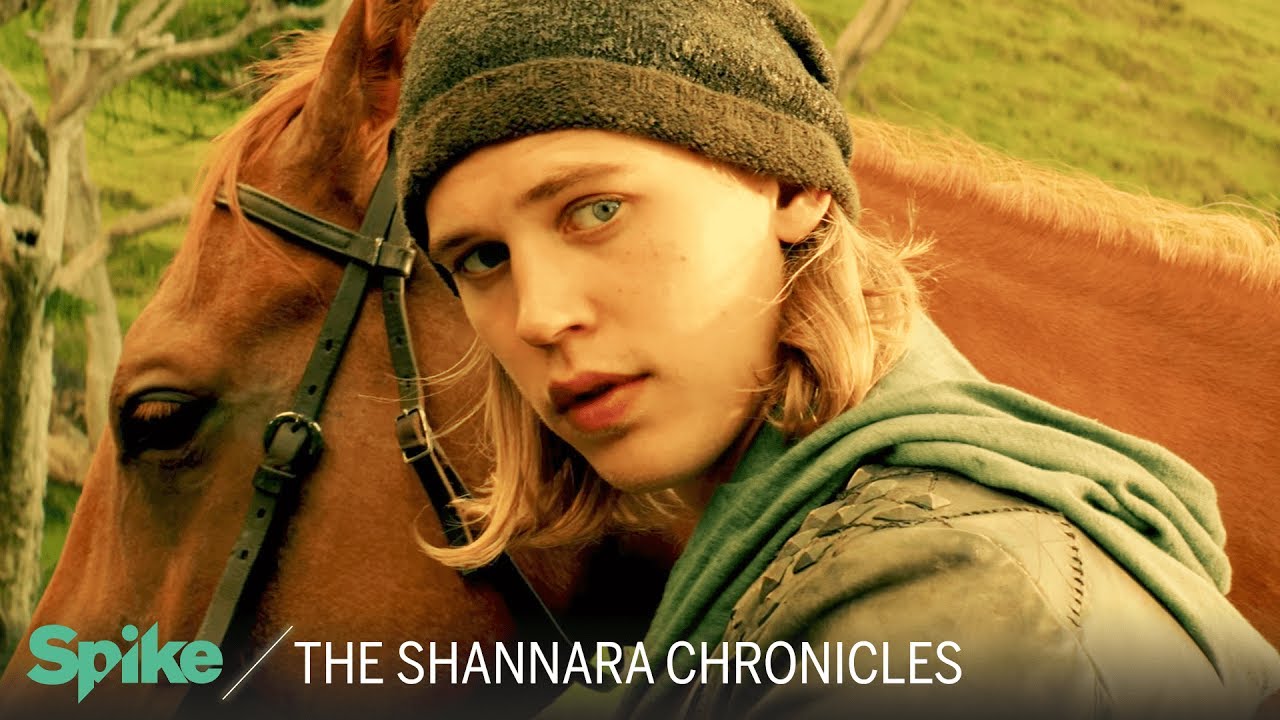 |
| Austin Butler, I'll "spare" you the images without shirt |
 |
| Ivana Baquero, naked, in a bath, with Poppy Drayton |
 |
| Manu Bennett as Alannon |
I think perhaps that one of the Chronicles Season One's failings is that while it discusses the history and frequently alludes to events that have occurred, it skips the prosaic matters that make fantasy worlds real. Traders on the road, the petty local politics of tyrants, the class struggles hidden, yet glorified by false visions of feudalism. The world of the Chronicles is shown to be a dystopian vision of isolated communities and roving bands of killers. While the Sword of Shannara actually makes a point of literally telling you that this decentralized version of the land is political choice (something in my reread I find unpleasant) it is ultimately lying about this because there are local politics and trade: decentralized political systems are a red herring. Gough's vision of the land of Shannara could take place on the same set as The Walking Dead. But it's just not true. The Apocalypse happened two to four thousand years prior, and world wars, which the land has experience many, are not apocalypses--just terrible.
Friday, August 19, 2016
The Deed of Paksenarrion by Elizabeth Moon
The quotes on the back of the book don't help. "This is the first work of high heroic fantasy that has taken the work of Tolkien, assimilated it totally, and deeply, and absolutely ..." Judith Tarr. (Whose life has taken a depressing turn for the worst, it seems.)
Still, I think Elizabeth Moon's reputation is based on a delightful though traditional approach to fantasy, and her works are certainly part of the firmament of the fantasy galaxy. And if you've never read any Moon, you need to get yourself to your Indie bookstore and buy The Deed of Paksenarrion. What makes fantasy, what really takes it from mere swords and sorcery, from plot-based fiction like Stephen Grisham, and much worse, the $2-3 ebook with 500 five-star amazon ratings, and turns it into something with impact, is it's ability to opine almost unerringly on what it is good, and right. And this is something that Paksenarrion does exceedingly well.

Character: The title character, Paksenarrion starts the novel as a teenage girl running away from home, and an arranged marriage, to join a mercenary company. There are a few things that jar about this from the get go, but I think it important to note that an important act of fantasy is the concept of creating an equal world. Not a world where everyone is equal, but one where equality is fundamentally valued by the author. All manner of awful things may happen in such a world, but when it is apparent that the author believes this, the worldview is upheld by a kind, just, and generous spirit. Such individuals create characters like them. And it is these characters who teach us, who show us (by their acts of unspeakable giving, love and faith) that humans are fundamentally capable of good--that despite our flaws, we are redeemable: that hope exist.
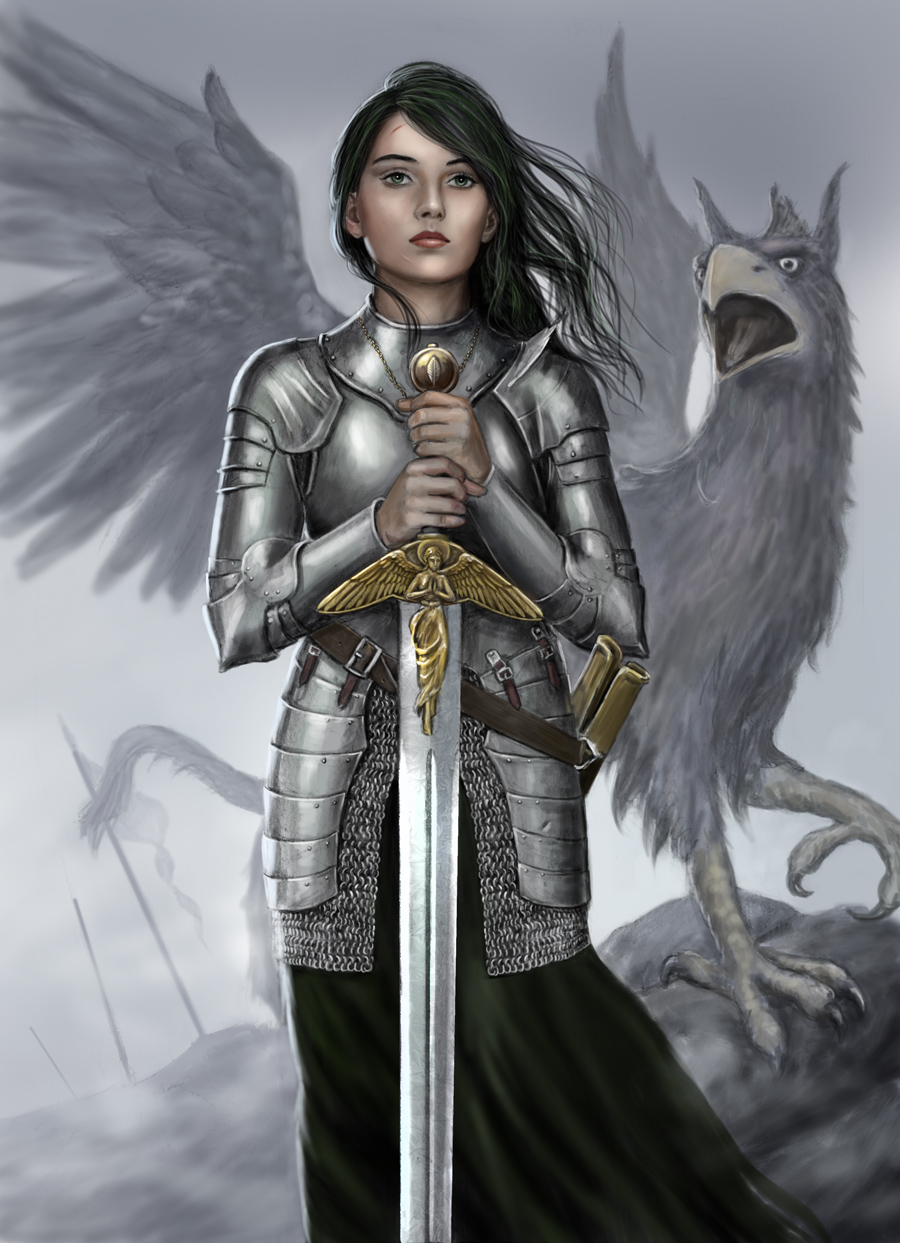 |
| No author caption here: fell down the rabbit hole |
 |
| Artist Unknown. Seriously, he probably died in a mass grave. |
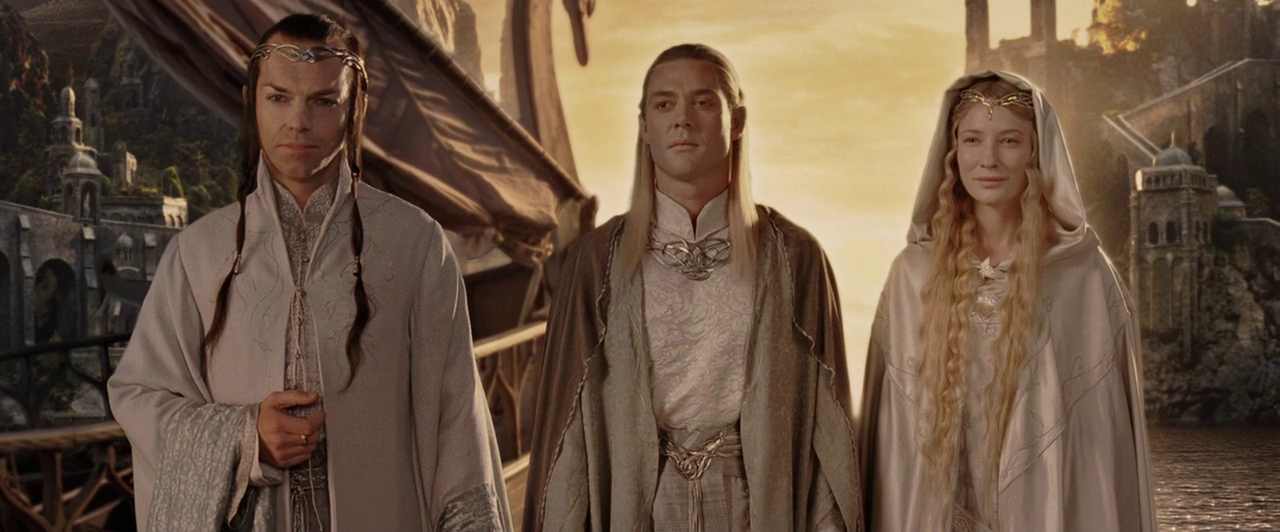
Cliche:This is 80s fantasy, so cliches abound. We will touch briefly upon the obvious ones, elves, dwarves, orcs, magic. The first book of the trilogy mentions the other races in passing, as well as gnomes, and a few other beasties. However, unusual to fantasy, the first book is almost entirely devoid of extra races. That said, elves and to a lesser extent dwarves, play a crucial role in the overall arch of the story. As usual, elves fulfill the usual Tolkien stereotypes. Immortal, tall, otherworldly, slim, beautiful, musical, etc. One neat thing about the elven component of The Deed is that it references something that other earlier fantasy works maintain, namely that the faerie dwell in a sort of shadow kingdom, a world within a world, different and similar to ours. Though Tolkien's elves left the plane of Middle Earth, during their time in it, they were squarely involved "in the shit" as it were. Moon changes the Dwarven cliche nicely. Instead of the beer swilling, anvil hefting, gold digging, creatures we have come to know and love, the Dwarves are very fond of ceremony, and have a peculiar dialect. Unfortunately, we don't learn much more than that. Orcs only really emerge as combatants, quickly slain, and with no real reason for being in the story, merely as a side effect of Evil Influence.
However, Moon, may have been one of the first to embrace the Dark Elf cliche, perhaps not even a cliche at the time. Tolkien's world explored the idea of the corrupted elf, Sauron, the ostensible reason for his long lasting evil. However, Sauron was an exception, there was no race of like minded long-lived evil ones. (I never did read the Simillarion though, so I can't speak to the whole of his work). Regardless, Moon's Dark Elves are unusual compared to the ones that the Dungeons and Dragons cliche embraced. They have the fine elven features, pointy ears, are long lived, etc. that all elves have. But they stink, and they intentionally corrupt all that is beautiful. I thought this was a really great detail, Dark Elves are the anti-elf in EVERY way in this series. The Dark Elves end up being a critical plot point for the series, though they make no appearance in the first book at all.
 |
| By Gerald Brom |
There are dwarves as well, though they play only a minor role. They fulfill some stereotypes, while trumping others. Moon's dwarves are different they have a formal speech, though they are boisterous by nature. A gnome stereotype exists which is quite interesting, though not much explored. The gnomes of Moon's writing aren't the slightly silly, less strong version of dwarves that you often see in the Dungeons & Dragon Realms. Their gnomes are fierce like Terry Brook's gnomes, but are strict adherents to order. Like many creatures faerie (another cliche) they do not believe in gift giving, only in fair exchange. It's an interesting dynamic, and explored more in later books.
Some of the cliche pages, like TV Tropes, point out that the Lawful Good cliche is in full effect here. I honestly don't think that's enough of a cliche to pursue. I do think Lawful Good characters are however, very interesting. It takes a lot of willful blindness to the world to always follow the law and still be good. Even a poor execution of a Lawful Good character can show this dialectic.

Adventure Time Cliche: So in writing this post, I lost an earlier draft, wherein I noted how very much like classic swords and sorcery, dungeons and dragons gaming parts of this book were. I have no problem with that overall, I've been trying to do the same for some time. Real drama is created in such games (the good ones) and a story-teller's polish of such events can create real lasting value. It worked for R.A. Salvator and Margaret Weiss afterall. I noted that one of the scenarios was Paks meeting of a certain half-elf of ill-repute on the road. The two join-up, explore a dungeon, and slay a wizard. But I'd forgotten that they do almost the same thing later on, in Brewers Bridge, the TVTropes site pointed out that it is almost the complete scenario for AD Module 1. For a more thorough listing of Paks cliches, check out this TV Tropes site.
Completeness: The Deed looks and feels like a complete world. Throughout the novels, we explore a good portion of the world, and the interconnectedness of nations is well-demonstrated. The wars of the south, for example, are in large part trade wars, defending various routes to various ports, and various choke points like the castle Dwarfwatch. These are the sorts of things that real wars are fought over, and I appreciate that detail. Moon has some military experience, and the battles are drawn in painstaking detail. Some readers are turned off by this, it seems, but strong detail is never a problem for me.

The religious aspect is well-developed without choking, and was not offensive for an old-time atheist like myself. I've played a few paladins myself, and like I said, I find the character type pretty interesting. The Gods are real, and come across that way--unlike the idiocy and petty squabling of the Forgotten Realms gods, and still ineffable and mysterious, unlike the gods of the Malazan epic.
There are a few untied threads. Now, life is a series of untied threads held together by place, time, and financial obligation. However, those things are tenuous at best in fiction, and untied threads can always be blamed on the author. That said, many of these threads seem to be tied to these one off AD and D adventure modules that occur throughout the books. Mini-stories, that are engrossing, but ultimately have little to do with the arc as a whole.
The arc is a long one, and many readers get turned off by the slow start. When Paks soul searching takes it's darker turn, and where it receives it's finest answer is where the book really starts to shine. It's also where Moon takes the gloves off and shows us some of what evil is truly capable of. In the end, I quite enjoyed The Deed. I did find some of its characters to be in part unrealistic, but wasn't ultimately turned off by it. The Deed of Paksenarrion is worth a read, and doesn't quite deserve some of the heated criticism its received.
Subscribe to:
Posts (Atom)