Search This Blog

Showing posts with label Ascendence. Show all posts

Friday, August 19, 2016

The Deed of Paksenarrion by Elizabeth Moon

I'm ashamed to admit that I had not heard of Elizabeth Moon until just last year. In an effort to get actual blog readers and to meet more like minded people, I kept hearing her name in relation to foundational fantasy literature: genre defining stuff. A new friend had some of her books, and I took her up on her generous "deed."  Having done some further research it is much clearer to me now, that Moon did much of her writing in the mid-to-late 80s and was merely part of the explosion of new fantasy at that time. 

The quotes on the back of the book don't help.  "This is the first work of high heroic fantasy that has taken the work of Tolkien, assimilated it totally, and deeply, and absolutely ..." Judith Tarr. (Whose life has taken a depressing turn for the worst, it seems.)

Still, I think Elizabeth Moon's reputation is based on a delightful though traditional approach to fantasy, and her works are certainly part of the firmament of the fantasy galaxy.  And if you've never read any Moon, you need to get yourself to your Indie bookstore and buy The Deed of Paksenarrion.  What makes fantasy, what really takes it from mere swords and sorcery, from plot-based fiction like Stephen Grisham, and much worse, the $2-3 ebook with 500 five-star amazon ratings, and turns it into something with impact, is it's ability to opine almost unerringly on what it is good, and right.  And this is something that Paksenarrion does exceedingly well.

Typically sold now as one volume, the book was released in three parts, the first of which is really the Deed.  After which the second and third book titles are almost meaningless, though they are where the true meat of the trilogy rests.  The book has sort of a slow start, and the first entire section if it, is devoted to a rather un-fantasy like treatise on the training of a mercenary company.  But fear not, if you can get past the first book, Paksenarrion truly blossoms.

Character:  The title character, Paksenarrion starts the novel as a teenage girl running away from home, and an arranged marriage, to join a mercenary company.  There are a few things that jar about this from the get go, but I think it important to note that an important act of fantasy is the concept of creating an equal world.  Not a world where everyone is equal, but one where equality is fundamentally valued by the author.  All manner of awful things may happen in such a world, but when it is apparent that the author believes this, the worldview is upheld by a kind, just, and generous spirit.  Such individuals create characters like them.  And it is these characters who teach us, who show us (by their acts of unspeakable giving, love and faith) that humans are fundamentally capable of good--that despite our flaws, we are redeemable:  that hope exist.

Paksenarrion is such a character.  She's not the sharpest tool in the shed.  She's uncurious, easily led, blind to her own talents, and blind to the shortcomings of others, and these qualities make her a frustrating heroine, though a real one.  Paksenarrion joins a mercenary company, and yet is surprised when the causes she is committed to are not always just.  This seems inherent to we, so wise in the world.  But she's a farm girl, fed on stories of soldiers, and living in a land far from the borders of any cohesive state.  Her actions are charmed, touched by the divine, and one thing she learns, quickly enough is that while she loves to fight, and indeed possesses no qualms about killing, will not fight for causes that are not just.  She loves her companions, and indeed never feels anything approximating lust or desire.  She is asexual, though never termed so.  I have mixed feelings about this, though I think it functions well for a paladin character--though the choice to abstain is in most churchy literature, it is not a consequence of disinterest, the choice to abstain is given as a sacrifice in god's name.  In Islam, it is the greater jihad, the fight to deny one's baser instincts.  Though more dark fantasy has embraced women as fully in-the-world, capable of desire as much as men (and not just mere foils to men's desires', trophies and patsies to the hero) Moon's beautiful rose is truly white. To wit, a modern asexual woman, is itself a massive break with stereotype.  
No author caption here: fell down the rabbit hole
However, the Deed of Paksenarrion is about paladins, and their becoming. In my Forgotten Realms readings, I have uncovered a few characters of priests, such as Adon from the Avatar trilogy.  Even the the Knights of Solamnia from the DragonLance series.  Or also from the Malazan epic, Shield Anvil's, the most devout servants of the gods of war.  Priests are a difficult caste in fantasy literature.  Indeed, books like Harry Potter, and others before it were shunned and castigated by religious organizations like the Catholic Church.  It's interesting to note that fantasy tackles religious matters, and religious organizations all the time, and yet issues of faith, issues that come close to proselytizing are almost always handled at arms-length.

But in a story about paladins, such discussions become central to the plot.  Let us not forget that original of all paladins, was also a female, Joan of Arc.  I found myself becoming uncomfortable at times by the direction Deed was taking. Ultimately, however, I feel that The Deed holds to what is True in fantasy while avoiding the snarls of dogma. And for most of the series, Paks is at best agnostic in her faith.

Artist Unknown.  Seriously, he probably died in a mass grave.


There are some difficulties.  For example, killing even if it is only killing for right is glorified, and there is never a moment of horror, a moment of self-recrimination for the slaughter of enemy combatants.  This is one of the reasons that I began to feel that Paks was not the brightest protagonist.  By the end of the third book, something happens to Paks, and she is broken, a cliche we will discuss later, but her personal struggle is caused by something external to her, something evil that takes root in her, and is then rooted out.  She emerges from the process in rough shape, but her main crisis is that she will be unable to wield a sword again, unable to fight, unable to kill.  Now of course, there are certain aspects of feminism at play.  For example, when Paks finds herself in a barn at night when two churls approach her.  Her inability to fight would have left her in poor straits had not the gods intervened on her behalf.  Now ultimately, the conversion, the self-examination that we want Paks to have, does happen.  But there again, it happens because a druid explains a few things to her.  It's difficult to parse, Elizabeth Moon may be one of those few, rare writers who does not write herself as the main character (not even Steven Erikson can say this).  Moon is a brilliant writer, and obviously a very smart person, but Paks is not.  Writing a dumb character, is I can say with all honesty, absolutely impossible for me.  It's not that I'm so smart, it's that as an intellectual I am constantly assailed by self-doubt and recrimination, things which make a character by nature introspective and thoughtful.  So let us at least say this:  Moon proves her writing chops not in the detail of her world, in the pique of her characters (that's all there) but in that she is able to do what so few writers even attempt to do, to write characters that do not exist within the range of her own "voice."

Cliche:This is 80s fantasy, so cliches abound.  We will touch briefly upon the obvious ones, elves, dwarves, orcs, magic. The first book of the trilogy mentions the other races in passing, as well as gnomes, and a few other beasties. However, unusual to fantasy, the first book is almost entirely devoid of extra races. That said, elves and to a lesser extent dwarves, play a crucial role in the overall arch of the story.  As usual, elves fulfill the usual Tolkien stereotypes.  Immortal, tall, otherworldly, slim, beautiful, musical, etc.  One neat thing about the elven component of The Deed is that it references something that other earlier fantasy works maintain, namely that the faerie dwell in a sort of shadow kingdom, a world within a world, different and similar to ours. Though Tolkien's elves left the plane of Middle Earth, during their time in it, they were squarely involved "in the shit" as it were.  Moon changes the Dwarven cliche nicely.  Instead of the beer swilling, anvil hefting, gold digging, creatures we have come to know and love, the Dwarves are very fond of ceremony, and have a peculiar dialect.  Unfortunately, we don't learn much more than that.  Orcs only really emerge as combatants, quickly slain, and with no real reason for being in the story, merely as a side effect of Evil Influence.

However, Moon, may have been one of the first to embrace the Dark Elf cliche, perhaps not even a cliche at the time. Tolkien's world explored the idea of the corrupted elf, Sauron, the ostensible reason for his long lasting evil.  However, Sauron was an exception, there was no race of like minded long-lived evil ones.  (I never did read the Simillarion though, so I can't speak to the whole of his work). Regardless, Moon's Dark Elves are unusual compared to the ones that the Dungeons and Dragons cliche embraced.  They have the fine elven features, pointy ears, are long lived, etc. that all elves have.  But they stink, and they intentionally corrupt all that is beautiful.  I thought this was a really great detail, Dark Elves are the anti-elf in EVERY way in this series.  The Dark Elves end up being a critical plot point for the series, though they make no appearance in the first book at all.
By Gerald Brom

There are dwarves as well, though they play only a minor role.  They fulfill some stereotypes, while trumping others.  Moon's dwarves are different they have a formal speech, though they are boisterous by nature.  A gnome stereotype exists which is quite interesting, though not much explored.  The gnomes of Moon's writing aren't the slightly silly, less strong version of dwarves that you often see in the Dungeons & Dragon Realms.  Their gnomes are fierce like Terry Brook's gnomes, but are strict adherents to order.  Like many creatures faerie (another cliche) they do not believe in gift giving, only in fair exchange.  It's an interesting dynamic, and explored more in later books.

Some of the cliche pages, like TV Tropes, point out that the Lawful Good cliche is in full effect here.  I honestly don't think that's enough of a cliche to pursue.  I do think Lawful Good characters are however, very interesting.  It takes a lot of willful blindness to the world to always follow the law and still be good.  Even a poor execution of a Lawful Good character can show this dialectic.

Adventure Time Cliche:  So in writing this post, I lost an earlier draft, wherein I noted how very much like classic swords and sorcery, dungeons and dragons gaming parts of this book were.  I have no problem with that overall, I've been trying to do the same for some time.  Real drama is created in such games (the good ones) and a story-teller's polish of such events can create real lasting value.  It worked for R.A. Salvator and Margaret Weiss afterall.  I noted that one of the scenarios was Paks meeting of a certain half-elf of ill-repute on the road.  The two join-up, explore a dungeon, and slay a wizard.  But I'd forgotten that they do almost the same thing later on, in Brewers Bridge, the TVTropes site pointed out that it is almost the complete scenario for AD Module 1.  For a more thorough listing of Paks cliches, check out this TV Tropes site.

Completeness: The Deed looks and feels like a complete world.  Throughout the novels, we explore a good portion of the world, and the interconnectedness of nations is well-demonstrated.  The wars of the south, for example, are in large part trade wars, defending various routes to various ports, and various choke points like the castle Dwarfwatch.  These are the sorts of things that real wars are fought over, and I appreciate that detail.  Moon has some military experience, and the battles are drawn in painstaking detail.  Some readers are turned off by this, it seems, but strong detail is never a problem for me.
>

The religious aspect is well-developed without choking, and was not offensive for an old-time atheist like myself.  I've played a few paladins myself, and like I said, I find the character type pretty interesting.  The Gods are real, and come across that way--unlike the idiocy and petty squabling of the Forgotten Realms gods, and still ineffable and mysterious, unlike the gods of the Malazan epic.

There are a few untied threads.  Now, life is a series of untied threads held together by place, time, and financial obligation.  However, those things are tenuous at best in fiction, and untied threads can always be blamed on the author.  That said, many of these threads seem to be tied to these one off AD and D adventure modules that occur throughout the books. Mini-stories, that are engrossing, but ultimately have little to do with the arc as a whole.

The arc is a long one, and many readers get turned off by the slow start.  When Paks soul searching takes it's darker turn, and where it receives it's finest answer is where the book really starts to shine.  It's also where Moon takes the gloves off and shows us some of what evil is truly capable of.  In the end, I quite enjoyed The Deed.  I did find some of its characters to be in part unrealistic, but wasn't ultimately turned off by it.  The Deed of Paksenarrion is worth a read, and doesn't quite deserve some of the heated criticism its received.

Sunday, June 5, 2016

Great Moments in Fantasy -- Paksenarrion Becomes a Paladin

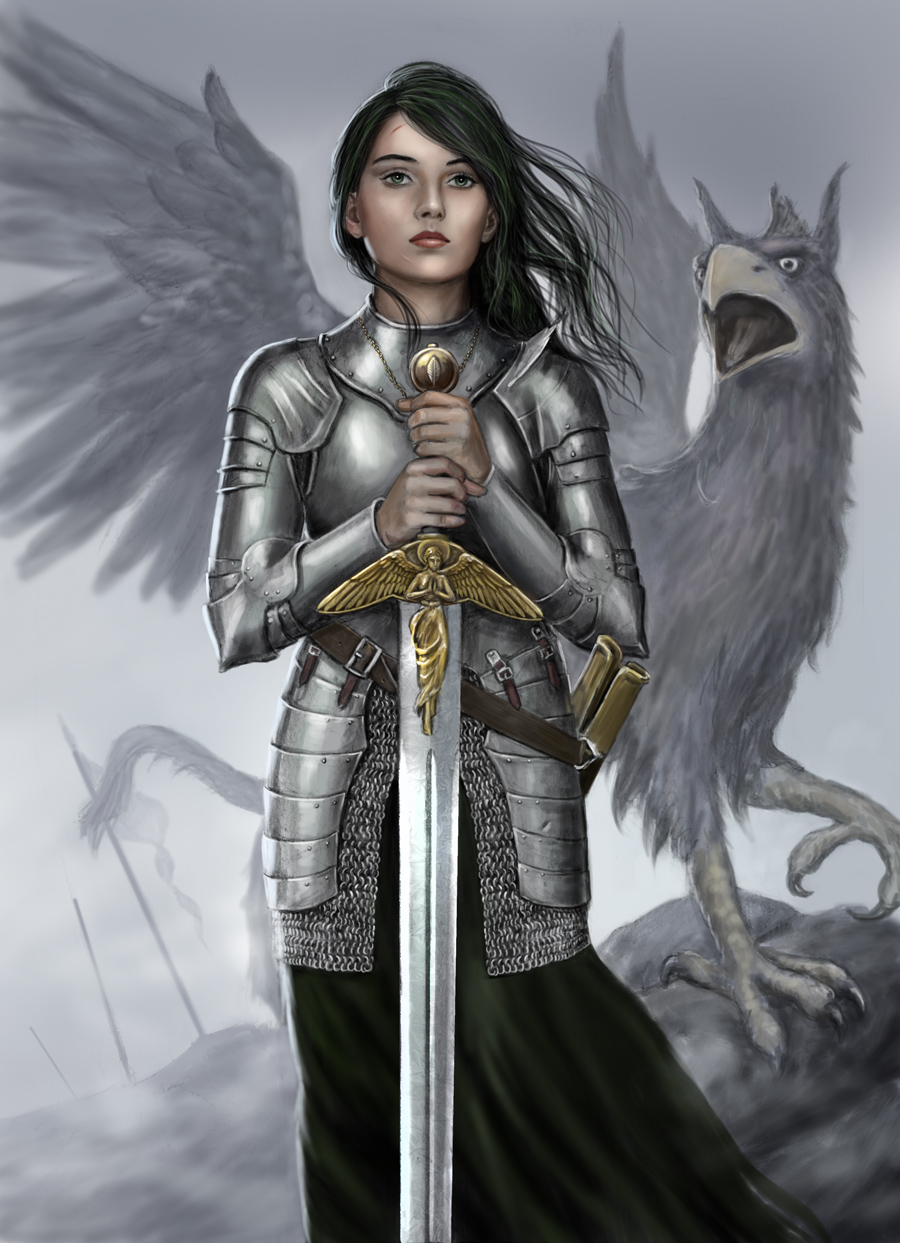
Paksenarrion by Mandy Tsung
A fair amount of background is necessary for this great moment.  Note that while this is a spoiler, it may also be worth reading, regardless.  These are moments that define fantasy, and have intrinsic value.  If reading these snippets make you go and get the book, then surprise be damned.

This is from Elizabeth Moon's, The Deed of Paksenarrion, published first in 1988, though split into three novels. The story details the heroics of one Paksenarrion, a former sheep farmer's daughter, and paladin.  I will be reviewing this novel forthwith, but here is a taste of some of what this novel has to offer.

At the first instance, Paks is at the nadir of her relatively short life.  After having survived a number of harrowing challenges, and becoming known throughout the realm for her bravery, skill as a swords woman, and downright goodness, she has lost her way.  A variety of poorly healed wounds, and psychological damage have crippled her.  Lost, homeless, and starving, she finds herself at the glade of a Kuakgannir, a servant of mother nature.  He heals her, but doubts remain, will her pyschic wounds forever ban her from fighting for the cause of good?


Friday, May 29, 2015

Waterdeep, by a different Richard Awlinson

So Waterdeep is the last novel in the Avatar Trilogy, though the story picks up again in two more later volumes.  Interesting side note: Richard Awlinson is a pen name for two separate men. Why? I don't know, the Forgotten Realms Wiki is silent on this issue. That said, Troy Denning, the author of this one did a fine job of finishing the series.

Waterdeep takes the remaining members of the Company of the Lynx, from the city of Tantras to the mega city of Waterdeep. It says something that I can't even find Tantras on the map.  The journey is long, and given the chaos of the Realms during the so called Time of Troubles, difficult. Of course, in fantasy, the Quest cliche is 90% of the story, so it's not surprising. The Time of Troubles, you recall, was initiated by the theft of the Tablets of Fate, and the expulsion of the gods from their astral plane to the mortal realm.  Midnight, Her lover, Kellemvor, and the cleric Adon, search for the second Tablet of Fate, which they hope to return to Ao, the over god of the Realms, and so end the Time of Troubles.

Character:  The characters remain startlingly satisfying in this third installment. I can tell you, I'm a third of the way through the Halfling's Gem, and I'm sick to death of Drizzt, Wulfgar, etc. but Midnight, Kellemvor, Adon, and Cyric are excellent characters.  Let me start with Cyric. In Tantras, we saw Cyric take a darker turn, becoming a minion, though a freelancer, to the dark god Bane. And while he was a cold mother fucker, you got the sense that Midnight's faith in him would be rewarded. SPOILER: it's not. Cyric becomes a truly awful human being in this novel. He slays a village full of halflings with women and children, he cuts the throat of another hanging from a rope. He slays an innkeeper, sole survivor of a zombie attack, mere minutes after the poor man gives him food and beverage from his ruined livelihood. Why? Because he simply does not care, and because people irk him.

Adon also continues to grow, becoming the group's leader. And while his faith in Sune is completely lost, by the story's end, his faith is yet restored. Though not in Sune, the goddess of beauty. Kellemvor, the group's former leader has made catastrophic decision after decision. Having had his curse removed in Tantras, he keeps leaping to the aid of defenseless citizens. While laudable, he's not the sharpest tool in the shed, and he's forgotten that at least three gods have been trying to track them down and kill them. After falling into half a dozen ambushes with his bull headed attempts, his confidence is finally assailed.
The exciting conclusion of Waterdeep

Cliche: Midnight is perhaps the biggest cliche of the entire series. She's just rather generic as a female character: she loves Kellemvor, but is furious with him for not trusting Cyric, and they spend half the novel fighting over it. She is strong, but uninteresting for the most part, and her history is left entirely unexplored.  What's worse is that she is, completely wrong in her faith, only enforcing an unpleasant gender stereotype. Another character cliche is in Adon's character. The Faithless Priest, is a half decent cliche and Adon's inner struggle, and his ultimate belief in humanism as a faith, is (Spoiler!) only made more interesting when Midnight ascends to god hood.  He becomes her High Priest, and but as Midnight is no longer merely mortal, is it still humanism? Which brings forth another cliche: Ascension.
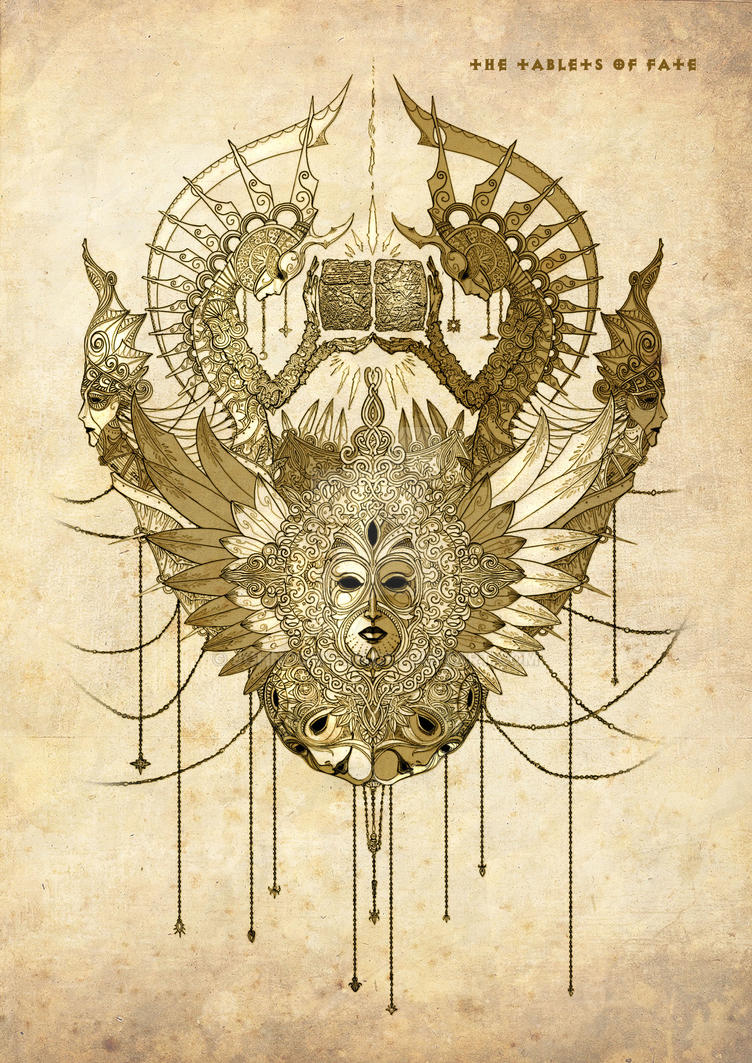
Tablets of Fate, Johndowson

I've talked about Ascension before in all of my Erikson, Malazan Book of the Fallen, reviews. (Spoilers!) At the end of Waterdeep, Mystra, Bane, Bhaal, and Mykrul, the gods of magic, strife, murder, and death, have all been killed. Quite a coup for the forces of light. Except Forgotten Realms doesn't really work that way, even Evil isn't really all that evil, and good is pretty tedious and ineffectual. The over god, Ao, appoints two mortals to become gods and take up the balance. This idea of men becoming Gods, is an old one, but for a former philosophy student, it is gobsmacking. That said, the idea of godhood here, as elsewhere, is really quite petty. Nonetheless, Ascension is a neat concept, and I always enjoy seeing it play out.

The last cliche I'll mention, is The Balance Cliche. Need I say more? Evil is always trying to usurp good, and good, when evil is struck down, becomes corrupt, greedy, and ultimately, because men are awful, evil. It's tiresome, but it does allow fantasy to keep going as a genre. One of the neat things about the Wheel of a time was that it dealt with this concept directly: Lews Therin Telamon, the Dragon, was reborn in a new vessel every thousand years or so, to fight the Dark One in a different battle. I'm sure non fantasists would find that tiresome. But what can I say, I find it thrilling. The chance, as Rand al'Thor discovers at the end, to try again.
“Why do we live again? Lews Therin asked, suddenly. His voice was crisp and distinct.
Yes, Rand said, pleading. Tell me. Why?
Maybe … Lews Therin said, shockingly lucid, not a hint of madness to him. He spoke softly, reverently. Why? Could it be … Maybe it’s so that we can have a second chance.
Completeness: so I'd been looking forward to Waterdeep for some time, because I thought it would tell me about the largest city in all of Faerun. And I was not disappointed. Ok, well, slightly disappointed. They don't get to Waterdeep until the very end, and so even though the detail is there, it was tantalizingly thin. What did we learn? Waterdeep is governed by a benign group of lords and protectors, most of whom remain secret. The city is reportedly democratic, but how you can have democracy with secret rulers is ... Ok ... Well, I guess realistic.  We learn some about the Watch, and how defense of the city is maintained. We also learn a bit about the Archmagus, Blackstaff, who, with Elminster's aid, attempts to help the heroes defeat Mykrul the god of the dead. We also learn street names! I love details like that, and they are so often overlooked.

So, I've found my first big inconsistency in the Realms. Douglas Niles made Bhaal out to be a powerhouse of a god. And so, you'd think, in the Avatar series, where Bhaal is brought to life, you'd at least find some of the same attributes.  But no. He may be the god of murder, but in point of fact, he really is the Patron of Assassins. Which is really quite different from the Moonwell corrupting, Druid slaying Bhaal of the Moonshae series. Keep in mind that none of these books or series follow a timeline. They're all out of whack,  but given that Bhaal kicks it after this installment, it seems unlikely to be resolved.  The Forgotten Realms wiki touches briefly on the matter, but it is not entirely believable.

Waterdeep is a pretty good Forgotten Realms novel.  We got to meet some important characters, names we will be seeing again, and we did get the origin story of at least two new gods.  But, it is still 80s-90s fantasy, and it just doesn't compare to what we've come to expect.  That said, it was a page turner, and worth a read if you've gotten to the end of Tantras and are wondering if you'd like to continue.

Monday, September 12, 2011

Deadhouse Gates - Steven Erikson

So I finished Deadhouse Gates a few days ago, only read for the second time.  And if Gardens of the Moon is an intermission, Deadhouse Gates is a dark and tragic epilogue.  Again, Erikson chooses a variety of settings and thematic story telling tools which are genre busting for fiction, let alone fantasy.

The story briefly picks up where Moon left off.  Dujek Onearm has been outlawed, and the Bridgeburners, lead by Whiskeyjack and Captain Paran are still in Darujhistan.  However, NONE of these characters is in Deadhouse Gates.  Instead, he takes the squad assassin, Kalam Mekhar, a squad sapper, Fiddler, and sends them back to Hissar, one of the seven holy cities, just ahead of a burgeoning revolution against Empress Laseen.

Deadhouse Gates is the story of that revolution's beginning, though not certainly the end.  Soon I'm going to add another great moment in fantasy, from the final pages of Deadhouse.  I don't want to spoil too much in the first half of this review, so I'll simply say, look for it on GODSOL soon.

Like Moon, the scope of Deadhouse is unreal.  The sheer volume of characters, important factual notes that will play important roles in future volumes, the riveting detail and power of the magics used, it's all there.  While Moon's climax was limited to the city of Darujhistan, the convergence that markes Deadhouse occurs in two--if not three--places.  At anyrate.  If you had trouble getting through Moon, you'll be rewarded by Deadhouse, it answers many questions about the nature of warrens, and the mystery behind the emperor's assassination.

One last general note:  Deadhouse is a slog in some ways.  It's supposed to be, the plot of the book revolves around the empire's fighting withdrawal from the Seven Cities Region, with over twenty-thousand refugees.  It's horrible and heartbreaking.  From the very first pages.

Ok, if you're going to read the novel, STOP HERE.

One absolutely novel idea at play in the Malazan world is the idea of Ascendency.  I spoke before of this in my Moon review, but several characters actually ascend in Deadhouse.  A discussion of ascendence requires discussion of a popular fantasy trope:  innate power, often conflated with destiny.  The innate power cliche is simple, character A is born with the power to destroy evil B.  The hero in Sword of Shannara is like this, he simply is the one born to defeat evil--it doesn't mean he can, or will succeed, only that destiny has dropped this power into his lap, and he must use it.  Garion of the David Edding's series' is similar.  He has a magical power, and he's born to use it to kill an evil god.  And of course, the King of all Innate Powers is Rand al'Thor, from the Wheel of Time.  The Dragon Reborn is a character gifted with the most power of all heros, born again and again to combat the Dark One.

The Malazan Epic discards this a priori conception of power and destiny, and picks up an a posteriori one.  Ascendency, the process by which gods are made, is something that happens to people of experience.  Sure, being born with the right attributes helps.  The Son of Darkness, Anomander Rake, is one mean customer, and has always been.  But someone like Sargeant Gessler, who may be a tough dude, is still just a human marine.  The difference is that he lived through hell.  And it was those experiences that made him ascend.  This might seem like a small difference, but for fantasy this is a huge change.  The limitations of innate definitions are pretty obvious, they do not grant us power, and instead limit us to how we are defined by ourselves and others.  "I'm not good at math," is a good example.  I find math difficult and frustrating, so I give up easily, and avoid it.  That's me giving in to an self defined innate observation.  But if you were to hold my feet to the fire, who knows?  I'm getting an accounting major, that's me throwing fate to the dogs and fighting for all I'm worth. 

Fantasy, as I've written, is liberalizing.  However, older fantasies adhere to a few conservative memes like this.  The Once and Future King (all Arthurian myths of course) is a story about a boy, born to be king, and despite his beautiful assertions of using "Might for Right," his noble conceits about what chivalry and charity consist of, he's still the lucky (or unlucky) product of the Divine Right of Kings, or the Ovarian Lottery to use Warren Buffet's phrase.  Think about it--there's a prophecy that he who plucks the Sword from the Stone will be king.  And he, an urchin serving as a page to a minor knight, randomly picks up the sword to hand it to his knight who lost his sword.  But it isn't random at all.  It was fate.  The boy was fated to pick up that sword.  And so, any appearance of democratization there is a lie.  This is not the case in the Erikson world of Ascendency.  In fact, experience and hard work can make you an Ascendant, maybe, but also, sheer random dumb luck.  Not destiny or fate, like in the above example, sheer randomness.  Like life.

Another meme that takes form in Deadhouse is convergence.  See my earlier post on Gardens for more on convergences.  The convergence in the prior book was between the Son of Darkness, the Jaghut Tyrant Raest, the Malazan Empire, and various and sundry wizards and assassins, in the city of Darujhistan.  All the characters met, in one city.  But Deadhouse is different.  The climax of the novel happens hundreds of leagues away from the convergence itself.  In Deadhouse, the theory of convergence is discussed more openly.  Icarium and his compatriot, Mappo, discuss it at great length.  The God of Shadow himself, discusses the new convergence, and makes plans to subvert it. 

The open references to what would normally be a story telling device, would normally be a point of poor writing, a way to "tell" the reader what they should be shown.  However, it is my view that Erikson here is making a philosophical point here, and, of course, his books (as we'll find more and more) all make philosophical and humanistic points.  His point here?  Convergences are necessary for storytelling, but they are in fact, a social necessity, and occur again and again as focal points to human history.  The energy that brought down Mubarrak and enlivened the Arab Spring is such a convergence.  In the Great Recession, dozens of the most powerful men met in tense, closeted conference rooms, desperately trying to avoid meltdown of the world's capital.

Ok, on to the nitty-gritty.  Let's talk about Feliesin.  The pretty younger sister of the hero from the last novel, Captain Paran, Feliesin, the youngest of the noble family of House Paran starts off the novel in chains.  And her sister put her there.  We met Feliesin briefly in Gardens, and she seemed a hopeful character, a beautiful girl, who was innocent and full of life.  Deadhouse destroys her utterly.  Again, Erikson goes with his cliche busting alternative to traditional fantasy.  Feliesin becomes the cheapest kind of whore, then a crack whore, filled with the worst kind of bile and hatred.  Of course, for all her vitriol, Erikson does provide a thin, thin shield of innocence.  Though she freely trades her body for Durhang (a drug similar to hash in effect, more like heroin in consistency) and other favors, extra food at the mining camp, easier jobs, etc., she still convinces herself in the way that a young teenager would, that her principal abuser, a camp supervisor named Benneth, is actually a good man who really cares for her.  To the point where when her actual protector murders him, she hates the man, insisting that Benneth was really looking out for her.  What's the point of all this?  Well--I dislike Deadhouse for this reason alone.  I hate what Erikson did to this young girl who he created.  It repulses me.  That's a personal prejudice that I just can't get over, and inhibits my real enjoyment of the book.  But I recognize it's sheer genre busting gall, and have to appreciate it.

So remember from Gardens, the character of Kruppe, the jovial fatman who took forever to say anything, and was so verbose and ludicrous that those around him never took him seriously?  Kruppe's out in Deadhouse.  So Erikson creates a new comic, Iskarral Pust.  Interestingly, though the sappers usually fill a comedic void in these novels, here, the main sapper, Fiddler, is completely straight in Deadhouse.  And in fact, becomes a serious lead, something which continues in later novels.  Iskarral Pust, though exhibiting much of the wit and rhetoric of Erikson's Kruppe, is nonetheless very distinguishable from the lovable High Mage.  Pust is a bat-shit crazy, high priest of Shadow.  That's right, he works for Kellenved, and is very similar to the former Emperor, now God.  Pust is hysterical.  He spends half of his time speaking his thoughts outloud, transparently trying to manipulate people and succeeding by the sheer confusion he thrusts on those near him.  Pust reminds me of another famous fantasy character from the DragonLance saga, Fizban, the bumbling wizard who is actually the God Palladine in disguise.  Pust

He is always surrounded by flying-ape like characters called Bhok'arala, who dance around him, throw fecies at him, and whom he hates with an abiding passion.  What's not to love about a character like Pust?  There are many mysteries regarding the man, how much of what he says is truthful, how much pure gibberish.  And why is he so afraid of spiders?  We get a glimmer of an answer at the end of Deadhouse, but the answer only leads to a larger mystery about the presence of the Soletaken Gate.
Which leads us to the Soletaken.  We've heard about them before.  Anomander Rake, from Gardens, is one.  So what is a soletaken?  Deadhouse is good for illuminating some of these weird facts and physics of the Malazan world.  A soletaken is a shapeshifter.  It's not entirely clear yet, how one becomes a shapeshifter, but one thing we do know, the number and size of the animal is greatly determinant of the power of the soletaken.  So for example, one such soletaken, Rashan, is a gigantic polar bear.  While another is a pack of plains wolves.  With the exception of Anomander Rake, we are lead to believe that all soletaken are slightly, to very, insane.  The soletaken are awesome in general, one of the most innovative fantasy creations I've ever read.  One such baddy, named Gryllen, is a horde of rats.  Imagine a horde of rats with a single mind, dedicated to eating its enemies.  However, one failing here is that none of these soletaken are very important to the plot.  And at the end of the novel, with the threat eliminated, one merely shrugs.  Of course, the drama in Deadhouse is the rebirth of Shaik, the soletaken threat's purpose is to grow the character of the Bridgeburner, Fiddler, and Icarium.

Another point that comes up in the Malazan universe is the presence of women soldiers and warriors.  Since Sonja and Conan the Barbarian female warriors have been an important part of fantasy realms.  However, it is jarring, the sheer number and egality with which Erikson writes and treats these characters.  In this, I much prefer Martin's reality, Songs of Fire and Ice, in which the only female warrior is gigantic, and considered to be very homely.  Swords and plate mail are heavy.  Sexual dimorphism is a real thing.  It's not that women can't be warriors, its just that it would be less likely, particularly in a fantasy world, where the great equalizer of size and strength, the gun, does not exist.  Characters like Feliesin are far more likely, and Martin's fantastic character of Queen Cersei is an excellent exemplar of this.

All that said, I don't disprove.  I like his female characters very much.  Though Memories of Ice is a better exemplar of these women.  Why is this comment in Deadhouse?  Simple, the Historian, Duiker is comforted by a nameless female marine, who he fights beside at times, and who offers him simple human (sexual) comfort during the Chain of Dogs.  Erikson keeps her nameless intentionally.  The woman, after her first encounter with the Historian (a fifty year old man at the least) resists Duiker's attempts to find her name.  The woe, the inevitable death of everyone on the Chain prevents her from forming a human connection.  Commander Lull, friend to Duiker, calls it as it is.  "Foolish."

So another interesting line, a theme which resonates across all the books, and is echoed again and again by the characters, is a warning.  "Don't mess with mortals." Says Feliesin, the whore, the Shaik Reborn.  Her brother Captain Paran, says it in later books.  Again and again, we are reminded that for all the power of ascendants like Anomander Rake, half-gods like Icarium, mortals are far more dangerous, and far more dangerous than even Hood, the god of death.  I like this theme a lot.  As a non -believer I have always found myself on the side of humanism.  Fatalism, the tool of the believer, holds that disaster and depravity are god's will, the punishments for our evil ways.  Don't mess with mortals exemplifies, to me, an existential creed--the ability each mortal has to alter destiny--to change irrevocably the careful plans of those more powerful, even to that of the most powerful.  The line above, was uttered when one of the Gods of War, (yes, Erikson's pantheon has at least three) is pulled to earth, drawn back from the ascendant realm to the mortal world, where he is vulnerable to all the trials of an ordinary mortal, albeit one with immense power.  However, this exciting and novel development does not play out in Deadhouse at all.  And, to my knowledge has yet to play out in the series at all.  Very frustrating.  As a finishing thought, these words remind me of Pynchon's Gravity's Rainbow: 

"But now and then, players in a game will, lull or crisis, be reminded how it is, after all, really play—and be unable then to continue in the same spirit. … Nor need it be anything sudden, spectacular—it may come in gentle—and regardless of the score, the number of watchers, the collective wish, penalties they or the Leagues may impose, the player will, waking deliberately. Perhaps with Katje’s own tough, young isolate’s shrug and stride, say fuck it and quit the game, quit it cold."


Icarium's Wrath by Slaine69

Add caption

 I've mentioned it a few times already, but the characters of Icarium and Mappo are a very interesting through line for the series.  Icarium, a half-Jhag of immense power, bears twin curses.  He has vast, indescriminate rage, capable of decimating an entire continent.  And his rages, once finished culminate in complete memory loss.  A blessing and a curse, because this phenomenal killer has a great concscience and would be desolate to know the consequences of his rages.  Also interesting is this:  Icarium is over a hundred thousand years old.  That's a long time to go searching for one's memory--his eternal quest, and one his companion and friend Mappo Trell has been bequested to avoid.  The real reason for bringing up Icarium here is that the story of Icarium and Mappo is one of the most tragic of all the fantasy tales I've read.  The two companions have been friends for thousands of years, and yet, the lie between them is that Mappo must continually hide the truth of Icarium's existence from him.  When a portion of the truth is revealed to Icarium, the ensuing scene between the two is a tear jerker.  While Icarium's character is interesting, he has an interesting, though as yet incomplete role in the series.  There's something of a doomsday device about the character, and indeed, he is a device maker, a clock maker and time keeper.

Icarium's creations in Raraku by Merlkir
Again and again in the Malazan world, death and rebirth occur.  Tattersail, who was incinerated in Garden's, Hairlock, soulshifting into a Barghast stick doll.  Paran dying and reaching Hood's Gate, only to have his life returned to him by Shadowthrone.  This is a genre busting tactic--not because rebirth is alien or new in fantasy--far from it--but the sheer frequency of these occurrences is ground breaking.  In many ways, it shakes one's belief in life changing experiences, which is usually what a rebirth connotes.  However, Erikson encourages us to think in new ways.  Rather than rebirth, it is merely the transition from state to state, like a liquid burning to gas, or a caterpillar going to pupa.  In Deadhouse two rebirths occur, and one is indicated as a possibility.  The minor character of Sormo Enath, a Wickan warlock is reborn after seven crows pick his soul to pieces and gift it to a new born.  And of course, Feliesin, the noble, made whore, than reborn as Shaik the Goddess of the Whirlwind.  And last, the death of Coltaine in the novel's final chapters, is a given as one who will be reborn after death.  Interestingly, of these three, only Feliesin's transition occurs while living, though her soul is arguably damaged and damned beyond all hopes of retrieval.  Despite the pivotal nature of Feliesin's character, her transition to Goddess is fairly unclear.  This is a prime example of what I referred to in my last post about Erikson's tendency to pack sentences so densely that pivotal moments are often hidden or obscured.  Or, of course, it could be another genre busting moment.  If you expected the transition to end with a bang, Erikson is going to beguile your expectations intentionally.

The last thing that deserves discussion is that which makes this novel a real slog.  The Chain of Dogs.  Like the Chain itself, reading Deadhouse is like watching 20,000 people die over a period of a month.  Because that's exactly what we're doing.  I won't go into great depths here, my next great moment post will sum this up nicely.  The Chain of Dogs forms the body of this book, a 500 league trail of bodies from the city of Hissar to the city of Aren, with a growing army at their backs, and numerous full-scale battles between them. 

Anyway, that's all for now.  I'm re reading Memories of Ice currently, but my next post will be on something new.  Sorry for the length of the post, but these books are inspiring!