Search This Blog

Showing posts with label Rand al'Thor. Show all posts

Friday, May 29, 2015

Waterdeep, by a different Richard Awlinson

So Waterdeep is the last novel in the Avatar Trilogy, though the story picks up again in two more later volumes.  Interesting side note: Richard Awlinson is a pen name for two separate men. Why? I don't know, the Forgotten Realms Wiki is silent on this issue. That said, Troy Denning, the author of this one did a fine job of finishing the series.

Waterdeep takes the remaining members of the Company of the Lynx, from the city of Tantras to the mega city of Waterdeep. It says something that I can't even find Tantras on the map.  The journey is long, and given the chaos of the Realms during the so called Time of Troubles, difficult. Of course, in fantasy, the Quest cliche is 90% of the story, so it's not surprising. The Time of Troubles, you recall, was initiated by the theft of the Tablets of Fate, and the expulsion of the gods from their astral plane to the mortal realm.  Midnight, Her lover, Kellemvor, and the cleric Adon, search for the second Tablet of Fate, which they hope to return to Ao, the over god of the Realms, and so end the Time of Troubles.

Character:  The characters remain startlingly satisfying in this third installment. I can tell you, I'm a third of the way through the Halfling's Gem, and I'm sick to death of Drizzt, Wulfgar, etc. but Midnight, Kellemvor, Adon, and Cyric are excellent characters.  Let me start with Cyric. In Tantras, we saw Cyric take a darker turn, becoming a minion, though a freelancer, to the dark god Bane. And while he was a cold mother fucker, you got the sense that Midnight's faith in him would be rewarded. SPOILER: it's not. Cyric becomes a truly awful human being in this novel. He slays a village full of halflings with women and children, he cuts the throat of another hanging from a rope. He slays an innkeeper, sole survivor of a zombie attack, mere minutes after the poor man gives him food and beverage from his ruined livelihood. Why? Because he simply does not care, and because people irk him.

Adon also continues to grow, becoming the group's leader. And while his faith in Sune is completely lost, by the story's end, his faith is yet restored. Though not in Sune, the goddess of beauty. Kellemvor, the group's former leader has made catastrophic decision after decision. Having had his curse removed in Tantras, he keeps leaping to the aid of defenseless citizens. While laudable, he's not the sharpest tool in the shed, and he's forgotten that at least three gods have been trying to track them down and kill them. After falling into half a dozen ambushes with his bull headed attempts, his confidence is finally assailed.
The exciting conclusion of Waterdeep

Cliche: Midnight is perhaps the biggest cliche of the entire series. She's just rather generic as a female character: she loves Kellemvor, but is furious with him for not trusting Cyric, and they spend half the novel fighting over it. She is strong, but uninteresting for the most part, and her history is left entirely unexplored.  What's worse is that she is, completely wrong in her faith, only enforcing an unpleasant gender stereotype. Another character cliche is in Adon's character. The Faithless Priest, is a half decent cliche and Adon's inner struggle, and his ultimate belief in humanism as a faith, is (Spoiler!) only made more interesting when Midnight ascends to god hood.  He becomes her High Priest, and but as Midnight is no longer merely mortal, is it still humanism? Which brings forth another cliche: Ascension.
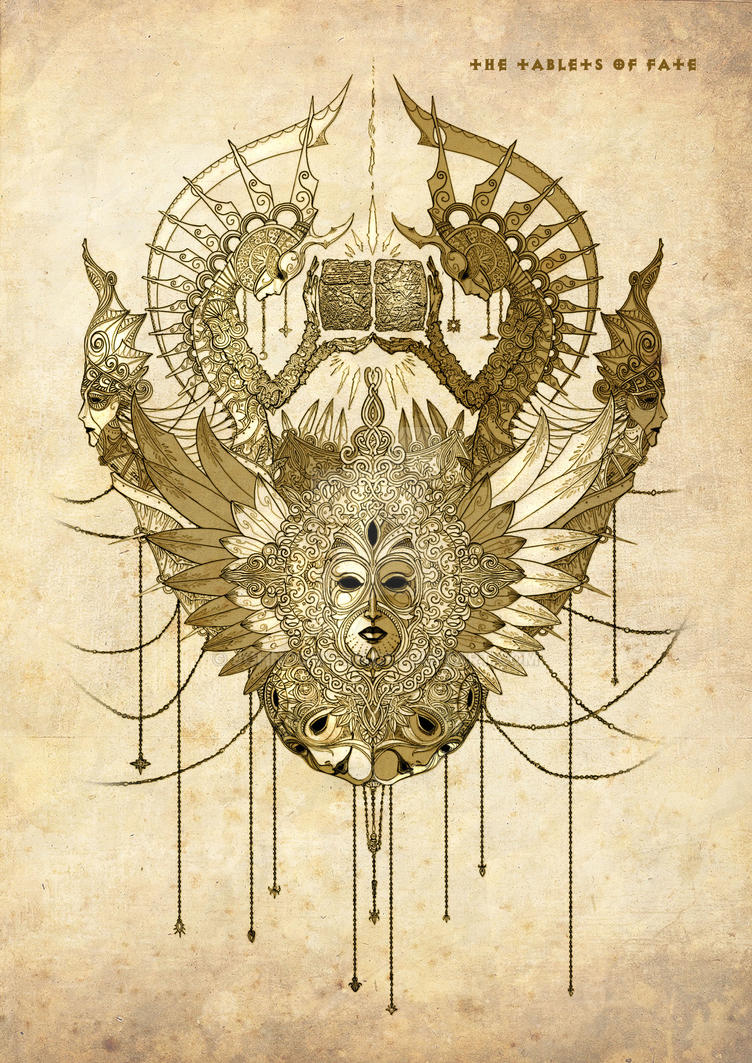
Tablets of Fate, Johndowson

I've talked about Ascension before in all of my Erikson, Malazan Book of the Fallen, reviews. (Spoilers!) At the end of Waterdeep, Mystra, Bane, Bhaal, and Mykrul, the gods of magic, strife, murder, and death, have all been killed. Quite a coup for the forces of light. Except Forgotten Realms doesn't really work that way, even Evil isn't really all that evil, and good is pretty tedious and ineffectual. The over god, Ao, appoints two mortals to become gods and take up the balance. This idea of men becoming Gods, is an old one, but for a former philosophy student, it is gobsmacking. That said, the idea of godhood here, as elsewhere, is really quite petty. Nonetheless, Ascension is a neat concept, and I always enjoy seeing it play out.

The last cliche I'll mention, is The Balance Cliche. Need I say more? Evil is always trying to usurp good, and good, when evil is struck down, becomes corrupt, greedy, and ultimately, because men are awful, evil. It's tiresome, but it does allow fantasy to keep going as a genre. One of the neat things about the Wheel of a time was that it dealt with this concept directly: Lews Therin Telamon, the Dragon, was reborn in a new vessel every thousand years or so, to fight the Dark One in a different battle. I'm sure non fantasists would find that tiresome. But what can I say, I find it thrilling. The chance, as Rand al'Thor discovers at the end, to try again.
“Why do we live again? Lews Therin asked, suddenly. His voice was crisp and distinct.
Yes, Rand said, pleading. Tell me. Why?
Maybe … Lews Therin said, shockingly lucid, not a hint of madness to him. He spoke softly, reverently. Why? Could it be … Maybe it’s so that we can have a second chance.
Completeness: so I'd been looking forward to Waterdeep for some time, because I thought it would tell me about the largest city in all of Faerun. And I was not disappointed. Ok, well, slightly disappointed. They don't get to Waterdeep until the very end, and so even though the detail is there, it was tantalizingly thin. What did we learn? Waterdeep is governed by a benign group of lords and protectors, most of whom remain secret. The city is reportedly democratic, but how you can have democracy with secret rulers is ... Ok ... Well, I guess realistic.  We learn some about the Watch, and how defense of the city is maintained. We also learn a bit about the Archmagus, Blackstaff, who, with Elminster's aid, attempts to help the heroes defeat Mykrul the god of the dead. We also learn street names! I love details like that, and they are so often overlooked.

So, I've found my first big inconsistency in the Realms. Douglas Niles made Bhaal out to be a powerhouse of a god. And so, you'd think, in the Avatar series, where Bhaal is brought to life, you'd at least find some of the same attributes.  But no. He may be the god of murder, but in point of fact, he really is the Patron of Assassins. Which is really quite different from the Moonwell corrupting, Druid slaying Bhaal of the Moonshae series. Keep in mind that none of these books or series follow a timeline. They're all out of whack,  but given that Bhaal kicks it after this installment, it seems unlikely to be resolved.  The Forgotten Realms wiki touches briefly on the matter, but it is not entirely believable.

Waterdeep is a pretty good Forgotten Realms novel.  We got to meet some important characters, names we will be seeing again, and we did get the origin story of at least two new gods.  But, it is still 80s-90s fantasy, and it just doesn't compare to what we've come to expect.  That said, it was a page turner, and worth a read if you've gotten to the end of Tantras and are wondering if you'd like to continue.

Thursday, November 21, 2013

Women in SFF

Tor.com recently sent out their weekly email with its attendant blogs, stories and news.  And Liz Bourke wrote an interesting column and interview following a piece I did not read.  There seem to be several points to her post, and the one previous, which I will first sum up.

1) There is a bias against female SFF writers
2) There are fewer new female SFF than male authors each year because of it
3) There is a bias amongst reviewers that indicates the same
4) Does it matter?

I wanted to add my own two cents here.  I'm going to make a little list.

My feelings:
  1. If I am guilty of reviewer's bias, it is certainly not a conscious one.  Unfortunately, that doesn't make it any less of a bias. 
  2. I certainly am guilty of reader's bias.
  3. I like central male characters, a bias that has nothing to do with the sex of the author, but my own preconceptions about viewpoint have, in ignorance, played to that point.
  4. Publishers have to play to their audiences.
  5. Yes, it matters, and yes we should at least make the occasional effort to expand our horizons.
1. To start, that there is a bias amongst reviewers clearly holds with me as well.  I have reviewed only Dragonsdawn by Anne McCaffrey, and Azure Bonds, by Kate Novak and Jeff Grub.  Both of which are at least twenty years old.  So, keep in mind, I don't review "new" titles.  My reviews are long-winded, seldom read, and I have no particular following to keep up with.  When I find a book particularly bad or good, or thought provoking, I write a review.  If I have time.  Publishers don't send me books hot off the presses (please do publishers! I've been using the friggin' Library for the past six months!) The selection process is random at best, and stilted, heavily leaning to books already in my collection at worst.  So I don't have the same kind of operators that Stefan Raets, or Renay, neither of whom I had ever heard of before today.  As all three of the bloggers, Raets, Bourke and Renay point out, the fact that I'm not consciously choosing titles according to author sex is still a bias, and a grievous one.

2.  I had to think, in my history, what else have I read by female fantasists?  Certainly almost the entirety of Margaret Weis's collection.  Raistlin Majere is certainly one of my favorite fantasy characters of all time, and he was her creation.  Recently, I read Robin Hobb's series, Assassin and Magic Ship, and Fool, or whatever the three series are called together.  And, I just found out that C.S. Friedman was a female, and I loved her Coldfire Trilogy.  All three of these women wrote incredibly strong, very detailed, and very interesting male central characters.  Did I think them less genuine because of that?  Not at all.  I was impressed by Robin Hobb's epic, but I confess, it wasn't my cup of tea.  I don't know if that had anything to do with the sex of the author.  It was a problem, or question of the theme.  I just left feeling somehow disastisfied.  I also read some C.J. Cheryh back in the 90s.  That's about it.  As I confessed years ago, I typically pick out books by the covers.  So if the publisher laid out for a good bookcover, and the book was at least four-hundred pages... there was a pretty good shot I'd try it. 

3.  Even though I quite like Jim Butcher's Furies series, I find the parts with Amara and her husband Bernard saccharine to the point of distaste.  I am a man, and the story has to appeal, find common ground with me.  I know a number of people who hated Rand al'Thor and the Ta'veren Trio, but his story always had a great deal of appeal to me.  Particularly as the 'nice' boy began to fade, and rage began to consume him in the ladder half of the series.  And I've spoken to some female fandom who find all three of them, Rand, Mat and Perrin inherently boring.  Still given what I pointed out above at the capacity of female authors to write excellent male characters, I suppose this bias really must end.

4.  I had this conversation with a female anthropology professor (not my wife) once, regarding the sexualization of female body parts in comic book characters.  And she showed me this image:
It is a pretty funny image, but she looked thoughtful when I told her that most of the readership of comic books are men, and that they wouldn't sell much if their characters all had bubble butts like this!  I also said, to say that male characters aren't over sexualized is ridiculous.  They don't frequently have gratuitous butt shots like those above, sure, but they all have tight abs, large shoulders, strong chins, cheekbones, large packages, and let's not forget, tight asses.  Interestingly, that's not to sell to women.  That is to play to men's insecurities about our own bodies.  I told her that if she were to look at any of the comicbooks from the eighties, their pages are filled with ads for muscle enlargement, how to get women, etc.  Their consumers were skinny, weak white dudes, and that was why you saw covers like this!  Still though, if you don't know about the HawkEye Initiative, check this out.
 

To apply that to fantasy authors, I honestly don't know what the breakdown is.  I was told about five years ago that men are reading less and less.  That was true then, of the overall market.  But SFF is a genre, and can the same be said?  If the majority of the consumer market is male, than publishers and reviewers choosing titles that best reflect their clients needs, is pretty if not fair, than standard practice.  I have lately seen more women than men reading in the genre, but that might also be a product of a completely different bias.  I didn't have the courage to be seen reading a fantasy book all through Highschool.  I kept them in my bag, and went off to secluded corners of the library to read them.  I frequently had my books stolen and ripped up.  I even had to chase them through the cafeteria from time to time because it just wasn't cool.  I'm not sure women and girls had to face the same bias in fantasy, though they certainly had to face a number of other ones.

5.  None of that matters.  The critics are right.  An effort must be made, it is simply the right thing to do.  I have three library books in my possession right now, all male authors.  But my next review, I promise will be by a female author.

Tuesday, February 1, 2011

The Dwarves by Markus Heitz

Let me start this post with a disclaimer:

Anyone who can finish a novel, and get it published has my utmost respect.  And more, they are in at least this one way far superior to me: they've the will to see it through.

Criticisms of this book might also be inappropriate for this reason:  The Dwarves is one of those few fantasy novels that bridged the language gap.  Every single other fantasy book I've ever read, and I've read many, were in English.  Translating from German is hard, and my philosophy professors always assured me, particularly the Germans, that a great deal is lost in even the best translation.  One of my central criticisms of this book is that the prose is simple to the point of being for a much younger audience, twelve to thirteen.  I suggest that this is the publisher's fault.  German is an exceedingly colorful language, and each word is dense with meaning.  This was not a book to go Hemmingway on.  But Americans are thought by editors at large to be fairly simplistic in their reading level, and so perhaps there is a sensible reason for this fault.  Compare the prose of The Dwarves to the prose of Erikson's from The Malazan Book of the Fallen and you'll see what I mean.

Overall, I enjoyed this book.  There's enough going for it, that I'd consider reading the sequel.  As usual, I'd seen this title in the bookstore and admired its fine cover.  Not only that, but I was intrigued.  Dwarves are usually in the model of Gimli from LOTR, amusing sidekicks, or Flint from the Dragonlance Saga.  The implication, and truth of the title, is that this might be one of the first such fantasy novels where the hero is a dwarf.  The book had an interesting, relatively swift moving plot, some gruesome details, and an exciting conclusion.

Very well, let's get to the five.

1.  Character:  This is perhaps my primary complaint about the story.  The characters are very naive.  Naivety is only bearable when it proves a point, is a statement about the character, not the writer.  Rand Al'Thor starts out the Wheel of Time very naive.  But Jordan does this intentionally, to show that he's an eighteen year old boy from a farming village.  Every single character, except maybe one, the Maga Andokai are naive to the point of iritation.  And they say the lamest things to one another!  The main character Tungdil is the worst for this, but even the main vilain, the Nudin the Knowledge-Lusty (For real! Really, a better translation wasn't available?  Maybe Google translate did their translation) was exceptionally naive.  He ravages his own homeland, convinced that he's acting on the greater good.  This would be an interesting character development except that it's not really talked about much, save for one of the the story's modes: the play within the play.  And he has a good excuse, he's inhabited by a demon spirit.  Madness is intriguing, ethical decision making is intriguing, devil possession is passing the buck.  In this case, passing it to the sequel I imagine.

The other reason The Dwarves fell flat, is that the Dwarves themselves were remarkably bland.  There is an interesting mythology presented, five clans of dwarves, separated by their God, Vraccas. (*I was dismayed by the name Vraccas, in one of my own unfinished works of 2002, I'd chosen this exact name to be an evil god.)  The dwarven mythos is essential to the story, and is one of the most enjoyable elements.  But even so, detail regarding the lives of regular dwarves was incredibly sparse.  Worse, Heitz had an excellent vehicle for doing so, and since the main character is a foundling, every sentence between two dwarves would have added color.  It's like a six year old's coloring book, full of poorly colored shapes, many pages left entirely blank.  Worser:  There's millions of helpful dwarven cliches in other fantasy novels that could provide further description without dragging down the plot.  This is why cliche's are useful, they speak volumes.

2)  Let's talk about Cliche:  Heitz had two options here.  Use the old dwarven cliches laid down by Tolkien, and many since, or bust a nut and create something new.  Either would have worked well for me.  However, by using a familiar race, beloved of fantasy readers everywhere, Heitz had already consigned himself to a certain amount of necessary cliche.  Let's see here:  Dwarves are short: check.  Dwarves prefer underground mountainous lairs: check.  Dwarves hate magic: check.  Dwarves are long lived: check.  Dwarves prefer axes: check.  Dwarves are smiths: check.  Dwarves love gold: check.  Heitz had a subtle spin on the dwarven love of gold, he made it genetic.  By which I mean, Dwarves have the love of gold and gems intrinsically.  Men love gold too, but its generally admitted that we love it for the things, including sex and status, that it can get for us.  Dwarves just like how it looks, sort of like human women.  Heitz also used the dwarven cliche of using names that involve all of the above.  I enjoy this particular cliche quite a bit, so no problems here.  In fact, these standard fantasy cliche's held true for all of the races.  Let's coin a term, "LOTR Race Cliche" shall mean that Dwarves are short and bulbous, Elves are tall and fair, humans are enh, orcs are evil.

The Coming of Age cliche was also used to some degree, though somewhat inexplicalbly.  Tungdil is 60 years old when the story starts.  This is really only about a third of a dwarf's life.  But I'm at a third through my life, and I don't act like a twenty year old, so what's this guy's excuse?  Tungdil isn't immature, he's just completely innocent.  Naive, as stated above.  And it bugged the hell out of me.  At 60 years old, you've learned a lot about life, particularly when you've spent the entire time living among humans.  That's at least two generations of medieval humans he would have lived through.  Still there are some good reasons, he's never met a female of his race.  God knows, women give you gray hairs.  And he's never met a male of his race, so when he meets the story's comic relief, the warrior twins Boindil and Boendil, acting a bit childlike would be understandable.  This leads to a third cliche: Self-Actualization.

Coming of Age cliche's often become self-actualization cliches.  In the Eye of the World, Rand al'Thor becomes a man.  But through the remainder of the series, he continues to grow and change, leaving behind the Coming of Age cliche of the first book.  Tungdil has a problem: he knows nothing about his race, other than what he's read in books.  Fortunately for him, everything he ever learned in his books about dwarves was completely accurate.  This bothered me, again I felt like this book was aimed at thirteen year olds.  That would be fine, but good fantasy is aimed at a much broader audience, thirteen year olds included.  I don't need you to tell me that books are good, thank you very much. 

3.  Scope:  The scope of the novel was perfect.  The realm is called Girdlegard (again, an awful translation choice--literally, the land is wearing a girdle that guards it from evil.)  Still Girdlegard is small, with delineated borders, and the reader is not in any way made curious about what lies beyond those borders.  A common fantasy trope is to name off lands far distant without providing a purpose for these lands.  Such a trope is merely to show that that the story takes place in a larger land, not in space.  Personally, I prefer bounded lands because, well frankly, its easy to make up funny names and toss in a sentence about far away lands.  It's a bad writers trick (I know, I use it)  Heitz doesn't indulge.  That said, there are just too many lands for a fairly simple story.  Were six human kingdoms really necessary?  No.  Only two are relevant.  In contrast, the five dwarven realms are completely relevant, and tantalizingly explained.  I mentioned in my last post how difficult it is to indicate scope without falling into such tropes, but Heitz sidesteps the issue very nicely.

To the Blight (The Eye of the World, Book 2)4.  Magic:  The story starts out with there being six main Magi, male and female.  And they save the realm from another cliche, The Perished Land. Not unlike Jordan's Blight.  Nothing grows in the Perished Land, and anyone who dies in it is forced to walk the land as a revenant, enslaved to the will of some gaseous form of evil that is only hinted at.  Magic isn't really explained, and Heitz falls back on more cliches, spell books, runes, jars of ingredients, eye of newt, you know the deal.  One thing for sure about magic.  You can eat other Magi's magical power.  Guess how.  It's an important plot point, but Heitz doesn't bother to explain it.  And maybe he's right--Dwarves hate magic.  And if nothing else, The Dwarves, is about Dwarves.  One fairly interesting and enjoyable part of the story is that, much of the book is taken up with quests searching for magical artifacts.  This is something fairly rare in fantasy of the past twenty years which is primarily character driven.  I don't want to spoil the novel, but it becomes clear in the first fifty pages, that the big bad can't be killed with the usual assortment of weaponry.  Magical weapons are cool, and anyone who ever played a fantasy board game, videogame or the beknighted Dungeons and Dragons knows it.

5.  Theme:  It's hard to get a handle on the overall theme of The Dwarves.  It might be too basic.  If the prose were more detailed, or better translated, I could make a better stab.  The Perished Land isn't particularly dark or frightening, and the revenants can talk, and in some cases, even be completely normal.  So darkness as a theme is out.  I guess if I had to peg it, I'd say, unity.  There's a weird scene in the end, after the big bad is beat, where a minor character makes a speech about unity between the races.  Given the happy-go-lucky nature of the characters, this theme seems to be the most prevalent.  I can't complain, go Unity.  Go Peace.  But...again, I'm not thirteen.

If the cover weren't so groovy, I'd tell you to borrow a copy.  Want mine?