Search This Blog

Showing posts with label Richard Awlinson. Show all posts

Friday, May 29, 2015

Waterdeep, by a different Richard Awlinson

So Waterdeep is the last novel in the Avatar Trilogy, though the story picks up again in two more later volumes.  Interesting side note: Richard Awlinson is a pen name for two separate men. Why? I don't know, the Forgotten Realms Wiki is silent on this issue. That said, Troy Denning, the author of this one did a fine job of finishing the series.

Waterdeep takes the remaining members of the Company of the Lynx, from the city of Tantras to the mega city of Waterdeep. It says something that I can't even find Tantras on the map.  The journey is long, and given the chaos of the Realms during the so called Time of Troubles, difficult. Of course, in fantasy, the Quest cliche is 90% of the story, so it's not surprising. The Time of Troubles, you recall, was initiated by the theft of the Tablets of Fate, and the expulsion of the gods from their astral plane to the mortal realm.  Midnight, Her lover, Kellemvor, and the cleric Adon, search for the second Tablet of Fate, which they hope to return to Ao, the over god of the Realms, and so end the Time of Troubles.

Character:  The characters remain startlingly satisfying in this third installment. I can tell you, I'm a third of the way through the Halfling's Gem, and I'm sick to death of Drizzt, Wulfgar, etc. but Midnight, Kellemvor, Adon, and Cyric are excellent characters.  Let me start with Cyric. In Tantras, we saw Cyric take a darker turn, becoming a minion, though a freelancer, to the dark god Bane. And while he was a cold mother fucker, you got the sense that Midnight's faith in him would be rewarded. SPOILER: it's not. Cyric becomes a truly awful human being in this novel. He slays a village full of halflings with women and children, he cuts the throat of another hanging from a rope. He slays an innkeeper, sole survivor of a zombie attack, mere minutes after the poor man gives him food and beverage from his ruined livelihood. Why? Because he simply does not care, and because people irk him.

Adon also continues to grow, becoming the group's leader. And while his faith in Sune is completely lost, by the story's end, his faith is yet restored. Though not in Sune, the goddess of beauty. Kellemvor, the group's former leader has made catastrophic decision after decision. Having had his curse removed in Tantras, he keeps leaping to the aid of defenseless citizens. While laudable, he's not the sharpest tool in the shed, and he's forgotten that at least three gods have been trying to track them down and kill them. After falling into half a dozen ambushes with his bull headed attempts, his confidence is finally assailed.
The exciting conclusion of Waterdeep

Cliche: Midnight is perhaps the biggest cliche of the entire series. She's just rather generic as a female character: she loves Kellemvor, but is furious with him for not trusting Cyric, and they spend half the novel fighting over it. She is strong, but uninteresting for the most part, and her history is left entirely unexplored.  What's worse is that she is, completely wrong in her faith, only enforcing an unpleasant gender stereotype. Another character cliche is in Adon's character. The Faithless Priest, is a half decent cliche and Adon's inner struggle, and his ultimate belief in humanism as a faith, is (Spoiler!) only made more interesting when Midnight ascends to god hood.  He becomes her High Priest, and but as Midnight is no longer merely mortal, is it still humanism? Which brings forth another cliche: Ascension.
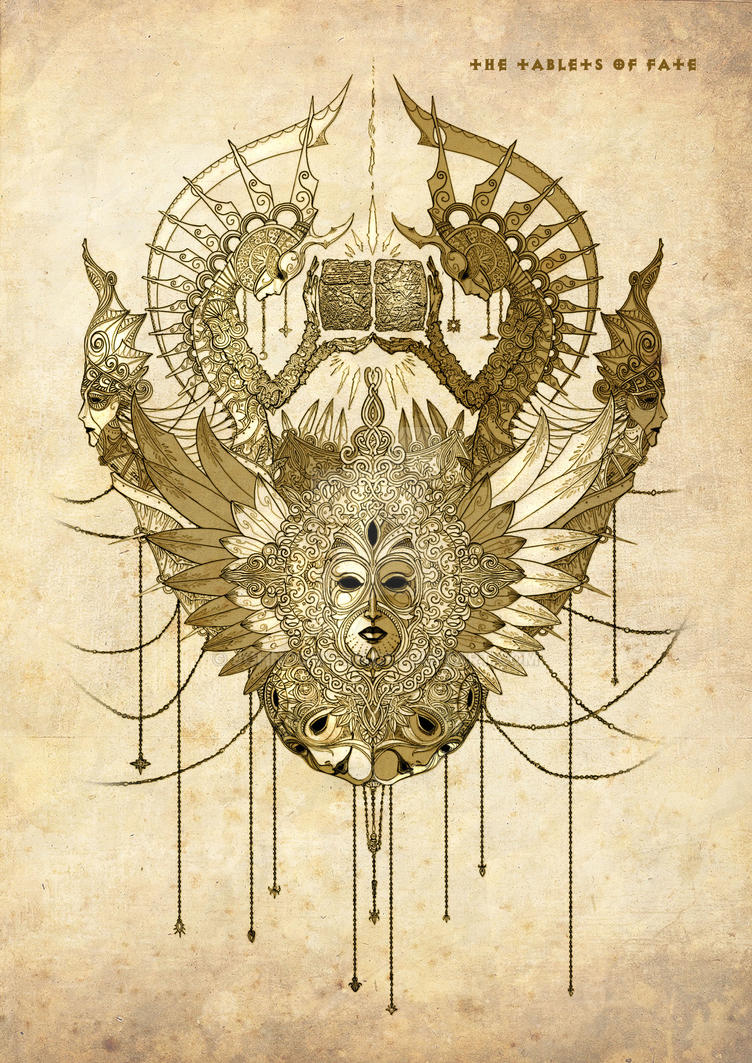
Tablets of Fate, Johndowson

I've talked about Ascension before in all of my Erikson, Malazan Book of the Fallen, reviews. (Spoilers!) At the end of Waterdeep, Mystra, Bane, Bhaal, and Mykrul, the gods of magic, strife, murder, and death, have all been killed. Quite a coup for the forces of light. Except Forgotten Realms doesn't really work that way, even Evil isn't really all that evil, and good is pretty tedious and ineffectual. The over god, Ao, appoints two mortals to become gods and take up the balance. This idea of men becoming Gods, is an old one, but for a former philosophy student, it is gobsmacking. That said, the idea of godhood here, as elsewhere, is really quite petty. Nonetheless, Ascension is a neat concept, and I always enjoy seeing it play out.

The last cliche I'll mention, is The Balance Cliche. Need I say more? Evil is always trying to usurp good, and good, when evil is struck down, becomes corrupt, greedy, and ultimately, because men are awful, evil. It's tiresome, but it does allow fantasy to keep going as a genre. One of the neat things about the Wheel of a time was that it dealt with this concept directly: Lews Therin Telamon, the Dragon, was reborn in a new vessel every thousand years or so, to fight the Dark One in a different battle. I'm sure non fantasists would find that tiresome. But what can I say, I find it thrilling. The chance, as Rand al'Thor discovers at the end, to try again.
“Why do we live again? Lews Therin asked, suddenly. His voice was crisp and distinct.
Yes, Rand said, pleading. Tell me. Why?
Maybe … Lews Therin said, shockingly lucid, not a hint of madness to him. He spoke softly, reverently. Why? Could it be … Maybe it’s so that we can have a second chance.
Completeness: so I'd been looking forward to Waterdeep for some time, because I thought it would tell me about the largest city in all of Faerun. And I was not disappointed. Ok, well, slightly disappointed. They don't get to Waterdeep until the very end, and so even though the detail is there, it was tantalizingly thin. What did we learn? Waterdeep is governed by a benign group of lords and protectors, most of whom remain secret. The city is reportedly democratic, but how you can have democracy with secret rulers is ... Ok ... Well, I guess realistic.  We learn some about the Watch, and how defense of the city is maintained. We also learn a bit about the Archmagus, Blackstaff, who, with Elminster's aid, attempts to help the heroes defeat Mykrul the god of the dead. We also learn street names! I love details like that, and they are so often overlooked.

So, I've found my first big inconsistency in the Realms. Douglas Niles made Bhaal out to be a powerhouse of a god. And so, you'd think, in the Avatar series, where Bhaal is brought to life, you'd at least find some of the same attributes.  But no. He may be the god of murder, but in point of fact, he really is the Patron of Assassins. Which is really quite different from the Moonwell corrupting, Druid slaying Bhaal of the Moonshae series. Keep in mind that none of these books or series follow a timeline. They're all out of whack,  but given that Bhaal kicks it after this installment, it seems unlikely to be resolved.  The Forgotten Realms wiki touches briefly on the matter, but it is not entirely believable.

Waterdeep is a pretty good Forgotten Realms novel.  We got to meet some important characters, names we will be seeing again, and we did get the origin story of at least two new gods.  But, it is still 80s-90s fantasy, and it just doesn't compare to what we've come to expect.  That said, it was a page turner, and worth a read if you've gotten to the end of Tantras and are wondering if you'd like to continue.

Sunday, May 3, 2015

Tantras by Richard Awlinson

This scene never takes place
So Tantras marks book two in Awlinson's Avatar series.  The book has a great beginning, a boring and confusing middle, and a fun finish.  If you're into going back into the history of the Realms, Tantras is worth a read. I should note that Awlinson is a pen name, and that this marks the last book in the Avatar trilogy that is written by Scott Ciencin.  That's right, Waterdeep the last book in the trilogy is written by another dude under the same pen name.  WTF?

As I have done in the past with books in a series, I will skip my usual rubric for critique and simply comment on more general aspects, namely character, plot and setting. Beware, this review is replete with spoilers.

I was very impressed with the first book in this series, Shadowdale. (Note that all of my adjectives, "impressed," "unusual," "great," are meant to be relative to what was being produced during this period of 1980s game world fantasy fiction.) The main characters were complex with unusually detailed backgrounds.

First there is Kellemvor with his nasty, giant cat breaks free of his chest in the most disgusting manner, curse.  There is Cyric, the Zhentish thief, seeking freedom from his past.  There is Adon, a playboy cleric, who suffers a disfiguring scar and abruptly becomes a morose, useless, foot dragging, minor warrior.  And of course, the least developed, the female lead, Midnight. Whose past we know very little about, but at the same time is the center of a love triangle between Kellemvor and Cyric.
Kellemvor

All four characters figure heavily in Book 2. And some drastic changes occur. I've been waiting for some crossover between the different Forgotten Realms novels, and by this time, about ten books into the world of Faerun, I'm beginning to see some. Ed Greenwood, in Spellfire, described all the characters in Shadowdale in such idyllic terms of brotherhood that the place seemed a lot like Monty Python's version of Camelot, "it's a silly place." Awlinson's Shadowdale takes a much darker turn. When Elminster is trapped in a demon realm at the end of the first book, he is assumed dead, and The Lord of Shadowdale, Mourngrym, holds a show trial in which Midnight and Adon are condemned to execution. Many of Greenwood's characters are given a third dimension in the first half of this book.

Which leads me to wonder about the dark turn that Cyric takes. the Zhentish thief decides to free Midnight from prison the night before the execution. And in so doing, he kills four guards in cold blood. This begins the transformation of the sarcastic, cynical thief into something far darker. Cyril's transformation is excellently done, his frustration with Adon, and his futile affection for Midnight turning him into something far worse than he might have been. That said, the crimes he commits in freeing Midnight seem mitigated to me by the fact that it's a lot easier to kill guards then to render them unconscious.  Moreover it was his friends, wrongly accused and falsely tried, whose lives were at stake. That said, by the end of Tantris, Cyric is clearly in Neutral Evil category.

Cyric
Meanwhile, Kellemvor, who was falling in love with Midnight, leaves her to her fate, and even leads a search party to return the trio to the gibbet. Kellemvor's character is rather straightforward, he wants to be good, but his curse doesn't allow him to do any good deeds. That said, in Tantras, he allows himself to be duped frequently. At first I was quite bothered by this, but upon further examination, I think it actually quite subtle. As a mercenary whose curse requires him to be paid for services rendered, he has become unusually good at accepting jobs that allow him to do a decent thing or two, while still getting his reward. This type of quandary would, of course, make for a very pliable character, someone who could easily justify a complete change of heart.

Adon spends the novel becoming useful again. In the Avatar series, clerics have lost their powers unless they are literally standing right next to the avatar of their god. So Adon had already lost his abilities to heal and cast other priestly spells. But when he lost his face, his overwhelming self-pity destroyed the boyish self-confidence he displayed in Shadowdale. While the priest loses his faith, he does gain a measure of self esteem by the end of Tantris.

Darth Krayt, but to my mind a good representation of Bane
No discussion of characters would be complete without the only other character worth noting, Bane the God of Strife and Tyranny. The God of Strife is a complete idiot. This is a major flaw in these novels to date.  So, it stands to reason that the God of Strife would be fairly petty. But gods have to be more than simply humans with massive powers. Though Awlinson made a few efforts in that direction in Shadowdale, by Tantras, the god is a mewling, cantankerous moron, careening from one disaster to the next.

I have made no study of the pantheon of the Forgotten Realms. But so far I am not impressed. We have Bane, we have Bhaal, we have Mykrul, all evil gods, but none save Bhaal seem particularly nasty. But, SPOILER, given that Bane doesn't make it past this novel the gods of evil do not seem particularly strong, or pernicious.

Finally, the whole reason for my continued self debasement of reading these Forgotten Realms novels is to learn about the fascinating world of Faerun.  I've shown the map before, and it is HUGE.  After ten novels I'm pleased to say that we still haven't explored more than an eighth of it, at best.

But what do we learn? Shadowdale is but one dale of many, all vying for control of a few areas. Scardale is one such town, an area garrisoned by troops from a loose federation of city states. We learn that Tantras is a city state that primarily worships the god of duty, Torm.  Of course, Torm doesn't seem to make it either, so I think at least one of Greenwood's characters is out of an occupation.  No natural wonders like there are in some of the other books, like the Icewind Dale series and it's troll infested marshlands. That said, since the day of Arrival, when all the gods were forced to assume mortal forms, major effed up crap has been happening across the realms. Like trees coming alive and spawning undead wax monkeys, or hot mists rising from nowhere and boiling people alive, or troops of trees marching to war.  And Awlinson has come up with some truly horrific encounters, something that adds a great deal of fun to the novel, and allows him to break with the fairly limited selection of Dungeon and Dragons monsters.

Overall, Tantras is a good romp.  And hopefully Bane will stay good and dead, as he was a particularly laughable villain.

Saturday, January 31, 2015

Shadowdale by Richard Awlinson

So this may be the first book in the Forgotten Realms series that I have really enjoyed, and have found to be a fairly mature story. It also was written in 1989, and while it still follows a fairly staid Dungeons & Dragons, hero's quest, type of format, it's characters have a great deal more depth, then even R. A. Salvatore's entry into the realms
over the same time period, (Streams of Silver). The troubled heroes actually have back story! Best of all, the story ends in a large, well detailed battle scene with gods, demons, and thousands of troops.

One thing I found troubling, if only in a vague way, was that the premise of this series of books is that the Gods have been banished from the planes by the über god Ao. And as such, they are sent to dwell as humans in the Realms. Now, alongside the release of these books, were actual campaign materials detailing the stats of everything that existed in these worlds.  So, when gods are killed in the  course of this story, were these gods listed in the materials? Or were they Awlinson's creation for the purpose of this particular tale.  The Arrival, as it is called, would have to be a pretty big deal in the worlds history, particularly in light of the fact that magic seems to stop working, and clerics spells only work in the physical presence of their god. So, is Shadowdale adding to the canon of the Realms, or is it just a one off? From this link, it turns out that the Realms Creator, Greenwood actually did conceive of Bane.

When I start reading the books written in 1990, I hope to see reference to the Arrival and the events that followed.  I know that the events that occur in Darkwell, and Streams of Silver are quite independent of this apocryphal event. Though, they could well have occurred prior (or long after) the events herein.

The most enjoyable attribute of Shadowdale is story's heroes, Midnight, Kelemvor, Cyric and Adon. The story begins as these unlikely adventurers skip town on a guard duty contract, although why you would want your city guarded by men on forced contracts enforceable by prison sentences is beyond me. Why? To aid a mysterious girl, whose mysterious mistress is trapped in an old ruined castle.

Kelemvor is ostensibly the most developed of the heroes. A fighter with a terrible curse laid upon him. This curse forces him to only engage in human relations on a contractual basis whereby he is promised a reward, and then actually receives it.  If he does not, (spoiler alert) he turns into a hideous beast. This makes him seem hard hearted. Now, if Awlinson had opted for a shallow character, the curse not withstanding, once removed, would allow Kelemvor to be the selfless hero we all want him to be. However, it turns out, that he is, as all real people are, much more complicated then this. He stays to defend Shadowdale against the Zhentarim, but not because he cares one whit for the people of Shadowdale. He stays because he loves Midnight, and is promised her love, as the basis for the contract. Imagine knowing, as a lover, that your partner may love you, but they can only be with you while under the terms of a very strict contract.  I quite like this twist, and it is in stark contrast to Salvatore's Drizzt Do Urden, the dark elf with the heart as big as the Realms itself.  As a note, if you are, as I am, reading these chronicles for the first time, DO NOT google Kelemvor.  I just inadvertently spoiled the next two books for myself!  Don't click on this.

Cyric is another interesting guy. A thief, turned multi-class, fighter. That's a term from the old days. At first in the D&D world, you had to choose, fighter, thief, or magic user. In later editions, more classes emerged, and in the advanced rules, your fourth level thief could choose to become a fighter. He would retain his thieving skills up to that level, but he would then have to level up as a fighter instead. You could also choose to level up both, but it'd take forever, so most people usually simply switched.  As a boy, I thought this was cheating (having your cake and eating it too. Don't like the paltry hit point scores of a thief? Multi-class him and have the best of both worlds). Now, as an old man, I know that we wear many hats in this lifetime, and we frequently put earlier chapters in our lives completely to bed.

I digress. Cyric was born in Zhentil Keep. First in Spellfire, and now in Shadowdale, we are introduced to Zhentil Keep, as a city that worships the evil gods of the Realms. I find this to be a really interesting concept. Say what you like about cities, but for them to exist, a certain amount of cooperation is required. A certain amount of trust. After all, a contract is a promise, and not all goods can be paid for up front. For a promissory note to hold value, you must trust its issuer to fulfill the obligations therein. And trust cannot exist in a city of Evil. Unless, of course, it's not all Evil. Which reminded me of my favorite St. Augustine quote, "And even when men are plotting to disturb the peace, it is merely to fashion a new peace nearer to the “heart'’ desire; it is not because they dislike peace as such.  It is not that they love peace less, but they love their kind of peace more."

So I was eager to learn more about Zhentil Keep, from the character of Cyric. He was a thief and a murderer, but his most ardent desire is to be free of his past. To be free from the shackles of the Thieves Guild that made him what he was. He too could care less about the people of Shadowdale, and in fact despises them for their apparent weakneses of trust, love, faith and optimism. And he too, opts to stay and defend it from the approaching army. He's also an atheist, which is pretty hard to be in a Realm where there are actually gods. Like I said, for a fantasy novel of the late eighties, this is pretty deep stuff.

My favorite character, is Adon. Adon is a cleric of the goddess Sune, the Realms' Aphrodite. He is incredibly vain, in a harmless, humorous way, and finds himself being chased out of town by a woman who somehow managed to resist his charms. Adon loves the ladies, and he is a firm believer in beauty. Which makes his devotion to Sune all the easier to believe. After all, to believe in beauty one must only know desire and possess eyes. This would all make Adon pretty one dimensional, save for the fact that as a cleric in a time where the gods have descended, he has lost his powers, and has made no effort to find the avatar of the goddess living within the Realms. Neither for his belief, nor for the powers it gave him.  Which, is, odd.  And then, in the last sixty pages, something happens to Adon which is definitely not expected. And he becomes a completely different person overnight. Who he is, we do not yet know. His tale will likely be continued in Shadowdale's sequel, Tantras.

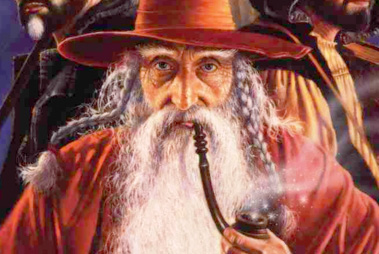
The last point I'd like to bring up is about that old sage, Elminster.  I've been hearing about Elminster for nearly two decades.  He's the Realms version of Gandalf, a long lived wizard of power to rival the gods.  Up till now we haven't learned much about him.  In Spellfire, we learned he had a dalliance with a student, who turned into an evil sorceress.  We also learned that he is short tempered, and humorous.  In my mind, I had always equated him with Dragonlance's Fizban, the bumbling old wizard who happens also to be the God Paladine.  But Elminster is definitely human.  This will probably make him a better character over all.  Though I must say, I rather miss old Fizban and his disastrous Fireball spells.

One last note. Shadowdale, Tantras, and Waterdeep were all released in the same year. Leading me to believe that they were written as one novel and broken up to sell more books, and to be more readable. It also suggests that Awlinson began these novels around the time that Niles, Greenwood, and Salvatore were composing their own founding works.

This was a good read, and if you're looking for some lite fantasy to get you through à lull, this would be a good choice.