Search This Blog

Showing posts with label Wheel of Time. Show all posts

Monday, November 11, 2013

Furies of Calderon - Jim Butcher


Jim Butcher is a name that has haunted me for some time, his Dresden series has been out for almost two decades, but I was not the target audience. Not so the Alera Codex.

So here it is, Book One, the Furies of Calderon

1) Character. Butcher's characters are well drawn, if a trifle hasty. Hasty? Well from page one, this book has been an action thriller; and while the characters are intelligent, believable and deep, in between fighting, fleeing, flying and furycrafting (the four Fs of the Codex) there really isn't much time for in depth character analysis. What a comparison to my last review of Way of Kings, which plodded between boring character soliloquies. That said, I would have preferred a slower build. The character which is probably the most complete is the young Cursor Amera. A Cursor, somewhat unusual for a fantasy novel, is an intelligence agent with a license to kill.  She is finishing her years of study and graduating what amounts to spy school. Her mentor is another excellent character, the masterspy and cold-hearted killer Fidelias. Fidelias is an unusual type of villain, and it is to Butcher's credit that all three of the evil usurpers top mercenaries are, if not always like able, certainly understandable. Of course the central character is a 15 year old boy named Tavi. Tavi's character is at once the most interesting and the most unbelievable. Making an unusual choice, what makes Tavi special is that he is the only person in the kingdom to not have a Fury. More on what that means later. Suffice it to say, what makes Tavi special is his ordinariness, and that he must rely on his wits, curiosity and courage, where others can simply use magic. Sometimes though Tavi's courage seems enough for ten men, and this is what makes his character just a tad hard to believe. Still, you want to believe in him, and as one of the story's main voices--it isn't hard to do so.  Fantasy novels are often built initially on a gimmick.  And though the choice to make Tavi the only non-magical being in the kingdom is unusual, it is not entirely without precedent.  Still the choice feels very much like a gimmick.  I can see Butcher in a coffee shop, pencil tapping his chin.  What about a magical land where everyone had special powers but the main character?  That said, and this is a big "that said," I absolutely do not have a problem with a good gimmick.
Tavi and Kitai, by Dystopiaworld at Deviant Art
2) Cliche. So the most obvious cliche, continuing with Tavi, is the Coming of Age cliche. Young Tavi starts the action by ignoring his duties to get a kiss from a girl. This is a truly great fantasy cliche, and almost every book uses it. Boy, small and ashamed, faces fears, adult terrors, great extremities and becomes a man. Interestingly, I'm not entirely sure that Tavi does grow, or at least his growth is well contained. It is after all book one, and he is only 15. Another cliche, less seldom used in fantasy is The Ugly Duckling. Amara is described as a girl with golden skin and golden hair, faintly boyish with a face somewhat severe. When her arc begins she considers herself unattractive, but by the end, she has found a man who thinks she's beautiful and indeed, many men have always thought so. The ugly Duckling cliche is unfortunate some of the time and disingenuous the rest of it. It would have been better if she'd actually been ugly, or actually pretty and aware of it.
 
The unbeautiful beautiful Amara, Sandara at Deviant Art
As for typical fantasy cliches, though it receives little note in this volume, there is a Shield Wall, very reminiscent to George R. R Martin's wall in that a group called the Icemen dwell beyond it. That said, they are not the overwhelming enemy-at least not in this volume. Another cliche used by Butcher is the Innate Power Cliche. This is such a common fantasy cliche that it needs little explanation. Think Aes Sedai and their ability to use the One Power, think Raistlin of DragonLance, or the Will and the Word of the Eddings books. The idea is simple, magic is innate. Some people are special some people ain't. Of course the foil for these powers, at least in traditional fantasy is that those who were physically weak could use the occult powers to even the playing field. There is also a cliche for long lived people, but they don't live hundreds of years. They are the magic users who bonded with water elementals and as they are the worlds healers they preserve and regenerate their own bodies as a matter of course. There is one fantasy cliche that Butcher employs with a broad brush. Magic is divided into the standard four elements, Fire, Earth, Wind and Water, with some unusual additions. While that sort of cliche is a little tired, Butcher does some novel things with it. But more of that in magic. No elves or dwarves, but there are giant spiders!

3) Scope: so when I first heard about Jim Butcher it was with all the gushing excitement of a thirteen year old on the Tor website. They made it sound like he was the second coming of Robert Jordan. I was skeptical, but figured I'd get around to him eventually. My skepticism has proved well founded. What made the worlds of Jordan, Martin and Erikson so remarkable was their scope. This is why scope is a signal element to a great fantasy. When you step into a world of someone's making and, to your delight, find it every bit as detailed as your own--it's exciting on a level so deep that every chapter almost throbs with life. How does one achieve it? To be honest, I am still working on that. It's not the number of books, or size of the words on the page, its not a world map with continents of people. It's not the number of characters-though that has something to so with it. It's not the number of political parties, or factions or world destroying g forces. It's literally about how the book is written.


Jim Butcher's world is large, and I already took the next two books out from the library. But the scope... Is merely pedestrian. I wrote a scene recently in a Jordan fanfic that I work on, and in it I have described in detail the vintages of wine from Tear, Cairhien and Altara (three separate nations in the Wheel of Time) I also described three works of art from no less than three different Ages. I'm not tooting my own horn, Jordan's world supplied the framework for this level of detail. I could create the same in Butcher's world, but it would be of entirely my own creation, and it would be a desecration of his work to add such detail. But Jordan's world is different, from book one we were provided tantalizing glimpses into the history of this continent, glimpses from time periods as disparate as twenty years prior to a thousand years before the present! That is depth.

Butcher chose to begin these tales in medias res. and it works, the book is a fun, fast read. But starting a political drama at the center of a world leaves little room to grow. We know that the present King is old and heirless, we know that there is much unrest, and that there are "many" people trying to take advantage. But the plot, SPOILER, is based on just one Lord's efforts to unseat the crown. After book one of Game of Thrones, you knew Cersei was a bitch, but you had no idea that the next book would detail the first year of the War of Five Kings.
 
Gratuitous picture of Queen Cersei by Teilku
There just isn't the level of detail necessary in the Codex of Alera to do that, not in book one. Which leads me to your next objection. You say, but surely scope must be in some way dependent on size, book two and three will add detail. True, but without the proper set up, you run into what I call the Wizard's First Rule Problem. Terry Goodkind's series was very successful, but when a friend once told me that you could either be a Goodkind girl or a Jordan girl, but not both, I was offended. Both men's first novels were designed to be stand alone books. Both morphed into ten book series. Only the smallest part of Jordan's world was explored in that first book, but much was alluded too. Goodkind's kingdom and its Big Bad Lord Rahl were dealt with in that first book, to fix the error he had to invent a threat from a whole other continent. A place that had simply not existed in that first novel, it wasn't until the second novel that he layed down the seeds for a saga. The device lacked the cohesive foresight of WoT. Butcher has indeed left room to grow, the mystery of Tavi's parentage, the mystery behind the slave Fade, the First Lord's wife (SPOILER) having an affair with Lord Aquitane, etc.  Clearly there is much going on, and I am excited to continue reading.  But as of now I have no desire to visit Alera.

An Earth Fury by MctChapman at DeviantArt
Magic: where would we be without it? The source of magic in Alera at least for the local humans are elemental spirits that bond with them. These spirits or furies, vary in strength and some furies have physical manifestations, while others are more ephemeral.  The stronger a fury, the higher in the caste strata a man can rise.  That said nobility remains patriarchal and passes on from generation to generation.  An interesting point is that power over Furies does seem to be hereditary.   The Furies are divided up into the standard element cliche, Fire, Earth, Wind, Wood, Water, and though there doesn't seem to be a physical fury for Metal, they seem to exist in many people, particularly in blacksmiths and swordsmen. Likewise a man can be bonded to more than one Fury. So Wood and Earth furies are common in at least two of the main characters. Unusual for the genre, Butcher doesn't spend too much time describing his system of magic, which provides solid evidence against one of Sanderson's guiding fantasy principles. Namely that magic must be rigorously standardized and adhere to its own rules. Butcher's furies are capable of new and novel things and the lack of explanation doesn't truly inhibit the power of the story. So Woodcrafters can move the forest to cover their tracks. They can guide arrows to targets. Earthcrafters are strong but they can also sense things both above the ground and below it, they can build walls and roads. Windcrafters can basically do all the things that the X-man Storm could do, fly, cause storms, lift targets, etc.  One neat thing that Butcher uses to enliven this cliche is that the elements can combine in natural and intelligent ways. A windcrafter can't start a fire, but as fire requires air, she can propel one a long distance or make a fire into a conflagration. A watercrafter is a healer, and unlike most magical healing, that merely binds wounds, eliminates viruses or bacterial infections, etc. it can actually restore lost limbs. Another trope that Butcher breaks is that healers can't heal themselves. In Alera, healers heal themselves first.  In fact their furies do it without conscious effort, and thus Watercrafters can live for one to two hundred years. As I said earlier, the furies are somewhat undefined. They exist as beings that bond to people but, it is revealed in the second book that many humans do not bond with individual furies, or at least that the ones they bond with contain little individuality. City folk furies are like this, country folk name their furies and seem to have a relationship with them. Inconsistencies abound in the Fury lore, but while this was somewhat irksome to me at first, I sense that one of the overall plot devices for the trilogy will unravel some of these mysteries. Suffice it to say, it is a clever use of a cliche, and a novel new form of magic.

Theme: last and hardest to define. Butcher's world uses slavery. I'm not sure why slavery has become endemic to modern fantasy writers, Sanderson's new story uses it, as does Butcher's. Slavery existed in medieval Europe, but it existed as serfdom, which was different. Serfs were the lowest of the caste society but they were still part of the society. Slaves are not part of the society, they are alien and not accorded the basic rights of humanity. They exist outside the social structure which is why their rights can be restricted in ordinary men's minds. It adds a dimension of darkness to any realm. That said, while Butcher's world contains dark elements such as sex slavery, it doesn't feel dark. This is in part because of the main character Tavi. Tavi represents what is perhaps the ultimate fantasy cliche, he is Good. And he's smart, which makes him much more likeable than say Sam or Frodo who just seemed too saccharine and idiotic to be more than patsies. But Tavi, like The Ta'veren Trio, is good and pure in a way that makes every chapter in which he belongs a delight to read. There is one thing, a nit really, but it does alter the theme. There is sex in this novel. I'm not sure how comfortable I am with that. Without getting gross, let me say, I love sex, and eroticism. But I can't square the circle of seeing it in my swords and sorcery. I don't know if it's because it's too "sweet" or that it seems disingenuous, but I just don't feel it. Here or elsewhere. I guess it adds a component of adulthood to the text, which reminds me to warn you that there is a brutal rape scene. It added little to the story but did at the very least demonstrate the depths of depravity of slavery.

Suffice it to say: the Theme of Calderon is entirely wrapped up in the viewpoints of its three largest characters: Tavi, Isana, and Amara. All three of whom believe in what is good, what is kind, what is right, and the importance of the rule of law.  And those themes are good enogh for me.

Do yourself a favor, get the first four books altogether.  It's hell trying to wait until I can get my hands on a copy of the fourth book.


Marat, by Sandera at Deviant Art, a beautiful illustration of the Marat horde moving toward Alera.

Tuesday, April 16, 2013

Brandon Sanderson's Way of Kings


My review of The Way of Kings, must start with certain caveats. First, I must cop to a certain envy of Brandon Sanderson, a man younger than myself, who is incredibly prolific, and talented, and successful, and... hand picked by Harriet Jordan to complete the Wheel of Time. My own attempts to start my career in fantasy have been thwarted mostly by myself. So, it is important to view my criticisms of his writing through a slightly jealous veil.

That said, I do have certain valid criticisms, of his writing style, and his view of fantasy. Also, looking at his essay on magic, though well intentioned as a guide to young writers, it doesn't quite fit the facts of some very successful sagas.

One thing is undeniable, Sanderson is a formidable story teller. I have read several of his Mistborn series, and Elantris, and each book is a well laid out, truly engrossing story. The same must be said for Way of Kings. And though his writing may not be my cup of tea, I certainly intend to finish the series, unlike Mistborn, which I did not complete.

I think I must state outright that, I think his writing lacks the sophistication of Martin, the breadth of vision of Jordan, the complexity and sublety of Erikson, the familiarity of the Eddings team, the cohesiveness of Weiss and Hickman. Any reader should know that going in to one of his stories. But maybe, Sanderson doesn't need to do that, he's made his own place in the starry sky of modern fantasy.

Let's go to the fantasy five.

Character: this is one of the things that I think Sanderson falls down on. The hero of this epic is a young soldier/slave named Kaladin. The book is over a thousand pages, probably 20% of that is given to describing Kaladin's state of mind, chiefly his depression. As Kaladin is as deep as a teapot, this makes for some boring reading. My wife has a saying that she used to describe certain boys when she was on the market: "darkness is not depth: do not mistake depression for intelligence, charisma, wisdom, or introspection". Kaladin has some decent reasons for being down, but for whatever reason, the constant vacillating on his state of mind, really just bores. That said, I found Dostoevsky's  Underground Man similarly irritating, and Notes from the Underground is considered to be one of his seminal short stories. In Way of Kings, even on page 600, Sanderson has Kal again teetering on the brink of his boring depression. Again. I don't have anything against depression, and for all I know the writer himself may have struggled with it, but it does not for concise story telling make, and Way of Kings would be a better book if it were about 200 pages shorter.
A beautiful illustration of Kaladin with Syl, by Dixon Leavitt, http://dixondoodles.blogspot.ca/2010/10/kaladin-meets-syl.html

Kaladin's history is told in increments through out the novel, culminating in the secret reveal in the last 100 pages. Several secrets revealed. One of which was worth it, the other of which, the reason for his depression, was, frankly not.

However, I am an optimist, and I do like Kaladin. And it was his story, not Shallan's, not Dalinar's that made me want to complete this novel.

Shallan's story, told in a different country of the same world was almost useless. I won't waste too much breath on Shallan. Much was made of her wit, by Sanderson, but to me, her wit was a slug-like thing next to the satirical utterances of Tyrion Lannister, or even Jaime Lannister. For some reason, Sanderson's editors at Tor (I love you darling people, so don't hate me for saying this) thought it was a good idea to keep the entire length of a poorly written essay by Shallan in the text of the book. It was not. It is a bad essay, and any non creative writing professor, and a few of them as well would have reduced it, and Shallan to shreds.

One neat note: I suspect Sanderson is an artist, because he describes the process of drawing, in so far as it works for me, very well. And all of the book's illustrations are quite good, though I haven't bothered to find out if they are his or not.

The other epic hero is Dalinar, who, interestingly is a much older man than usual in fantasy. He has to be about fifty, with a 20 year old son. That's good. As a man getting older myself, I find myself frustrated by the fact that say, all of Jordan's central characters are between the ages of 18 and 22.  Rand al'Thor frequently acts impossibly mature for his tender 22 years.  However, Dalinar suffers from the same problem that all of Sanderson's characters do, he's one dimensional.

You can get an idea of what I'm talking about from a casual sampling of his "extras". Sailors are crude but happy, blacksmiths are big and jolly, priests ingratiating, standard nobles are feckless, you get the picture. As I've written ad nauseum, tropes are a necessary part of writing, yet... It doesn't work for Sanderson. His characters are Saturday morning cartoon versions of what ought to be a made for HBO series.

Cliche: Sanderson is not a believer in the use of standard fantasy cliches. I don't have a problem with that necessarily. There are no dwarves or elves, and the magic, which I'll discuss in depth, seems to be original. However, as I've suggested, Sanderson's lack of character depth means that the central characters all rely on the bad sorts of cliches, the types that are unintentional and indicative of bad writing.

Sanderson breaks with standard cliches in the following ways. There seems to be no central awful evil one, not by the end of the first book at least. We know that there were, thousands of years ago, crazed beasts called the Voidbringers, which sounds a lot like the beasts that destroyed the land of the Never Ending Story, the Nothing. The races that populate this world, are nothing like the other races we have come to love, they are different colours, but carnival colours. Class and caste are determined by eye color. Size differences are slight, and poorly delineated. The biggest cliche that Sanderson dispenses with is the simple air and water his characters live on. The continent in which the action takes place, is like the ocean bed from The Little Mermaid. I kid, but Sanderson's imagination runs wild with this world. This was truly inspired. A funny example is that there are chickens in this world, but they are rare and exotic. People eat crustacheans only and grow seaweed from rock pods. Pretty neat, though it trends toward science fiction. 
A Warg from the Never Ending Story

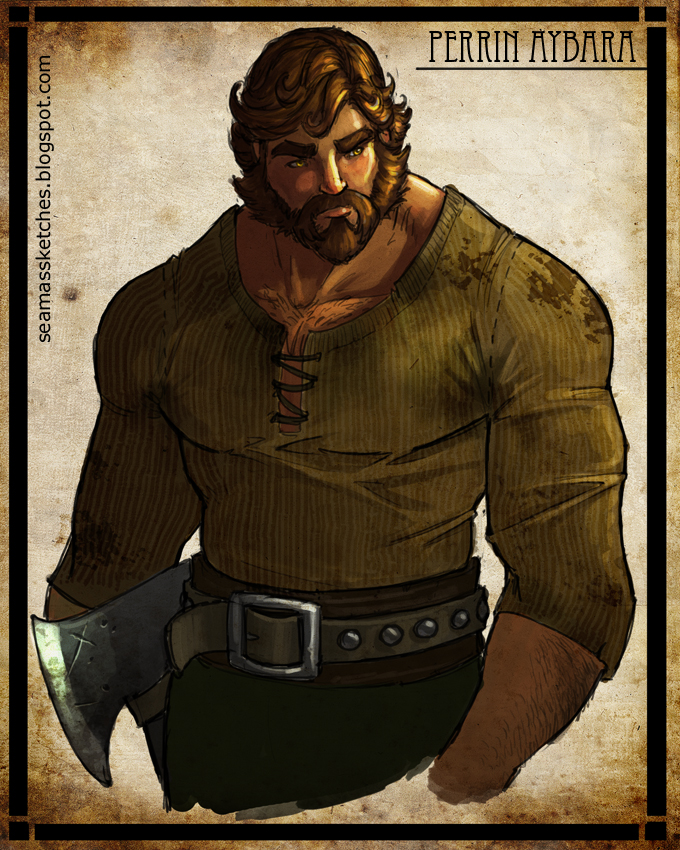
As I wrote, Sanderson is invested in some cliches, standard story type cliches, thus sloppy writing cliches. It's one thing to call to mind a sailor with his lewd mouth and ruddy complexion, it's another thing to make him act like an after school special, version of himself. I think that's one way other writers successfully use cliches. The Belgariad's Durnik, was exactly the sort of man you'd expect to be a smith, as is Perrin from the Wheel of Time. Yet, each of these characters had a subtle sense of originality. durnik's heartbreaking devotion to Polgara, Perrin, slow to rage, yet given to his wolven nature of blood frenzy.

Speaking specifically about the story's main hero, Kaladin, SPOILER ALERT, I mentioned the Coming of Age cliche, and the Hero's Redemption, cliche. I think one of the greatest examples of the Hero's Redemption is Mad Mordigan from the film Willow, whose first appearance is having been locked in a cage and left to rot. The first time we meet Kal, he is a proud and strong soldier, a few years later he is an escaped slave, recaptured and bitter, but not broken. Gradually we see him enliven, and boy do I mean gradually.
Mad Martigan from Willow as we first see him, in chains like the scoundrel he is.

Another familiar cliche, The Am I Going Crazy cliche, is used for the story's older hero Dalinar, the old warrior who begins to have prophetic visions. I think this works rather well for Sanderson, even if it is somewhat tired, and the answer to the cliches question, is simply "no". When Jordan used the Am I Going Crazy Cliche in Lord of Chaos, it was to describe The emergence of Lews Therin Telamon in Rand Al'Thor's mind. Jordan showed his depth with that one, and the answer was much more complicated than simply yes or no. Still, the novel is already too long, and even more boring soul searching would have further dragged the novel down.

Scope: The best thing Way of Kings has going for it, are its magic and its scope. Little Mermaid with gigantic swords, is actually a great start to a story. And the book is full of interesting little details, for example, the female nobility of Alethkar, keep one hand, their "safe hand" hidden as is only proper for a lady of good breeding. Men and women have acceptable norms for behaviour. Men should study war and be fighters, women, should study music and reading and writing. In fact, men are intentionally illiterate, typically having their wives scribe for them, reading books aloud, or writing messages out for their husbands. I like this, not because I don't like equal rights in my fantasy, but because sexual dimorphism is a real thing. I am constantly surprised by the number of really powerful women fighters in Steven Erikson's novels, and he is an practicing anthropologist! I don't mind the idea of it, but if you have them, then they can't allbe thin wisps, most of them would have to be like Martin's Brienne of Tarth, big, or ugly, and literally built like a man. Swords are heavy, armour is even heavier.
The Maid of Tarth, played excellently by GWENDOLINE CHRISTIE, who happens actually to be quite pretty in real life.

But i digress, the scope of this planet is large, and you get the feeling that Sanderson spent considerable time developing it. that said, it isn't deliverd particularly skillfully. One of the things that made the world of the Wheel of Time so compelling, was that it started out small, in a small village called Emond's Field, far from anywhere else. But Jordan didn't declaim as Author, "the people of this subcontinent eat fillet of fish," or "the people of this continent only eat fried bugs," what we learned, we learned through the omniscient story telling voice of whatever characters were central at that time. The villagers of Emond's Field knew that far to the south, a city named Tear existed, but they wouldn't have been able to tell much more than that. Jordan made damn clear, almost annoyingly so by page 7000, that people learn by rumor, by word of mouth, and even the omniscient voice was frequently wrong about the facts.
Emond's Field, the cover of the Wheel of Time's first installment, The Eye of The World
All of which to say, Sanderson throws a lot at you at once. It is nice that the action takes place in several kingdoms at once (though I would have nixed Shallan as a character altogether) but, at this early early stage of the game, it's sort of unnecessary and distracting. The main story is about Kaladin, and that takes place on the Shattered Plains, where Chasm Fiends roam like giant lobsters. With flashbacks to his homeland, just over the border. Kaladins fellow slaves are from all over the world, and are thus incredibly diverse, showing just how much Sanderson has in store for us. And yet--I don't buy in.
A beautiful rendering of a Chasm Fiend, by Mighty5cent, and courtesy of http://bookswithoutanypictures.wordpress.com/2011/08/29/way-of-kings-readalong-part-iv/
It takes a singular talent to make new races, new peoples, and to introduce them in such a way as to hold to the reality of the world. Because that is what we are talking about ultimately with fantasy. The world bends or breaks the laws of Earth, and the Galaxy in general, but it must adhere to its own rules. Sanderson knows this, indeed a portion of essay on magic systems stems from observations bout internal consistencies. Sanderson is rigid about making sure his system works, and I commend his outstanding creativity.

The world of Way of Kings is truly ground breaking. Still, it might have been nice for him to explain some of its intricacies through the characters, and not through bland references to far away kingdoms and customs. A good example of this idiot tactic, is Kaladin's blithe reference to Corinne's slave rules.  I guess there is some nation named Corinne, or person, or state, where they've established laws that govern slavery.  While it is absolutely fascinating, and a worthy endeavor to detail such laws, that's not what Sanderson did, he threw this supposedly obscure reference in to add depth, I know its bad writing because I do it myself.  It just comes off as amateurish.  When Jordan does the same thing, a good example would be Birgitte Silverbow, who has lived countless lives as she is attached to the Wheel of Time as one of its greatest heroes.  She makes fun passing analogies, like, "Elayne's always looking down her nose like some Tovan Councilor."  But the context for Birgitte has been established, she has lived dozens of times, and each time she was born and died a member of a different nation, in a different land, it's only natural for her to mention names we've never heard of.  And, even better, Jordan will bring up those references, miniscule as they are, later when we find out hundreds of pages further along that a Tovan Councilor is a really snooty elder from a nation that died during the Trolloc Wars.  I sincerely doubt that we will ever see reference to the Corinne Rules again.  That is not to say he doesn't always get it right.  He did do a neat job with describing chicken. Naturally, these crustacean devouring Alethkari, think it the most exotic food, and, he even includes a random trading scene where chickens are acquired (somehow relevant to the plot, but I can't say how.)
image by quargon http://grand-fantasy.tumblr.com/post/36947495502/shardblade-concepts-by-quargon-conceptual-art-of

Magic: not to be out done by his own system of allomancy in the Mistborn saga, the Stormlight Archive, the proposed name for the saga Sanderson hopes will be his opus, uses several systems of magic. There are Sheardbearers, men who wield gigantic swords reminiscent of he blades from manga comics. The swords are magic and weigh little to their owners. I must say I enjoy this particular brand of magic, a child of Dungeon and Dragons, and Final Fantasy video games, I am much enamoured of magic swords, and they are not as common as you might think in contemporary fantasy. It was the openings scene of this novel, which I read in a Tor newsletter sample over two years ago that made me want to purchase this novel two begin with. That opening scene featured a dozen of these gigantic blades rammed into the ground after a megalithic battle. That opening had real promise, sadly, the book itself has not measured up to its glorious beginning.

But I digress again, there are other forms of magic: Stormlight, soul casting (which is creating matter out of thin air) and some power called Lashing, that uses Stormlight (Sanderson's source of Magic are these massive high storms that pass through every week or so. The power gathers in gems, which powerful people use to power their magic items). Lashing uses some of the facets of Allomancy, namely, the push me pull you method of moving. It is a singularly scientific manner of creating a system of magic, people who are flying aren't defying gravity, so much as using methods of force and trajectory, with the allocations of various elements. In Mistborn, allomancers use different kinds of metals to perform different actions, and the metal "burns" during use, such that it disappears. Because magic always has to have limits. Similarly, gems lose their light after infusing the caster with Stormlight.  Interesting that Sanderson's opus uses such a similar method of magic, Stormlight, as his last trilogy. It harkens to another fantasy cliche, Fire and Ice. In all final fantasy games, and in many manga epics, including Naruto, the earth is divided into elements that complement each other: fire and ice, earth and wind, lightning and water (much as that ancient Greek philosopher Thales did). I don't think this was intentional, but the magic system of Mistborn clearly was "earth" while the magic of Way of Kings, is "lightning". As I've said dozens of times, I see nothing wrong with the use of cliche. It enhances a story, it says without saying, implies without utterance.  In this case, I think it novel.

One of the things at which Sanderson excels, is his technical treatments of magic and battles. The second prologue in Way of Kings, (I call it a prologue, because it proceeds the main action of the story by five years, not because Sanderson designates it as such) has a fantastic scene during which a minor but pivotal character, the Assassin in White, is introduced. It is a phenomenal battle scene, and reminds me about of some of the battles in the science fiction epic, Enders Game, where gravity and perspective are thrown to the four winds. Good work Sanderson, good work.

Last...we have Theme. As usual it is the hardest to define, and the most important piece of the puzzle. Oftentimes, We know what we like, the second we see it. Sometimes, we have to do a thing, or see a thing many times before we know that. What is the difference? Does it matter? I knew I liked the Wheel of Time immediately. A song of Ice and Fire, (Game of Thrones) I hated at first, because I was young, and having my favourite characters killed was awful. But successive rereads over the years have made me love Game of Thrones dearly. I did not like Harry Potter at first,  I thought the writing childish and simplistic (and its teenie bopper lit, so that's not wrong) but the cleverness, and growth of the characters in successive books made it well worth it. I knew the second I cracked the cover of The Black Company that it was awesome.

 But where does Way of Kings fit in all of that? I look forward to the second book, published in a matter of days I believe. But... as you may have guessed, I'm not a Sanderson groupie. There is just something about the writing that puts me off. In Fires of Heaven, when Rand al'Thor stares off into the mountains and asks Asmodean if he knew what those distant ruins were, Asmodean shrugs and says he doesn't know, that the world has changed too much. But I believe Jordan knew. Or, if he did not, he could have fit those nameless ruins into his epic without upsetting the story, or world history. I do not have that same confidence with Sanderson. Nor did I with Goodkind.  If I had to define Sanderson's theme, it might be, I see him as a fantasy cover artist who had a gift with words, who can visualize and depict incredibly intricate worlds, but does not have the depth of a great game changing writer. And he definitely tries, there's enough, faux pholosophy and character analysis to indicate that if he could do it, he would have.  He is the John Grisham of his genre, that's not too cold I don't think. Grishams novels are vastly entertaining, and they will keep you on the edge of your seat, waiting to find out what happens next, but they won't educate you, they won't enlarge your experience, and they won't make you a better person. And sadly, I think that must be true of Way of Kings as well. Which is sad, because the title of the book is named after a book that was aimed at doing precisely that.

Tuesday, February 1, 2011

The Dwarves by Markus Heitz

Let me start this post with a disclaimer:

Anyone who can finish a novel, and get it published has my utmost respect.  And more, they are in at least this one way far superior to me: they've the will to see it through.

Criticisms of this book might also be inappropriate for this reason:  The Dwarves is one of those few fantasy novels that bridged the language gap.  Every single other fantasy book I've ever read, and I've read many, were in English.  Translating from German is hard, and my philosophy professors always assured me, particularly the Germans, that a great deal is lost in even the best translation.  One of my central criticisms of this book is that the prose is simple to the point of being for a much younger audience, twelve to thirteen.  I suggest that this is the publisher's fault.  German is an exceedingly colorful language, and each word is dense with meaning.  This was not a book to go Hemmingway on.  But Americans are thought by editors at large to be fairly simplistic in their reading level, and so perhaps there is a sensible reason for this fault.  Compare the prose of The Dwarves to the prose of Erikson's from The Malazan Book of the Fallen and you'll see what I mean.

Overall, I enjoyed this book.  There's enough going for it, that I'd consider reading the sequel.  As usual, I'd seen this title in the bookstore and admired its fine cover.  Not only that, but I was intrigued.  Dwarves are usually in the model of Gimli from LOTR, amusing sidekicks, or Flint from the Dragonlance Saga.  The implication, and truth of the title, is that this might be one of the first such fantasy novels where the hero is a dwarf.  The book had an interesting, relatively swift moving plot, some gruesome details, and an exciting conclusion.

Very well, let's get to the five.

1.  Character:  This is perhaps my primary complaint about the story.  The characters are very naive.  Naivety is only bearable when it proves a point, is a statement about the character, not the writer.  Rand Al'Thor starts out the Wheel of Time very naive.  But Jordan does this intentionally, to show that he's an eighteen year old boy from a farming village.  Every single character, except maybe one, the Maga Andokai are naive to the point of iritation.  And they say the lamest things to one another!  The main character Tungdil is the worst for this, but even the main vilain, the Nudin the Knowledge-Lusty (For real! Really, a better translation wasn't available?  Maybe Google translate did their translation) was exceptionally naive.  He ravages his own homeland, convinced that he's acting on the greater good.  This would be an interesting character development except that it's not really talked about much, save for one of the the story's modes: the play within the play.  And he has a good excuse, he's inhabited by a demon spirit.  Madness is intriguing, ethical decision making is intriguing, devil possession is passing the buck.  In this case, passing it to the sequel I imagine.

The other reason The Dwarves fell flat, is that the Dwarves themselves were remarkably bland.  There is an interesting mythology presented, five clans of dwarves, separated by their God, Vraccas. (*I was dismayed by the name Vraccas, in one of my own unfinished works of 2002, I'd chosen this exact name to be an evil god.)  The dwarven mythos is essential to the story, and is one of the most enjoyable elements.  But even so, detail regarding the lives of regular dwarves was incredibly sparse.  Worse, Heitz had an excellent vehicle for doing so, and since the main character is a foundling, every sentence between two dwarves would have added color.  It's like a six year old's coloring book, full of poorly colored shapes, many pages left entirely blank.  Worser:  There's millions of helpful dwarven cliches in other fantasy novels that could provide further description without dragging down the plot.  This is why cliche's are useful, they speak volumes.

2)  Let's talk about Cliche:  Heitz had two options here.  Use the old dwarven cliches laid down by Tolkien, and many since, or bust a nut and create something new.  Either would have worked well for me.  However, by using a familiar race, beloved of fantasy readers everywhere, Heitz had already consigned himself to a certain amount of necessary cliche.  Let's see here:  Dwarves are short: check.  Dwarves prefer underground mountainous lairs: check.  Dwarves hate magic: check.  Dwarves are long lived: check.  Dwarves prefer axes: check.  Dwarves are smiths: check.  Dwarves love gold: check.  Heitz had a subtle spin on the dwarven love of gold, he made it genetic.  By which I mean, Dwarves have the love of gold and gems intrinsically.  Men love gold too, but its generally admitted that we love it for the things, including sex and status, that it can get for us.  Dwarves just like how it looks, sort of like human women.  Heitz also used the dwarven cliche of using names that involve all of the above.  I enjoy this particular cliche quite a bit, so no problems here.  In fact, these standard fantasy cliche's held true for all of the races.  Let's coin a term, "LOTR Race Cliche" shall mean that Dwarves are short and bulbous, Elves are tall and fair, humans are enh, orcs are evil.

The Coming of Age cliche was also used to some degree, though somewhat inexplicalbly.  Tungdil is 60 years old when the story starts.  This is really only about a third of a dwarf's life.  But I'm at a third through my life, and I don't act like a twenty year old, so what's this guy's excuse?  Tungdil isn't immature, he's just completely innocent.  Naive, as stated above.  And it bugged the hell out of me.  At 60 years old, you've learned a lot about life, particularly when you've spent the entire time living among humans.  That's at least two generations of medieval humans he would have lived through.  Still there are some good reasons, he's never met a female of his race.  God knows, women give you gray hairs.  And he's never met a male of his race, so when he meets the story's comic relief, the warrior twins Boindil and Boendil, acting a bit childlike would be understandable.  This leads to a third cliche: Self-Actualization.

Coming of Age cliche's often become self-actualization cliches.  In the Eye of the World, Rand al'Thor becomes a man.  But through the remainder of the series, he continues to grow and change, leaving behind the Coming of Age cliche of the first book.  Tungdil has a problem: he knows nothing about his race, other than what he's read in books.  Fortunately for him, everything he ever learned in his books about dwarves was completely accurate.  This bothered me, again I felt like this book was aimed at thirteen year olds.  That would be fine, but good fantasy is aimed at a much broader audience, thirteen year olds included.  I don't need you to tell me that books are good, thank you very much. 

3.  Scope:  The scope of the novel was perfect.  The realm is called Girdlegard (again, an awful translation choice--literally, the land is wearing a girdle that guards it from evil.)  Still Girdlegard is small, with delineated borders, and the reader is not in any way made curious about what lies beyond those borders.  A common fantasy trope is to name off lands far distant without providing a purpose for these lands.  Such a trope is merely to show that that the story takes place in a larger land, not in space.  Personally, I prefer bounded lands because, well frankly, its easy to make up funny names and toss in a sentence about far away lands.  It's a bad writers trick (I know, I use it)  Heitz doesn't indulge.  That said, there are just too many lands for a fairly simple story.  Were six human kingdoms really necessary?  No.  Only two are relevant.  In contrast, the five dwarven realms are completely relevant, and tantalizingly explained.  I mentioned in my last post how difficult it is to indicate scope without falling into such tropes, but Heitz sidesteps the issue very nicely.

To the Blight (The Eye of the World, Book 2)4.  Magic:  The story starts out with there being six main Magi, male and female.  And they save the realm from another cliche, The Perished Land. Not unlike Jordan's Blight.  Nothing grows in the Perished Land, and anyone who dies in it is forced to walk the land as a revenant, enslaved to the will of some gaseous form of evil that is only hinted at.  Magic isn't really explained, and Heitz falls back on more cliches, spell books, runes, jars of ingredients, eye of newt, you know the deal.  One thing for sure about magic.  You can eat other Magi's magical power.  Guess how.  It's an important plot point, but Heitz doesn't bother to explain it.  And maybe he's right--Dwarves hate magic.  And if nothing else, The Dwarves, is about Dwarves.  One fairly interesting and enjoyable part of the story is that, much of the book is taken up with quests searching for magical artifacts.  This is something fairly rare in fantasy of the past twenty years which is primarily character driven.  I don't want to spoil the novel, but it becomes clear in the first fifty pages, that the big bad can't be killed with the usual assortment of weaponry.  Magical weapons are cool, and anyone who ever played a fantasy board game, videogame or the beknighted Dungeons and Dragons knows it.
5.  Theme:  It's hard to get a handle on the overall theme of The Dwarves.  It might be too basic.  If the prose were more detailed, or better translated, I could make a better stab.  The Perished Land isn't particularly dark or frightening, and the revenants can talk, and in some cases, even be completely normal.  So darkness as a theme is out.  I guess if I had to peg it, I'd say, unity.  There's a weird scene in the end, after the big bad is beat, where a minor character makes a speech about unity between the races.  Given the happy-go-lucky nature of the characters, this theme seems to be the most prevalent.  I can't complain, go Unity.  Go Peace.  But...again, I'm not thirteen.

If the cover weren't so groovy, I'd tell you to borrow a copy.  Want mine?