Search This Blog

Showing posts with label Gnomes. Show all posts

Friday, August 19, 2016

The Deed of Paksenarrion by Elizabeth Moon

I'm ashamed to admit that I had not heard of Elizabeth Moon until just last year. In an effort to get actual blog readers and to meet more like minded people, I kept hearing her name in relation to foundational fantasy literature: genre defining stuff. A new friend had some of her books, and I took her up on her generous "deed."  Having done some further research it is much clearer to me now, that Moon did much of her writing in the mid-to-late 80s and was merely part of the explosion of new fantasy at that time. 

The quotes on the back of the book don't help.  "This is the first work of high heroic fantasy that has taken the work of Tolkien, assimilated it totally, and deeply, and absolutely ..." Judith Tarr. (Whose life has taken a depressing turn for the worst, it seems.)

Still, I think Elizabeth Moon's reputation is based on a delightful though traditional approach to fantasy, and her works are certainly part of the firmament of the fantasy galaxy.  And if you've never read any Moon, you need to get yourself to your Indie bookstore and buy The Deed of Paksenarrion.  What makes fantasy, what really takes it from mere swords and sorcery, from plot-based fiction like Stephen Grisham, and much worse, the $2-3 ebook with 500 five-star amazon ratings, and turns it into something with impact, is it's ability to opine almost unerringly on what it is good, and right.  And this is something that Paksenarrion does exceedingly well.

Typically sold now as one volume, the book was released in three parts, the first of which is really the Deed.  After which the second and third book titles are almost meaningless, though they are where the true meat of the trilogy rests.  The book has sort of a slow start, and the first entire section if it, is devoted to a rather un-fantasy like treatise on the training of a mercenary company.  But fear not, if you can get past the first book, Paksenarrion truly blossoms.

Character:  The title character, Paksenarrion starts the novel as a teenage girl running away from home, and an arranged marriage, to join a mercenary company.  There are a few things that jar about this from the get go, but I think it important to note that an important act of fantasy is the concept of creating an equal world.  Not a world where everyone is equal, but one where equality is fundamentally valued by the author.  All manner of awful things may happen in such a world, but when it is apparent that the author believes this, the worldview is upheld by a kind, just, and generous spirit.  Such individuals create characters like them.  And it is these characters who teach us, who show us (by their acts of unspeakable giving, love and faith) that humans are fundamentally capable of good--that despite our flaws, we are redeemable:  that hope exist.
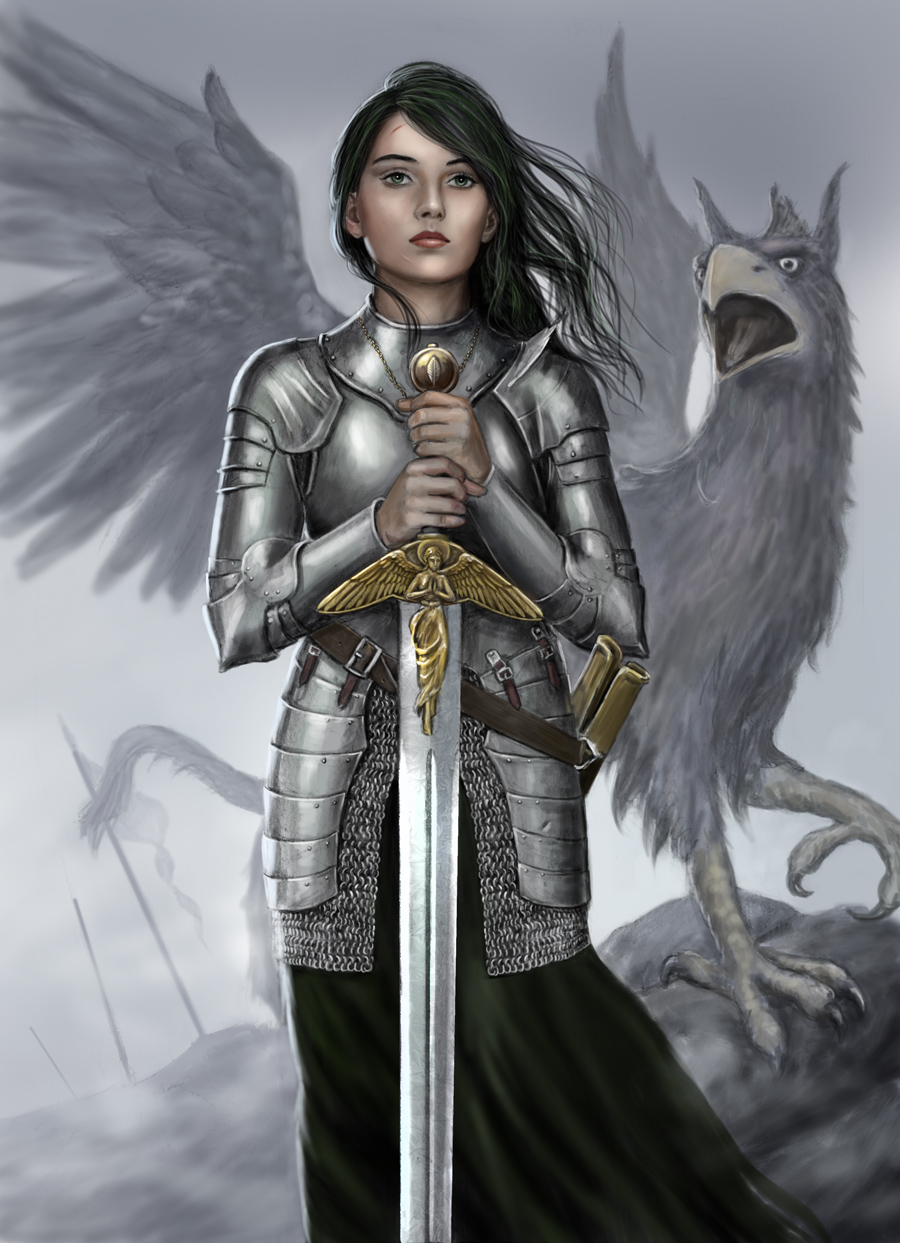
Paksenarrion is such a character.  She's not the sharpest tool in the shed.  She's uncurious, easily led, blind to her own talents, and blind to the shortcomings of others, and these qualities make her a frustrating heroine, though a real one.  Paksenarrion joins a mercenary company, and yet is surprised when the causes she is committed to are not always just.  This seems inherent to we, so wise in the world.  But she's a farm girl, fed on stories of soldiers, and living in a land far from the borders of any cohesive state.  Her actions are charmed, touched by the divine, and one thing she learns, quickly enough is that while she loves to fight, and indeed possesses no qualms about killing, will not fight for causes that are not just.  She loves her companions, and indeed never feels anything approximating lust or desire.  She is asexual, though never termed so.  I have mixed feelings about this, though I think it functions well for a paladin character--though the choice to abstain is in most churchy literature, it is not a consequence of disinterest, the choice to abstain is given as a sacrifice in god's name.  In Islam, it is the greater jihad, the fight to deny one's baser instincts.  Though more dark fantasy has embraced women as fully in-the-world, capable of desire as much as men (and not just mere foils to men's desires', trophies and patsies to the hero) Moon's beautiful rose is truly white. To wit, a modern asexual woman, is itself a massive break with stereotype.  
No author caption here: fell down the rabbit hole
However, the Deed of Paksenarrion is about paladins, and their becoming. In my Forgotten Realms readings, I have uncovered a few characters of priests, such as Adon from the Avatar trilogy.  Even the the Knights of Solamnia from the DragonLance series.  Or also from the Malazan epic, Shield Anvil's, the most devout servants of the gods of war.  Priests are a difficult caste in fantasy literature.  Indeed, books like Harry Potter, and others before it were shunned and castigated by religious organizations like the Catholic Church.  It's interesting to note that fantasy tackles religious matters, and religious organizations all the time, and yet issues of faith, issues that come close to proselytizing are almost always handled at arms-length.

But in a story about paladins, such discussions become central to the plot.  Let us not forget that original of all paladins, was also a female, Joan of Arc.  I found myself becoming uncomfortable at times by the direction Deed was taking. Ultimately, however, I feel that The Deed holds to what is True in fantasy while avoiding the snarls of dogma. And for most of the series, Paks is at best agnostic in her faith.

Artist Unknown.  Seriously, he probably died in a mass grave.


There are some difficulties.  For example, killing even if it is only killing for right is glorified, and there is never a moment of horror, a moment of self-recrimination for the slaughter of enemy combatants.  This is one of the reasons that I began to feel that Paks was not the brightest protagonist.  By the end of the third book, something happens to Paks, and she is broken, a cliche we will discuss later, but her personal struggle is caused by something external to her, something evil that takes root in her, and is then rooted out.  She emerges from the process in rough shape, but her main crisis is that she will be unable to wield a sword again, unable to fight, unable to kill.  Now of course, there are certain aspects of feminism at play.  For example, when Paks finds herself in a barn at night when two churls approach her.  Her inability to fight would have left her in poor straits had not the gods intervened on her behalf.  Now ultimately, the conversion, the self-examination that we want Paks to have, does happen.  But there again, it happens because a druid explains a few things to her.  It's difficult to parse, Elizabeth Moon may be one of those few, rare writers who does not write herself as the main character (not even Steven Erikson can say this).  Moon is a brilliant writer, and obviously a very smart person, but Paks is not.  Writing a dumb character, is I can say with all honesty, absolutely impossible for me.  It's not that I'm so smart, it's that as an intellectual I am constantly assailed by self-doubt and recrimination, things which make a character by nature introspective and thoughtful.  So let us at least say this:  Moon proves her writing chops not in the detail of her world, in the pique of her characters (that's all there) but in that she is able to do what so few writers even attempt to do, to write characters that do not exist within the range of her own "voice."

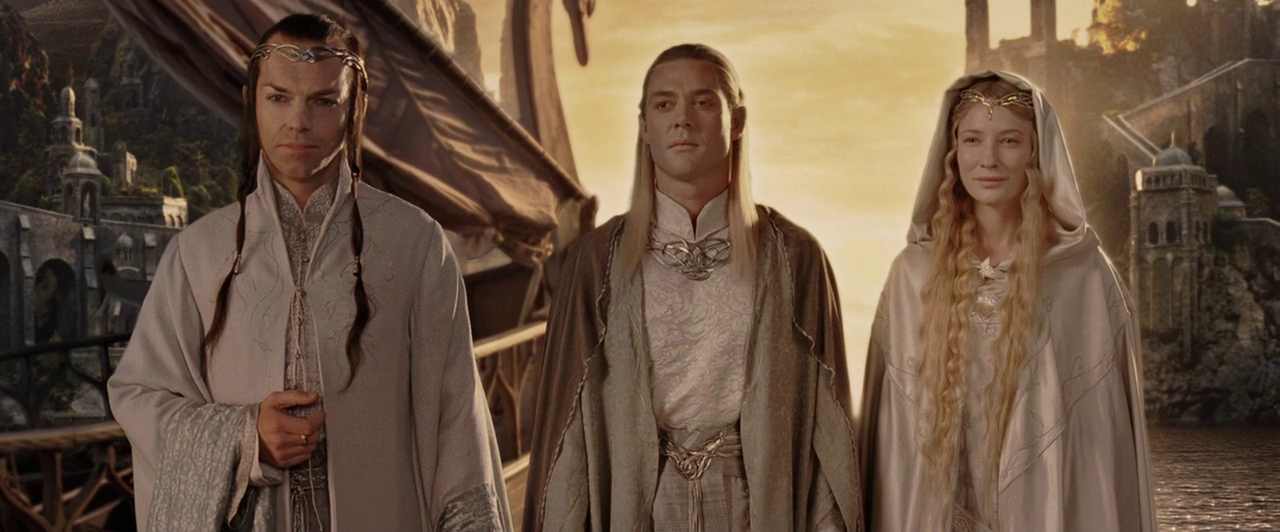
Cliche:This is 80s fantasy, so cliches abound.  We will touch briefly upon the obvious ones, elves, dwarves, orcs, magic. The first book of the trilogy mentions the other races in passing, as well as gnomes, and a few other beasties. However, unusual to fantasy, the first book is almost entirely devoid of extra races. That said, elves and to a lesser extent dwarves, play a crucial role in the overall arch of the story.  As usual, elves fulfill the usual Tolkien stereotypes.  Immortal, tall, otherworldly, slim, beautiful, musical, etc.  One neat thing about the elven component of The Deed is that it references something that other earlier fantasy works maintain, namely that the faerie dwell in a sort of shadow kingdom, a world within a world, different and similar to ours. Though Tolkien's elves left the plane of Middle Earth, during their time in it, they were squarely involved "in the shit" as it were.  Moon changes the Dwarven cliche nicely.  Instead of the beer swilling, anvil hefting, gold digging, creatures we have come to know and love, the Dwarves are very fond of ceremony, and have a peculiar dialect.  Unfortunately, we don't learn much more than that.  Orcs only really emerge as combatants, quickly slain, and with no real reason for being in the story, merely as a side effect of Evil Influence.

However, Moon, may have been one of the first to embrace the Dark Elf cliche, perhaps not even a cliche at the time. Tolkien's world explored the idea of the corrupted elf, Sauron, the ostensible reason for his long lasting evil.  However, Sauron was an exception, there was no race of like minded long-lived evil ones.  (I never did read the Simillarion though, so I can't speak to the whole of his work). Regardless, Moon's Dark Elves are unusual compared to the ones that the Dungeons and Dragons cliche embraced.  They have the fine elven features, pointy ears, are long lived, etc. that all elves have.  But they stink, and they intentionally corrupt all that is beautiful.  I thought this was a really great detail, Dark Elves are the anti-elf in EVERY way in this series.  The Dark Elves end up being a critical plot point for the series, though they make no appearance in the first book at all.
By Gerald Brom

There are dwarves as well, though they play only a minor role.  They fulfill some stereotypes, while trumping others.  Moon's dwarves are different they have a formal speech, though they are boisterous by nature.  A gnome stereotype exists which is quite interesting, though not much explored.  The gnomes of Moon's writing aren't the slightly silly, less strong version of dwarves that you often see in the Dungeons & Dragon Realms.  Their gnomes are fierce like Terry Brook's gnomes, but are strict adherents to order.  Like many creatures faerie (another cliche) they do not believe in gift giving, only in fair exchange.  It's an interesting dynamic, and explored more in later books.

Some of the cliche pages, like TV Tropes, point out that the Lawful Good cliche is in full effect here.  I honestly don't think that's enough of a cliche to pursue.  I do think Lawful Good characters are however, very interesting.  It takes a lot of willful blindness to the world to always follow the law and still be good.  Even a poor execution of a Lawful Good character can show this dialectic.

Adventure Time Cliche:  So in writing this post, I lost an earlier draft, wherein I noted how very much like classic swords and sorcery, dungeons and dragons gaming parts of this book were.  I have no problem with that overall, I've been trying to do the same for some time.  Real drama is created in such games (the good ones) and a story-teller's polish of such events can create real lasting value.  It worked for R.A. Salvator and Margaret Weiss afterall.  I noted that one of the scenarios was Paks meeting of a certain half-elf of ill-repute on the road.  The two join-up, explore a dungeon, and slay a wizard.  But I'd forgotten that they do almost the same thing later on, in Brewers Bridge, the TVTropes site pointed out that it is almost the complete scenario for AD Module 1.  For a more thorough listing of Paks cliches, check out this TV Tropes site.

Completeness: The Deed looks and feels like a complete world.  Throughout the novels, we explore a good portion of the world, and the interconnectedness of nations is well-demonstrated.  The wars of the south, for example, are in large part trade wars, defending various routes to various ports, and various choke points like the castle Dwarfwatch.  These are the sorts of things that real wars are fought over, and I appreciate that detail.  Moon has some military experience, and the battles are drawn in painstaking detail.  Some readers are turned off by this, it seems, but strong detail is never a problem for me.
>

The religious aspect is well-developed without choking, and was not offensive for an old-time atheist like myself.  I've played a few paladins myself, and like I said, I find the character type pretty interesting.  The Gods are real, and come across that way--unlike the idiocy and petty squabling of the Forgotten Realms gods, and still ineffable and mysterious, unlike the gods of the Malazan epic.

There are a few untied threads.  Now, life is a series of untied threads held together by place, time, and financial obligation.  However, those things are tenuous at best in fiction, and untied threads can always be blamed on the author.  That said, many of these threads seem to be tied to these one off AD and D adventure modules that occur throughout the books. Mini-stories, that are engrossing, but ultimately have little to do with the arc as a whole.

The arc is a long one, and many readers get turned off by the slow start.  When Paks soul searching takes it's darker turn, and where it receives it's finest answer is where the book really starts to shine.  It's also where Moon takes the gloves off and shows us some of what evil is truly capable of.  In the end, I quite enjoyed The Deed.  I did find some of its characters to be in part unrealistic, but wasn't ultimately turned off by it.  The Deed of Paksenarrion is worth a read, and doesn't quite deserve some of the heated criticism its received.

Tuesday, September 13, 2011

Homeland, R.A. Salvatore, Forgotten Realms

I was always a DragonLance man, so for many years I figured reading Forgotten Realms books would be treason.  How silly is that?  Of course, they never made a DragonLance videogame worth its salt, though attempts were made on the 386!  Did I date myself or what?!

So my first Forgotten Realms experience was actually through the truly excellent videogame, Baldur's Gate (which is really a precursor to DragonAge Origins.) And I loved it.  Years later, after seeing R.A. Salvatore books on the shelf, and being suitably intrigued.  I finally decided to go for it.  If you want a phenomenal history of the Realms go to Wertzone site

Since I'm taking a break from Memories of Ice to read this, it's interesting to note the stark differences in contemporary fantasy with fantasy from two decades ago.  Salvatore did not invent the Realms.  Far from it--Ed Greenwood did.  I actually a did some research for this post, something I rarely do, but the Realms have a complex history.  And unlike DragonLance whose seminal volumes were all penned by Margaret Weis and Tracy Hickman, the Realms were created by a collective of writers drawing on the maps and notes of an accomplished Dungeon Master.  The Realms were designed to be free floating, more loose than DragonLance which took place in the middle of a continent spanning total-war.

Anyway, the point of all this is to show, once again, that good fiction does not have to be genre busting.  In fact, it can draw on cliche's so overdone as to be boring and repugnant, and still make a good yarn.

Let me say from the outset, I thoroughly enjoyed Homeland, and intend to immerse myself in the Realms, 20 years after their creation.  I have one caveat.  The book, though an absorbing and fun read, is no poetic work of genius.  It's a good romp through an interesting world.

1.)  Character.  Drizzt Do'Urden is the name of the main character for this volume.  I grew up with this cat, though I didn't know it.  I saw his picture on shiny hardcover novels all over the Barnes & Nobles of my youth.  Homeland is definitely a plot based story, nonetheless its characters are compelling.  The story begins with a race of dark elves called the Drow, dwelling in lightless caverns called the Underdark.  I've always found evil races to be an interesting study.  How can such a society function?  All societies are based on trust and cooperation--which is a flat impossibilty for the genetically evil.  And of course, this is a central conflict in Homeland.  The Drow worship the spider Goddess Lolth, who believes in corruption and greed, and encourages her priestesses to war with one another.  However, Drizzt, and his father Zak are different, possessing an inate innocence that puts them at conflict with the larger drow society.  They don't like to kill, yet both of them are singularly gifted fighters.  So the natural conflict set up here is between Drizzt and his entire race, his entire culture, and closer to home, his mothers, sisters and brothers.  Which brings us to cliche.


Mindflayer from FR wiki

2)  Cliche.  Elves, Dark Elves, Coming of Age, Dungeons & Dragons, are all cliches used by Salvatore.  Elves figure only as a distant enemy to the Drow, but as the Dark Elf cliche is built off the Elven cliche, much of the same is true about both.  Elves are long-lived, beautiful artisans, dwelling in nature, strong, yet slight, natively good, and are beautiful to look upon, and inherently magical. All this is true for the Drow, save the natively good part.  The city of Menzoberranzan is carved from stalagtites, and the buildings and temples are designed to look like spiders.  A thoroughly disgusting concept, yet one requiring a degree of skill in art and engineering to execute.  The drow live as long as elves, except for the fact that they keep on killing each other.  This means that despite the native difficulty of breeding (elven females ovulate infrequently, like every 50 years or so) a concentrated effort is made to breed, since family strength is a direct and certain route to power.  This culminates in some interesting breeding practices practiced by female drow. The drow is likewise beautiful to look upon, but they have black skin and pure white hair.  Like elves, the drow is capable of casting spells from an early age, and all drow are capable of casting certain spells, regardless of caste.  Which brings up the Dungeons & Dragons cliche.  Every single item or monster in this entire novel has a series of stats to back it up, from the adamantine twin scimitars which are Drizzt's hallmark, to the tentacular mindflayers who dwell in the Underdark.  Anyone who ever played Dungeons & Dragons knows the mindflayer intimately, even those who didn't ever have to fight one, the picture was just so frickin cool you had to look at it.  These cliche's for the most part are informative.  However, for a non D&Der, and we're dying out, some of the cliches are just obscure.  Halfling and Gnomes.  All manner of small people.  Halflings are familiar because of the Lord of the Rings, but most people are familiar with the term hobbits instead.  There are no hobbits in Dungeons & Dragons.  Just halflings.  Gnomes are another one.  We're all familiar with garden gnomes, those cone hatted, blue skirted small creatures, but just how are they different from dwarves?

3)  Scope.  The scope is immense and confined all at once.  The Realms are hard and fast.  Ed Greenwood's world is all mapped out, its creatures are decided, it's politics analyzed.  It's open ended in terms of story telling, but the world, like ours has a physics that is entirely determined by the roll of six, eight, twelve and twenty sided dice.  This makes for a very interesting fantasy setting.  Half of the joy of fantasy is discovery, does the comprehensive mapping elminate this joy?  It turns out, no.  I look at they world map, and I wonder what famous warriors have traveled to Cormyr?  Who is the greatest wizard in Waterdeep?  All this and more, after reading Homeland, I intend to find out.  Now of course, I wonder, how should I read these books?  Drizzt wasn't a character started in Homeland, far from it--he was first mentioned in the Crystal Shard, (again, hat tip to the Wertzone).  I have determined that the best way to do this is to read the books in order of publication, though I may drop off after the first ten books or so.  I always found that the splinter novels in the DragonLance series were of a drastically lower quality, and that the events that occurred in these books had no play in any of the more central literature.  Even so, the more limited scope is Menzoberanzan, the drow city.  And in this Salvatore is the acknowledged champion.

4)  Magic.  Dungeons & Dragons magic.  After having spent a lot of time with more complex brands of magic.  Sanderson's Allomancy, Jordan's The One Power, Erikson's Warrens, the system of magic in the Realms is reassuringly simple.  Most spells require ingredients, and must be memorized to be cast.  They can only be cast once or twice, depending on the sophisitcation and "level" of the wizard, and then they must be re-memorized.  Magic is important, of course, but having owned the 2nd edition Players Handbook, I know most of them already.  There is no magic to devastate an entire city here.

5)  Theme.  As stated above, this novel is no scintillating work of genius.  It's fast moving, absorbing, with interesting characters and a fun, unpredictable plot line.  It's candy, it's beach reading, even more so than most fantasy is considered to be.  That said, the writing isn't poor by any means--it's just there to communicate a story, not to edify.  There is a tone to Salvatore's writing, but its businesslike and not self-reflective.

This book is definitely worth a read, and it has definitely inspired me to read further.  Unfortunately, my wife has decreed an end to all fantasy books, and so I can't buy anymore of them unless they're grand slams.  (It's not the money so much as it is the space on our shelves)  I think I see a Kindle in my future.