Search This Blog

Showing posts with label Dungeons and Dragons. Show all posts

Wednesday, January 13, 2016

The Wyvern's Spur by Kate Novak and Jeff Grub

This was one of the best Forgotten Realms novels yet. Not only did it occur within the standard realms, a fortified town in Cormyr, it had some truly loveable characters.

It was not a complex novel by modern standards, but after the sanctimonious and cliched writing of the Ice Wind Dale trilogy it was a great relief. The novel continues the events of the Curse of the Azure Bonds, popularized by the SSI one of the earliest PC games in history.  However it takes as it main character a complete nonentity, as we used to say in the biz an NPC, or non-player-character, a drunk partygoer who mimicked the King and nearly died when Alias tried to kill him. But before we get any further let me state simply and for the record: The Curse of the Wyvern's Spur is a thoroughly enjoyable novel.

Character: so the harmless partygoer is named Giogini Wyvernspur, and he's a delight. Foppish and insecure, but undeniably good natured, he returns from the mission that the King sent him on and his apartments in the city suddenly seem too small. He's been bitten by the adventure bug and for the first time in his life he's doing things for himself. His manservant is astonished! When he comes home, he returns just in time to find out that the Wyvernspur family, of which he is the primary heir, has just lost the magical artifact that gave the family it's name. Meanwhile his Uncle, an old but powerful wizard has a very important message for him. The novel is almost written as a mystery novel, which is a nice twist for fantasy, unusual too.

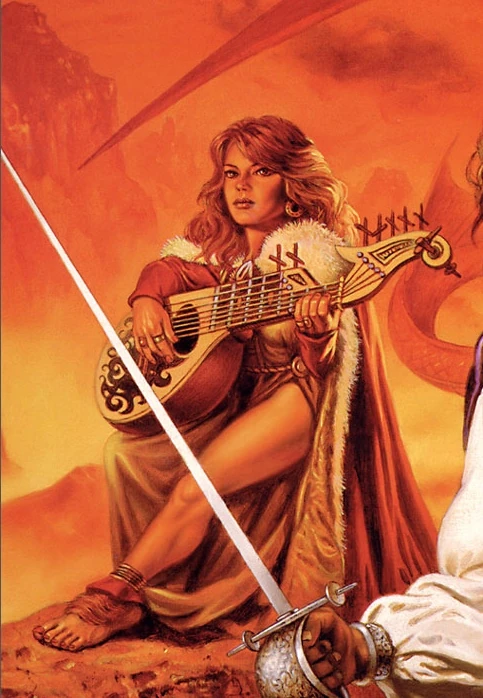
There are only two other characters of note: and one of them is a mystery. The other is Olive Ruskettle. If you remember Azure Bonds at all, you"ll remember the Halfling bard, Olive Ruskettle, whose desire to create a lasting melody provided the foil for The mystery of the azure bonds and the nature of Alias. In this novel, she finds herself back to her thieving roots, having taken on an apprentice. Her apprentice is Alias! But not really, apparently this area of the realms is chock full of Alias copies. Each a different class, none of whom has any idea of her mysterious parentage or fabricated nature. But back to Olive: she is probably the most interesting Halfling character I've read: in general I find them sort of boring.  Like dwarves, they tend to be very one-sided, in the opposite way. They are carefree, disloyal, low level fighters, or thieves. Olive exhibits these tendencies of course, what good a cliche if it's use is completely dissociative. But she also displays real leadership, particularly in Spur, given Giogini's befuddled nature. She seems to have a genuine history if not particularly well explicated, there is a third volume in the series: which if she plays a part will make the Alias trilogy really the Ruskettle Trilogy. Of course there are disappointments, Olive is "spurred" (haha) to help Giogi because of grief over her apprentice's sudden demise, but that grief, though referenced often enough is just not written convincingly.  In part because we do not know much about her slain friend: which brings us to the third character of note, the Alias look alike.

I don't even remember her name, an indication of how soft this part of the story is. Like so many love interests she is a soft amorphous blob, not saccharine, she displays rare moments of pique, but is just not very interesting. That said, this is often true in narrative fiction so maybe it's unrealistic to expect in pulp fantasy.

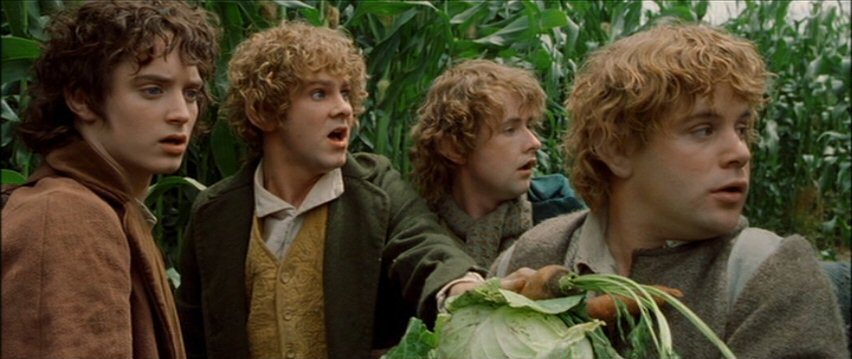
Cliche: we've mentioned the Halfling cliche, what's interesting about this is that what really made the Halfling cliche were Tolkien's hobbits. The hobbits of the Shire are really very charming, quaint and amusing details abound them really bring such characters to life. Unfortunately this charm almost never translates to D and D.
Hobbits everyone knows and loves


The Wyvern cliche is a relatively minor one, possibly not even worth mentioning other than the fact that they are smaller, armless dragons of lower intelligence. They do translate across fantasies, notably Erikson's Malazan epic has a small if memorable place for them.

Obviously all the D and D cliches apply. One cliche that sticks out a bit in this book is the magic-user D and D cliche, including: the mechanics of spell book casting, magical properties of spell components, scrolls, memorization etc.  It reminds me that aside from historical accuracy (relative accuracy) the main reason for such contrivances was to impose limitations on characters that would otherwise be far too powerful in a game setting. Compare that with the sweeping powers of Anomander Rake or Rand al'Thor. The limitations provided an additional layer of strategy. Fighters went forward to cover the firepower of spell casters. Spell casters could exert enormous force on massive monsters or provide a distraction to beleaguered fighters. I still remember the Fall of Pale from Gardens of the Moon and how it shattered my spell casting memes.


Another cliche explored in this novel, a more generalized cliche is the Whose Yer Daddy cliche. Given the preponderance of this cliche in literature I'm sure there must be some more technical name, but I can't resist it: who's your daddy? The cliche for children with mysterious parentage. Rand al 'Thor, Garion from the Belgariad. In this case, Giogi's father was a great adventurer whom the Crown relied on for certain dangerous tasks. Of course, Giogi's Aunt Dorath, herself a colorful, if minor character, hides the secret of Giogi's parentage.

Which brings us to Completeness. This novel is a tightly polished miniature puzzle and all of the pieces fit together extremely well. It has drama, love, high magic, the undead,and best of all a genuine warmth and sense of humor. It is self contained and there is no sense that the third novel in the Alias series will have anything to do with Giogi (more's the pity.).  We did learn a bit more about the Realms, about the nation of Cormyr. King Azoun, part of a long running dynasty is a relatively fair ruler. There is an interesting form of patronage at work: successful adventurers can be given land and title as governors of the land though they are not granted nobility and the title does not pass through the family  line, unless the governor marries into the local nobility.  One nice thing about the story is that since it stays in the same locality a few nice details have time to come about.

So, on the whole, this is a decent novel and might even be with a reread a few years from now. High praise indeed for a Forgotten Realms novel.

Monday, October 5, 2015

Halfling's Gem by R. A. Salvatore

Given the empire of Forgotten Realms fiction that R.A. Salvatore has put upon this earth (nearly 22 novels), you'd think the first three novels of his would be classics. Forbes did a great interview with the author, and in it Salvatore gives us a plausible reason for this:


“You don’t have to start at the beginning,” he tells me. “Contrast that with George Martin or Robert Jordan and the way they did their series. You couldn’t pick up the sixth book of Wheel of Time and read it, I don’t think, if you hadn’t read the first five. With the Drizzt books you could pick up the 6th book, the 10th book, the 15th book, the 20th book. It’s more like Sherlock Holmes or James Bond.”

Of course, that is the very definition of pulp fiction, and why Martin and Jordan are hailed as serious authors who shook up the world of fantasy fiction.

Halfling's Gem was an atrocious train wreck that I barely feel deserves a review. Not as bad perhaps as Spellfire, but up there.

Halfling's Gem concludes the Icewind Dale Trilogy. The plot continues the drama between the Calishite assassin Artemis Entieri and the dark elf Drizzt Do'Urden, as they fight over possession of a Halfling thief. Also appearing for the first time, the man who put the price on the halfling's head, Pasha Pook.
Artemis Entreri


The plot ... is ok. Where this book repeatedly fails is in the juvenile level of the text. Juvenile isn't quite correct because even teen literature is often more nuanced.

Character: Halfling characters get the worst treatment. At least Douglas Niles and Kate Novak used female dwarves and halflings. The D and D rules made these characters pretty limited but creating an interesting back story could have at least made Bruenor more palatable. So SPOILER: Bruenor is assumed dead at the start of the novel having ridden a flaming dragon into the abyss. And a neat part of the book is the discovery and fight through the abandoned city, but for whatever reason Salvatore spoils the surprise for his characters and has the all knowing and all powerful Drizzt realize long before the reveal that Bruenor may yet live. Salvatore had a chance for his characters to explore the very real emotions of raw grief, and he shied away from it to point out, yet again, how cool Drizzt is.


Wulfgar is also pretty terrible. We discussed in my review of The Blade Itself the Barbarian cliche. Wulfgar is that cliche, no twist, no subtlety, if you wanted to describe the Barbarian cliche in one word, that word is Wulfgar. The emotions that Wulfgar feels are simple: love, anger and grief. About as skin deep as you can imagine. Grief is not the mere absence of that which is held dear, it is the cacophony of successive failures, missed opportunities and piercingly poignant memories replayed continually within a mind unwilling or incapable of stopping itself.

I guess what I'm saying is that Salvatore keeps telling us when he should be showing us. A classic writing criticism.  This was 20 years ago, I'm hopeful that Salvatore's technique has been honed by 20+ books.

Last, we have Drizzt, in the second novel in the trilogy we learned that he felt his meeting with Entrieri to be a fateful one. That there was a strange connection through skill of arms with the assassin. While this morbid curiosity might have added a dimension to Drizzt's personality, it fails as Drizzt is forced to utter trite truism after trite truism.  It's sad because I've begun to suspect that Drizzt is actually a fairly deep character. For example Drizzt is offered a magic mask that makes him white. And he uses it because people fear the drow. But he comes to quite enjoy the anonymity and access the mask allows him. The notion of "passing" is an extremely loaded one for African Americans and its place in this banal fantasy novel is notable. Another moment has Drizzt stealing a kiss from the unconscious Cattie-Brie. A kiss which is never addressed again. 

As a general rule: If you were to strike every single line of dialog from the book, it would be immeasurably improved.

Cliche: all the usual D and D cliches apply, so I won't waste any time but to list them: Dwarves, halflings, elves, Dungeons and Dragon's Race Cliche, barbarian.

Some new ones include The Kidnapping, the Middle East and the Thieves Guild.  The Kidnapping is pretty self explanatory: it's a common fiction cliche, helpless child/girl/Halfling taken by force on a long journey, vengeful heroes hot on the trail, always close, but never quite catching until the final pages. One difference here is that the Heroes give up catching the assassin fairly early on and simply make for the final destination. One famous example of the Kidnapping motif would be from Tolkien's Two Towers when Pippin and Merry get taken by the Orcs.

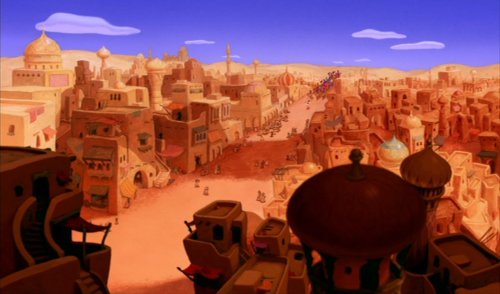
Agrabah, or Calimport by Disney
The Middle East cliche  is a common one as well, Calimport is clearly a middle eastern city, and it's denizens, though magical (halflings, humans and wererats follow the same dress and speech patterns. This type of Orientalism would be offensive to some, but the point of the cliche is to save time and space. Calling to mind a westerner's idea of a 1300th century Middle Eastern city provides leagues of description without straining the readers imagination.  As I get older, and my anthropologist wife teaches me to be more sensitive to and less tolerant of micro aggressions that form the undercurrent to overt racism, I begin to wonder about such tropes, and I begin to understand why so many authors have attempted to create whole new worlds, absent of these cliches.
The internets are loaded down with Skyrim images.  Best I could come up with.

The Thieves Guild cliche is an incredibly common one in fantasy.  One the one hand it gives voice to a real world occurrence in a fantasy world, that of organized crime, and on the other hand, it speaks to the shadow economy that likewise exists in every city and state, the sale of untaxable, untrackable, and unregulated goods.  One thing that the Thieves Guild cliche does frequently in fantasy, however, is to neuter the more dangerous and pyschopathic elements of such a community.  To Salvatore's credit, his thieves guild is pretty despicable.  Pasha Pook the crime boss of Calimsport runs the guild with the aid of three henchmen, a dark wizard (fairly servile, as evil wizards go) the deadly assassin Entrieri, and a runaway pack of were-rats.  Though the subplot in Halfling's Gem of trouble in Pasha Pook's organization is never really explored or prevailed upon in any major way, it does give voice to the fact that such an organization would be almost impossible to govern.  But If you're looking for fantasy mafia stories to thrill and awe you, leave Halfling's Gem on the penny shelf, and pick up Scott Lynch's Gentleman Bastard trilogy.


Completeness:  Sadly, I think Halfling's Gem is not the end of this pitiful story.  As the action closes and the heroes sail away righteous and victorious, we know a larger battle is on the horizon as the dwarves of clan Battle Hammer are massing to retake the mines of Bruenor's father.  Still, this story does wrap up the unexplained nature of the halfling's powers and the mystery of how he obtained his magical gem.  It also sheds further light on several new areas of the Realms.

As I become more home in the world of the Realms, I see that there is very little overlap or common knowledge.  Virtually none of the stories I've read or reviewed so far even occur within the same thirty year period.  While, this excites me on some level to know that the breadth of the history of this place is huge, it also feels sloppy and haphazard in the retelling.  I have attempted to follow the date of publication for these books rather than take a timeline version of the books approach.  I chose that route because I want to see the vision of the realms as its actual creation was occurring, not as a second-guessed, revised version.  However, this choice has lead to some frustration on my part.  Right now the only common element is Elminster, and he's kind of crotchety and fallible for an Old Wizard type. 

On the whole, I'd say feel free to skip the Icewind Dale Trilogy.

Monday, March 23, 2015

Dragons of Autumn Twilight by Margaret Weiss and Tracy Hickman

So, Dragons of Autumn Twilight, and indeed the DragonLance Saga was one of those formational books in my career as a fantasist.  The timing was apocryphal, 80s fantasy was proliferating, and the fantasy section of Waldenbooks (remember them?) was expanding from four shelves to an entire section.

But the writing was still in its infancy, it was a simpler time in fantasy.  Which is not to say that there weren't complex characters or narratives, merely that the expectation was merely swords and sorcery, not quality. Just about anything with a sword or dragon could qualify back then.

I say all of this because Tor has commenced its own DragonLance reread, and both bloggers, Jared and Muvesh, point out the text is simplistic and rife with cliche.  They're not wrong, but they started their reread with the creme de la creme. I started my reread with the dreck that is the first five novels of the Forgotten Realms books.

The Tor bloggers also point out what I have mentioned in my Forgotten Realm reviews, namely that these novels are limited by the fantasy rules of Dungeons & Dragons. Jared and Muvesh come from two different backgrounds, Jared obviously played the game "way to roll a 1 beardy!", and Muvesh came to the novels fresh, having grown up far far away from the kitsch of American consumerism in the 80s.

I actually purchased the DragonLance module for the D&D world, intending to Dungeon Master it for my friends. Unfortunately, my friends "grew up" before I did, and so I never got the chance. But I've actually seen the stats for the story's heroes. If you recall, or if you were born after 1985, the stats were rolled with a six-sided die. That I even had to qualify the number of sides for you is pretty indicative of the type of geek I'm talking about. All of this to say, the highest number you could get, at least in the original rules, was 18. The better your stats, the better your character's chance of hitting, dodging, casting spells, attracting followers, etc.  All of this was rolled into those first computer games, D&D and 4-bit Heroes of Might and Magic. Except for the fact that the game developers learned pretty quickly that if the same number of missed swings continued in battle, they would kill their market pretty quickly.

I bring this up because I remember being slightly puzzled by how low the stats of all the DragonLance Heroes had actually been, except for Raistlin whose intelligence was a stunning 17. As a young teen none of us wanted our heroes to be ordinary, so we gamed our dice until we came up with a number we felt comfortable with. The Realms computer game Baldur's Gate came up with a clever way of bypassing this, let the computer roll your stats, and then get a few flex points to tailor your character as you wish. Point is, the Heroes of the Lance were rather ordinary.

Anyway, Dragons of Autumn Twilight was published before even the first Realms book came out, so there was some real trailblazing here.

Character: Tanis, Raistlin, Caramon, Sturm, Flint and Tas. Need I say more? The figurehead, the leader,
and the character we all loved unequivocally, was Tanis Half-Elf. The product of rape, a dichotomy of elf and human, long and short lived, noble and peasant, lustful and pure, courageous but filled with self doubt and inner torment.  And a love triangle!  In Jared's reread week #2, he points out that DragonLancers fall into two categories, Raistlin or Tanis fans.  If this is true, then I confess I am probably a Tanis fan.  Though I do love the character of Raistlin, his all-consuming thirst for power was less interesting to me then the painfully torn personal anguish that Tanis felt.  In retrospect though, the writing of Tanis' inner torment is of a lower quality then that of Raistlin's.  That said, Tanis is the story's main hero, its leader, and there is just more detail regarding his thoughts and feelings.

The Twins, Raistlin and Caramon, darkness and light, Mage and warrior, ambition and loyalty. These two were so beloved that Weiss and Hickman wrote an entirely different series for them! I recall an interview with Margaret Weiss where she told us that Raistlin was her favorite character. The dynamic of the Twins told us so much of human nature.  The desire to protect and help our lesser brother, as the warrior Caramon so often did with Raist. The desire to be free from physical constraint and independent, as Raistlin personified. And ambition, oh, so much about ambition.  And it's converse.  Caramon's greatest desire, his most fundamental ambition is to make lots of babies with Tika Waylan, and live on a farm with his kooky brother as one big family. In stark contrast to Raistlin, who would one day challenge a god with his magic, not to vanquish her evil, but to consume and supplant it!

Then we had Sturm, himself a conundrum.  A boy aspiring to the past glories of knighthood. Trying to live the code, My Honour is my Life, yet knowing that he was no knight in truth, and the organization he worshiped, the Solamnic Knights had grown petty and powerless. As a teen, it was Sturm who captured my imagination.  I had the Death of Sturm, that famous Larry Elmore painting, taped to my college dorm room wall. His courage and his sacrifice were symbolic to me of all that men were meant to be. On my reread, I realize now that Sturm was also incredibly angry and intolerant.   Something
that probably appealed to me then.

Then there were Flint and Tas, the crusty dwarf and the irascible kender.  As a side note, I learned last month that in those early days, TSR the owner of Dungeons & Dragons was involved in a number of disputes with the the owner of the Tolkien merchandising, one Saul Zaentz. Possession of the term Hobbit was one of them, and by 1978 per Sacnoth's Scriptorium the most obvious terms, Ent, Hobbit, Nazgul, etc. were gone from the franchises. TSR compensated in a variety of ways, creating Halflings and Gnomes in the Forgotten Realms, Kender, Gully Dwarves, and Gnomes in the DragonLance series. While all dwarves seem to assume fairly typical clichéd attributes, and Flint is no exception, the splinter races of Hobbit take on a variety of different tropes. Gnomes are tiny but ingenious and industrious, Gully dwarves are filthy, uneducated and the lowest caste, and kender are the fun loving scamps of the tiny person world. Tas was one of these, and it's the relationship between these two that grants Flint a life beyond mere Dwarf cliches. To be sure, even Flint's fury at the kender's antics is fairly cliched, but the Death of Flint still brings tears to my eyes.

There are others, great loves and great heroes, but these are the essential Heroes Party.  Itself a cliche, a group of five or six heroes who compliment each other's skill sets and agree to quest together.

Cliche:  Where to begin?  Let's skip the obvious ones.  Dungeons and Dragons was all about cliche.  In fact, the original rules didn't even have a Dwarf class, the Dwarf was simply a fighter, the Elf, simply an Archer.  I mentioned one above, the Heroes Party cliche.  I note this because the cliche has certainly changed over time.  In the D&D world, the characters were very failable, your heroes died all the time.  You could get them resurrected without too much trouble, but only if someone in your party survived and was able to haul your keister back. To wit, the parties were larger.  You could have as many as seven or eight people to a party.  More with a good DM.  Parties are smaller these days, and videogames blazed that particular trail, parties are typically three now, with more characters waiting in the background.
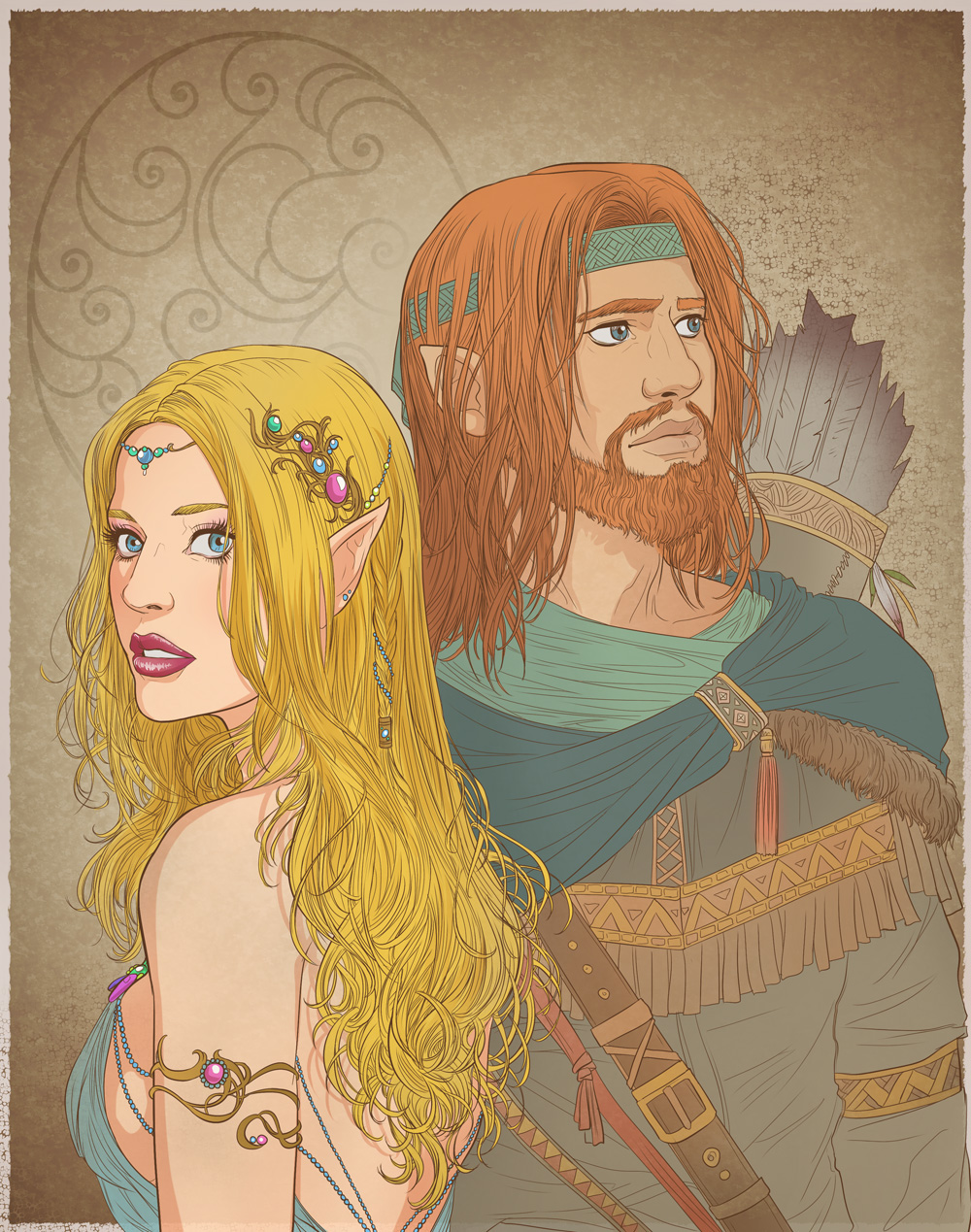
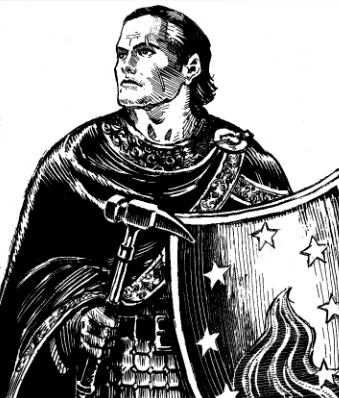
Fan art, tried to find all three together. by Autumn-Sacura
I mentioned the Love Triangle earlier, a cliche but not one native to fantasy.  Tanis grew up in love with an elf maid, a princess of his people.  She loved him back with childlike naivety. But Tanis left because Elves are intolerant to the extreme, big on social purity.  And though humans are no better, human society is much less structured than the that of the long-lived elves.  And his other lover is a human woman who isn't even "good!"

Which calls to mind another D&D creation, the Character Alignment Cliche.  So when creating your character you had to choose two of six attributes, one from a set of three.  Good, Neutral, Evil, Chaotic, Neutral, Lawful.  For a great listing of character of alignments in D&D click here.  Why bother you ask?  Well, despite the massive amounts of rules, D&D attempted to create real story telling.  Which necessitated real characters, which necessitated real thought.  Choosing an alignment was a way of thinking about your character.  In effect, it made the game more fun.  "I will kill this murderer!" says the Paladin, "because I am the arbiter of justice, and because the rule of law says that this man must die!"  "I'm sorry," says the ex-soldier now adventurer, who continues "Though he is guilty of murder, he is also deserving of kindness.  He murdered only to protect his kin!"  Part of what made the Party system so interesting was that you had to have your six or seven heroes all get along together!  You don't see this cliche too often anymore.

As the Tor blog pointed out, the book begins in an Inn, a symbolic setting for the Dungeons & Dragons meme. And the Inn certainly manifests itself often enough in fantasy to warrant its own cliche. the jovial innkeeper, warm fire, large bosomed barmaids. Or it's the Evil Inn cousin, think shifty innkeeper, slatterns, and nefarious doings in the corner.  But in Dragons, it's the Inn of the Last Home, where friends gather to eat Otik's famous potatoes and flirt with the luscious Tika Waylan. And so the epic starts as Friends gather after a long absence.

Completeness: I talk sometimes about scope, and in this simple thematic device, that of old friends meeting, the book establishes a complicated history from page one. Why did the friends part? Where did they go? Why are some together, and some separate? Were there mixed feelings, old dramas, triumphs of old? What about that sensation we've all had about life: that the past is dead, never to be felt again.  That you can't go home, and that memory is always different then what was.  I actually can't think of another fantasy book that begins quite this way. The Eddings' Belgariad had old friends meeting up along the road, but off hand that's it.  For all it's tropism in the Dungeon & Dragons world, it is fairly novel.

"Dragons" suffers from a very obvious and perfectly explainable completeness issue: much is purposely left unexplained. The back story to the characters is only alluded to within the trilogy.  Other authors were contracted to pick up the yarn and finish these quests.  This was frustrating in the 80s, as the other authors were never as strong as Weiss & Hickman.  In some cases entire chapters seem to be left out.  That said, Dragons was a pretty thick book for back then.  Particularly given that the average "game module book" probably ran about 250 pages.  It might well be that some of the missing content was merely cut for size.
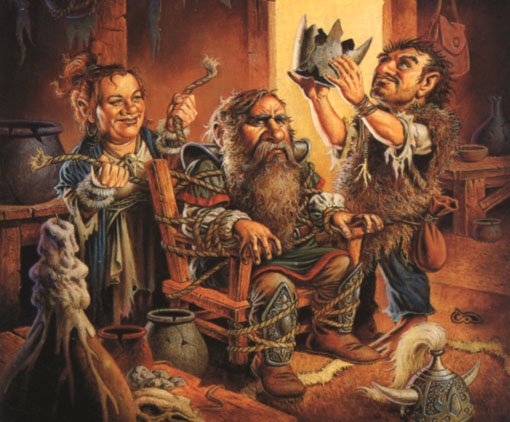
Flint the King, what Flint did during his 5 year trip

There are a few interesting points I wish to make here.  In almost all fantasy genres of the 80s and early 90s, the basic baddy, the foot soldier of evil was more or less incomprehensible, the other, alien and bestial (orcs, trollocs, demons.  Not so in DragonLance.  Hobgoblins and Draconians are fully sentient, frequently speak the common tongue, and are sometimes even playable races within the games.  So when, in that first chapter of Dragons, Tanis and Flint have a conversation with Fewmaster Toede (a hobgoblin comic-relief villain) it's almost shocking.  Usually when orcs appear, swords are drawn, and orc blood rains black from the heavens.  There is no discussion, no capacity for empathy.  It's just kind of a neat thing.  For all that Jordan advanced the genre, the only conversation he ever had with a Trolloc was one where it was being tortured for information, or attempting to trick its human target.

Fewmaster Toede, almost all of these images are Elmore originals
Last, what Dragons lacks in completeness, the game module, the other books in the series, and the other books in DragonLance as a whole compliment and fill utterly.  Though the book itself seems riddled with holes, you can rest assured that everything is explainable with reference to some rule in the Player's Handbook or in the lore of the series, or even in the fanverse that has, in the intervening years given these books a completely new life.

Having completed my reread of the first novel, I still love the Heroes of the Lance.  My admiration for Weiss and Hickman remains, though it is tempered by the amazing writing of what the future of fantasy would soon hold.

Saturday, January 31, 2015

Shadowdale by Richard Awlinson

So this may be the first book in the Forgotten Realms series that I have really enjoyed, and have found to be a fairly mature story. It also was written in 1989, and while it still follows a fairly staid Dungeons & Dragons, hero's quest, type of format, it's characters have a great deal more depth, then even R. A. Salvatore's entry into the realms
over the same time period, (Streams of Silver). The troubled heroes actually have back story! Best of all, the story ends in a large, well detailed battle scene with gods, demons, and thousands of troops.

One thing I found troubling, if only in a vague way, was that the premise of this series of books is that the Gods have been banished from the planes by the über god Ao. And as such, they are sent to dwell as humans in the Realms. Now, alongside the release of these books, were actual campaign materials detailing the stats of everything that existed in these worlds.  So, when gods are killed in the  course of this story, were these gods listed in the materials? Or were they Awlinson's creation for the purpose of this particular tale.  The Arrival, as it is called, would have to be a pretty big deal in the worlds history, particularly in light of the fact that magic seems to stop working, and clerics spells only work in the physical presence of their god. So, is Shadowdale adding to the canon of the Realms, or is it just a one off? From this link, it turns out that the Realms Creator, Greenwood actually did conceive of Bane.

When I start reading the books written in 1990, I hope to see reference to the Arrival and the events that followed.  I know that the events that occur in Darkwell, and Streams of Silver are quite independent of this apocryphal event. Though, they could well have occurred prior (or long after) the events herein.

The most enjoyable attribute of Shadowdale is story's heroes, Midnight, Kelemvor, Cyric and Adon. The story begins as these unlikely adventurers skip town on a guard duty contract, although why you would want your city guarded by men on forced contracts enforceable by prison sentences is beyond me. Why? To aid a mysterious girl, whose mysterious mistress is trapped in an old ruined castle.

Kelemvor is ostensibly the most developed of the heroes. A fighter with a terrible curse laid upon him. This curse forces him to only engage in human relations on a contractual basis whereby he is promised a reward, and then actually receives it.  If he does not, (spoiler alert) he turns into a hideous beast. This makes him seem hard hearted. Now, if Awlinson had opted for a shallow character, the curse not withstanding, once removed, would allow Kelemvor to be the selfless hero we all want him to be. However, it turns out, that he is, as all real people are, much more complicated then this. He stays to defend Shadowdale against the Zhentarim, but not because he cares one whit for the people of Shadowdale. He stays because he loves Midnight, and is promised her love, as the basis for the contract. Imagine knowing, as a lover, that your partner may love you, but they can only be with you while under the terms of a very strict contract.  I quite like this twist, and it is in stark contrast to Salvatore's Drizzt Do Urden, the dark elf with the heart as big as the Realms itself.  As a note, if you are, as I am, reading these chronicles for the first time, DO NOT google Kelemvor.  I just inadvertently spoiled the next two books for myself!  Don't click on this.

Cyric is another interesting guy. A thief, turned multi-class, fighter. That's a term from the old days. At first in the D&D world, you had to choose, fighter, thief, or magic user. In later editions, more classes emerged, and in the advanced rules, your fourth level thief could choose to become a fighter. He would retain his thieving skills up to that level, but he would then have to level up as a fighter instead. You could also choose to level up both, but it'd take forever, so most people usually simply switched.  As a boy, I thought this was cheating (having your cake and eating it too. Don't like the paltry hit point scores of a thief? Multi-class him and have the best of both worlds). Now, as an old man, I know that we wear many hats in this lifetime, and we frequently put earlier chapters in our lives completely to bed.

I digress. Cyric was born in Zhentil Keep. First in Spellfire, and now in Shadowdale, we are introduced to Zhentil Keep, as a city that worships the evil gods of the Realms. I find this to be a really interesting concept. Say what you like about cities, but for them to exist, a certain amount of cooperation is required. A certain amount of trust. After all, a contract is a promise, and not all goods can be paid for up front. For a promissory note to hold value, you must trust its issuer to fulfill the obligations therein. And trust cannot exist in a city of Evil. Unless, of course, it's not all Evil. Which reminded me of my favorite St. Augustine quote, "And even when men are plotting to disturb the peace, it is merely to fashion a new peace nearer to the “heart'’ desire; it is not because they dislike peace as such.  It is not that they love peace less, but they love their kind of peace more."

So I was eager to learn more about Zhentil Keep, from the character of Cyric. He was a thief and a murderer, but his most ardent desire is to be free of his past. To be free from the shackles of the Thieves Guild that made him what he was. He too could care less about the people of Shadowdale, and in fact despises them for their apparent weakneses of trust, love, faith and optimism. And he too, opts to stay and defend it from the approaching army. He's also an atheist, which is pretty hard to be in a Realm where there are actually gods. Like I said, for a fantasy novel of the late eighties, this is pretty deep stuff.

My favorite character, is Adon. Adon is a cleric of the goddess Sune, the Realms' Aphrodite. He is incredibly vain, in a harmless, humorous way, and finds himself being chased out of town by a woman who somehow managed to resist his charms. Adon loves the ladies, and he is a firm believer in beauty. Which makes his devotion to Sune all the easier to believe. After all, to believe in beauty one must only know desire and possess eyes. This would all make Adon pretty one dimensional, save for the fact that as a cleric in a time where the gods have descended, he has lost his powers, and has made no effort to find the avatar of the goddess living within the Realms. Neither for his belief, nor for the powers it gave him.  Which, is, odd.  And then, in the last sixty pages, something happens to Adon which is definitely not expected. And he becomes a completely different person overnight. Who he is, we do not yet know. His tale will likely be continued in Shadowdale's sequel, Tantras.

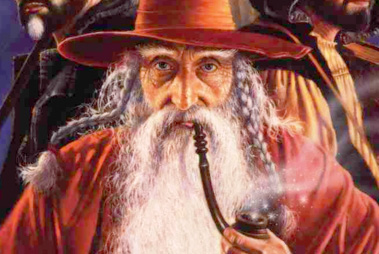
The last point I'd like to bring up is about that old sage, Elminster.  I've been hearing about Elminster for nearly two decades.  He's the Realms version of Gandalf, a long lived wizard of power to rival the gods.  Up till now we haven't learned much about him.  In Spellfire, we learned he had a dalliance with a student, who turned into an evil sorceress.  We also learned that he is short tempered, and humorous.  In my mind, I had always equated him with Dragonlance's Fizban, the bumbling old wizard who happens also to be the God Paladine.  But Elminster is definitely human.  This will probably make him a better character over all.  Though I must say, I rather miss old Fizban and his disastrous Fireball spells.

One last note. Shadowdale, Tantras, and Waterdeep were all released in the same year. Leading me to believe that they were written as one novel and broken up to sell more books, and to be more readable. It also suggests that Awlinson began these novels around the time that Niles, Greenwood, and Salvatore were composing their own founding works.

This was a good read, and if you're looking for some lite fantasy to get you through à lull, this would be a good choice.

Monday, January 19, 2015

Darkwell by Douglas Niles

This marks the final installment in the Moonshae Trilogy.  And, as I am going to start writing shorter blog posts, let me simply outline a few points about the series, about the Realms, and about this particular novel.

The Moonshae Trilogy are some of the first books published in the universe of the Forgotten Realms, published in 1987 to 1989.  And this was a period of great schlock in the fantasy genre.  And these books fit the bill.  They are pure swords and sorcery.  Dungeons and Dragons at its most obvious level.  In some ways, though the books were intended to help sell the games, and vice versa, the books are fairly limited by the universe of the D&D world.  Anyone who has ever read the Players Handbook has had their eyes glaze over with the sheer number of rules, dice roles, and mathematical calculations required for even the simplest of actions.

So when a level six druid casts the level three spell Plant Growth, what happens can be described anyway the dungeon master wants, but at the same time has to adhere to a very specific set of limitations.  And in many ways these stories of the Forgotten Realms are just that, well DM'd stories by a group of players fulfilling quest objectives.

Or the DM can break the rules entirely, as they sometimes do.  But breaking the rules is dangerous business and it can backfire on the author.  One nice thing about writing in a new, or less proscribed fantasy realm is that the limit is your own imagination, and the rules are yours.  Breaking your own rules creates problems too, but a re-envisioning of said rules, an enlarging of the paradigm, is a simple escape from these sorts of problems.

And in each of the Realms books I've read (and I've only read up to 1989) you can literally see spells being cast out of the Magic User's guide.  When the dark god Bhaal creates his evil champions to battle the heroes, they came straight of the Monster's Compendium.  And they have to, because the main rule of writing in an open series like this is a certain consistency.  Still, I'm not sure how I feel about a Displacer Beast being a big bad.  On the one hand, it recalls my egregiously misspent youth (playing with dice and pencils when I should have been out drinking and having sex) on the other hand, the sense of horror and intrigue created by the unveiling of a "new monster" is almost entirely mitigated.

Up until now, just three years into the history of the Forgotten Realms, the books have no inter connectivity, save for a few common city names.  The tales have begun at the far ends of the Realms and have involved relatively little geography.  Though R.A. Salvatore's Icewind Dale series has some decent travel.  Ed Greenwood's own first novel, the man behind the Realms,  taking place in his own world was simply atrocious.  Spellfire has to be one of the worst books I've ever read.

This was never the case in DragonLance, which had such a serious and continuous narrative of the War of the Lance to underscore the personal dramas within.  That said, the Realm of DragonLance was much less flexible, and probably why the Forgotten Realms have, I think, ultimately triumphed in the worlds of TSR.  Anyway, my next book in this series is Shadowdale.  A town first discussed in Spellfire.  I am looking forward, finally, to some crossover.

Last point, about Darkwell.  This book was a pleasant surprise.  The characters took some dark turns, and some of the most intrinsic characters actually died.  That said, the book would have been vastly improved if Niles had NOT decided to make it a happy ending.  Meaning boy gets girl, boy gets forgiven, atonement occurs, and they have many happy children together.  If Niles had not pulled his punches at the last minute, his characters could well have lived on to a fourth or fifth book.  The druid heroine, Robyn, having turned Cleric after the death of her god, the Earthmother, would not have forgiven the King's infidelities.  And Tristan would have actually grown for it.  If Tristan had been wracked by actual guilt over the death of his friend, then he would never have forgiven himself, and the sadness this engendered in him would have made him a far better King.

That said, until the last six pages this novel was difficult to put down.  And that makes it the best Realms novel in the series so far.

For a nice history of D&;D, look here.

Wednesday, June 4, 2014

Rhapsody by Elizabeth Haydon

Rhapsody is a book that may technically fall under romance, but the author is female and because it was in my list to review it anyway, I'll bring it to the fore. Both times I've read this novel I've really enjoyed it. Elizabeth Hayden borrowed nearly every fantasy trope and cliche in the book, but as I've written before, the use of cliche is the bread and butter of fiction, and when used well creates a yarn that echoes down to the very deepest recesses of our souls. Aside from the standard fiction and fantasy cliches, Hayden borrows liberally from Greek and Norse myth, which isn't typical in modern fantasy. And while children's novels Percy Jackson gets filed under teen fantasy, it isn't necessarily fantasy since it literally uses the Same Greek pantheon that the actual Greeks used.

One thing to note at the outset: Elizabeth Hayden is just a good writer. Tight phrasing, concise character development, she is a writer from the old school. many modern writers allow so much vernacular or poor phrasing into their stories, thinking of it as a stylistic. All it does is point to the simplicity of their writing. Hayden's story telling is masterful.

No great fanfic of what Rhapsody looks like, this is my guess, Taylor Swift
Character  the first 200 pages or so uses only four characters really, so you get an excellent chance to know them. The Foremost is the book's namesake Rhapsody. Rhapsody's character is truly one to fall in love with, not only is she so essentially good and true and honest, she is also so modest that other characters are constantly bemused by her self effacing and willful blindness to the effect she has on others. She's also ravishing, which never hurts. One cliche breaker in Rhapsody's character is that she is a Fallen Woman, while itself a cliche, Fallen Women are rarely the lead characters of stories. They either get redeemed, get their just deserts, or simply get a measure of pity or empathy from the author. Not so Rhapsody, she was a doxy who sold her body freely and readily. Much later you find out that she had certain standards, but given that one of her return clients was a truly abusive and sadistic prick, you get the sense that even her standards were compromised from time to time. Another interesting thing about the Fallen Woman, and something that probably comes from a uniquely female perspective is that she is never redeemed. Without spoiling, an event leads to a certain physical restoration, but the mental anguish that ruined her never leaves her. This, I am lead to believe, is common among the raped. Such intelligent memes are welcome in New Fantasy, where the world is a complicated place.
Achmed, by MeetmebytheSea, Deviant Art

In fact this can be said of all of her main characters and some of the lesser. Achmed the Snake, her assassin friend is a great example of that, a man who is a cold-blooded killer, who despite our desire to like him, remains a merciless bastard well into the third book in the series where he threatens to murder children. On the other hand he develops a real and abiding affection for Rhapsody and becomes her protector. He also wields a truly neat weapon, an unusual device that is a crossbow/sling that fires off steel discs about the size of your hand at great speed. Unusual or magical weaponry is part of what makes fantasy great! The last character note on Achmed is that a turning point in his character occurs well before the entire story begins, through flashbacks and story telling you learn how he was broken. Not broken to become the bad ass assassin that he is, broken from being that bad ass and starting to flee for his life. Which, is how we first meet him. Hayden accomplishes this very simply in iust a few lines, and it seems utterly horrific. Like I said, tight writing.

There are many great characters, however it deserves mention that at least one of the three main characters is very simplistically drawn, the half ogre Grunthor, who speaks in a cockney accent and "sure loves tha lil' miss". Still he is a character intended to draw your affection, and to anchor you in the story, and he accomplishes both adroitly.

Cliche In doing research for this section (yes, I do research, I ran across a truly excellent website, www.tvtropes.org.  They have an interesting quote on their front page, that I thought I'd reproduce for you:  "Tropes are devices and conventions that a writer can reasonably rely on as being present in the audience members' minds and expectations."  They differentiate them from cliches, which is fine. For my purposes I will continue to call them cliches simply to keep my posting and listing of them, paralleled.   In Rhapsody, I will simply list them to start, as usual, where I haven't mentioned them before I will give them names. The Power of Names, the Broken Homeland, star crossed lovers, Welsh, Dungeons and Dragons, the BFG (or the Shrek), the Fallen Woman, the Bard, A Time to Remember, the Great Tree, The Druids, the sleeping child, the purification, the wise old man, the Greedy dragon. Phew: there are more, but I can't go on forever.

The Power of Names: this cliche is one of the most basic in fantasy, and in its cousin angel/demon/ghost/vampire lit. The concept that to know the name of a thing is to have power over it. This sort of cliche harkens to the Islamic belief of not being pictured or the Indian belief in totems, the Christian belief of not naming the devil, or the Jewish belief of not naming, or writing the name of God. In this case, Rhapsody is a Namer, an invention of Hayden's and it basically means she has the power to rename a thing, thus breaking the yoke of someone else knowing your true name, or healing or protecting someone through the power of knowing their true name. It's a neat concept and it was well done.  A concept Patrick Rothfuss, knowingly, or unknowingly aped in developing his Name of the Wind series.

The Fall of Atlantis, by Gaius31duke at Deviant Art
The Broken Homeland this is a neat one and much more rare: there is a place, in this case an island, where a certain race, group or sect of people, all of great power or technology, came from, and it was destroyed by something great and terrible and inexorable. Some examples: Atlantis from myth, but also from Stephen Lawhead's Merlin series. Valyria, where Martin's Targaeryen's were from. Tolkien's elves are said to have left from their own plane to come to Middle Earth, presumably Upper Earth. The Tiste Andii, of Erikson's world fled mother Dark's wrath and left their home city a smoking ruin. Here the island is named Serendair, and the island was immolated by a giant meteor (arranged by, we learn, the evil F'dor) and though it's people are largely normal, the ocean voyage of the fleeing inhabitants all become immortal as they wander the seas for years crossing untold lengths of ocean.  My research here lead me to this essay from Robert Moss, on Tolkien and Atlantis.

Romeon and Juliet, outside the Papp Theatre in NYC
Star Crossed Lovers is a common cliche in all fiction, and the phrasing of my cute name for the cliche, itself harkens from Romeo and Juliet. It means a pair of lovers chosen by fate to fall completely in love are ripped apart by events out of their control, and wander the world in desperate search of their other half. Plato's Symposium had a good example of this in Aristophanes tale of the four legged, four armed titans, ripped apart by the gods and forever in search if their other half. In this story, Hayden has her characters ripped from completely different time periods, thousands of years apart. They meet, fall in love, and then go back to their own time, with no explanation or parting words. As with Romeo and Juliet, this irrevocably changes the two lovers in dark ways.

Welsh:  While this is more of a theme then a cliche, as fantasy has its roots In western folklore, it's only natural when words, phrasings, names and character types hail from one of those old world tribes. In this case, the folklore of Wales, names like Gwydion abound, double ffs and silent Ls. Lloyd Alexander's chronicles of Prydain used this cliche, and certainly T. H. White's Once and Future King, (though King Arthur was supposedly Welsh to begin with, so perhaps calling it a cliche is unfair.)

Dungeons and Dragons: anyone who has read my reviews know what I'm talking about. Elves, dwarves, ogres, dragons, races and character classes. Hayden has given them new names, but it really wasn't necessary, most of the corollaries are pretty obvious: Lirin are elves, a spiritual race that adores nature, nain are dwarves, the firbolg are ogres. One cliche breaker that Hayden uses here to great effect is that the races are seldom pure, half breeds and mixed bloods abound. And in fact, much like real life evolution, old races die out or evolve to newer or different forms, it isn't until you go back hundreds of thousands (possibly millions) of years that you see the first five progenitor races, which include the dragons, and the devils, the F'dor.

BFG: the Big Friendly Giant reference might be a little dated, and I have no idea if kids still read Roald Dahl in school. The BFG concept is simple: a big scary monster, is actually the sweetest character in the book, supposedly shedding light on how poorly behaved we humans can be. A good example from the Belgarion, was Barack, but even his character has more depth than Grunthor. Who just seems like a really sweet guy.

Lena Headley as Queen Cersei from HBO's #GOT
The Fallen Woman: I've already described this one above, but as a general rule this is not a common fantasy cliche. Even in modern fantasy women are virtuous, clean, as gentle. The one obvious example to this is Steven Erikson, who is really not afraid to drag his female characters through the mud. Both Felisin's come to mind. To be honest, it is probably a male hang up, I know its a personal hang up. The treatment of Felisin in Deadhouse Gates nearly ruined the novel for me. I suppose you could say that Queen Cersei, of Game of Thrones renown, is a fallen woman, but she is never raped, nor is she ever destitute, these are important qualities for the Fallen Woman. It isn't that the poverty is a justification, it's that poverty is its own palpable kind of degradation, one that has nothing to do with the sanctity of the body.  There is much to say on this concept, but I don't want to explore too deeply here.

There were a great many to choose from, but I just liked this image
The Bard: this is a great fantasy sub class. Too often you just see warriors and wizards, or in today's fantasy those who are masters at both, which was a major D&D no no.  You see tons of thieves and scads of assassins. But bards are a class of their own, much more rare. Although, again Patrick Rothfuss seems to have taken a leaf from Hayden's book in making his own main character Kvothe, somewhat Bard like.  The power of a bard is in his voice, in his music, but he can fight, and steal as well. He might even know low ranking magics, the type to get him out of sticky situations. They are scoundrels and wastrels and are just great characters. It's rare when they are the lead character, as Rhapsody is, and tend to be comic, or romantic relief.  Some great bards: Taliesin of Stephen R. Lawhead, Thom Merlyn of Jordan's WoT, Merry and Pippin of LOTR, and now Kvothe from the Name of the Wind. One neat thing about bards are that as a class, they pay homage to the fact that in a pre-industrial world, people can't play an iPod to entertain themselves. Somebody is playing or there is no music. And last it is an opportunity for the author to expound on the history and culture of the world that the author has built.

A Time to Remember:  Time travel is not fantasy specific, in fact, very few fantasy novels use this device at all. When they describe the past, it's through flashbacks or reminiscing.  In this story the central plot point, is caused by the removal of a modern man to several thousand years prior to fall in love with a woman and leave her, after promptly deflowering her. Also, as nearly all the characters in this book are long-lived, some are simply immortal and choose suicide after thousands of years of grief. There are a few other notables from the overall genre that use the cliche, including the DragonLance historian Astinus. The man stands outside of time, and writes the history of the world, but at the same time he maintains a temporal residence on Krynn and people can visit him. Feist's Magician series has the dragonriders whose dragons can see their own deaths and are themselves long lived to the thousands of years.

The Great Tree and Druids:  this is a neat concept, and a very green one. The elvish cliche holds that elves live in the forest, but frequently within those forests live other creatures of the woods, unicorns and dryads and ents, and massive trees the size of mountains. I like this cliche for two reasons, one it's primeval fantasy at work, this mythos reaches back to antiquity, and perhaps because of that, it finds its way into other types of literature. Some examples include Martin's heart trees in the North, Weis and Hickman's brothers Majere lived in Solace, a town built on such massive trees. Several iterations of the Robinhood myth have the Prince of Thieves residing in the trees, and of course Tolkien's forests are primeval to the extreme, featuring giant spiders, massive trees, ents, you name it. In Rhapsody's world, there are two or three such trees and their root system is so massive that they span the entire crust of the planet, reaching almost to the planet's fiery core. There is, on the surface, a group of mixed race Druids who live in the shadows of the great trees and serve its needs.
Because why not add Jean Grey?

The Sleeping Child:  The sleeping child is a very common religious theme, here's how it goes, the Earth is actually a dragon, who settled down for a nap millions of years ago, and hasn't woken up.  One day he shall wake up, and the destruction of the world is assured.  I had difficulty tracing the origins of this particular myth.  I had thought it was Norse because of a review I read last year, but since then I have been unable to dig it up.  That said, it's existence in popular culture is very obvious.  For one, Steven Erikson's Malazan epic, is based on the idea of Burn's Sleep.  Burn is the being at the center of the earth, and it is she that the Crippled God has poisoned, because he wishes to destroy the world.  Another good example would be the Hellfire Club of X-men renown.  The Hellfire Club worship the Phoenix, who they believe has been dormant in the center of the Earth, and will wake up one day, inhabit a young hot red head and "reform" the planet.  In Hayden's world, the F'dor, the demons locked in a gravity well at the center of the Earth, want to wake up the Sleeping Child, in this case an enormous dragon.  The dragon will wake up, shed the earth around it, and raize the rest.  What's kind of cool about Rhapsody, is that you actually get to see part of the dragon and get a sense of its immensity.  Sidebar:  Googling the "sleeping child/dragon at the center of the earth' was an education on just how crazy the internet is, and the Tennessee Valley Authority should never have been brought into existence if it meant these people got electricity, and fifty years later, the internet.  I'm also disappointed to note that I couldn't find a single appropriate image for this motif, which leads me to believe it is not as common as I thought.  Or the internet failed.

The Purification:  This is a common fictional motif, where the hero undergoes some sort of test, some sort of a cleansing, and comes out stronger, more peaceful of mind, and frequently with other powers.  This occurs all over the Malazan epic, when the Bridgeburners gain ascendancy, the Bonehunters survive the conflagration at Y'ghitan, Tattersail dying in the warren of Tellann only to be reborn a soletaken.  Gandalf the Grey, of course, becomes Gandalf the White after falling through the center of the earth and displacing Saruman.  In this case, Rhapsody does just that, passing through the center of the earth.  I like Purification cliches because the transformation from dark to light seems innately pleasing to me.  They also supply ample reasons for what in Malazan terms is ascendancy, the concept of gaining godhood or improved powers. We videogamers live for such moments.
One of my favorite images, the battle between Gandalf and the Balrog, before they plummet through the earth


I'm not going to bother with The Wise Old Man, or the Greedy Dragon Cliche.  This post is too long already, and they seem fairly obvious as cliches.

Scope:  Hayden's world certainly lives and breathes, so from that perspective it is a very successful fantasy novel.  The world does not seemed hurried or vague, and if it borrows perhaps a wee bit much from the most common cliches, having them all together in one world creates a very unique sense of the faerie.  One thing the plot suffers from is that the story is almost entirely told from the perspective of Rhapsody and her companions.  While that isn't necessarily a problem, it sometimes can feel like naught occurs in the world without our single-camera focus.  While there are other events that occur over time, in the next book, and the one thereafter, the details of what occur elsewhere are fairly general and do not provide the greatest depth.

Magic:  Magic in Rhapsody takes many different forms.  Rhapsody herself, through her art of Naming, is the practitioner of one type, the F'dor, shapeshifters also wield fire.  The various races have magic innate to their own races, and of course, dragons and druids have their own forces.  All in all, it's a hodgepodge.  This isn't necessarily a bad thing, it adds to the sense of a bazaar of magic.  And at anyrate, it's hardly alone in classic fantasy.  That said, it does seem to fall victim to Sanderson's rule.  Meaning, it can become a plot device to extricate the author from a sticky situation.  Having rules regarding magic is important, and when done well can lead to very creative fixes.
Korlat and Whiskeyjack, I wish I knew whose art...

Theme:  The last category, always hardest to describe is also where I'll stick some general notes about the book.  As stated in the first paragraph, this book is often described as a romance.  And that is probably the best indicator of theme, the notes of high romance, long-lost love, unbelievably good sex, is omnipresent.  It's also irritating.  Fantasy isn't fantasy to me without a little romance.  I like the guy to get the girl, or vice versa, or whatever, whenever possible.  That said, even George R. R. Martin is a bit shy about the actual act of describing coitus.  The sex is often implied, sometimes spelled out, but it is always brief.  Rhapsody has several love making scenes throughout the series, and they go on just a page too long.  And sex's handmaiden, love is their in spades.  When love is mature, filled with anxiety, and tinged with bitterness, I'm on board, but sometimes the lovemaking can get a little saccharine.  It certainly did in Jim Butcher's Furies series, and it does here as well.  I don't know why it bothers me so.  Is it a failing on my part?  I'd like to believe that it is not.  Afterall, there are times when love in fantasy really does break my heart, as in Whiskeyjack's doomed romance with Korlat.  One last aspect of the theme, which is quite appealing is that the story is often times like a murder mystery.  The story is framed around a love affair that is 2,000 years dead.  And began a war that lasted 500 years.  The details of which take three novels to flesh out.  It's an excellent plot device.

If you haven't read Hayden's Rhapsody series.  You should read the first book at least.  It's a book of many tropes, it's true.  But it is also a very well written book.  That cannot be understated.  And if you've a mind for romance, then this book may be exactly your speed.