

I recall, when Harry Potter came out, being late to get on that train as well. I had a conversation recently with a tenured anthropologist who shall remain nameless, wherein she basically encapsulated my feeling about Harry Potter, pre-reading: "I've been reading adult fantasy my entire life, why am I wasting my time on this kids stuff?" Of course, as anyone who has actually read the novels knows, the rewards are startling, immediate, and not at all vindicating for a former hater. So for Susan Collins (btw, while I do not understand the her reference, I know exactly where Susan Collins was standing in Central Park when that photo was taken--GOD I MISS NYC).

 |
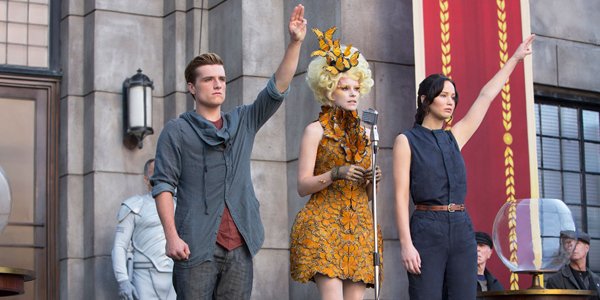
| Katniss, bringing the bow and arrow back for the new millennium |
 The other elements that make teen drama: are an over emphasis on sexual tension, sexuality, hormones, and teen drama. Well, this book ain't that either. Katniss is a largely asexual creation. And none of the anecdotes of the story feature any overt sexuality. There is frankly a lot of kissing. But it is all in the context of duress, where the heroin feels that she must provide a show to save both her life and that of her compatriot. Therefore the uncomfortable romance of the novel is one driven by political expedience. I think this novel could even be called feminist lit as, the subject of Katniss' body becomes everyone's business, and the ideas of disinterest, individualism, power, and objectification are all explored in some very subtle ways, and other more direct approaches. I will read this book to my daughter one day, not all that long from now, either.
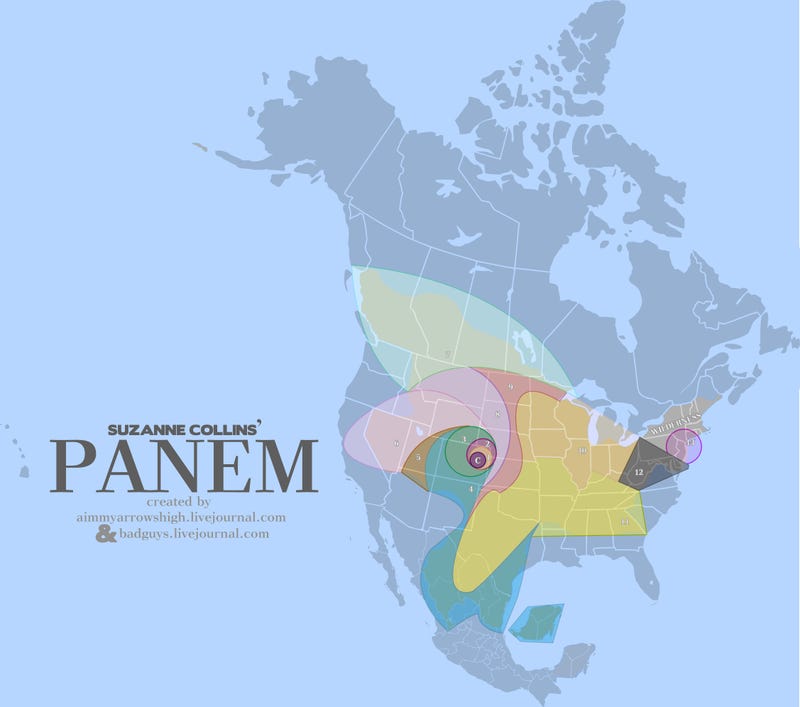 |
| A strange, but supposedly accurate map of Panem |
Even though everyone in the world has either read the books, I think I should provide some basic info. In this future, the world has largely destroyed itself (likely through Nuclear war/winter. A surviving remnant of humanity (though there may be others) has organized itself into 13 outlying districts and a major metropolitan area in the Rockies which feeds on the mercantile production of the outlying districts. Each district provides a different commodity, though that in itself is a very strange, unlikely economic reality. It does make things easy for young readers I suppose. While it is certainly true that there are regions of the world which provide principally one export (oil based economies for example) in any sophisticated economy, such single export based economies are unlikely. And if it were true, a coal based economy like District 12, would likely be a good deal richer, providing as it does a major energy export. (Adherents to the series might say that nuclear power, in District 13 might have done for the District 12 what nuclear power did to coal rich regions like Wyoming and West Virginia. My counter would be: what District 13, it was destroyed, even with nuclear facilities in District 2, the price of coal would have skyrocketed.) Regardless of how unlikely such a scenario would be, the districting provides a useful structure for the books, a lot like "races" in a fantasy book. At one point in this post democratic society, a 13th district rose up, complaining about the excesses of the megalopolis, and the unfair treatment of those in the districts. And of course, brutal war followed that, destroying the 13th district altogether.
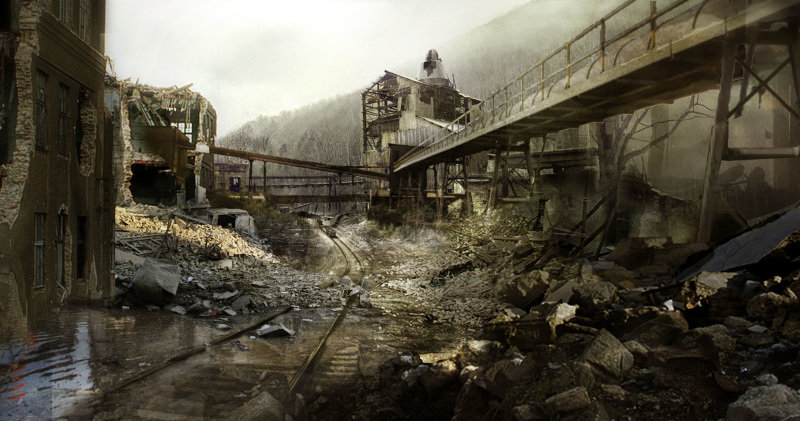
Following the war, for whatever reason, the Capitol decided that a ritualistic killing of young people was the best way to keep the districts in line. While this invention can be debated, it really forms the crux of the book, so there's little point. What matters is that the contestants for these games are randomly selected, but they can volunteer if they want. They have no recourse for selection, and they know that all but one will be killed in the game's arena. Our heroine, an aggressive, ornery, teenager named Katniss Everdeen is not picked. Instead her sister is, and she rushes forward to take her sister's place. The early pages of this novel feel a lot like Shirley Jackson's famous short story, The Lottery, where winning means death.
The rest of the book is one brutal killing after another, mixed with harsh social commentary on life in the Capitol, describing the profligate, media-driven, obsequious and superficial 1% of Panem. These critiques are stinging, though as always with such platitudes, it is easy to point "to the other guy" as the one who lives in excess. Still, I had to admire the grittiness of the tale. These were hard-bitten cynical people who had endured real suffering: starvation, beatings, cold winters, mal-nutrition. These are real things and they are not frequently in adult fantasy, let alone young adult fantasy. To add to this, Katniss is not a particularly eloquent character. She is terse, and represents SELF-ALIENATION to a fault. She is really a very difficult character to like, which for fiction of this kind adds a great deal of charm. Her relationship with her sole surviving parent is sketched out in rather broad strokes, but her mother's depression following the death of her husband, caused Katniss to withdraw in a wonderfully original way. A parent's failure to parent, whether it be for mental illness, or even death, is nigh-unforgivable to a child.
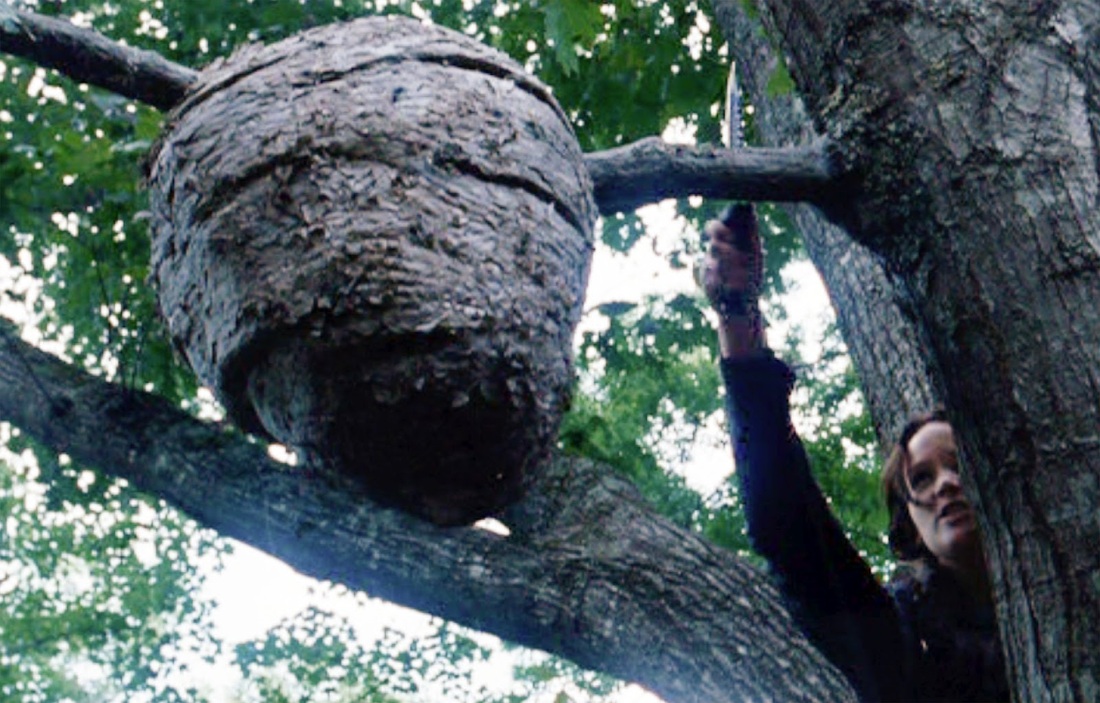 |
| The tracker jacker nest that kills one of the participants |
Perhaps one of the markers of real fiction, of fiction that actually makes the grade is the ability to show a character change. And Katniss does, and it is not the one that the reader wants--one more reason Hunger Games is a really phenomenal and unpredictable story. She does not get kinder, she does not fall in love, she does not turn into the Capitol's creature. Her personal growth is, to my opinion, a fairly subtle shade. She's very introverted, very in her-own-world, and as she becomes the media star of the Hunger Games, and then the wider symbol of a subversive movement she becomes if not a thrilled participant, certainly a willing one. Also, like many selfish people masquerading as selfless people, she begins to understand that people other than her sister depend on her.
One thing about Katniss which I find off-putting as a dyed in the wool liberal is her willingness to kill, and the ease with which she does so. That said, the other main character, her male counterpart in the games, Peeta has enough conscience for both of them.
SPOILER ALERT: I think the lack of love triangle with Peeta, Gale, and Katniss is an unusual one for a teen drama, and it drives the whole series forward. (A whole genre of fanfiction exists to explore this relationship) Katniss, who loved and revered her father, became emotionally crippled when he died in a mining accident. And with her mother's depression she was forced to assume too much responsibility for a child to have to endure. Perhaps as a consequence to this traumatic event her emotional growth really stopped at this time. There are two boys however, Gale and Peeta who have developed an abiding love for Katniss, and have multiple instances to prove said love. In all cases, Katniss rejects/or is completely ambivalent to this love. It's not that she can't choose, it's that she can't choose to not have either. This seems highly unusual for all fiction, let alone teen fiction. It also seems to be a pretty strong feminist interpretation of womanhood. The other important relationship, touched upon briefly, is the relationship Katniss has with her mother. It's a relationship described mostly by its absence. Our heroine does not crouch in the hard rain of the arena, desperately crying for her mommy, as any reasonable person would. But the anger and resentment against her mother is tangible in its absence. In some respects, I felt like this gaping hole was a problem, unbelievable. At other times, I felt that the absence spoke more eloquently than the pages of backstory would have.

The Hunger Games was such a good novel I read all three books in three weeks. Basically pushing off all other assignments. I think, ultimately, that is the highest review a bonafide reader can give.


