Search This Blog

Showing posts with label Halfling Cliche. Show all posts

Wednesday, January 13, 2016

The Wyvern's Spur by Kate Novak and Jeff Grub

This was one of the best Forgotten Realms novels yet. Not only did it occur within the standard realms, a fortified town in Cormyr, it had some truly loveable characters.

It was not a complex novel by modern standards, but after the sanctimonious and cliched writing of the Ice Wind Dale trilogy it was a great relief. The novel continues the events of the Curse of the Azure Bonds, popularized by the SSI one of the earliest PC games in history.  However it takes as it main character a complete nonentity, as we used to say in the biz an NPC, or non-player-character, a drunk partygoer who mimicked the King and nearly died when Alias tried to kill him. But before we get any further let me state simply and for the record: The Curse of the Wyvern's Spur is a thoroughly enjoyable novel.

Character: so the harmless partygoer is named Giogini Wyvernspur, and he's a delight. Foppish and insecure, but undeniably good natured, he returns from the mission that the King sent him on and his apartments in the city suddenly seem too small. He's been bitten by the adventure bug and for the first time in his life he's doing things for himself. His manservant is astonished! When he comes home, he returns just in time to find out that the Wyvernspur family, of which he is the primary heir, has just lost the magical artifact that gave the family it's name. Meanwhile his Uncle, an old but powerful wizard has a very important message for him. The novel is almost written as a mystery novel, which is a nice twist for fantasy, unusual too.
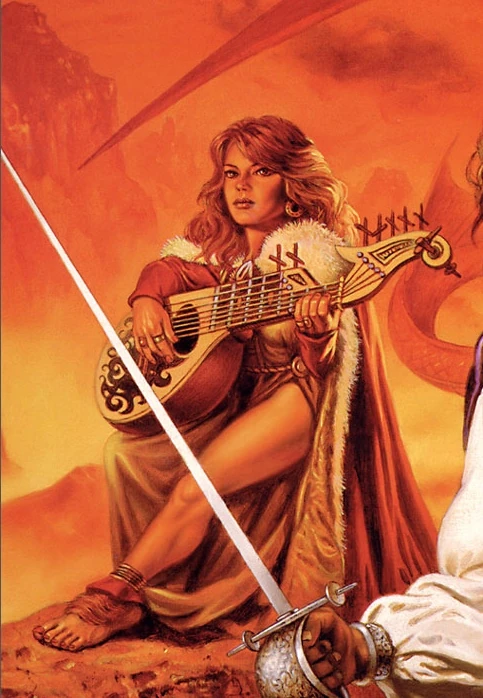
There are only two other characters of note: and one of them is a mystery. The other is Olive Ruskettle. If you remember Azure Bonds at all, you"ll remember the Halfling bard, Olive Ruskettle, whose desire to create a lasting melody provided the foil for The mystery of the azure bonds and the nature of Alias. In this novel, she finds herself back to her thieving roots, having taken on an apprentice. Her apprentice is Alias! But not really, apparently this area of the realms is chock full of Alias copies. Each a different class, none of whom has any idea of her mysterious parentage or fabricated nature. But back to Olive: she is probably the most interesting Halfling character I've read: in general I find them sort of boring.  Like dwarves, they tend to be very one-sided, in the opposite way. They are carefree, disloyal, low level fighters, or thieves. Olive exhibits these tendencies of course, what good a cliche if it's use is completely dissociative. But she also displays real leadership, particularly in Spur, given Giogini's befuddled nature. She seems to have a genuine history if not particularly well explicated, there is a third volume in the series: which if she plays a part will make the Alias trilogy really the Ruskettle Trilogy. Of course there are disappointments, Olive is "spurred" (haha) to help Giogi because of grief over her apprentice's sudden demise, but that grief, though referenced often enough is just not written convincingly.  In part because we do not know much about her slain friend: which brings us to the third character of note, the Alias look alike.

I don't even remember her name, an indication of how soft this part of the story is. Like so many love interests she is a soft amorphous blob, not saccharine, she displays rare moments of pique, but is just not very interesting. That said, this is often true in narrative fiction so maybe it's unrealistic to expect in pulp fantasy.

Cliche: we've mentioned the Halfling cliche, what's interesting about this is that what really made the Halfling cliche were Tolkien's hobbits. The hobbits of the Shire are really very charming, quaint and amusing details abound them really bring such characters to life. Unfortunately this charm almost never translates to D and D.
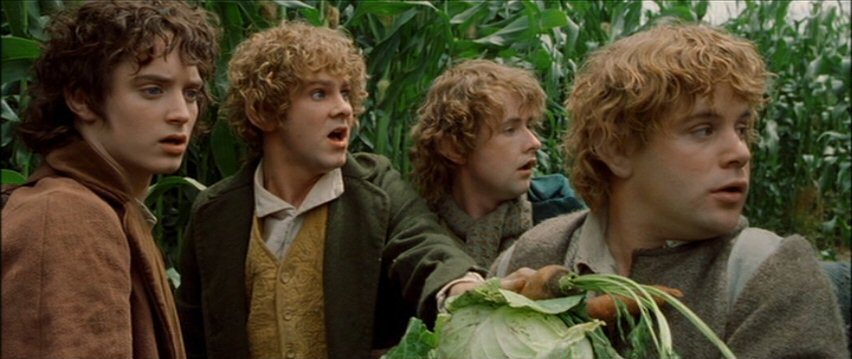
Hobbits everyone knows and loves


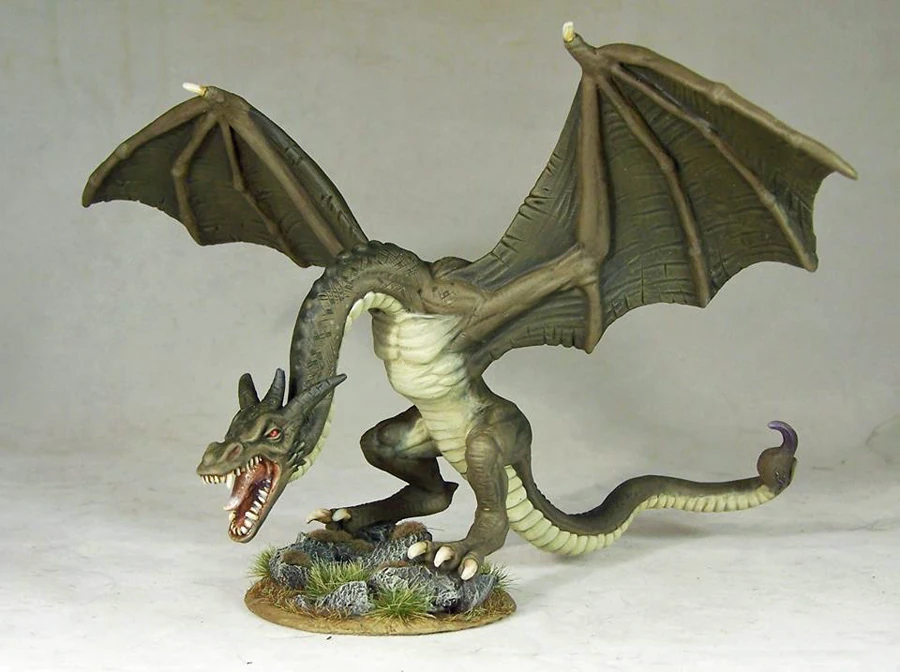
The Wyvern cliche is a relatively minor one, possibly not even worth mentioning other than the fact that they are smaller, armless dragons of lower intelligence. They do translate across fantasies, notably Erikson's Malazan epic has a small if memorable place for them.

Obviously all the D and D cliches apply. One cliche that sticks out a bit in this book is the magic-user D and D cliche, including: the mechanics of spell book casting, magical properties of spell components, scrolls, memorization etc.  It reminds me that aside from historical accuracy (relative accuracy) the main reason for such contrivances was to impose limitations on characters that would otherwise be far too powerful in a game setting. Compare that with the sweeping powers of Anomander Rake or Rand al'Thor. The limitations provided an additional layer of strategy. Fighters went forward to cover the firepower of spell casters. Spell casters could exert enormous force on massive monsters or provide a distraction to beleaguered fighters. I still remember the Fall of Pale from Gardens of the Moon and how it shattered my spell casting memes.

Another cliche explored in this novel, a more generalized cliche is the Whose Yer Daddy cliche. Given the preponderance of this cliche in literature I'm sure there must be some more technical name, but I can't resist it: who's your daddy? The cliche for children with mysterious parentage. Rand al 'Thor, Garion from the Belgariad. In this case, Giogi's father was a great adventurer whom the Crown relied on for certain dangerous tasks. Of course, Giogi's Aunt Dorath, herself a colorful, if minor character, hides the secret of Giogi's parentage.

Which brings us to Completeness. This novel is a tightly polished miniature puzzle and all of the pieces fit together extremely well. It has drama, love, high magic, the undead,and best of all a genuine warmth and sense of humor. It is self contained and there is no sense that the third novel in the Alias series will have anything to do with Giogi (more's the pity.).  We did learn a bit more about the Realms, about the nation of Cormyr. King Azoun, part of a long running dynasty is a relatively fair ruler. There is an interesting form of patronage at work: successful adventurers can be given land and title as governors of the land though they are not granted nobility and the title does not pass through the family  line, unless the governor marries into the local nobility.  One nice thing about the story is that since it stays in the same locality a few nice details have time to come about.

So, on the whole, this is a decent novel and might even be with a reread a few years from now. High praise indeed for a Forgotten Realms novel.

Monday, October 5, 2015

Halfling's Gem by R. A. Salvatore

Given the empire of Forgotten Realms fiction that R.A. Salvatore has put upon this earth (nearly 22 novels), you'd think the first three novels of his would be classics. Forbes did a great interview with the author, and in it Salvatore gives us a plausible reason for this:


“You don’t have to start at the beginning,” he tells me. “Contrast that with George Martin or Robert Jordan and the way they did their series. You couldn’t pick up the sixth book of Wheel of Time and read it, I don’t think, if you hadn’t read the first five. With the Drizzt books you could pick up the 6th book, the 10th book, the 15th book, the 20th book. It’s more like Sherlock Holmes or James Bond.”

Of course, that is the very definition of pulp fiction, and why Martin and Jordan are hailed as serious authors who shook up the world of fantasy fiction.

Halfling's Gem was an atrocious train wreck that I barely feel deserves a review. Not as bad perhaps as Spellfire, but up there.

Halfling's Gem concludes the Icewind Dale Trilogy. The plot continues the drama between the Calishite assassin Artemis Entieri and the dark elf Drizzt Do'Urden, as they fight over possession of a Halfling thief. Also appearing for the first time, the man who put the price on the halfling's head, Pasha Pook.
Artemis Entreri


The plot ... is ok. Where this book repeatedly fails is in the juvenile level of the text. Juvenile isn't quite correct because even teen literature is often more nuanced.

Character: Halfling characters get the worst treatment. At least Douglas Niles and Kate Novak used female dwarves and halflings. The D and D rules made these characters pretty limited but creating an interesting back story could have at least made Bruenor more palatable. So SPOILER: Bruenor is assumed dead at the start of the novel having ridden a flaming dragon into the abyss. And a neat part of the book is the discovery and fight through the abandoned city, but for whatever reason Salvatore spoils the surprise for his characters and has the all knowing and all powerful Drizzt realize long before the reveal that Bruenor may yet live. Salvatore had a chance for his characters to explore the very real emotions of raw grief, and he shied away from it to point out, yet again, how cool Drizzt is.


Wulfgar is also pretty terrible. We discussed in my review of The Blade Itself the Barbarian cliche. Wulfgar is that cliche, no twist, no subtlety, if you wanted to describe the Barbarian cliche in one word, that word is Wulfgar. The emotions that Wulfgar feels are simple: love, anger and grief. About as skin deep as you can imagine. Grief is not the mere absence of that which is held dear, it is the cacophony of successive failures, missed opportunities and piercingly poignant memories replayed continually within a mind unwilling or incapable of stopping itself.

I guess what I'm saying is that Salvatore keeps telling us when he should be showing us. A classic writing criticism.  This was 20 years ago, I'm hopeful that Salvatore's technique has been honed by 20+ books.

Last, we have Drizzt, in the second novel in the trilogy we learned that he felt his meeting with Entrieri to be a fateful one. That there was a strange connection through skill of arms with the assassin. While this morbid curiosity might have added a dimension to Drizzt's personality, it fails as Drizzt is forced to utter trite truism after trite truism.  It's sad because I've begun to suspect that Drizzt is actually a fairly deep character. For example Drizzt is offered a magic mask that makes him white. And he uses it because people fear the drow. But he comes to quite enjoy the anonymity and access the mask allows him. The notion of "passing" is an extremely loaded one for African Americans and its place in this banal fantasy novel is notable. Another moment has Drizzt stealing a kiss from the unconscious Cattie-Brie. A kiss which is never addressed again. 

As a general rule: If you were to strike every single line of dialog from the book, it would be immeasurably improved.

Cliche: all the usual D and D cliches apply, so I won't waste any time but to list them: Dwarves, halflings, elves, Dungeons and Dragon's Race Cliche, barbarian.

Some new ones include The Kidnapping, the Middle East and the Thieves Guild.  The Kidnapping is pretty self explanatory: it's a common fiction cliche, helpless child/girl/Halfling taken by force on a long journey, vengeful heroes hot on the trail, always close, but never quite catching until the final pages. One difference here is that the Heroes give up catching the assassin fairly early on and simply make for the final destination. One famous example of the Kidnapping motif would be from Tolkien's Two Towers when Pippin and Merry get taken by the Orcs.

Agrabah, or Calimport by Disney
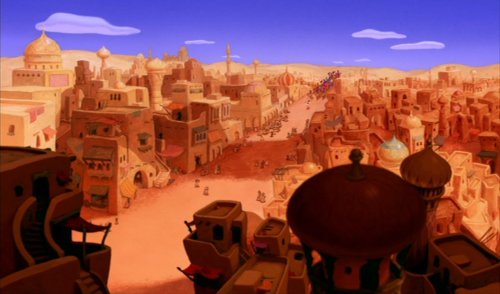
The Middle East cliche  is a common one as well, Calimport is clearly a middle eastern city, and it's denizens, though magical (halflings, humans and wererats follow the same dress and speech patterns. This type of Orientalism would be offensive to some, but the point of the cliche is to save time and space. Calling to mind a westerner's idea of a 1300th century Middle Eastern city provides leagues of description without straining the readers imagination.  As I get older, and my anthropologist wife teaches me to be more sensitive to and less tolerant of micro aggressions that form the undercurrent to overt racism, I begin to wonder about such tropes, and I begin to understand why so many authors have attempted to create whole new worlds, absent of these cliches.
The internets are loaded down with Skyrim images.  Best I could come up with.

The Thieves Guild cliche is an incredibly common one in fantasy.  One the one hand it gives voice to a real world occurrence in a fantasy world, that of organized crime, and on the other hand, it speaks to the shadow economy that likewise exists in every city and state, the sale of untaxable, untrackable, and unregulated goods.  One thing that the Thieves Guild cliche does frequently in fantasy, however, is to neuter the more dangerous and pyschopathic elements of such a community.  To Salvatore's credit, his thieves guild is pretty despicable.  Pasha Pook the crime boss of Calimsport runs the guild with the aid of three henchmen, a dark wizard (fairly servile, as evil wizards go) the deadly assassin Entrieri, and a runaway pack of were-rats.  Though the subplot in Halfling's Gem of trouble in Pasha Pook's organization is never really explored or prevailed upon in any major way, it does give voice to the fact that such an organization would be almost impossible to govern.  But If you're looking for fantasy mafia stories to thrill and awe you, leave Halfling's Gem on the penny shelf, and pick up Scott Lynch's Gentleman Bastard trilogy.


Completeness:  Sadly, I think Halfling's Gem is not the end of this pitiful story.  As the action closes and the heroes sail away righteous and victorious, we know a larger battle is on the horizon as the dwarves of clan Battle Hammer are massing to retake the mines of Bruenor's father.  Still, this story does wrap up the unexplained nature of the halfling's powers and the mystery of how he obtained his magical gem.  It also sheds further light on several new areas of the Realms.

As I become more home in the world of the Realms, I see that there is very little overlap or common knowledge.  Virtually none of the stories I've read or reviewed so far even occur within the same thirty year period.  While, this excites me on some level to know that the breadth of the history of this place is huge, it also feels sloppy and haphazard in the retelling.  I have attempted to follow the date of publication for these books rather than take a timeline version of the books approach.  I chose that route because I want to see the vision of the realms as its actual creation was occurring, not as a second-guessed, revised version.  However, this choice has lead to some frustration on my part.  Right now the only common element is Elminster, and he's kind of crotchety and fallible for an Old Wizard type. 

On the whole, I'd say feel free to skip the Icewind Dale Trilogy.

Tuesday, September 13, 2011

Homeland, R.A. Salvatore, Forgotten Realms

I was always a DragonLance man, so for many years I figured reading Forgotten Realms books would be treason.  How silly is that?  Of course, they never made a DragonLance videogame worth its salt, though attempts were made on the 386!  Did I date myself or what?!

So my first Forgotten Realms experience was actually through the truly excellent videogame, Baldur's Gate (which is really a precursor to DragonAge Origins.) And I loved it.  Years later, after seeing R.A. Salvatore books on the shelf, and being suitably intrigued.  I finally decided to go for it.  If you want a phenomenal history of the Realms go to Wertzone site

Since I'm taking a break from Memories of Ice to read this, it's interesting to note the stark differences in contemporary fantasy with fantasy from two decades ago.  Salvatore did not invent the Realms.  Far from it--Ed Greenwood did.  I actually a did some research for this post, something I rarely do, but the Realms have a complex history.  And unlike DragonLance whose seminal volumes were all penned by Margaret Weis and Tracy Hickman, the Realms were created by a collective of writers drawing on the maps and notes of an accomplished Dungeon Master.  The Realms were designed to be free floating, more loose than DragonLance which took place in the middle of a continent spanning total-war.

Anyway, the point of all this is to show, once again, that good fiction does not have to be genre busting.  In fact, it can draw on cliche's so overdone as to be boring and repugnant, and still make a good yarn.

Let me say from the outset, I thoroughly enjoyed Homeland, and intend to immerse myself in the Realms, 20 years after their creation.  I have one caveat.  The book, though an absorbing and fun read, is no poetic work of genius.  It's a good romp through an interesting world.

1.)  Character.  Drizzt Do'Urden is the name of the main character for this volume.  I grew up with this cat, though I didn't know it.  I saw his picture on shiny hardcover novels all over the Barnes & Nobles of my youth.  Homeland is definitely a plot based story, nonetheless its characters are compelling.  The story begins with a race of dark elves called the Drow, dwelling in lightless caverns called the Underdark.  I've always found evil races to be an interesting study.  How can such a society function?  All societies are based on trust and cooperation--which is a flat impossibilty for the genetically evil.  And of course, this is a central conflict in Homeland.  The Drow worship the spider Goddess Lolth, who believes in corruption and greed, and encourages her priestesses to war with one another.  However, Drizzt, and his father Zak are different, possessing an inate innocence that puts them at conflict with the larger drow society.  They don't like to kill, yet both of them are singularly gifted fighters.  So the natural conflict set up here is between Drizzt and his entire race, his entire culture, and closer to home, his mothers, sisters and brothers.  Which brings us to cliche.


Mindflayer from FR wiki

2)  Cliche.  Elves, Dark Elves, Coming of Age, Dungeons & Dragons, are all cliches used by Salvatore.  Elves figure only as a distant enemy to the Drow, but as the Dark Elf cliche is built off the Elven cliche, much of the same is true about both.  Elves are long-lived, beautiful artisans, dwelling in nature, strong, yet slight, natively good, and are beautiful to look upon, and inherently magical. All this is true for the Drow, save the natively good part.  The city of Menzoberranzan is carved from stalagtites, and the buildings and temples are designed to look like spiders.  A thoroughly disgusting concept, yet one requiring a degree of skill in art and engineering to execute.  The drow live as long as elves, except for the fact that they keep on killing each other.  This means that despite the native difficulty of breeding (elven females ovulate infrequently, like every 50 years or so) a concentrated effort is made to breed, since family strength is a direct and certain route to power.  This culminates in some interesting breeding practices practiced by female drow. The drow is likewise beautiful to look upon, but they have black skin and pure white hair.  Like elves, the drow is capable of casting spells from an early age, and all drow are capable of casting certain spells, regardless of caste.  Which brings up the Dungeons & Dragons cliche.  Every single item or monster in this entire novel has a series of stats to back it up, from the adamantine twin scimitars which are Drizzt's hallmark, to the tentacular mindflayers who dwell in the Underdark.  Anyone who ever played Dungeons & Dragons knows the mindflayer intimately, even those who didn't ever have to fight one, the picture was just so frickin cool you had to look at it.  These cliche's for the most part are informative.  However, for a non D&Der, and we're dying out, some of the cliches are just obscure.  Halfling and Gnomes.  All manner of small people.  Halflings are familiar because of the Lord of the Rings, but most people are familiar with the term hobbits instead.  There are no hobbits in Dungeons & Dragons.  Just halflings.  Gnomes are another one.  We're all familiar with garden gnomes, those cone hatted, blue skirted small creatures, but just how are they different from dwarves?

3)  Scope.  The scope is immense and confined all at once.  The Realms are hard and fast.  Ed Greenwood's world is all mapped out, its creatures are decided, it's politics analyzed.  It's open ended in terms of story telling, but the world, like ours has a physics that is entirely determined by the roll of six, eight, twelve and twenty sided dice.  This makes for a very interesting fantasy setting.  Half of the joy of fantasy is discovery, does the comprehensive mapping elminate this joy?  It turns out, no.  I look at they world map, and I wonder what famous warriors have traveled to Cormyr?  Who is the greatest wizard in Waterdeep?  All this and more, after reading Homeland, I intend to find out.  Now of course, I wonder, how should I read these books?  Drizzt wasn't a character started in Homeland, far from it--he was first mentioned in the Crystal Shard, (again, hat tip to the Wertzone).  I have determined that the best way to do this is to read the books in order of publication, though I may drop off after the first ten books or so.  I always found that the splinter novels in the DragonLance series were of a drastically lower quality, and that the events that occurred in these books had no play in any of the more central literature.  Even so, the more limited scope is Menzoberanzan, the drow city.  And in this Salvatore is the acknowledged champion.

4)  Magic.  Dungeons & Dragons magic.  After having spent a lot of time with more complex brands of magic.  Sanderson's Allomancy, Jordan's The One Power, Erikson's Warrens, the system of magic in the Realms is reassuringly simple.  Most spells require ingredients, and must be memorized to be cast.  They can only be cast once or twice, depending on the sophisitcation and "level" of the wizard, and then they must be re-memorized.  Magic is important, of course, but having owned the 2nd edition Players Handbook, I know most of them already.  There is no magic to devastate an entire city here.

5)  Theme.  As stated above, this novel is no scintillating work of genius.  It's fast moving, absorbing, with interesting characters and a fun, unpredictable plot line.  It's candy, it's beach reading, even more so than most fantasy is considered to be.  That said, the writing isn't poor by any means--it's just there to communicate a story, not to edify.  There is a tone to Salvatore's writing, but its businesslike and not self-reflective.

This book is definitely worth a read, and it has definitely inspired me to read further.  Unfortunately, my wife has decreed an end to all fantasy books, and so I can't buy anymore of them unless they're grand slams.  (It's not the money so much as it is the space on our shelves)  I think I see a Kindle in my future.