Search This Blog

Showing posts with label Sword of Shannara. Show all posts

Saturday, September 24, 2016

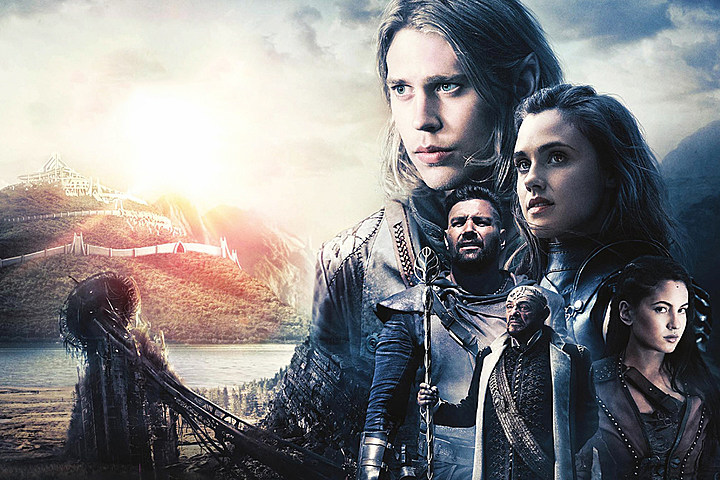
The Chronicles of Shannara on MTV, Season 1

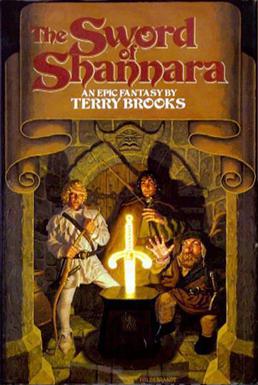
The Sword of Shannara was the first big fantasy novel I ever read. I still remember walking into the Walden Books on Main Street in the New England town in which I grew up, and sorting through the titles in their tiny fantasy section.  I remember the glowing sword on the cover.  I remember turning back to that cover again and again, trying to imagine the three main characters fleeing the Skull Bearers in that flight to to the Silver River.  I remember hiding the book in high school in that same New England town so that I wouldn't get teased by my peers.  I remember that same book being thrown around a classroom while I struggled to get it back like some scene in a John Hughes movie.
   When I heard that the Chronicles of Shannara was being produced, I contained my excitement.  It's a new dawn for fantasy, or at least, it is compared to what I grew up with.  Given the success of Game of Thrones, it was no wonder really that classic fantasy was sought after to produce.  In fact, a television friend of mine even asked me for some recommendations.  That was back before I left the center of the universe, NYC.
When I saw that it was MTV that decided to produce it, unlike some fans, I wasn't perturbed.  I liked "The 100."  Now that I'm officially old, seeing teen melodrama doesn't irritate me, it amuses me, and I admit a certain enjoyment of the eroticism in shows filmed to titillate the chattering class.  I'd been meaning to review the Sword of Shannara for eons, and I am now doing a reread.  However, the Chronicles begin at the second book.  There is an interesting history to that second book, given briefly by Wikipedia.


   To begin with, since this is a film review, I am not going to adhere to my usual rubric.  I will simply comment on that which seems appropriate.  First, the style.  It is immediately apparent that this was filmed to capture the Hunger Games generation.  I admit that I have only seen the first movie, and have never read the books.  However, the starting scenes of the book show a very Hunger Games competition to become Chosen to the Ellcrys.  The whole thing is filmed to maximize on a teen audience, from broad declarations of love and loyalty, to sex scenes that never occurred and gratuitous kissing/flesh, etc.  None of this bothered me, and since I have not read The Elfstones of Shannara in twenty years I cannot yet comment on accuracy.  Though, it seems pretty obviously NOT accurate.  Again, I don't care so much.  I care for the lingering success of my genre, for its mainstream appeal, and for what I believe to be the ultimate benefit: chiefly, the liberalizing of America.
The Space Needle in Seattle
In another shameless appeal to the younger generation, the show really rams home the post-Apocalyptic nature of the Shannara world.  If I were a producer, I'd be saying, "Look at The Walking Dead, people LOVE this stuff!" At one point in the first season, the teens fall into an old ballroom decked out for high school prom (minus the skeletons).  Though the books are pretty over-explanatory, the Druid Alannon outlines the entire history of the world in the first 100 pages of "Sword," they do not reference a single ruin or artifact of the old world until the Scions of Shannara, the fourth Shannara book written by Terry Brooks.  The action in the Elfstones of Shannara (Season 1) occur several thousand years after the Apocalypse.  There isn't a single car, bridge, or building remaining.  Though the Hadeshorn lake is likely still a remnant of radioactive poison.  In Chronicles, Season 1, ruins are ubiquitous.  At one point, Will Ohmsford even asks his co star "don't you ever think about how remarkable ancient humans were?"  This just doesn't happen in the books.  Nonetheless, I like it, though it feels a lot less like fantasy this way.  And the imagery the shows creators show is stunning, if not quite as original as some of its progenitors.
 
Poppy Drayton. Just gorgeous.
Let's talk actors, the series stars, Austin Butler, Poppy Drayton, Ivana Baquero, all three of them pretty hot.  Though Poppy (I'm sorry Poppy, but if I'd rather be named Amberle than Poppy) is really stunning as the elf princess.  I can't say much for acting.  Not that it's bad, I just can't say much about it.   Hers is not a character inflected with obvious weaknesses.  She is a strong, smart woman, and she faces adversity with will and strength.  Strong characters can be somewhat boring, it's true.  Maybe she's a good actor, maybe not.  Even though I spent a decade as an actor in NYC, I've never felt qualified toIt's been too long since I read the book, but I'm pretty sure that Ivana Baquero's character is made up for the series.  Again, so what?  She's hot too, and gets to take Will's cherry in the first episode or so.


Austin Butler, I'll "spare" you the images without shirt
Will (Austin) is an interesting choice re hotness.  Granted, as a straight man, maybe I'm wrong, but I do not think he is a particularly good looking man-boy.  But what I like about him is his sort of soft, innocent, and caring appearance.  Will Ohmsford is sort of an interesting character overall.  In fact, all of the Shannara boys are, including Shea Ohmsford, (Will's father in the series, like great great great grandfather in the books), he is not a swash-buckling hero, he's not even a swash-buckling hero in training.  He isn't a mage, or sorcerer's apprentice either.  If he is anything at all, he is an apprentice healer.  An odd choice for a hero.  This grants a fair amount of depth to the young Will, allowing him to play the caring, feeling role normally reserved for female characters. On the otherhand, the two women get to enjoy more traditionally masculine roles.  Amberle, a young warrioress elf, and Eretria, a thief character.  However, this welcome role reversal does not make these characters particularly deep.  Far from it, but it seems like MTV certainly tried to have strong female roles.  Even if both women fall for one dude.  Like many MTV properties, they even had some lesbian foreplay at one point, titillation for the younger crowd.
Ivana Baquero, naked, in a bath, with Poppy Drayton
   One of my concerns about Shannara was going to be the casting of Alannon.  Alannon is a different sort of Old Wizard cliche.  Young seeming, but silent, withdrawn, and timeless, there is nothing funny about the dark druid.  He is a druid, and falls more under the Druid cliche, though these druids are not worshipers of nature, but worshipers of the old order of men, purveyors of the knowledge of the Age of Man.  I loved Alannon growing up, and having him as a fixture in a series whose faces changed with each book was a welcome sight, even if a grim one.  As one character states, "when Alannon shows up, you know you're in trouble."  Regardless, I can state with confidence that the casting of Manu Bennett is almost perfect.  He is strong, reserved, and stately.  He even brings a little bit of grim humor to the role.  He is a tad good-looking for the role, something I was nervous about at first.  But my reservations were quickly abandoned. Having begun my reread of the Sword of Shannara, I can state that Manu reflects the druid pretty well.
Manu Bennett as Alannon
   One aspect of the show that falls short for me is that there is something flat and one dimensional about the world created by creator's Alfred Gough and Miles Millar.  It's hard to define.  When you read the Sword of Shannara you can't tell that it's Earth until Alannon literally tells you. In my mind, this had the opposite effect you might expect.  The world is less familiar as a post Apocalyptic America then it is a world with a dynamic history and geography of its own.  The beautiful vistas Gough and Millar create make you think of High Apocalypse novels, not of High Fantasy.  I don't know why this matters, but it does.  In some respects many fantasies take place in a post apocalyptic vision.  The characters walk through ancient, haunted ruins, surrounded by a bygone era of grandeur, forever lost.  Tolkien's Middle Earth was very similiar in that respect.  The world of the Fellowship is a shadow of the world before The War of the Elves in the Second Age. Ruins are in the very bones of High Fantasy.  And the swords, torches, and horses are the very outcome of low tech society that has lost its way.
   I think perhaps that one of the Chronicles Season One's failings is that while it discusses the history and frequently alludes to events that have occurred, it skips the prosaic matters that make fantasy worlds real.  Traders on the road, the petty local politics of tyrants, the class struggles hidden, yet glorified by false visions of feudalism.  The world of the Chronicles is shown to be a dystopian vision of isolated communities and roving bands of killers.  While the Sword of Shannara actually makes a point of literally telling you that this decentralized version of the land is political choice (something in my reread I find unpleasant) it is ultimately lying about this because there are local politics and trade: decentralized political systems are a red herring.  Gough's vision of the land of Shannara could take place on the same set as The Walking Dead.  But it's just not true.  The Apocalypse happened two to four thousand years prior, and world wars, which the land has experience many, are not apocalypses--just terrible.
   Regardless, it appears that there will be a second season of the show.  And I'm glad.  There was a time, perhaps when I was both jealous of a younger generation taking fantasy on, and grateful that my preferred medium was successful.  But I am jealous no longer.  With a daughter of my own, I am thrilled to see fantasy living and expanding past what my generation had done for it.

Tuesday, July 19, 2011

Gardens of the Moon by Steven Erikson

This is a book that I've been wanting to review for ages.  In fact, in some ways, Erikson was the genesis of this here blog.  I've been writing about fantasy since I was in highschool.  My Junior Year Position Paper was on C.S. Lewis.  The next year, my paper was on the genre as a whole.  But after voraciously devouring this series and its genre busting all-out action, I knew things had changed in the genre as a whole.  I stopped reading fantasy in college.  I started dating, made friends, and basically didn't have the time.  Years later, bartending in New York, and living in Harlem I had a lot of time to myself again, and I started to reread some of the classics on my shelf.  I had no interest in new fantasy.  I figured the genre had gone to Forgotten Realms and DragonLance knock offs.  Erikson made me a believer again.

I've tried to turn people on to this book, and this series, to no avail.  And not to "Norms" (non-fantasy readers) to bonafide sword-swinging fantasy lovers.  This series is so good I had to take notes while reading it again so I'd remember all the ideas within that I'd wanted to explore.  So I'm going to abandon the usual format.  The format, afterall, is intended to provoke critical thought.

Kalam, Quick Ben, Whiskeyjack
First of all, Gardens of the Moon, though the first in the series, The Malazan Book of the Fallen, is an intermission.  I think this may be why so many people have trouble getting into it.  It starts after a massive battle, after an emperor was assasinated, after a city has fallen.  Much of the book is getting the characters from the remains of one city to the next on the new Empress hit list.  There are other reasons of course.  The scope of this world is enormous.  That's one of the fantasy five, and Erikson gets full marks.  His world is enormous and intricate.  This is not surprising.  He and a friend developed the world as a game a la Dungeons and Dragons.  It should also be noted that Erikson (his pen name) was an anthropologist.  As someone who is married (yes!  as of a months ago) to an anthropologist, I know just how much is crammed into their heads.  Each people of this world is intricate and fully developed straight out of the gate.  Another reason why this is an intermission is because Erikson wastes little time on explanation.  Single, dense phrases are used to describe entire peoples.  And there are literally over two hundred of them, from the plains dwellers on Genabackis, the Rhivi, to the denizens of the Seven Cities, to the Gral, to the fishing people of Quon Tali, the sophisticated Daru, and the imperially minded Malazans.  All those names are confusing, and that turns a lot of people off.  It is very easy to miss important details, things that occur, pivotal moments described in a single sentence, and moved on only to be referred to again and again with no explanation.  Still the important thing to remember when reading this epic, is that you don't always need to pay attention to these names.  This series is a series to re-read, to parse, to explore.  Get what you can, and have faith that Erikson will explain further in due time.  It might take to the seventh volume of the series, but he has never contradicted himself that I can see, so be patient and keep reading.  The really good stuff doesn't even occur until the third volume, Memories of Ice.

Anomander Rake - Son of Darkness
Before I get further into my notes, let's hit some of the basics.  Like in Jordan's works, there are literally hundreds of characters, so this is a plot driven story.  That said, given the sheer number of words in over ten volumes, many characters emerge extremely well developed.  The story starts with a character named Gannoes Paran, he's young, good looking, and you expect him to be the story's main hero.  Not so, because there is no main hero.  This is an ensemble cast, and there half a dozen main characters at least.  There is an evil empire, the Malazan Empire, which isn't really that evil, or much of an empire it turns out.  But none of the soldiers of that Empire are evil, they're just men, and this is, among other things, a soldier's novel, about companionship, and loyalty in the ranks.  But the Empire is the backdrop for something much much larger, which is really only hinted at in the first book, and in fact, is not even given a name to in the first of the series.

Another thing that's great about the series is the magic system.  One of the Fantasy Five, magic.  It's completely unexplained in the first book, but it's astonishing.  The book opens with a battle between a planet sized asteroid hovering hundreds of feet in the air, and five arch-mages sending corruscating waves of power into the sky.  The typical magic cliche for fantasy is -- the big stuff doesn't play until the end.  Until then, its all parlor tricks and smokescreens.  Another cliche ripped to pieces

Ok, so onto the nitty-gritty.  This is a discussion for Moon readers.  So stop now if you haven't read the book.  Adjunct Lorn.  Why did she have to die?  I rather liked the character of the stern, attractive, warrior woman, and thought she would have made a better partner to Gannoes.  The reason I ask is because Erikson indeed revives characters with impunity, having killed Gannoes in the first 50 pages, Tattersail and sending Toc the Younger off into a mysterious chaos warren.  Lorn was a fascinating character with a fascinating weapon, her Ottatoral sword.  But then again, Erikson refers to himself as a cliche breaker, and having Gannoes end up falling for the fat mage Tattersail, is a real change of pace for any genre, much less fantasy.

Hedge and Fiddler, Bridgeburners
One of the central mysteries of the first book is the assassination of the old Emperor.  Who did it?  Why?  Is the Emperor really dead, and what about his cronies, are they dead too, like Toc the Elder, or Daseem Ultor?  It's an interesting frame for the series.  Many of these questions don't even get answered in Moon, but are answered in the sequel Deadhouse Gates, and in many ways the entire series strives to answer these questions.  Along the same lines, is the idea that the Bridgeburners, the seminal unit of the Malazan Army that is known far and wide must also die.  I regret this, there are only about seven of them left to begin with, and they all seem to be great characters.  Still, the series is called the Malazan Book of the Fallen, and if Malazans didn't fall, well, what would be the point?

Next topic: The Deck of Dragons.  So Erikson takes the game of Tarot and makes it real.  It's an unbelievably clever mechanism for the story, it adds a ton of depth, and a ton of detail.  However, it does make the story denser and harder for the lite-fantasist to glom onto.  The Deck of Dragons is a playing deck of all the gods and demi-gods in the saga's pantheon.  They're organized into aligned houses, and unaligned houses.  And when characters like Tattersail give a reading, it often reveals what Gods are at play in the field.  All the houses, and the players in each deck are noted at the beginning of the first book.  This cheat is not repeated in later books.

Another very divergent aspect of Erikson's work is his quixotic narrators.  Calling them narrators is a bit misleading, they are characters, who often speak in riddles, or long nearly non-sensical rants that seldom make sense to the other players, but which are more often directed at the reader.  Each book has such a character, but the one in Gardens is none other than Kruppe.  Kruppe is a fat, balding little wizard who is a master thief, and we find out during the book, quite a powerful mage.  However, his persona is one of befuddlement and misdirection, and even his greatest friends seldom realize that their actions and thoughts are directed entirely by the mischievous Kruppe.  This fat wizard also provides the book with its greatest sense of comic relief.  These narrative voices are almost always comedic and poke fun at both the author, and his characters.  You get a sense of the author himself, or at least, who the author might like to be, as these characters, in addition to being funny, are almost always really good natured as well.

This is another aspect which deserves exploration:  Erikson is a master of good and evil.  It sounds trite, and I'm sure that he would prefer to think of himself as a trend breaker, but fantasy is about good and evil, Gods of Dark, Swords of Light.  In this Erikson doesn't break the trend, he masters it.  You may recall from a prior review of Naruto, that the character of the young Ninja is extremely good, happy, kind, and despite his idiocy, his heart is warm and caring for all.  The good--in the Erikson novels--is similar.  However, Gardens of the Moon, is less of an exploration of good and evil than his later novels.  Still you get flashes of it through characters like Kruppe and his companions, Gannoes love for Tattersail, Tattersail's heartwrenching guilt about previous monstrosities committed under imperial writ.

Ok, just a few last points:  There are many characters, including the "hero" Gannoes, and the anti-hero Lorn, who are forced continually to sublimate their will.  They act for the good of the empire, of which they are committed agents.  Sergeant Whiskeyjack of the Bridgeburners who is offered the chance to retire, flee certain death because of his love and loyalty of his comrades, and their own love for him.  This sublimation of the will, can be seen as character building, but it also exerts an exceedingly destructive force.  When Lorn finds out that Tattersail was the agent responsible for atrocities committed in Malaz City, the girl, shorn of her previous life, reemerges from her imperial shell, the illustrious general Dujek Onearm reminds her of her current responsibilities, and that she herself is the second in command to none other than the woman who commanded the purge.  Of course, these events are all historical, past events that are mere artifacts to the story, but the sheer depth is staggering.  And I'm in love with it.  I want to unearth the entire history of this continent that goes back over two-hundred thousand years.

Penultimate point:  Dragnipur.  How cool is that?  A massively powered sword, that itself harbors a magical realm of pain and imprisonment, where a massive cart is pulled by a single Atlas like godling.

Ultimate point:  Erikson stories as we'll discover are all about convergence.  This I think qualifies as a cliche, but Erikson is the first that I've read to be so open about it.  Jordan's books use the same cliche, the Wheel of Time books always end with a convergence.  So what does this mean?  A convergence is a meeting of fell powers, the climax of every story, where all the pivotal characters meet for their hour of greatest conflict.  What makes Erikson's convergences so remarkable?  The sheer scope of the powers involved.  Even now, I recall vividly the ending of the Sword of Shannara, and the half-elf Shea's meeting with the evil wizard.  Those powers were great and scary, buy Shea was a quiet, hobbit like character with no real power's of his own.  As a brief aside, Japanese horror movies, and anime is very similar, and in fact may be the progenitor for this sort of convergence.  The powers that meet are colossal, far greater than human, far greater than mere wizard or swordman.  The forces that converge in an Erikson novel are titanic in nature.  And astonishing.  As an aspiring author, it makes me weep with jealousy.  The depths of horror, the depths of love, the depths of friendship and loyalty, seem to be unsurpassable.

So.  If you can get through all the names, if you can get through all the lands and peoples and characters, if you can look beyond the things you don't yet know, and enjoy it for what it is, the rewards are entirely worth it.  Buy this book.

Note:  I intend to add photos to this soon, so check back!

Wednesday, February 9, 2011

Children's Fantasy

The Dark Is Rising (The Dark Is Rising Sequence)The Book of Three (The Chronicles of Prydain Book 1)I grew up in a time when children's fantasy was a very small part of the genre.  Susan Cooper's Dark is Rising Sequence (Published 1973), and The Chronicles of Prydain (Published 1964) were pretty much it.  Cooper's series combined elements of the children's pulp of an earlier generation, The Hardy Boys or Nancy Drew and mixed it with cultural references from an even older generation's fantasy, The Chronicles of Narnia and LOTR.  Both series were excellent, and moderately popular in their day, evidenced by the fact that Disney made a film of The Black Cauldron.  These were the books that opened my mind to fantasy.  But the step from those children's books to adult fantasy was a steep one: go for the Once and Future King, or risk drowning in LOTR.  But the field has changed a lot since then.

There were many authors who revitalized the genre but the real break through came with J.K. Rowling's epic, Harry Potter.  I was a young man when these books came out, and I resisted for over a year before succumbing to Pottermania.  My feeling at the time was simply, these are children's books, I read adult fantasy.  And true to form, when I began to read the series, I was immediately critical of the simplicity of the prose.  It didn't take long for me to reform my views on the matter.  But even now, my attitude toward children's fantasy is slightly deprecatory.  I haven't read Percy Jackson and the Olympians and have absolutely no desire to do so.  Nor have I seen the movie, or read the books of The Last Airbender.  I do have in my collection, The Golden Compass, and though I've seen and enjoyed the film, I have yet to start the series.

The Sword of Shannara: An Epic FantasySo why the antipathy?  Well, for one thing, my first real adult fantasy book, after reading the book report worthy LOTR and Narnias listed above, was Sword of Shannara by Terry Brooks.  I loved the original cover, pictured here.  Swords of Light derives half of its name from that pivotal moment in my life.  It was difficult, and over eight hundred pages.  But it was by reading adult fiction that I learned to write and speak as well I have.  I never needed to study the GRE, GMAT, or LSAT vocabulary modules, 800 page novels are not models in brevity.  They require a significant range of word choice.  Descriptive passages need more than words like dark and dirty.  For example:

The elf walked down the dark hallway, ready to fight.

The elf crept down the dank passageway, arrow nocked and half-drawn.
or
The elf lithely skulked down the corridor, cedar bow drawn and tipped with venom, arms tense, eyes sweeping the crumbling path before him.

Sometimes the best way to learn is to dive into the deep end, not continue skimming the surface.  I'm not a teenage girl, and so I have limited utility for vampires, but I do make an effort to be au currant, and so I read the first book of The Twilight Saga, Twilight.  Unlike Harry Potter, I was not convinced.  This was an atrociously written book, incredibly boring and a bit like eating uncooked tofu, tasteless and devoid of substance.  You want Vampires?  Read Ann Rice.  I didn't mind the Christian messaging in the book, both Tolkien and Lewis were hard-core Christians.  Christ imagery abounds in both.  I minded the poor quality writing and the utter boredom.

My other critique of children's fantasy, particulary in its more modern vintage is its tendency to protect and pull punches.  Though the evil vampire is eventually pulled limb from limb in Twilight, there is no description, no gore.  The young woman never has sex with her man.  That's fine, but at least let her have dirty fantasies.  Christianity is rife with rules about sex and sexuality, if you're going to use it, you should be torturing the reader with temptation, not regurgitating apollinian fantasies about love. 

Fantasy is about real life.  By creating realms that can't possibly exist, we transcend believability and are able  to examine relationships that might otherwise be obscured by traitorous thoughts like "oh, that's not realistic!"  That possibility is dimmed when the lewd and the tragic are ignored.  Harry Potter's saving grace is that the teenagers are teenagers, death is death, and loss is inescapable.  These were how the original fairy tales educated.  Think "ashes, ashes we all fall down," that hoary old children's chant that describes Europe's time during the Black Death.  Think Jack and The Beanstalk.  Jack kills a giant after stealing his wealth.  Not pretty, not nice, and above all, completely unsanitized.  Think Rumpelstiltskin, a beautiful girl about to be raped by a lord, she tricks a gnome, who ultimately pays for her deception with his life.

You see where I'm going with this.  Fantasy is vital to children's development.  It teaches them ethics, right and wrong, about caring, duty honor, and love.  But sapped of life's tragic realities, it's just a desensitizing Hallmark card.

Monday, June 7, 2010

The Fantasy Post

In a further attempt to make all of my time productive, behold, The Fantasy Post.  Here I intend to write reviews of fantasy novels as I read them.  Some of these novels will be contemporary, some older novels reread. 

My credentials:  I read my first fantasy novel when I was ten or eleven, it was The Sword of Shannara, a novel by Terry Brooks.  Since then I've been hooked.  I've gone through all of the greatest series by Brooks, Eddings, Jordan, Donaldson, Martin.  In college I gave up fantasy for chicks and booze.  This turned out to be a grave mistake.  I've been back for a couple of years now and I've discovered some great new authors in my absence.

I am also a big fan of fantasy art.  I once wanted to be a fantasy painter. My favorite at the time was Larry Elmore who did much of the painting in the DragonLance Series for TSR.  Though a reasonable painter and artist, I always needed models to do my best work.  When I saw that many of my friends, painted and drew from their imaginations, I decided to move on.  It wasn't until fairly recently when I started following Tor's rerelease of the Jordan novels in eBook format that I saw that real fantasy artists use models too!

Alas.  Anyway, below is an Elmore painting from the DragonLance series, Time of the Twins, by Margaret Weiss and Tracy Hickman.