Search This Blog

Showing posts with label Forgotten Realms. Show all posts

Tuesday, April 19, 2016

Iron Helm by Douglas Niles

This was the second Forgotten Realms offering by The Moonshae Trilogy's author, Douglas Niles, published in 1990. And again, the novel details a land that isn't even on the map.  Or maybe it's on some weird extended map. The novel was chiefly  interesting because of a very obvious parallel to the discovery of the Americas by the Spanish Conquistadors. While this transparent comparison was so blatant that the cover featured a Spanish Comb Morion (Spanish infantry helmet) I enjoyed the comparison because I too, as a fantasy writer am interested in the time period because of the Spanish gold rush of the 15th century.  Overall, it was an exciting yarn, with lots of room to expand, (and it did) as the Maztica Trilogy.  Don't expect earth shattering character development, but for a summer read, it's not bad.

Character: Though the characters are leaps and bounds ahead of Moonshae's simplistic Tristan, Robyn, and Daryth love triangle, and the moronic impulses of the God of Murder, Bhaal, the characters are still not terribly sophisticated.  This is not necessarily a bad thing, the plot moves quickly and a number of unseen plot twists make the novel unpredictable (except for that which we know--the Spanish conquer America, and it seems likely that the Amnish mercenary company will do the same thing.
Yes, this is a Spanish Comb Morion
The hero's name is Halloran, a first level mage turned warrior in Captain Cordell's Golden Legion.  He's loyal to Cordell, a man of iron ambition with a drow lover.  However, events transpire to separate Hal from the legion and his loyalties are sorely tested, particularly when he begins to fall for Pocohontas, err, I mean Erixl, the female protagonist.  Erixl's story is rather interesting.  She begins as a girl, gathering magical feathers for her father, a craftsman of the local magic.  By the story's end, she has been a slave, escaped, enslaved, and released to become an unwilling priestess of Coexycoetl.  Possibly the most interesting character is Captain Cordell, the strongest one certainly.  A general of a mercenary legion, but one who inspires great trust and loyalty among his subordinates.  And yet, we're lead to believe he is capable of being quite cold, and then there is the mystery of his elf girlfriend, a sorceress of great power.

Hot elfess, that is completely unrelated
Cliche: The most obvious, and previously discussed cliche, not really a cliche per se, is the obvious parallel to history.  I enjoy such parallels in my own writing, and I feel that as a technique, you can unpack a lot of learning in a fun and novel way.  That said, while it deserves mention, it is by no means a traditional cliche.

Of course, like any Forgotten Realms book it uses enough of the Dungeons & Dragons Cliches.  Although, as this book takes place away from a more traditional fantasy scape, it has far fewer cliches.  Even so, it does have a dwarf and elf, and the dwarf at least conforms to all the usual stereotypes, tough, stalwart, grumpy, gruff, hard bitten warrior-type with a heart of gold.

Completeness:  Well... yes, and no.  This is the first book that touches on the City State of Amn, a place that is near and dear to my heart from my Balder's Gate days.  However, the introduction, again, of a completely new section of the map, seems premature.  I know all of these guys were friends, and that they all sat around the gaming table and talked this stuff over, but the map of the Realms is enormous, why did they feel compelled to write in this story a mere four years from the start of this completely new fantasy realm?

Overall, this was not the worst installment in the Forgotten Realms books.  Surprisingly, or not, the internet has not saturated this story or this book.  There may be only a handful of reviews of this book on the entire internet.  Which seems a shame, because it's not a bad book.  I suppose it's possible that some have found it distasteful because of the historical subject matter, shunning it because of its possible racial and demographic gauchness.  Still, if you're doing a Douglas Niles reread, this book ought to make it to your list.


Wednesday, January 13, 2016

The Wyvern's Spur by Kate Novak and Jeff Grub

This was one of the best Forgotten Realms novels yet. Not only did it occur within the standard realms, a fortified town in Cormyr, it had some truly loveable characters.

It was not a complex novel by modern standards, but after the sanctimonious and cliched writing of the Ice Wind Dale trilogy it was a great relief. The novel continues the events of the Curse of the Azure Bonds, popularized by the SSI one of the earliest PC games in history.  However it takes as it main character a complete nonentity, as we used to say in the biz an NPC, or non-player-character, a drunk partygoer who mimicked the King and nearly died when Alias tried to kill him. But before we get any further let me state simply and for the record: The Curse of the Wyvern's Spur is a thoroughly enjoyable novel.

Character: so the harmless partygoer is named Giogini Wyvernspur, and he's a delight. Foppish and insecure, but undeniably good natured, he returns from the mission that the King sent him on and his apartments in the city suddenly seem too small. He's been bitten by the adventure bug and for the first time in his life he's doing things for himself. His manservant is astonished! When he comes home, he returns just in time to find out that the Wyvernspur family, of which he is the primary heir, has just lost the magical artifact that gave the family it's name. Meanwhile his Uncle, an old but powerful wizard has a very important message for him. The novel is almost written as a mystery novel, which is a nice twist for fantasy, unusual too.

There are only two other characters of note: and one of them is a mystery. The other is Olive Ruskettle. If you remember Azure Bonds at all, you"ll remember the Halfling bard, Olive Ruskettle, whose desire to create a lasting melody provided the foil for The mystery of the azure bonds and the nature of Alias. In this novel, she finds herself back to her thieving roots, having taken on an apprentice. Her apprentice is Alias! But not really, apparently this area of the realms is chock full of Alias copies. Each a different class, none of whom has any idea of her mysterious parentage or fabricated nature. But back to Olive: she is probably the most interesting Halfling character I've read: in general I find them sort of boring.  Like dwarves, they tend to be very one-sided, in the opposite way. They are carefree, disloyal, low level fighters, or thieves. Olive exhibits these tendencies of course, what good a cliche if it's use is completely dissociative. But she also displays real leadership, particularly in Spur, given Giogini's befuddled nature. She seems to have a genuine history if not particularly well explicated, there is a third volume in the series: which if she plays a part will make the Alias trilogy really the Ruskettle Trilogy. Of course there are disappointments, Olive is "spurred" (haha) to help Giogi because of grief over her apprentice's sudden demise, but that grief, though referenced often enough is just not written convincingly.  In part because we do not know much about her slain friend: which brings us to the third character of note, the Alias look alike.

I don't even remember her name, an indication of how soft this part of the story is. Like so many love interests she is a soft amorphous blob, not saccharine, she displays rare moments of pique, but is just not very interesting. That said, this is often true in narrative fiction so maybe it's unrealistic to expect in pulp fantasy.

Cliche: we've mentioned the Halfling cliche, what's interesting about this is that what really made the Halfling cliche were Tolkien's hobbits. The hobbits of the Shire are really very charming, quaint and amusing details abound them really bring such characters to life. Unfortunately this charm almost never translates to D and D.
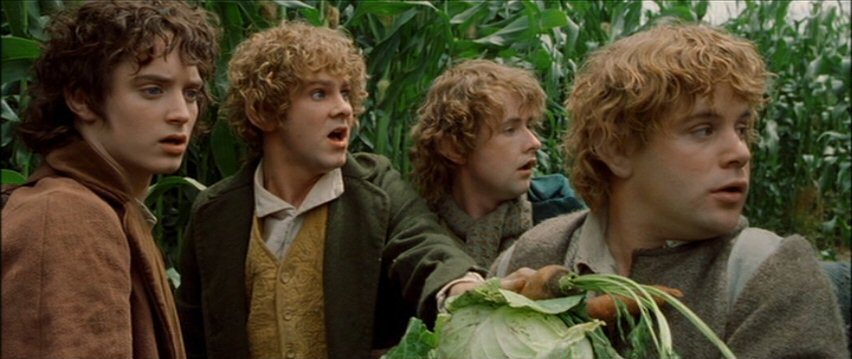
Hobbits everyone knows and loves


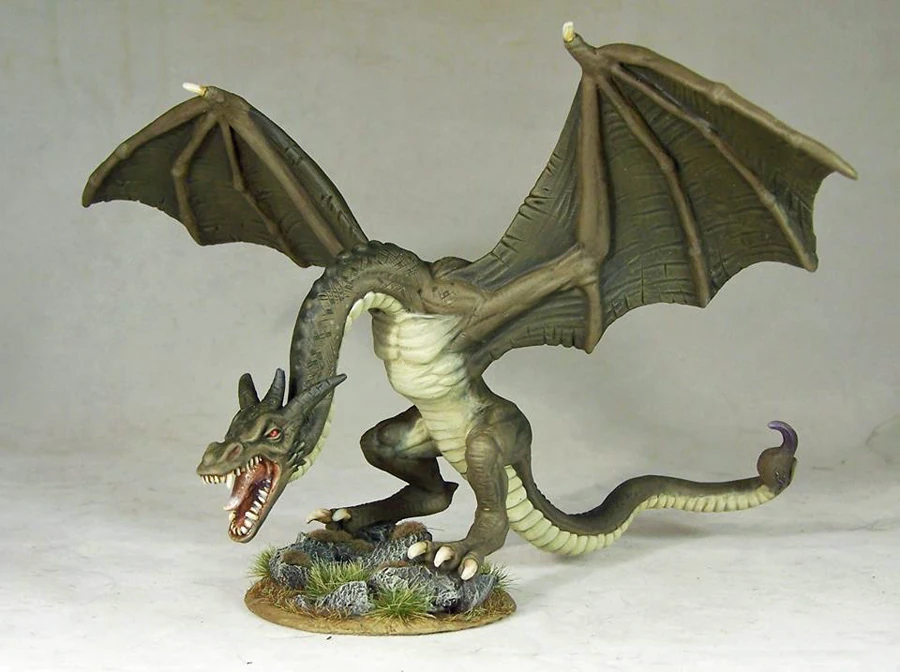
The Wyvern cliche is a relatively minor one, possibly not even worth mentioning other than the fact that they are smaller, armless dragons of lower intelligence. They do translate across fantasies, notably Erikson's Malazan epic has a small if memorable place for them.

Obviously all the D and D cliches apply. One cliche that sticks out a bit in this book is the magic-user D and D cliche, including: the mechanics of spell book casting, magical properties of spell components, scrolls, memorization etc.  It reminds me that aside from historical accuracy (relative accuracy) the main reason for such contrivances was to impose limitations on characters that would otherwise be far too powerful in a game setting. Compare that with the sweeping powers of Anomander Rake or Rand al'Thor. The limitations provided an additional layer of strategy. Fighters went forward to cover the firepower of spell casters. Spell casters could exert enormous force on massive monsters or provide a distraction to beleaguered fighters. I still remember the Fall of Pale from Gardens of the Moon and how it shattered my spell casting memes.


Another cliche explored in this novel, a more generalized cliche is the Whose Yer Daddy cliche. Given the preponderance of this cliche in literature I'm sure there must be some more technical name, but I can't resist it: who's your daddy? The cliche for children with mysterious parentage. Rand al 'Thor, Garion from the Belgariad. In this case, Giogi's father was a great adventurer whom the Crown relied on for certain dangerous tasks. Of course, Giogi's Aunt Dorath, herself a colorful, if minor character, hides the secret of Giogi's parentage.

Which brings us to Completeness. This novel is a tightly polished miniature puzzle and all of the pieces fit together extremely well. It has drama, love, high magic, the undead,and best of all a genuine warmth and sense of humor. It is self contained and there is no sense that the third novel in the Alias series will have anything to do with Giogi (more's the pity.).  We did learn a bit more about the Realms, about the nation of Cormyr. King Azoun, part of a long running dynasty is a relatively fair ruler. There is an interesting form of patronage at work: successful adventurers can be given land and title as governors of the land though they are not granted nobility and the title does not pass through the family  line, unless the governor marries into the local nobility.  One nice thing about the story is that since it stays in the same locality a few nice details have time to come about.

So, on the whole, this is a decent novel and might even be with a reread a few years from now. High praise indeed for a Forgotten Realms novel.

Friday, May 29, 2015

Waterdeep, by a different Richard Awlinson

So Waterdeep is the last novel in the Avatar Trilogy, though the story picks up again in two more later volumes.  Interesting side note: Richard Awlinson is a pen name for two separate men. Why? I don't know, the Forgotten Realms Wiki is silent on this issue. That said, Troy Denning, the author of this one did a fine job of finishing the series.

Waterdeep takes the remaining members of the Company of the Lynx, from the city of Tantras to the mega city of Waterdeep. It says something that I can't even find Tantras on the map.  The journey is long, and given the chaos of the Realms during the so called Time of Troubles, difficult. Of course, in fantasy, the Quest cliche is 90% of the story, so it's not surprising. The Time of Troubles, you recall, was initiated by the theft of the Tablets of Fate, and the expulsion of the gods from their astral plane to the mortal realm.  Midnight, Her lover, Kellemvor, and the cleric Adon, search for the second Tablet of Fate, which they hope to return to Ao, the over god of the Realms, and so end the Time of Troubles.

Character:  The characters remain startlingly satisfying in this third installment. I can tell you, I'm a third of the way through the Halfling's Gem, and I'm sick to death of Drizzt, Wulfgar, etc. but Midnight, Kellemvor, Adon, and Cyric are excellent characters.  Let me start with Cyric. In Tantras, we saw Cyric take a darker turn, becoming a minion, though a freelancer, to the dark god Bane. And while he was a cold mother fucker, you got the sense that Midnight's faith in him would be rewarded. SPOILER: it's not. Cyric becomes a truly awful human being in this novel. He slays a village full of halflings with women and children, he cuts the throat of another hanging from a rope. He slays an innkeeper, sole survivor of a zombie attack, mere minutes after the poor man gives him food and beverage from his ruined livelihood. Why? Because he simply does not care, and because people irk him.

Adon also continues to grow, becoming the group's leader. And while his faith in Sune is completely lost, by the story's end, his faith is yet restored. Though not in Sune, the goddess of beauty. Kellemvor, the group's former leader has made catastrophic decision after decision. Having had his curse removed in Tantras, he keeps leaping to the aid of defenseless citizens. While laudable, he's not the sharpest tool in the shed, and he's forgotten that at least three gods have been trying to track them down and kill them. After falling into half a dozen ambushes with his bull headed attempts, his confidence is finally assailed.
The exciting conclusion of Waterdeep

Cliche: Midnight is perhaps the biggest cliche of the entire series. She's just rather generic as a female character: she loves Kellemvor, but is furious with him for not trusting Cyric, and they spend half the novel fighting over it. She is strong, but uninteresting for the most part, and her history is left entirely unexplored.  What's worse is that she is, completely wrong in her faith, only enforcing an unpleasant gender stereotype. Another character cliche is in Adon's character. The Faithless Priest, is a half decent cliche and Adon's inner struggle, and his ultimate belief in humanism as a faith, is (Spoiler!) only made more interesting when Midnight ascends to god hood.  He becomes her High Priest, and but as Midnight is no longer merely mortal, is it still humanism? Which brings forth another cliche: Ascension.
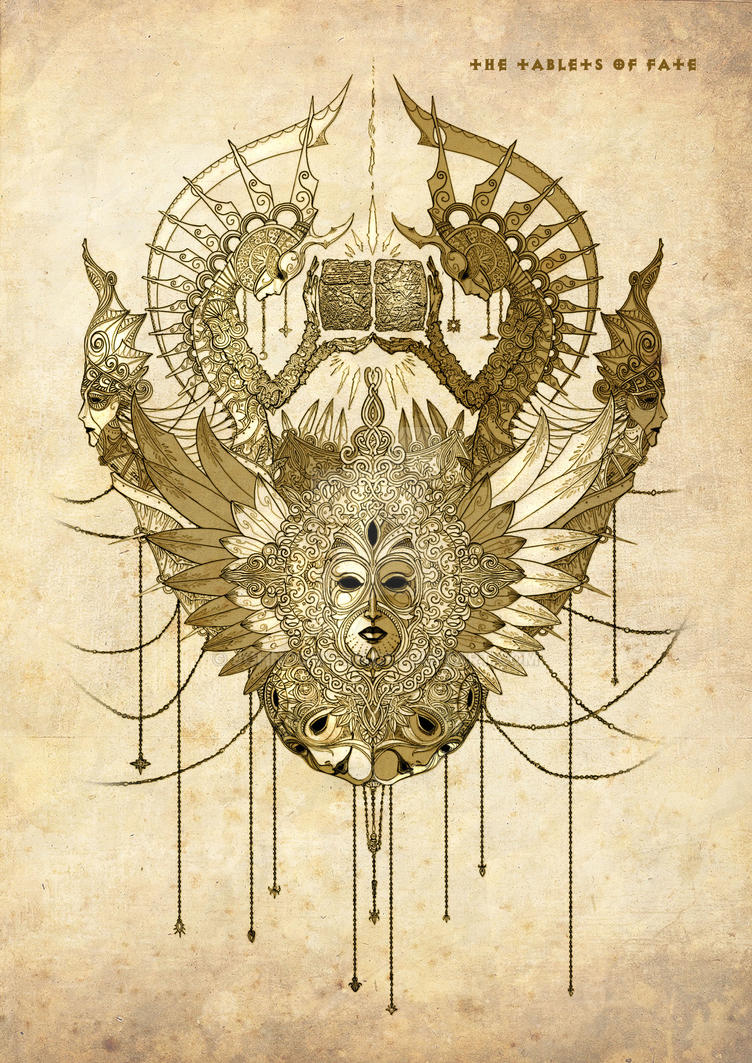
Tablets of Fate, Johndowson

I've talked about Ascension before in all of my Erikson, Malazan Book of the Fallen, reviews. (Spoilers!) At the end of Waterdeep, Mystra, Bane, Bhaal, and Mykrul, the gods of magic, strife, murder, and death, have all been killed. Quite a coup for the forces of light. Except Forgotten Realms doesn't really work that way, even Evil isn't really all that evil, and good is pretty tedious and ineffectual. The over god, Ao, appoints two mortals to become gods and take up the balance. This idea of men becoming Gods, is an old one, but for a former philosophy student, it is gobsmacking. That said, the idea of godhood here, as elsewhere, is really quite petty. Nonetheless, Ascension is a neat concept, and I always enjoy seeing it play out.

The last cliche I'll mention, is The Balance Cliche. Need I say more? Evil is always trying to usurp good, and good, when evil is struck down, becomes corrupt, greedy, and ultimately, because men are awful, evil. It's tiresome, but it does allow fantasy to keep going as a genre. One of the neat things about the Wheel of a time was that it dealt with this concept directly: Lews Therin Telamon, the Dragon, was reborn in a new vessel every thousand years or so, to fight the Dark One in a different battle. I'm sure non fantasists would find that tiresome. But what can I say, I find it thrilling. The chance, as Rand al'Thor discovers at the end, to try again.
“Why do we live again? Lews Therin asked, suddenly. His voice was crisp and distinct.
Yes, Rand said, pleading. Tell me. Why?
Maybe … Lews Therin said, shockingly lucid, not a hint of madness to him. He spoke softly, reverently. Why? Could it be … Maybe it’s so that we can have a second chance.
Completeness: so I'd been looking forward to Waterdeep for some time, because I thought it would tell me about the largest city in all of Faerun. And I was not disappointed. Ok, well, slightly disappointed. They don't get to Waterdeep until the very end, and so even though the detail is there, it was tantalizingly thin. What did we learn? Waterdeep is governed by a benign group of lords and protectors, most of whom remain secret. The city is reportedly democratic, but how you can have democracy with secret rulers is ... Ok ... Well, I guess realistic.  We learn some about the Watch, and how defense of the city is maintained. We also learn a bit about the Archmagus, Blackstaff, who, with Elminster's aid, attempts to help the heroes defeat Mykrul the god of the dead. We also learn street names! I love details like that, and they are so often overlooked.

So, I've found my first big inconsistency in the Realms. Douglas Niles made Bhaal out to be a powerhouse of a god. And so, you'd think, in the Avatar series, where Bhaal is brought to life, you'd at least find some of the same attributes.  But no. He may be the god of murder, but in point of fact, he really is the Patron of Assassins. Which is really quite different from the Moonwell corrupting, Druid slaying Bhaal of the Moonshae series. Keep in mind that none of these books or series follow a timeline. They're all out of whack,  but given that Bhaal kicks it after this installment, it seems unlikely to be resolved.  The Forgotten Realms wiki touches briefly on the matter, but it is not entirely believable.

Waterdeep is a pretty good Forgotten Realms novel.  We got to meet some important characters, names we will be seeing again, and we did get the origin story of at least two new gods.  But, it is still 80s-90s fantasy, and it just doesn't compare to what we've come to expect.  That said, it was a page turner, and worth a read if you've gotten to the end of Tantras and are wondering if you'd like to continue.

Sunday, May 3, 2015

Tantras by Richard Awlinson

This scene never takes place
So Tantras marks book two in Awlinson's Avatar series.  The book has a great beginning, a boring and confusing middle, and a fun finish.  If you're into going back into the history of the Realms, Tantras is worth a read. I should note that Awlinson is a pen name, and that this marks the last book in the Avatar trilogy that is written by Scott Ciencin.  That's right, Waterdeep the last book in the trilogy is written by another dude under the same pen name.  WTF?

As I have done in the past with books in a series, I will skip my usual rubric for critique and simply comment on more general aspects, namely character, plot and setting. Beware, this review is replete with spoilers.

I was very impressed with the first book in this series, Shadowdale. (Note that all of my adjectives, "impressed," "unusual," "great," are meant to be relative to what was being produced during this period of 1980s game world fantasy fiction.) The main characters were complex with unusually detailed backgrounds.

First there is Kellemvor with his nasty, giant cat breaks free of his chest in the most disgusting manner, curse.  There is Cyric, the Zhentish thief, seeking freedom from his past.  There is Adon, a playboy cleric, who suffers a disfiguring scar and abruptly becomes a morose, useless, foot dragging, minor warrior.  And of course, the least developed, the female lead, Midnight. Whose past we know very little about, but at the same time is the center of a love triangle between Kellemvor and Cyric.
Kellemvor

All four characters figure heavily in Book 2. And some drastic changes occur. I've been waiting for some crossover between the different Forgotten Realms novels, and by this time, about ten books into the world of Faerun, I'm beginning to see some. Ed Greenwood, in Spellfire, described all the characters in Shadowdale in such idyllic terms of brotherhood that the place seemed a lot like Monty Python's version of Camelot, "it's a silly place." Awlinson's Shadowdale takes a much darker turn. When Elminster is trapped in a demon realm at the end of the first book, he is assumed dead, and The Lord of Shadowdale, Mourngrym, holds a show trial in which Midnight and Adon are condemned to execution. Many of Greenwood's characters are given a third dimension in the first half of this book.

Which leads me to wonder about the dark turn that Cyric takes. the Zhentish thief decides to free Midnight from prison the night before the execution. And in so doing, he kills four guards in cold blood. This begins the transformation of the sarcastic, cynical thief into something far darker. Cyril's transformation is excellently done, his frustration with Adon, and his futile affection for Midnight turning him into something far worse than he might have been. That said, the crimes he commits in freeing Midnight seem mitigated to me by the fact that it's a lot easier to kill guards then to render them unconscious.  Moreover it was his friends, wrongly accused and falsely tried, whose lives were at stake. That said, by the end of Tantris, Cyric is clearly in Neutral Evil category.

Cyric
Meanwhile, Kellemvor, who was falling in love with Midnight, leaves her to her fate, and even leads a search party to return the trio to the gibbet. Kellemvor's character is rather straightforward, he wants to be good, but his curse doesn't allow him to do any good deeds. That said, in Tantras, he allows himself to be duped frequently. At first I was quite bothered by this, but upon further examination, I think it actually quite subtle. As a mercenary whose curse requires him to be paid for services rendered, he has become unusually good at accepting jobs that allow him to do a decent thing or two, while still getting his reward. This type of quandary would, of course, make for a very pliable character, someone who could easily justify a complete change of heart.

Adon spends the novel becoming useful again. In the Avatar series, clerics have lost their powers unless they are literally standing right next to the avatar of their god. So Adon had already lost his abilities to heal and cast other priestly spells. But when he lost his face, his overwhelming self-pity destroyed the boyish self-confidence he displayed in Shadowdale. While the priest loses his faith, he does gain a measure of self esteem by the end of Tantris.

Darth Krayt, but to my mind a good representation of Bane
No discussion of characters would be complete without the only other character worth noting, Bane the God of Strife and Tyranny. The God of Strife is a complete idiot. This is a major flaw in these novels to date.  So, it stands to reason that the God of Strife would be fairly petty. But gods have to be more than simply humans with massive powers. Though Awlinson made a few efforts in that direction in Shadowdale, by Tantras, the god is a mewling, cantankerous moron, careening from one disaster to the next.

I have made no study of the pantheon of the Forgotten Realms. But so far I am not impressed. We have Bane, we have Bhaal, we have Mykrul, all evil gods, but none save Bhaal seem particularly nasty. But, SPOILER, given that Bane doesn't make it past this novel the gods of evil do not seem particularly strong, or pernicious.

Finally, the whole reason for my continued self debasement of reading these Forgotten Realms novels is to learn about the fascinating world of Faerun.  I've shown the map before, and it is HUGE.  After ten novels I'm pleased to say that we still haven't explored more than an eighth of it, at best.

But what do we learn? Shadowdale is but one dale of many, all vying for control of a few areas. Scardale is one such town, an area garrisoned by troops from a loose federation of city states. We learn that Tantras is a city state that primarily worships the god of duty, Torm.  Of course, Torm doesn't seem to make it either, so I think at least one of Greenwood's characters is out of an occupation.  No natural wonders like there are in some of the other books, like the Icewind Dale series and it's troll infested marshlands. That said, since the day of Arrival, when all the gods were forced to assume mortal forms, major effed up crap has been happening across the realms. Like trees coming alive and spawning undead wax monkeys, or hot mists rising from nowhere and boiling people alive, or troops of trees marching to war.  And Awlinson has come up with some truly horrific encounters, something that adds a great deal of fun to the novel, and allows him to break with the fairly limited selection of Dungeon and Dragons monsters.

Overall, Tantras is a good romp.  And hopefully Bane will stay good and dead, as he was a particularly laughable villain.

Monday, March 23, 2015

Dragons of Autumn Twilight by Margaret Weiss and Tracy Hickman

So, Dragons of Autumn Twilight, and indeed the DragonLance Saga was one of those formational books in my career as a fantasist.  The timing was apocryphal, 80s fantasy was proliferating, and the fantasy section of Waldenbooks (remember them?) was expanding from four shelves to an entire section.

But the writing was still in its infancy, it was a simpler time in fantasy.  Which is not to say that there weren't complex characters or narratives, merely that the expectation was merely swords and sorcery, not quality. Just about anything with a sword or dragon could qualify back then.

I say all of this because Tor has commenced its own DragonLance reread, and both bloggers, Jared and Muvesh, point out the text is simplistic and rife with cliche.  They're not wrong, but they started their reread with the creme de la creme. I started my reread with the dreck that is the first five novels of the Forgotten Realms books.

The Tor bloggers also point out what I have mentioned in my Forgotten Realm reviews, namely that these novels are limited by the fantasy rules of Dungeons & Dragons. Jared and Muvesh come from two different backgrounds, Jared obviously played the game "way to roll a 1 beardy!", and Muvesh came to the novels fresh, having grown up far far away from the kitsch of American consumerism in the 80s.

I actually purchased the DragonLance module for the D&D world, intending to Dungeon Master it for my friends. Unfortunately, my friends "grew up" before I did, and so I never got the chance. But I've actually seen the stats for the story's heroes. If you recall, or if you were born after 1985, the stats were rolled with a six-sided die. That I even had to qualify the number of sides for you is pretty indicative of the type of geek I'm talking about. All of this to say, the highest number you could get, at least in the original rules, was 18. The better your stats, the better your character's chance of hitting, dodging, casting spells, attracting followers, etc.  All of this was rolled into those first computer games, D&D and 4-bit Heroes of Might and Magic. Except for the fact that the game developers learned pretty quickly that if the same number of missed swings continued in battle, they would kill their market pretty quickly.

I bring this up because I remember being slightly puzzled by how low the stats of all the DragonLance Heroes had actually been, except for Raistlin whose intelligence was a stunning 17. As a young teen none of us wanted our heroes to be ordinary, so we gamed our dice until we came up with a number we felt comfortable with. The Realms computer game Baldur's Gate came up with a clever way of bypassing this, let the computer roll your stats, and then get a few flex points to tailor your character as you wish. Point is, the Heroes of the Lance were rather ordinary.

Anyway, Dragons of Autumn Twilight was published before even the first Realms book came out, so there was some real trailblazing here.

Character: Tanis, Raistlin, Caramon, Sturm, Flint and Tas. Need I say more? The figurehead, the leader,
and the character we all loved unequivocally, was Tanis Half-Elf. The product of rape, a dichotomy of elf and human, long and short lived, noble and peasant, lustful and pure, courageous but filled with self doubt and inner torment.  And a love triangle!  In Jared's reread week #2, he points out that DragonLancers fall into two categories, Raistlin or Tanis fans.  If this is true, then I confess I am probably a Tanis fan.  Though I do love the character of Raistlin, his all-consuming thirst for power was less interesting to me then the painfully torn personal anguish that Tanis felt.  In retrospect though, the writing of Tanis' inner torment is of a lower quality then that of Raistlin's.  That said, Tanis is the story's main hero, its leader, and there is just more detail regarding his thoughts and feelings.

The Twins, Raistlin and Caramon, darkness and light, Mage and warrior, ambition and loyalty. These two were so beloved that Weiss and Hickman wrote an entirely different series for them! I recall an interview with Margaret Weiss where she told us that Raistlin was her favorite character. The dynamic of the Twins told us so much of human nature.  The desire to protect and help our lesser brother, as the warrior Caramon so often did with Raist. The desire to be free from physical constraint and independent, as Raistlin personified. And ambition, oh, so much about ambition.  And it's converse.  Caramon's greatest desire, his most fundamental ambition is to make lots of babies with Tika Waylan, and live on a farm with his kooky brother as one big family. In stark contrast to Raistlin, who would one day challenge a god with his magic, not to vanquish her evil, but to consume and supplant it!

Then we had Sturm, himself a conundrum.  A boy aspiring to the past glories of knighthood. Trying to live the code, My Honour is my Life, yet knowing that he was no knight in truth, and the organization he worshiped, the Solamnic Knights had grown petty and powerless. As a teen, it was Sturm who captured my imagination.  I had the Death of Sturm, that famous Larry Elmore painting, taped to my college dorm room wall. His courage and his sacrifice were symbolic to me of all that men were meant to be. On my reread, I realize now that Sturm was also incredibly angry and intolerant.   Something
that probably appealed to me then.

Then there were Flint and Tas, the crusty dwarf and the irascible kender.  As a side note, I learned last month that in those early days, TSR the owner of Dungeons & Dragons was involved in a number of disputes with the the owner of the Tolkien merchandising, one Saul Zaentz. Possession of the term Hobbit was one of them, and by 1978 per Sacnoth's Scriptorium the most obvious terms, Ent, Hobbit, Nazgul, etc. were gone from the franchises. TSR compensated in a variety of ways, creating Halflings and Gnomes in the Forgotten Realms, Kender, Gully Dwarves, and Gnomes in the DragonLance series. While all dwarves seem to assume fairly typical clichéd attributes, and Flint is no exception, the splinter races of Hobbit take on a variety of different tropes. Gnomes are tiny but ingenious and industrious, Gully dwarves are filthy, uneducated and the lowest caste, and kender are the fun loving scamps of the tiny person world. Tas was one of these, and it's the relationship between these two that grants Flint a life beyond mere Dwarf cliches. To be sure, even Flint's fury at the kender's antics is fairly cliched, but the Death of Flint still brings tears to my eyes.

There are others, great loves and great heroes, but these are the essential Heroes Party.  Itself a cliche, a group of five or six heroes who compliment each other's skill sets and agree to quest together.

Cliche:  Where to begin?  Let's skip the obvious ones.  Dungeons and Dragons was all about cliche.  In fact, the original rules didn't even have a Dwarf class, the Dwarf was simply a fighter, the Elf, simply an Archer.  I mentioned one above, the Heroes Party cliche.  I note this because the cliche has certainly changed over time.  In the D&D world, the characters were very failable, your heroes died all the time.  You could get them resurrected without too much trouble, but only if someone in your party survived and was able to haul your keister back. To wit, the parties were larger.  You could have as many as seven or eight people to a party.  More with a good DM.  Parties are smaller these days, and videogames blazed that particular trail, parties are typically three now, with more characters waiting in the background.
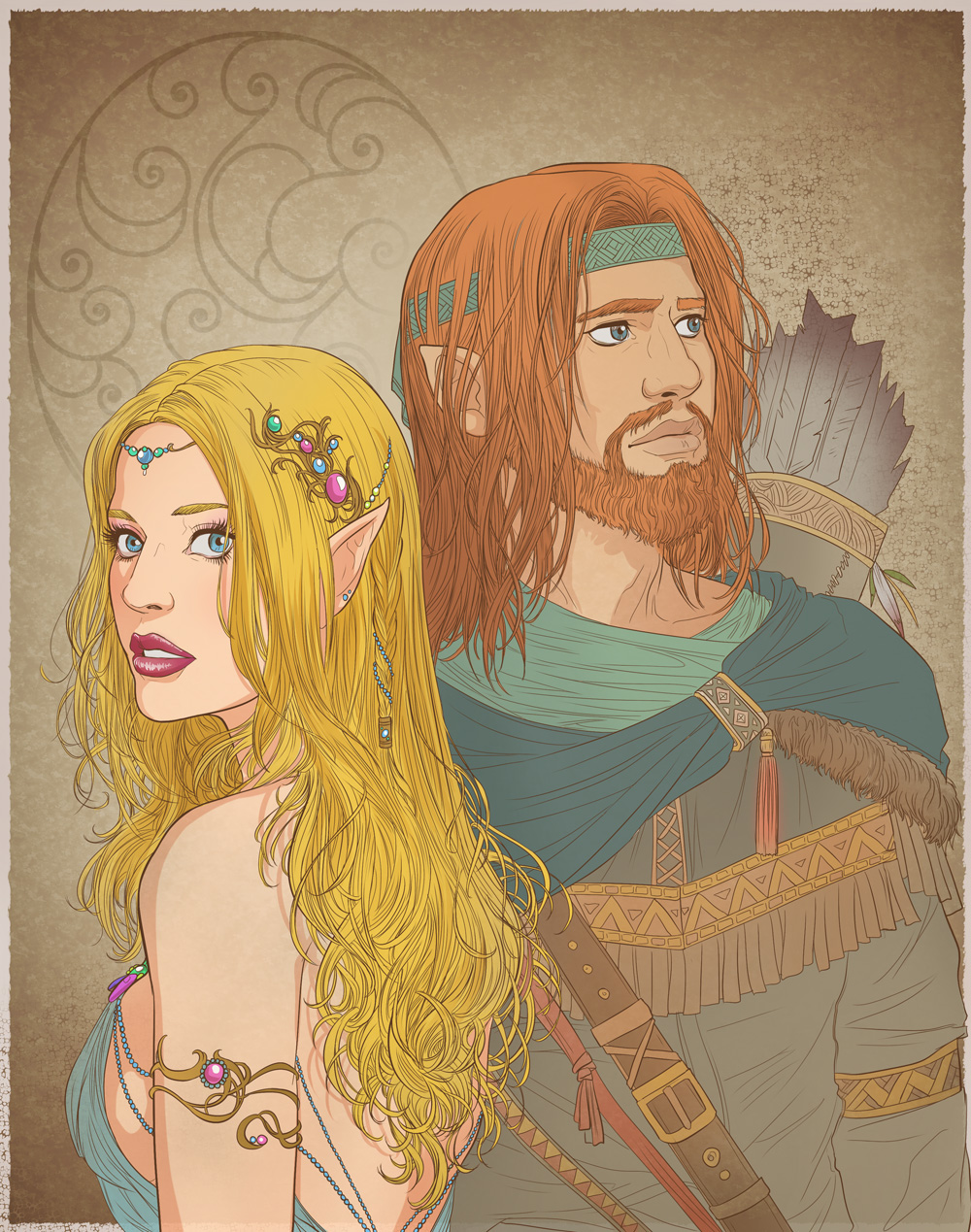
Fan art, tried to find all three together. by Autumn-Sacura
I mentioned the Love Triangle earlier, a cliche but not one native to fantasy.  Tanis grew up in love with an elf maid, a princess of his people.  She loved him back with childlike naivety. But Tanis left because Elves are intolerant to the extreme, big on social purity.  And though humans are no better, human society is much less structured than the that of the long-lived elves.  And his other lover is a human woman who isn't even "good!"

Which calls to mind another D&D creation, the Character Alignment Cliche.  So when creating your character you had to choose two of six attributes, one from a set of three.  Good, Neutral, Evil, Chaotic, Neutral, Lawful.  For a great listing of character of alignments in D&D click here.  Why bother you ask?  Well, despite the massive amounts of rules, D&D attempted to create real story telling.  Which necessitated real characters, which necessitated real thought.  Choosing an alignment was a way of thinking about your character.  In effect, it made the game more fun.  "I will kill this murderer!" says the Paladin, "because I am the arbiter of justice, and because the rule of law says that this man must die!"  "I'm sorry," says the ex-soldier now adventurer, who continues "Though he is guilty of murder, he is also deserving of kindness.  He murdered only to protect his kin!"  Part of what made the Party system so interesting was that you had to have your six or seven heroes all get along together!  You don't see this cliche too often anymore.

As the Tor blog pointed out, the book begins in an Inn, a symbolic setting for the Dungeons & Dragons meme. And the Inn certainly manifests itself often enough in fantasy to warrant its own cliche. the jovial innkeeper, warm fire, large bosomed barmaids. Or it's the Evil Inn cousin, think shifty innkeeper, slatterns, and nefarious doings in the corner.  But in Dragons, it's the Inn of the Last Home, where friends gather to eat Otik's famous potatoes and flirt with the luscious Tika Waylan. And so the epic starts as Friends gather after a long absence.

Completeness: I talk sometimes about scope, and in this simple thematic device, that of old friends meeting, the book establishes a complicated history from page one. Why did the friends part? Where did they go? Why are some together, and some separate? Were there mixed feelings, old dramas, triumphs of old? What about that sensation we've all had about life: that the past is dead, never to be felt again.  That you can't go home, and that memory is always different then what was.  I actually can't think of another fantasy book that begins quite this way. The Eddings' Belgariad had old friends meeting up along the road, but off hand that's it.  For all it's tropism in the Dungeon & Dragons world, it is fairly novel.

"Dragons" suffers from a very obvious and perfectly explainable completeness issue: much is purposely left unexplained. The back story to the characters is only alluded to within the trilogy.  Other authors were contracted to pick up the yarn and finish these quests.  This was frustrating in the 80s, as the other authors were never as strong as Weiss & Hickman.  In some cases entire chapters seem to be left out.  That said, Dragons was a pretty thick book for back then.  Particularly given that the average "game module book" probably ran about 250 pages.  It might well be that some of the missing content was merely cut for size.
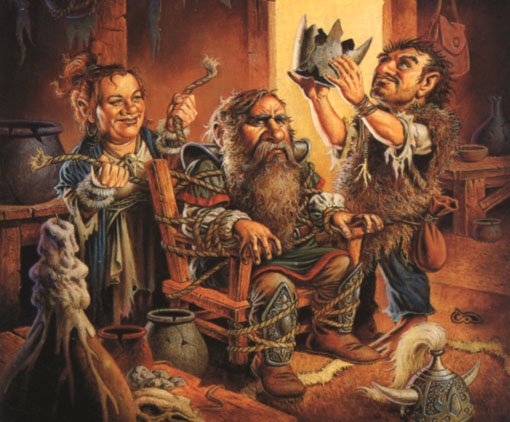
Flint the King, what Flint did during his 5 year trip

There are a few interesting points I wish to make here.  In almost all fantasy genres of the 80s and early 90s, the basic baddy, the foot soldier of evil was more or less incomprehensible, the other, alien and bestial (orcs, trollocs, demons.  Not so in DragonLance.  Hobgoblins and Draconians are fully sentient, frequently speak the common tongue, and are sometimes even playable races within the games.  So when, in that first chapter of Dragons, Tanis and Flint have a conversation with Fewmaster Toede (a hobgoblin comic-relief villain) it's almost shocking.  Usually when orcs appear, swords are drawn, and orc blood rains black from the heavens.  There is no discussion, no capacity for empathy.  It's just kind of a neat thing.  For all that Jordan advanced the genre, the only conversation he ever had with a Trolloc was one where it was being tortured for information, or attempting to trick its human target.

Fewmaster Toede, almost all of these images are Elmore originals
Last, what Dragons lacks in completeness, the game module, the other books in the series, and the other books in DragonLance as a whole compliment and fill utterly.  Though the book itself seems riddled with holes, you can rest assured that everything is explainable with reference to some rule in the Player's Handbook or in the lore of the series, or even in the fanverse that has, in the intervening years given these books a completely new life.

Having completed my reread of the first novel, I still love the Heroes of the Lance.  My admiration for Weiss and Hickman remains, though it is tempered by the amazing writing of what the future of fantasy would soon hold.

Saturday, January 31, 2015

Shadowdale by Richard Awlinson

So this may be the first book in the Forgotten Realms series that I have really enjoyed, and have found to be a fairly mature story. It also was written in 1989, and while it still follows a fairly staid Dungeons & Dragons, hero's quest, type of format, it's characters have a great deal more depth, then even R. A. Salvatore's entry into the realms
over the same time period, (Streams of Silver). The troubled heroes actually have back story! Best of all, the story ends in a large, well detailed battle scene with gods, demons, and thousands of troops.

One thing I found troubling, if only in a vague way, was that the premise of this series of books is that the Gods have been banished from the planes by the über god Ao. And as such, they are sent to dwell as humans in the Realms. Now, alongside the release of these books, were actual campaign materials detailing the stats of everything that existed in these worlds.  So, when gods are killed in the  course of this story, were these gods listed in the materials? Or were they Awlinson's creation for the purpose of this particular tale.  The Arrival, as it is called, would have to be a pretty big deal in the worlds history, particularly in light of the fact that magic seems to stop working, and clerics spells only work in the physical presence of their god. So, is Shadowdale adding to the canon of the Realms, or is it just a one off? From this link, it turns out that the Realms Creator, Greenwood actually did conceive of Bane.

When I start reading the books written in 1990, I hope to see reference to the Arrival and the events that followed.  I know that the events that occur in Darkwell, and Streams of Silver are quite independent of this apocryphal event. Though, they could well have occurred prior (or long after) the events herein.

The most enjoyable attribute of Shadowdale is story's heroes, Midnight, Kelemvor, Cyric and Adon. The story begins as these unlikely adventurers skip town on a guard duty contract, although why you would want your city guarded by men on forced contracts enforceable by prison sentences is beyond me. Why? To aid a mysterious girl, whose mysterious mistress is trapped in an old ruined castle.

Kelemvor is ostensibly the most developed of the heroes. A fighter with a terrible curse laid upon him. This curse forces him to only engage in human relations on a contractual basis whereby he is promised a reward, and then actually receives it.  If he does not, (spoiler alert) he turns into a hideous beast. This makes him seem hard hearted. Now, if Awlinson had opted for a shallow character, the curse not withstanding, once removed, would allow Kelemvor to be the selfless hero we all want him to be. However, it turns out, that he is, as all real people are, much more complicated then this. He stays to defend Shadowdale against the Zhentarim, but not because he cares one whit for the people of Shadowdale. He stays because he loves Midnight, and is promised her love, as the basis for the contract. Imagine knowing, as a lover, that your partner may love you, but they can only be with you while under the terms of a very strict contract.  I quite like this twist, and it is in stark contrast to Salvatore's Drizzt Do Urden, the dark elf with the heart as big as the Realms itself.  As a note, if you are, as I am, reading these chronicles for the first time, DO NOT google Kelemvor.  I just inadvertently spoiled the next two books for myself!  Don't click on this.

Cyric is another interesting guy. A thief, turned multi-class, fighter. That's a term from the old days. At first in the D&D world, you had to choose, fighter, thief, or magic user. In later editions, more classes emerged, and in the advanced rules, your fourth level thief could choose to become a fighter. He would retain his thieving skills up to that level, but he would then have to level up as a fighter instead. You could also choose to level up both, but it'd take forever, so most people usually simply switched.  As a boy, I thought this was cheating (having your cake and eating it too. Don't like the paltry hit point scores of a thief? Multi-class him and have the best of both worlds). Now, as an old man, I know that we wear many hats in this lifetime, and we frequently put earlier chapters in our lives completely to bed.

I digress. Cyric was born in Zhentil Keep. First in Spellfire, and now in Shadowdale, we are introduced to Zhentil Keep, as a city that worships the evil gods of the Realms. I find this to be a really interesting concept. Say what you like about cities, but for them to exist, a certain amount of cooperation is required. A certain amount of trust. After all, a contract is a promise, and not all goods can be paid for up front. For a promissory note to hold value, you must trust its issuer to fulfill the obligations therein. And trust cannot exist in a city of Evil. Unless, of course, it's not all Evil. Which reminded me of my favorite St. Augustine quote, "And even when men are plotting to disturb the peace, it is merely to fashion a new peace nearer to the “heart'’ desire; it is not because they dislike peace as such.  It is not that they love peace less, but they love their kind of peace more."

So I was eager to learn more about Zhentil Keep, from the character of Cyric. He was a thief and a murderer, but his most ardent desire is to be free of his past. To be free from the shackles of the Thieves Guild that made him what he was. He too could care less about the people of Shadowdale, and in fact despises them for their apparent weakneses of trust, love, faith and optimism. And he too, opts to stay and defend it from the approaching army. He's also an atheist, which is pretty hard to be in a Realm where there are actually gods. Like I said, for a fantasy novel of the late eighties, this is pretty deep stuff.

My favorite character, is Adon. Adon is a cleric of the goddess Sune, the Realms' Aphrodite. He is incredibly vain, in a harmless, humorous way, and finds himself being chased out of town by a woman who somehow managed to resist his charms. Adon loves the ladies, and he is a firm believer in beauty. Which makes his devotion to Sune all the easier to believe. After all, to believe in beauty one must only know desire and possess eyes. This would all make Adon pretty one dimensional, save for the fact that as a cleric in a time where the gods have descended, he has lost his powers, and has made no effort to find the avatar of the goddess living within the Realms. Neither for his belief, nor for the powers it gave him.  Which, is, odd.  And then, in the last sixty pages, something happens to Adon which is definitely not expected. And he becomes a completely different person overnight. Who he is, we do not yet know. His tale will likely be continued in Shadowdale's sequel, Tantras.

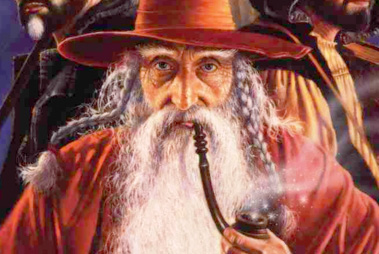
The last point I'd like to bring up is about that old sage, Elminster.  I've been hearing about Elminster for nearly two decades.  He's the Realms version of Gandalf, a long lived wizard of power to rival the gods.  Up till now we haven't learned much about him.  In Spellfire, we learned he had a dalliance with a student, who turned into an evil sorceress.  We also learned that he is short tempered, and humorous.  In my mind, I had always equated him with Dragonlance's Fizban, the bumbling old wizard who happens also to be the God Paladine.  But Elminster is definitely human.  This will probably make him a better character over all.  Though I must say, I rather miss old Fizban and his disastrous Fireball spells.

One last note. Shadowdale, Tantras, and Waterdeep were all released in the same year. Leading me to believe that they were written as one novel and broken up to sell more books, and to be more readable. It also suggests that Awlinson began these novels around the time that Niles, Greenwood, and Salvatore were composing their own founding works.

This was a good read, and if you're looking for some lite fantasy to get you through à lull, this would be a good choice.

Monday, January 19, 2015

Darkwell by Douglas Niles

This marks the final installment in the Moonshae Trilogy.  And, as I am going to start writing shorter blog posts, let me simply outline a few points about the series, about the Realms, and about this particular novel.

The Moonshae Trilogy are some of the first books published in the universe of the Forgotten Realms, published in 1987 to 1989.  And this was a period of great schlock in the fantasy genre.  And these books fit the bill.  They are pure swords and sorcery.  Dungeons and Dragons at its most obvious level.  In some ways, though the books were intended to help sell the games, and vice versa, the books are fairly limited by the universe of the D&D world.  Anyone who has ever read the Players Handbook has had their eyes glaze over with the sheer number of rules, dice roles, and mathematical calculations required for even the simplest of actions.

So when a level six druid casts the level three spell Plant Growth, what happens can be described anyway the dungeon master wants, but at the same time has to adhere to a very specific set of limitations.  And in many ways these stories of the Forgotten Realms are just that, well DM'd stories by a group of players fulfilling quest objectives.

Or the DM can break the rules entirely, as they sometimes do.  But breaking the rules is dangerous business and it can backfire on the author.  One nice thing about writing in a new, or less proscribed fantasy realm is that the limit is your own imagination, and the rules are yours.  Breaking your own rules creates problems too, but a re-envisioning of said rules, an enlarging of the paradigm, is a simple escape from these sorts of problems.

And in each of the Realms books I've read (and I've only read up to 1989) you can literally see spells being cast out of the Magic User's guide.  When the dark god Bhaal creates his evil champions to battle the heroes, they came straight of the Monster's Compendium.  And they have to, because the main rule of writing in an open series like this is a certain consistency.  Still, I'm not sure how I feel about a Displacer Beast being a big bad.  On the one hand, it recalls my egregiously misspent youth (playing with dice and pencils when I should have been out drinking and having sex) on the other hand, the sense of horror and intrigue created by the unveiling of a "new monster" is almost entirely mitigated.

Up until now, just three years into the history of the Forgotten Realms, the books have no inter connectivity, save for a few common city names.  The tales have begun at the far ends of the Realms and have involved relatively little geography.  Though R.A. Salvatore's Icewind Dale series has some decent travel.  Ed Greenwood's own first novel, the man behind the Realms,  taking place in his own world was simply atrocious.  Spellfire has to be one of the worst books I've ever read.

This was never the case in DragonLance, which had such a serious and continuous narrative of the War of the Lance to underscore the personal dramas within.  That said, the Realm of DragonLance was much less flexible, and probably why the Forgotten Realms have, I think, ultimately triumphed in the worlds of TSR.  Anyway, my next book in this series is Shadowdale.  A town first discussed in Spellfire.  I am looking forward, finally, to some crossover.

Last point, about Darkwell.  This book was a pleasant surprise.  The characters took some dark turns, and some of the most intrinsic characters actually died.  That said, the book would have been vastly improved if Niles had NOT decided to make it a happy ending.  Meaning boy gets girl, boy gets forgiven, atonement occurs, and they have many happy children together.  If Niles had not pulled his punches at the last minute, his characters could well have lived on to a fourth or fifth book.  The druid heroine, Robyn, having turned Cleric after the death of her god, the Earthmother, would not have forgiven the King's infidelities.  And Tristan would have actually grown for it.  If Tristan had been wracked by actual guilt over the death of his friend, then he would never have forgiven himself, and the sadness this engendered in him would have made him a far better King.

That said, until the last six pages this novel was difficult to put down.  And that makes it the best Realms novel in the series so far.

For a nice history of D&;D, look here.

Monday, April 9, 2012

Azure Bonds by Kate Novak and Jeff Grubb

Now this is really the beginning of the Forgotten Realms Novels.  You might remember my complaints about Darkwalker on Moonshae. It was a fairly shallow piece of princely do-goodery, that really said nothing about the Realms or their history.

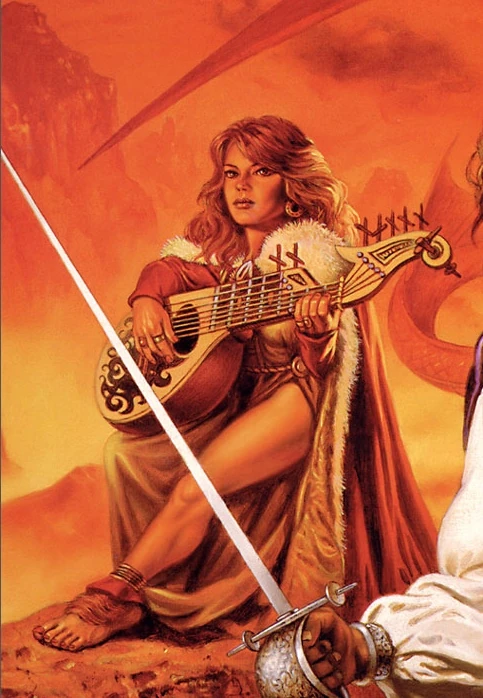
Azure Bonds is everything I hoped for.  It has the beginnings of characters who were well known to me, long before I started reading the Realms, action, adventure, and humor.  If there was no romance, that's ok.  This time.  When I was a young kid, Dungeon & Dragons, attempted to compete with the already-past its prime moment of "Magic the Gathering" with a series of cards called "SpellFire".  Given that TSR, owned the rights to much of the famous Dungeons and Dragon's artwork, they had a ready supply of easily choppable art for these cards.  And they often kept characters more or less intact.  I had the Alias card, the lusty redhead above.  I always thought she was crazy sexy, and so I was curious about who this person was.  Well, now I know.

As a side note, I actually saw people playing Magic the Gathering a few weeks back, in a pizzeria on the Upper East Side.  The guy was actually showing off for a girl.  He had every single card in a thick, clear, possibly bullet proof, plastic container.  Which is crazy.  That's a "back away slowly" kind of dude.  I keep my Spellfire cards under lock and key.  If I showed them to my wife, she'd probably divorce me.
Let's get back to the Fantasy Five, something I've ignored in my ardor over the Malazan Book of the Fallen.

1) Character
2) Cliche
3) Scope
4) Magic
5) Theme

Character:
Azure Bonds is definitely a plot driven story.  But it has some interesting philosophical points, as any fantasy and science fiction novel must, that help define character.  I won't ruin it for anyone who wants to reread this classic, but the nature of the main character is a central dispute of the novel.  Regardless, the main character, a warrior woman named Alias, is an extremely likable character.  She's sarcasic and clever, but at the same time cares for her companions.  Her supporting adventurers are also extremely likable, and somewhat genre breaking, save for the Halfling Thief.  The wizard, though is a what Alias calls, "A Green Grocer" a merchant of magic, and not a true wizard with the long white hair, and the mysterious airs.  The halfling, though stereotypically a thief, is a fun and enjoyable character.  Mostly, characters are skin deep in Azure Bonds.  That said, we do learn some things about Alias, and her father, that provide some interesting character insights.  Unfortunately, I can't talk much about them without spoiling the book.  Of course, the best character, is Elminster, the very essence of quixotic wizard.  And though the character of Elminster is minor, and fairly cliched, you can't help but love the fiercely powerful, irascible old coot.

Cliche:
Azure Bonds takes place in the Dungeons & Dragons, rule-based system, and in the Forgotten Realms Universe, that comes with all of the Dungeons & Dragons cliches.  That said, Novak manages to make the magic and combat systems seem completely natural and not stilted or forced.  Which makes sense, I mean, the original 2nd Edition Rules were supposed to make combat realistic.  If it didn't involve so much THACO and Armor Class shenanigans, it wouldn't have been such a trying game.  Regardless, Forgotten Realms also made several cliche's of its own.  One of the mega villains, a fantastic creation called Moander, a dark God, who is literally a living wall of reanimated detritus, was used by the UbiSoft developers in the Heroes of Might and Magic series of video games.  Used in both Three and Four, here he is reimagined.  Of course, Kate Novak's Moander looks nothing like this undead piece of work, but the developers paid homage in many respects to both D&D, DragonLance, and Forgotten Realms. In terms of character cliche's there are relatively few.  The character of the halfling thief was fairly trite, but she's a non-essential character (though her actions are important). 

Scope:
The scope of Azure Bonds provides a narrowness of focus that gives ample detail about the Forgotten Realms, while not being needlessly compartmentalized as Darkwalker was.  The action starts in the town of Suzail in the nation of Cormyr.  One thing that the Realms reminds us is that the writ of law is only as strong as the nation that rules.  And the Realms are relatively small fiefdoms, with various small time Kings.  There isn't the sense of international politics that there is in Jordan's or Martin's epics.  There are some political upheavals, but so far, things are pretty local.  Sometimes I like that.  It takes an awful lot of memory and concentration to understand the politics of dozens of fictional nations.  I know that Tear sold grain to Illian and Cairhien despite a trade embargo on the one, and civil war on the other.  That's pretty messed up.  I know about as much or more about those three nations as I do Iran, Iraq and Syria.  One thing that bothered me though, was the interplanar warfare that occurs later in the book.  The concept of planes is very neat, and it is central to Ed Greenwoods original concept of what the Realms were--but in this case, it seems like too much of a convenience for a writer to engineer an exciting ending.  I like that the Realms are fairly grounded.  The magic has limits, and even though there is a much more diverse panoply of creatures to choose from, they are all bounded by the rules of a game, making them less.  Boundaries are important in fantasy, you have to adhere to the rules you set.

Magic:
I've covered this in some part.  Spells take time to cast, they use a variety of scrolls and components, they need to be memorized before each use, etc. etc.  The magic is covered by the Dungeons & Dragon's cliches, however, it still comes across as a novel, not the mechanical manifestation of spell casting in video games and in the old paper and pencil method.  But...there are times when the magic wielded does seem to completely bypass the rules altogether.  Given that Novak and Grubbs were writing when fantasy fiction was in its adolescence, this rookie mistake can be glossed over.  It's a genuinely entertaining story.

Theme:
That Azure Bonds qualifies as fantasy fiction is unmistakable.  The themes are all there, companions, loyalty, friendship.  Likewise, the evil triumvirate, greed, pursuit of immortality, and the pursuit of power, plagues the supervillains in this novel.  One theme however, permeates the Realms in a way that other mega epics fail.  The stories of the realms, Azure included, reinvigorate the notion of the quest.  In all the big serialized fantasy worlds, there are a small set of characters who pursue a goal for thousands of pages.  The goals change, but they're all in pursuit of a larger purpose.  The Realms, unlike the world of DragonLance, a war torn world with heroes and an evil goddess, were designed to be episodic, referential without commanding a single story line.  This is a concept that has been lost by modern fantasy.  And it's sad.  Because the quest doesn't always have to be epic, it can sometimes be as hard as a paralyzed man learning to wiggle his toes, or a pair of skinny kids freeing their sister from a den of Orcs.

Overall, I encourage readers to dust off this 1988 special.

Thursday, October 6, 2011

Darkwalker on Moonshae, Forgotten Realms 1, Douglas Niles

I intend my review of this book to be short and sweet.  This book was terrible.  As an intro to the Realms, it brought, literally nothing to the depth of the world created by Ed Greenwood.  After reading R.A. Salvatore's Homeland, I was deeply disappointed.  As I stated last post, I am going to attempt to read these books by date of publishing, having faith that Wizards of the Coast had some idea that the world they would be creating would be somewhat cohesive, and not like The Simpsons, where every character restarts every episode with little or no history.  Granted, this was the late eighties (published 1987), and it was a different time for fantasy genre fiction.  The genre, whose following grew by leaps and bounds because of works like these, has grown infinitely more sophisticated.  However, Douglas Niles' first stab at a Forgotten Realms novel reads like the senior project of a highschool student.

I was rather hoping that the first series in the Realms would be of the same caliber as Margaret Weis and Tracy Hickman's War of the Lance, saga.  So far, I am deeply disappointed.

Character:  There are no characters in this book.  The lead character is a feckless prince named Tristan.  He's apparently irresponsible, but we don't see any evidence for that, apparently he whores and drinks every night, but we only see that one night at a summer festival.  And apparently, he's got a heart made of gold, and is really in love with a ward of the King, a young girl named Robyn.  Who flirts with a thief, for no apparent reason, which never goes anywhere, and is completely unresolved by storie's end.  SPOILER:  It turns out she's in love with the prince too, and the thief flirt was a red herring.  Big surprise.  Still though, it's not all bad.  I'm reminded that a big part of high fantasy was romantic love.  A lot of modern fantasy writers, in their cynicism choose to ignore this.  But Arwen and Aragorn's forbidden love was a highlight of Tolkien's saga, not a distraction, or a subplot.  Readers of fantasy are romantics, and love, no matter how unrealistic, always appeals to us.  Back to the facts:  Tristan is the most developed character, and he's as shallow as condensation.

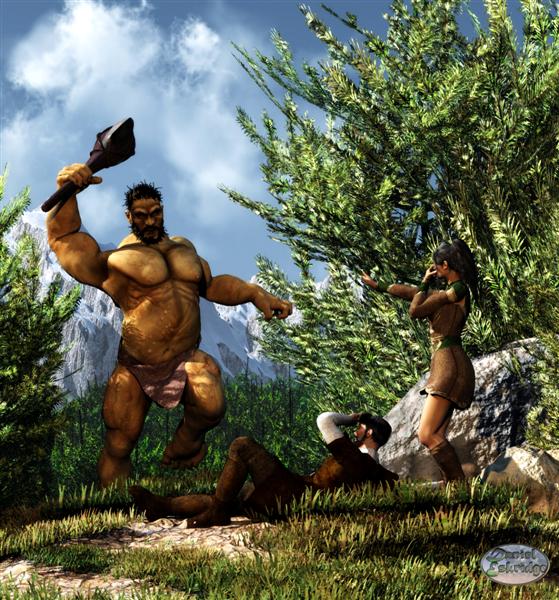
Images are from Daniel Eskridge's website
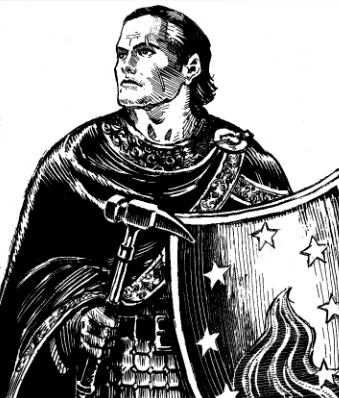
Cliche:  The interesting thing about reading a book that takes place in a world that is determined entirely by the rules of the 2nd edition of the Dungeon and Dragons handbook, is that the author can choose when he breaks with the rules, and when he upholds them.  As an old dungeon master, I find both possibilities interesting.  When one of the minor characters, the aforementioned flirty thief, Daryth garrots a Firbolg in one stroke, you realize immediately, that is what those of us in the trade called a "backstab" an attack that only a thief or assassin type character class can use, depends upon him being "hiding in shadows" and gets to roll an incredible damage roll (I forget the dice roll, and the internet failed me--D&D was pre-internet!)  On a side note, I've noticed that much of the D&D terminology pervades the videogaming industry at large, and that the first hits for the term backstab, were DragonAge Origins hits.  Anyway, Darkwalker uses all the D&D cliches, about dwarves, halflings and elves, with some interesting additions.  The Moonshae Isles are home to a druidic clan of peoples based largely on a Celtic-Welsch-Scottish mythos.  Druids are anything but common (though possible) in Dungeons & Dragons, and to have three of the central characters, including the novel's central conflict be based off a Druidic conflagration was quite refreshing.

Eskridge, Image of Tristan's home, Corwell
Scope:  Despite this being our first immersion in the Forgotten Realms, the scope of this novel was perilously small.  There were the Ffolk of the Moonshae Isles (which don't seem to be isles at all) and the Northmen (think Vikings) who ravaged the peaceful Ffolk in longships.  The only reference to a larger world is that this character, Daryth, the thief, rogue, assassin, was from another land, and was called a Calishite.  No reference is drawn to a larger world, and even the central conflict of Darkwalker is based around the defense of a fairly minor castle in a larger kingdom, the High King of which never bother's to even show up.  Still, this is the first book of a series, so I'll be patient. 

Magic:  As in cliche, the magic of Darkwalker is fairly limited.  The Big Bad seems to be unlimited in scope, but is ultimately defeated with a magic sword.  Here Niles completely abandons D&D rules.  D&D is one of those games where characters die all the time.  Dungeon Masters can be unflinching about killing characters, despite the vast amounts of time it takes to create one.  So Big Bads are really, really hard to kill.  This is why Rogue characters are so important.  If you can't kill the Dragon, you need someone who can steal the famed Gem of Aranar from it!  As a rule, in Darkwalker, all of the magic is clerical in nature.  This is unusal for the genre, particularly in D&D where magic is an involved affair with spell memorization and spell ingredients.  Clerical power is innate and based on your level, your natural abilities, and your chosen faith.)

Theme:  Despite all of my misgivings about Darkwalker, it's fairly lighthearted.  Something, which after the heavy fiction of Steven Erikson and others is a bit of a relief.  Still, Darkwalker seems like a one off, classic swords and sorcery novel.  The writing has an innocense about it that comes off as amateur rather than intentional.  Since its plot based fiction, which skimps on the characters inner dramas, or treats them, again amateurly, there's really no theme to this novel.  It's get in there, and get her done.  Slay the dragon, save the damsel.