Search This Blog

Showing posts with label Steven Erikson. Show all posts

Saturday, February 7, 2015

The Wise Words of Karsa Orlong, House of Chains, Steven Erikson

So, in the Malazan world, a favorite character of mine, and of fandom, is the Thelomon Toblakai, Karsa Orlong.  The character change this of this behemoth blade-master changes much over-time, but even at his most barbaric, he speaks with a gravitas, that is always stirring.  Even the author finds Karsa an interesting study.  For Erikson's treatise on Karsa and 'the other,' click here.

This quote, from Steven Erikson's House of Chains, occurs as the Teblor warrior muses on the rebellion known as The Apocalypse.  He has thrown in his lot with the Apocalypse, almost by chance.  He abhors the rebellion's avowed purpose, and by now has come to admire the Malazan Empire somewhat.  These are his musings on the War of the Apocalypse.

And if you read my other blog, RavingLeftatic, you'll see why I excerpted this here.  All credit goes to the author, again, Steven Erikson.

by shadaan
"The notion of a life spent tilling fields was repellent to the Teblor Warrior.  The rewards seemed to be exclusive to the highborn landowners, whilst the labourers themselves had only a minimal existence, prematurely aged and worn down by the ceaseless toil.  And the distinction between high and low status, was born from farming itself -- or so it seemed to Karsa.  Wealth was measured in control over other people, and the grip of that control could never be permitted to loosen.  Odd then, that this rebellion had nothing to do with such inequities, that in truth it had been little more than a struggle between those who would be in charge.

Yet the majority of the suffering had descended upon the lowborn, upon the common folk.  What matter the colour of the collar around a man's neck, if the chains linked to them were identical?

Better to struggle against helplessness, as far as he was concerned.  This blood-soaked Apocalypse was pointless, a misdirected explosion of fury that, when it passed, left the world unchanged."
by slaine69 at deviantart


Tuesday, April 16, 2013

Brandon Sanderson's Way of Kings


My review of The Way of Kings, must start with certain caveats. First, I must cop to a certain envy of Brandon Sanderson, a man younger than myself, who is incredibly prolific, and talented, and successful, and... hand picked by Harriet Jordan to complete the Wheel of Time. My own attempts to start my career in fantasy have been thwarted mostly by myself. So, it is important to view my criticisms of his writing through a slightly jealous veil.

That said, I do have certain valid criticisms, of his writing style, and his view of fantasy. Also, looking at his essay on magic, though well intentioned as a guide to young writers, it doesn't quite fit the facts of some very successful sagas.

One thing is undeniable, Sanderson is a formidable story teller. I have read several of his Mistborn series, and Elantris, and each book is a well laid out, truly engrossing story. The same must be said for Way of Kings. And though his writing may not be my cup of tea, I certainly intend to finish the series, unlike Mistborn, which I did not complete.

I think I must state outright that, I think his writing lacks the sophistication of Martin, the breadth of vision of Jordan, the complexity and sublety of Erikson, the familiarity of the Eddings team, the cohesiveness of Weiss and Hickman. Any reader should know that going in to one of his stories. But maybe, Sanderson doesn't need to do that, he's made his own place in the starry sky of modern fantasy.

Let's go to the fantasy five.

Character: this is one of the things that I think Sanderson falls down on. The hero of this epic is a young soldier/slave named Kaladin. The book is over a thousand pages, probably 20% of that is given to describing Kaladin's state of mind, chiefly his depression. As Kaladin is as deep as a teapot, this makes for some boring reading. My wife has a saying that she used to describe certain boys when she was on the market: "darkness is not depth: do not mistake depression for intelligence, charisma, wisdom, or introspection". Kaladin has some decent reasons for being down, but for whatever reason, the constant vacillating on his state of mind, really just bores. That said, I found Dostoevsky's  Underground Man similarly irritating, and Notes from the Underground is considered to be one of his seminal short stories. In Way of Kings, even on page 600, Sanderson has Kal again teetering on the brink of his boring depression. Again. I don't have anything against depression, and for all I know the writer himself may have struggled with it, but it does not for concise story telling make, and Way of Kings would be a better book if it were about 200 pages shorter.
A beautiful illustration of Kaladin with Syl, by Dixon Leavitt, http://dixondoodles.blogspot.ca/2010/10/kaladin-meets-syl.html

Kaladin's history is told in increments through out the novel, culminating in the secret reveal in the last 100 pages. Several secrets revealed. One of which was worth it, the other of which, the reason for his depression, was, frankly not.

However, I am an optimist, and I do like Kaladin. And it was his story, not Shallan's, not Dalinar's that made me want to complete this novel.

Shallan's story, told in a different country of the same world was almost useless. I won't waste too much breath on Shallan. Much was made of her wit, by Sanderson, but to me, her wit was a slug-like thing next to the satirical utterances of Tyrion Lannister, or even Jaime Lannister. For some reason, Sanderson's editors at Tor (I love you darling people, so don't hate me for saying this) thought it was a good idea to keep the entire length of a poorly written essay by Shallan in the text of the book. It was not. It is a bad essay, and any non creative writing professor, and a few of them as well would have reduced it, and Shallan to shreds.

One neat note: I suspect Sanderson is an artist, because he describes the process of drawing, in so far as it works for me, very well. And all of the book's illustrations are quite good, though I haven't bothered to find out if they are his or not.

The other epic hero is Dalinar, who, interestingly is a much older man than usual in fantasy. He has to be about fifty, with a 20 year old son. That's good. As a man getting older myself, I find myself frustrated by the fact that say, all of Jordan's central characters are between the ages of 18 and 22.  Rand al'Thor frequently acts impossibly mature for his tender 22 years.  However, Dalinar suffers from the same problem that all of Sanderson's characters do, he's one dimensional.

You can get an idea of what I'm talking about from a casual sampling of his "extras". Sailors are crude but happy, blacksmiths are big and jolly, priests ingratiating, standard nobles are feckless, you get the picture. As I've written ad nauseum, tropes are a necessary part of writing, yet... It doesn't work for Sanderson. His characters are Saturday morning cartoon versions of what ought to be a made for HBO series.

Cliche: Sanderson is not a believer in the use of standard fantasy cliches. I don't have a problem with that necessarily. There are no dwarves or elves, and the magic, which I'll discuss in depth, seems to be original. However, as I've suggested, Sanderson's lack of character depth means that the central characters all rely on the bad sorts of cliches, the types that are unintentional and indicative of bad writing.

Sanderson breaks with standard cliches in the following ways. There seems to be no central awful evil one, not by the end of the first book at least. We know that there were, thousands of years ago, crazed beasts called the Voidbringers, which sounds a lot like the beasts that destroyed the land of the Never Ending Story, the Nothing. The races that populate this world, are nothing like the other races we have come to love, they are different colours, but carnival colours. Class and caste are determined by eye color. Size differences are slight, and poorly delineated. The biggest cliche that Sanderson dispenses with is the simple air and water his characters live on. The continent in which the action takes place, is like the ocean bed from The Little Mermaid. I kid, but Sanderson's imagination runs wild with this world. This was truly inspired. A funny example is that there are chickens in this world, but they are rare and exotic. People eat crustacheans only and grow seaweed from rock pods. Pretty neat, though it trends toward science fiction. 
A Warg from the Never Ending Story

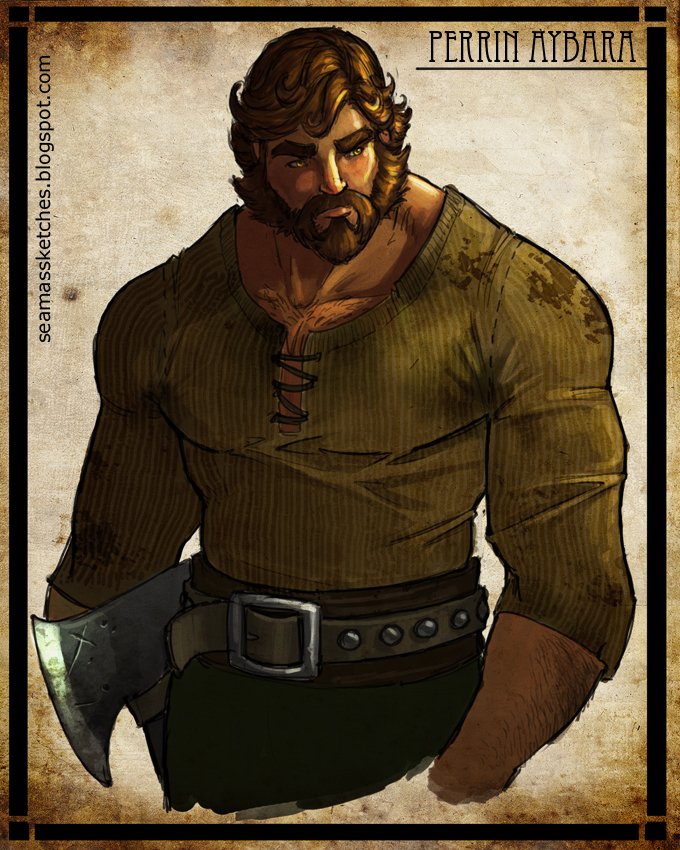
As I wrote, Sanderson is invested in some cliches, standard story type cliches, thus sloppy writing cliches. It's one thing to call to mind a sailor with his lewd mouth and ruddy complexion, it's another thing to make him act like an after school special, version of himself. I think that's one way other writers successfully use cliches. The Belgariad's Durnik, was exactly the sort of man you'd expect to be a smith, as is Perrin from the Wheel of Time. Yet, each of these characters had a subtle sense of originality. durnik's heartbreaking devotion to Polgara, Perrin, slow to rage, yet given to his wolven nature of blood frenzy.

Speaking specifically about the story's main hero, Kaladin, SPOILER ALERT, I mentioned the Coming of Age cliche, and the Hero's Redemption, cliche. I think one of the greatest examples of the Hero's Redemption is Mad Mordigan from the film Willow, whose first appearance is having been locked in a cage and left to rot. The first time we meet Kal, he is a proud and strong soldier, a few years later he is an escaped slave, recaptured and bitter, but not broken. Gradually we see him enliven, and boy do I mean gradually.
Mad Martigan from Willow as we first see him, in chains like the scoundrel he is.

Another familiar cliche, The Am I Going Crazy cliche, is used for the story's older hero Dalinar, the old warrior who begins to have prophetic visions. I think this works rather well for Sanderson, even if it is somewhat tired, and the answer to the cliches question, is simply "no". When Jordan used the Am I Going Crazy Cliche in Lord of Chaos, it was to describe The emergence of Lews Therin Telamon in Rand Al'Thor's mind. Jordan showed his depth with that one, and the answer was much more complicated than simply yes or no. Still, the novel is already too long, and even more boring soul searching would have further dragged the novel down.

Scope: The best thing Way of Kings has going for it, are its magic and its scope. Little Mermaid with gigantic swords, is actually a great start to a story. And the book is full of interesting little details, for example, the female nobility of Alethkar, keep one hand, their "safe hand" hidden as is only proper for a lady of good breeding. Men and women have acceptable norms for behaviour. Men should study war and be fighters, women, should study music and reading and writing. In fact, men are intentionally illiterate, typically having their wives scribe for them, reading books aloud, or writing messages out for their husbands. I like this, not because I don't like equal rights in my fantasy, but because sexual dimorphism is a real thing. I am constantly surprised by the number of really powerful women fighters in Steven Erikson's novels, and he is an practicing anthropologist! I don't mind the idea of it, but if you have them, then they can't allbe thin wisps, most of them would have to be like Martin's Brienne of Tarth, big, or ugly, and literally built like a man. Swords are heavy, armour is even heavier.
The Maid of Tarth, played excellently by GWENDOLINE CHRISTIE, who happens actually to be quite pretty in real life.

But i digress, the scope of this planet is large, and you get the feeling that Sanderson spent considerable time developing it. that said, it isn't deliverd particularly skillfully. One of the things that made the world of the Wheel of Time so compelling, was that it started out small, in a small village called Emond's Field, far from anywhere else. But Jordan didn't declaim as Author, "the people of this subcontinent eat fillet of fish," or "the people of this continent only eat fried bugs," what we learned, we learned through the omniscient story telling voice of whatever characters were central at that time. The villagers of Emond's Field knew that far to the south, a city named Tear existed, but they wouldn't have been able to tell much more than that. Jordan made damn clear, almost annoyingly so by page 7000, that people learn by rumor, by word of mouth, and even the omniscient voice was frequently wrong about the facts.
Emond's Field, the cover of the Wheel of Time's first installment, The Eye of The World
All of which to say, Sanderson throws a lot at you at once. It is nice that the action takes place in several kingdoms at once (though I would have nixed Shallan as a character altogether) but, at this early early stage of the game, it's sort of unnecessary and distracting. The main story is about Kaladin, and that takes place on the Shattered Plains, where Chasm Fiends roam like giant lobsters. With flashbacks to his homeland, just over the border. Kaladins fellow slaves are from all over the world, and are thus incredibly diverse, showing just how much Sanderson has in store for us. And yet--I don't buy in.
A beautiful rendering of a Chasm Fiend, by Mighty5cent, and courtesy of http://bookswithoutanypictures.wordpress.com/2011/08/29/way-of-kings-readalong-part-iv/
It takes a singular talent to make new races, new peoples, and to introduce them in such a way as to hold to the reality of the world. Because that is what we are talking about ultimately with fantasy. The world bends or breaks the laws of Earth, and the Galaxy in general, but it must adhere to its own rules. Sanderson knows this, indeed a portion of essay on magic systems stems from observations bout internal consistencies. Sanderson is rigid about making sure his system works, and I commend his outstanding creativity.

The world of Way of Kings is truly ground breaking. Still, it might have been nice for him to explain some of its intricacies through the characters, and not through bland references to far away kingdoms and customs. A good example of this idiot tactic, is Kaladin's blithe reference to Corinne's slave rules.  I guess there is some nation named Corinne, or person, or state, where they've established laws that govern slavery.  While it is absolutely fascinating, and a worthy endeavor to detail such laws, that's not what Sanderson did, he threw this supposedly obscure reference in to add depth, I know its bad writing because I do it myself.  It just comes off as amateurish.  When Jordan does the same thing, a good example would be Birgitte Silverbow, who has lived countless lives as she is attached to the Wheel of Time as one of its greatest heroes.  She makes fun passing analogies, like, "Elayne's always looking down her nose like some Tovan Councilor."  But the context for Birgitte has been established, she has lived dozens of times, and each time she was born and died a member of a different nation, in a different land, it's only natural for her to mention names we've never heard of.  And, even better, Jordan will bring up those references, miniscule as they are, later when we find out hundreds of pages further along that a Tovan Councilor is a really snooty elder from a nation that died during the Trolloc Wars.  I sincerely doubt that we will ever see reference to the Corinne Rules again.  That is not to say he doesn't always get it right.  He did do a neat job with describing chicken. Naturally, these crustacean devouring Alethkari, think it the most exotic food, and, he even includes a random trading scene where chickens are acquired (somehow relevant to the plot, but I can't say how.)
image by quargon http://grand-fantasy.tumblr.com/post/36947495502/shardblade-concepts-by-quargon-conceptual-art-of

Magic: not to be out done by his own system of allomancy in the Mistborn saga, the Stormlight Archive, the proposed name for the saga Sanderson hopes will be his opus, uses several systems of magic. There are Sheardbearers, men who wield gigantic swords reminiscent of he blades from manga comics. The swords are magic and weigh little to their owners. I must say I enjoy this particular brand of magic, a child of Dungeon and Dragons, and Final Fantasy video games, I am much enamoured of magic swords, and they are not as common as you might think in contemporary fantasy. It was the openings scene of this novel, which I read in a Tor newsletter sample over two years ago that made me want to purchase this novel two begin with. That opening scene featured a dozen of these gigantic blades rammed into the ground after a megalithic battle. That opening had real promise, sadly, the book itself has not measured up to its glorious beginning.

But I digress again, there are other forms of magic: Stormlight, soul casting (which is creating matter out of thin air) and some power called Lashing, that uses Stormlight (Sanderson's source of Magic are these massive high storms that pass through every week or so. The power gathers in gems, which powerful people use to power their magic items). Lashing uses some of the facets of Allomancy, namely, the push me pull you method of moving. It is a singularly scientific manner of creating a system of magic, people who are flying aren't defying gravity, so much as using methods of force and trajectory, with the allocations of various elements. In Mistborn, allomancers use different kinds of metals to perform different actions, and the metal "burns" during use, such that it disappears. Because magic always has to have limits. Similarly, gems lose their light after infusing the caster with Stormlight.  Interesting that Sanderson's opus uses such a similar method of magic, Stormlight, as his last trilogy. It harkens to another fantasy cliche, Fire and Ice. In all final fantasy games, and in many manga epics, including Naruto, the earth is divided into elements that complement each other: fire and ice, earth and wind, lightning and water (much as that ancient Greek philosopher Thales did). I don't think this was intentional, but the magic system of Mistborn clearly was "earth" while the magic of Way of Kings, is "lightning". As I've said dozens of times, I see nothing wrong with the use of cliche. It enhances a story, it says without saying, implies without utterance.  In this case, I think it novel.

One of the things at which Sanderson excels, is his technical treatments of magic and battles. The second prologue in Way of Kings, (I call it a prologue, because it proceeds the main action of the story by five years, not because Sanderson designates it as such) has a fantastic scene during which a minor but pivotal character, the Assassin in White, is introduced. It is a phenomenal battle scene, and reminds me about of some of the battles in the science fiction epic, Enders Game, where gravity and perspective are thrown to the four winds. Good work Sanderson, good work.

Last...we have Theme. As usual it is the hardest to define, and the most important piece of the puzzle. Oftentimes, We know what we like, the second we see it. Sometimes, we have to do a thing, or see a thing many times before we know that. What is the difference? Does it matter? I knew I liked the Wheel of Time immediately. A song of Ice and Fire, (Game of Thrones) I hated at first, because I was young, and having my favourite characters killed was awful. But successive rereads over the years have made me love Game of Thrones dearly. I did not like Harry Potter at first,  I thought the writing childish and simplistic (and its teenie bopper lit, so that's not wrong) but the cleverness, and growth of the characters in successive books made it well worth it. I knew the second I cracked the cover of The Black Company that it was awesome.

 But where does Way of Kings fit in all of that? I look forward to the second book, published in a matter of days I believe. But... as you may have guessed, I'm not a Sanderson groupie. There is just something about the writing that puts me off. In Fires of Heaven, when Rand al'Thor stares off into the mountains and asks Asmodean if he knew what those distant ruins were, Asmodean shrugs and says he doesn't know, that the world has changed too much. But I believe Jordan knew. Or, if he did not, he could have fit those nameless ruins into his epic without upsetting the story, or world history. I do not have that same confidence with Sanderson. Nor did I with Goodkind.  If I had to define Sanderson's theme, it might be, I see him as a fantasy cover artist who had a gift with words, who can visualize and depict incredibly intricate worlds, but does not have the depth of a great game changing writer. And he definitely tries, there's enough, faux pholosophy and character analysis to indicate that if he could do it, he would have.  He is the John Grisham of his genre, that's not too cold I don't think. Grishams novels are vastly entertaining, and they will keep you on the edge of your seat, waiting to find out what happens next, but they won't educate you, they won't enlarge your experience, and they won't make you a better person. And sadly, I think that must be true of Way of Kings as well. Which is sad, because the title of the book is named after a book that was aimed at doing precisely that.

Thursday, May 24, 2012

Great Moments in Fantasy - Anaster's Grief

So, I hate to do this, but there are so many good moments in Memories of Ice.  I had to choose two great moments which I will post separately.  Both involve the character Itkovian, the Shield Anvil to the God Fener.

The first, I call Anaster's Grief.  In my previous post on Memories of Ice, you probably noted my reverence for the character Itkovian.  I won't go into it in depth here, and the moment below explains what he is, and what he does pretty adequately.  What you may not know is that Anaster is what they call, a "Child of the Dead Seed" his mother, (one of the first witches of the Pannion Seer) is a fanatic, who slept with a dying soldier on the battlefield.  The Pannion Seer preaches, of course, that the Dead Seed is holy, and that children born of such a union are his personal shock troops. Anaster was the first Child of the Dead Seed, and is its leader. He's a young man with empty eyes.

-----

Anaster by Luktarig at Devaint Art
Itkovian studied the young man, and saw what he had not expected to see.  'First Child,' he said.  'There is despair within you.  I will take it from you, sir, and with it your burdens.'


Anaster jolted as if he had been physically struck.  He drew his knees up, climbed onto the seat of the throne, face twitching.  A hand closed on the strange obsidian dagger in his belt, then fliched away as if the stone was hot.


His mother screamed, clawed up her son's outstretched arm.  Snarling, he pulled himself free.  She sank down ot he floor, curled up.


'I am not your father,' Itkovian continued, 'but I shall be as him.  Unleash your flood, First CHild.'


The young man stared, lips peeling back to bare his teeth. 'Who -- what are you?' he hissed.


The captain stepped forward. 'We forgive your ignorance, sir,' she said. 'He is the Shield Anvil.  Fener knows grief, so much grief that it is beyond his capacity to withstand it.  And so he chooses a human heart. Armoured. A mortal soul, toa ssume the sorrow of the world.  The Shield Anvil.


'These days and nights have witnessed vast sorrow, profound shame -- all of which, we see now, is writ as plain knowledge in your eyes.  You cannot deceive yourself, sir, can you?'


'You never could,' Itkovian said. 'Give me your despair, First Child.  I am ready to receive it.'


Anaster's wail rang through the main hall.  He clambered still further up the throne's high back, arms wrapping around himself.


All eyes held on him.


No one moved.


Chest heaving, the First Child stared at Itkovian.  Then he shook his head. 'No,' he whsipered, 'you shall not have my -- my despair.'


The captain hissed. 'This is a gift! First Child--'
'Not!'
Itkovian seemed to sag.  Sword-pont wavering, lowering.  The recruit moved close to support the Shield Anvil.
'You cannot have it!  You cannot have it!'
The captain's eyes were wide as she turned to Itkovian.  'Sir, I am unable to countenance this--'


The Shield Anvil shook his head, slowly straightened once more. 'No, I understand. The First Child - within him there is naught but despair.  Without it...'


He is as nothing.

----

It's easy to feel pity for Anaster here, despite the atrocities he and his 'family' have committed.  The slaughter of innocents, the mass cannibalizations of entire subjugated cities.  He was raised by an insane woman, worshipping an insane religion, being cynically controlled by the Crippled God.  A God who wants everyone to feel the pain his own crippling caused him.  His entire birth was an abdomination, and yet--somehow he is an innocent.  And the Shield Anvil can see it, deep within his soulless body.  Well played Erikson.

Thursday, November 17, 2011

Memories of Ice, Steven Erikson

So my Amazon Associates is no longer working. So if you want to pick up this title, click here.
So this is one of my favorite entries in the Malazan Book of the Fallen.  There are some great new characters who live, some amazing, honorable new characters who die, great drama, and as usual with Erikson's work, events occur which make every atrocity you've ever heard of pale in comparison.  I think that is why Memories of Ice sticks with me so vividly.  My second reread was not easy.  It's as heavy as Deadhouse in its own way, and I had to read some lighter works in between.  But the imagery is dark, and those who are good, are so heartbreakingly good as to inspire in a way that real people cannot.

I remember from my school days reading Chaim Potok's The Chosen and learning about a concept in Judaism that I always loved.  In it, Reb Saunders is a tzaddik, one who suffers for the entire community.  At least that's my definition.  The Wikipedia definition involves the Kabala and notions of purity that I'm uncomfortable with.  Memories of Ice is filled with suffering, and one character is charged with accepting the suffering of two entire peoples. Why am I so enamored of this concept?  I suppose because I think from day to day, most of us detach ourselves from the suffering that is ever present in the world.  We have to do so for our own survival, though in many cases it is for our own convenience.  That such men and women can exist that can feel for others to this degree is a beautiful idea.  Though perhaps, mere acceptance and benign willingness to receive it is not very helpful to those who are in need now.  It was this concept that so drew me to my wife, who would see the ads of suffering children on the TV and start crying in empathy.

At anyrate, I'm going to continue, as I have thus far reviewed the Malazan Book of the Fallen, by simply discussing topics of interest.  As usual, if you haven't read the book, or are leery of spoilers, DO NOT READ AHEAD!

Topic 1:  The Bridgeburners are back!  After an incidental appearance in the second novel, the Bridgeburners themselves are more central to the story in Memories of Ice.  Erikson has very cleverly built up the reputation of the Bridgeburners.  He shows the trust and admiration that the rest of the soldiers have for these old timers in small ways.  A soldier is startled to learn that one soldier is the illustrius Fiddler, Detoran, Hedge and Trotts are reeled off as famous soldiers.  In this way, the epic's name "The Malazan Book of the Fallen" is very apt--it is a scrapbook of famous soldiers.  And so in the last 100 pages of the book, when the unit is decimated in the fall of Coral, it feels like I lost some family.  The importance of the soldiery, particularly of the Bridgeburners, cannot be understated.  The soldiers' black humor, pithy commentary, and sage advice gets the reader through some of the more hellacious moments in the book.


Topic 2:  Some mysteries resolved.  The first two books of this epic have referred to an overall baddy, and that baddy is finally given a shape, a voice, and a name.  He is the Chained God, the Crippled God, and for a villain, he is BAD ASS.  He was a god to another realm, lured to the aid of a troubled city-state undersiege.  Unfortunately, bringing a god to another universe requires some fell magics, and those magics destroy the city, melt the entire continent, and leaves the Chained One, severely crippled.  However, still powerful, massively ticked off at his predicament, he is chained to the sleeping Goddess, Burn, who sleeps beneath the earth (who is in fact, the earth) by the most powerful ascendants on the planet, including our friend Anomander Rake.  But that all happened thousands of years ago.  But the point is this:  The Crippled God is an alien, and as such his power is a different type from what our ascendants are used to--raw Chaos.

I love Chaos and Order as themes in fantasy, I've always thought that L.E. Modesitt's treatment of it in the Magic of Recluce was excellent, a very biological view of the world.  Order bounds chaos, but the energy inherent in chaos is also life sustaining, when properly order bound.  I digress.  This is not the rubric Erikson uses.  Chaos is a tainted force, and he uses it to tell us more about how the magic of the Malazan world works.  Magic is based on a system of warrens, which are different worlds.  Warrens can be used for travel, but they also have certain properties that can be harnessed for casting destructive magics.  It is not entirely clear how this process works.  Regardless, in Memories of Ice, we learn that the Crippled God has tainted the warrens, and in so doing, he has poisoned the blood of one of the Elder Gods, K'rul.  Though the explanation seems somewhat convolouted here, it actually comes as something of a revelation.  Certainly to some of the more powerful ascendants, who are old enough to know better.

By Lady Envy by Luktarig

Topic 3:  Lady Envy.  I love Lady Envy. First of all, the naming convention of the two sisters, Spite and Envy, is pretty awesome.  Though Spite does not necessarily appear in Memories of Ice.  Envy is a beautiful and funny character.  And though extremely powerful when angered, she does not come across as sullen or remote, as the female assassin, Sorry, from the first two novels.  Lady Envy is actually quite charming, and we get the picture that we'll be seeing more of her.  I like this painting by Luktarig of her, but he did a particularly shoddy job of her legs.  Oh well.

Topic 4:  Burn's Sleep. When you open the first book of the series, you notice that it's dated 1157th year of Burn's Sleep.  An odd way of dating things.  But the explanation, is actually quite literal.  Burn is an earth goddess, sort of like the sleeping dragon of yore on whom the world lives.  However, Burn is taking a more central role in the story now.  Caladan Brood serves as the goddess proxy, and his hammer has the power to wake the goddess.  A true doomsday device.  Brood was a character in Gardens of the Moon, though he was barely mentioned.  He is a mercenary captain with an enormous hammer, an ascendant who has been a long time friend of Anomander Rake.  Oddly, I could find no internet art on Caladan Brood.  He is not a central character as yet. 

Topic 5: The Return of Tattersail.  We knew she'd come back, Erikson made it quite clear.  However, her return poses new questions.  She is not the woman she once was, a warm-hearted, vulnerable woman, the paramour of Gannoes Paran.  Instead, she is four people in one:  Tattersail, Belladuran, Nightchill, and born of the T'lan Imass.  Nightchill, who died in the first book before we e'er knew her, is actually a goddess in disguise, the sister of K'rul.  Though we only suspect at this point.  But Nightchill, was not a nice woman...not an evil woman, but a necromancer, and a her reputation as a Malazan High Mage was fearsome.  Belladuran, was her lover, another mage in the Malazan Mage Cadre.  A very gentle soul, but there is little evidence of him in 'Sail's personality.  More, Tattersail, who started as a child, and grows to teenage in a few short months, is sucking the life from her Rhivi mother as she grows.  This makes her something less than innocent, even though she is a young girl.  And though her intentions are good (to help her Malazan allies) a number of mistakes and unfortunate occurrences make her character turn on a very dark path.  In fact, her primary cause of existence is to end the Ritual of Tellann, which created the undead T'lan Imass.  After thousands of years of warfare, these long-dead, undead warriors are tired, and want their torment to be over.  Tatterail refuses!


Kallor, by Timett
Topic 6:  Kallor, the High King.  I love the character of Kallor.  One of the oldest memes, or Cliches in fantasy, is that of the High King.  The myth of the High King is derivative of King Arthur, Lord of the Rings, and is also part of the Chronicles of Prydain.  The High King is almost always a force of good.  Jordan made good use of the High King myth in his Artur Hawkwing--another interesting portrayal of the High King cliche.  Artur Hawkwing, though a noble hero in many respects, was a Napoleonic conqueror and reformer.  He's also guilty of a massive pogrom against those who could channel the One Power.  Kallor however, seems to have none of the good qualities of a High King, and is merely a twisted and evil opportunist.  He had amassed an entire kingdom, and ruled it ruthlessly and tyrannically.  And when the Elder Gods attempted to intervene on behalf of humanity, he raized the entire continent.  Which provides another answer to another mystery.  K'rul removed the ravaged continent from the world, and created an entire warren to hold it.  What we are lead to believe is the ashen and dead, Imperial Warren.  The gods punished Kallor for his sin, and cursed him to live as an ascendant without granting him the powers or immortality of one.  Despite Kallor's cruelty and to the betrayal he perpetrates at the end of Memories of Ice, he is a fascinating character, and one to watch.  Spiteful, cynical, and cruel, he is still an imminently believable character.

Topic 7:  Kruppe v. Brood, Deathmatch!  This was a truly excellent scene.  For over a thousand pages, we've been subjected to Kruppe's meandering, circular, and misleading dialogue.  In contrast, the Warlord Caladan Brood is eloquent in that he carries a big hammer.  For hundreds of pages we've wondered at this absurd power Kruppe seems to wield.  He's not a magician, he has no warren to wield, nor is he religious and belonging to a god or cult.  Instead, he's just brilliant, and its his brilliance alone which stands up to the test.  So when Kruppe's loquacious, and mischevious tongue infuriates the reluctant warrior Brood, the giant slams his God Waking Hammer down to the earth and creates a chasm.  Which goes completely around the rotund little man.  It isn't explained, it isn't clear, but it was glorious good fun to "watch."

Topic 8:  The Mule.  Yes, a real mule.  This endearing character has been around from the first book, ridden by Kruppe on his way out of Darujhistan, then living with the high priest of Shadow, Iskarral Pust.  Each time, the Mule has been ridden by a comedic character, and not surprisingly, as we find out later, is anything but a mule.  My guess is that the Mule is actually the god of the sea, Mael.  Who takes great pleasure in unseating those of great genius.

In this famous Bridgeburners painting, Whiskeyjack is on the right.
Topic 9:  Whiskeyjack, His Leg, His Death. In my first read of the Malazan epic, I was as in love with Whiskeyjack as Erikson must have wanted me to be.  He was hard-bitten, a fierce warrior, a beloved commander, a gentleman, accomplished.  But having read the series a second time, though I still look with great fondness on the character--I've realized just how little the author has given us to go on.  Whiskeyjack is only a character in a few scenes in the first and third books, and his death, though sad...well, we just don't know that much about him.  In fact, it isn't until future books that we learn postumously about his life.  That said, there are a couple of things that stand out about him:  his protection of Tattersail.  As we've discussed, there is ample reason to distrust the child-god, but Whiskeyjack, sees only the first half of that conjunction, and so when Kallor threatens her life, he responds with force, earning the High King's enmity.  Later, when the Tenescowri witches have been rounded up, they're about to cast an awful spell, but he executes them himself because rather than have Anomander Rake slay them with his sword Dragnipur, a promise of eternal suffering.  Before we move on to the betrayal that kills him--we must touch upon his leg.  Erikson uses a very obvious Achilles Heel cliche, the Fatal Flaw cliche, or to use the Greek, Homartia.  From the Siege of Pale to his death at Coral, Whiskeyjack has been plagued by a simple injury, a bum leg that was never healed correctly.  Given that the magics of the Malazan Epic could easily correct this, it becomes almost a series joke.  Mallet, the squad surgeon, asks him if he can take a look at "that leg" and Whiskeyjack always refuses, he's too busy, or his men are in worse condition and need Mallet's talents more than he.  Which leads us to the death of Whiskeyjack, and the end of the Bridgeburners.  When Kallor shows his hand, that he is indeed a member of the House of Chains, Whiskeyjack stands in his way and duels him.  And of course, he fights well given the almost-ascendant nature of the High King, but the duel ends abruptly when he lunges on his bum leg, and no surprise, collapses on it.  Kallor impales him, and the Malazan legend dies. 

Korlat, by Dolemn+, Deviant Art

But not before he is allowed to pursue the greatest of human endeavors, to love again in midlife, with the beautiful Tiste Andii, Korlat. Of course, what makes death so unbearable, isn't that it signifies the end for the victim, but that it represents an end for all who remain. Korlat's grief at having loved for the first time in millenia (she's immortal) Quick Ben, and the other Bridgeburner's grief at losing a valued commander, and friend.  It is witnesses their grief which makes the Death of Whiskeyjack so poignant. 

Topic 10:  Heboric Light-Touch
Though Heboric is not in Memories of Ice, several events are commented on within it which help solve some of the riddles posed in Deadhouse Gates.  So the former historian was a priest of Fener (The God of War), who was unjustly accused of something.  The punishment for that something was to have his hands sawed off.  Anomander Rake however, reveals that the priest of Fener was highly ranked, and was probably set up by a Claw (the empress' master assassins) in so doing, the unjust ritual corrupted the act and put Fener at risk.  The God sealed those hands (the tattoing in Deadhouse) and eventually, Heboric would die and be reunited with his hands, whereon he would become an avenging angel of some kind.  In most writers this sort of thing would be a stretch, if not absolutely inconveivable.  Contrary to popular opinion, even fantasy has to adhere to some rules--namely--its own.  But due to the size, complexity, and timing of this revelation.  I bought it completely, and was even gratified to understand what had taken place in the earlier novel. To top it all off, Heboric's contact with the Jade pillar, which is somehow connected to the Crippled God (more of that in Midnight Tides) destroyed Fener's seal, and pushed the God into the mortal realm!  Wowee Zowee!

Gruntle, by Merlkir at Deviant Art
Topic 11: Redeemed Drunks
I thought this an interesting topic because Erikson is a big fan of the anti-hero.  That's right, remember your 9th Grade lit classes.  An Anti-Hero is one whose great potential is marred by his own tragic excesses or personal flaws, and who is offered time and time again, a path to redemption, but never seems to take it.  Anti-heroes are difficult characters to draw in fantasy since the arc of a character can go for thousands of pages.  But the two characters I have in mind here are Gruntle and Coll, although later books drop a few other drunks into our laps.  Coll was a Gardens character, a noble who had lost his title to a conniving prostitute, and devolved into drunkenness. He was "rescued" by his friends in Darujhistan, but really, it was redeemed by a conversation with Captain Paran--another anti-hero, where he decided that he wasn't ready to drink himself into oblivion quiet yet.  Our new character, Gruntle, is a Memories of Ice character.  Gruntle is a caravan driver, and mercenary captain who is chosen to be the Mortal Sword of Trake, (the ascendant who becomes the new God of War by book's end.)  Gruntle is into doing his job and getting out.  A real Han Solo.  However, in getting his employer and team to the city of Capustan, his best friend is killed.  He takes it hard.  Really hard.  In fact, in this one instance I find Erikson's decisions a little poorly justified.  Drinking yourself into oblivion after a friend dies, even your best friend, is hard for me to believe.  Particularly because that friendship isn't particularly well fleshed out, nor does the dead friend seem to have a deep connection to the man.  However, Gruntle is a real alcoholic.  And, I guess more to the point, he's done this before.  So after reaching the city, he goes on a drunken binge that lasts the entire course of the novel.  However, it is Gruntle's heroic visage which adorns the copy of the book, so you know he's going to pull out of it.  And he does so, only when the city's walls are breached by the Tenescowri.  A Seerdomin (an enemy captain) rapes his other best friend (and casual love interest) Stonny, and Gruntle goes beserk.  His killing frenzy calls upon the ascendant Trake, and feeds his ascendancy, even while Fener's Destriant is killed defending the same city.  However, it is difficult to say whether or not Gruntle is actually redeemed by the book's end.  He climbs out of the bottle, and again becomes theornery caravan driver who just happens to be the hand of a god.  Unlike Coll, there seems to be little character growth for Gruntle.

Topic 11: The Missing Tribes of Tellann

Trull and Onrack, Onrack is T'lan Imass, by Slaine69
Almost from the get go, one of the most interesting aspects of the Malazan world is the presence of the T'lan Imass, an undead race of people who sacrificed their mortality so that they could enjoy a senseless eternal war against the Jaghut.  One of the reasons that the Malazan world is so dense is that the reader is dealing with hundreds of thousands of years of history.  Remember that Erikson was an anthropologist.  He knows all about early peoples, and phylogenetic trees.  Both of which are incredibly relevant.  As my wife is an Ph.D in Anthro, it just so happens that I know a little bit about these things myself.  The Imass, are defined as one of the original three races, the Forkrul Assail, the T'lan Imass, and the Jaghut.  The Jaghut were hunted to extinction by the Imass, and know one really knows what happened to the Forkrul Assail.  However, it is given that humanity is generally derived of Imass stock.  Splitting into a dozen tribes and peoples in their ceasless quest to rid the world of Jaghut.  The Imass are the younguest of the three peoples, but their own history goes back about 400,000 years.  This is relevant because nearly a half a million years of evolution has passed between then and now.  And the descendants of the Imass (those who didn't join the ritual to become undead, are human.  Though House of Chains goes far more into depths about the history of the Imass.  Memories of Ice shows us two things: 1) The current war against the Pannion Seer is a direct result of this ancient war between the Imass and Jaghut, and 2) We first learn that the Imass as a people have modern descendants, the Barghast, who are more closely related to them genetically.  Think of the Barghast as maybe a more intelligent Homo Habilis.  Above is a picture of a character from House of Chains, but it is the best representation of a T'lan Imass that I've seen.  Note the enormous flint sword, which is a ritual weapon typical of these undead warriors.  The T'lan Imass were born in the "Stone Age" of the Malazan world.

Topic 12:  Silverfox and Captain Paran

Captain Paran by Dolmen, Deviant Art-though I pictured him slimmer
 So one of my favorite characters is Captain Paran, sort of the classic fantasy hero: young good looking male hero type.  And after a hiatus in Deadhouse, he's back.  Now, his run ins with various entities of great power, including a hound of shadow, have made him something more than human.  And fate has a new role for him to play.  Meanwhile, his lover Tattersail, now Silverfox has matured into a young woman.  Yet, their meeting, though a poignant one, is filled with a bitter distance.  Silverfox is on entirely new level of power, and Paran, just learning his new role as Master of the Deck is uncomfortable with the two other wizards stored inside this girl.  Also, Silverfox possesses an entirely different set of issues, described in part, above.  I'm not sure what I wanted from this meeting.  Romance is a necessary part of fantasy, though not, I believe in science fiction.  It doesn't have to be a vast sweeping love story, but Korlat and Whiskeyjack's love story adds character color and poignancy to a world torn by war.  But, there are many books left to go.  Though Silverfox and Paran's parting was cool, much can happen in 20,000 pages of writing.

Topic 13:  The Painter and the Toad.
So we have two new characters who make a brief yet intriguing debut in Memories of Ice. Ormulogun is the official painter of the Malazan Army.  I like that the Empire has official historians and painters.  These are the sorts of details that are often overlooked.  Court painters were common, and even now, I suspect the U.S. has a portrait painter for each American President, though the thing now seems to be photographs.  At anyrate, though Ormulogun's appearance in Memories is small, you get the sense that if mere experience can guarantee magical powers, than the court painter of the Malazan Empire, must have some kind of power.  Not the least of which, is a caustic talking toad as his familiar or "art crtic."  The exchange between them was definitely one of the funnier in the book.

Topic 14: New Enemies-The Tiste Edur
So, while the Pannion Seer's terrible reign is destroyed in Memories of Ice, one is informed consistently, that this war, terrible as it is, is not the main thrust at all.  Erikson does a good job of very slowly introducing the real enemies.  The Tiste Edur.  As you may recall, The Tiste Andii, are the children of Mother Dark, and are a race of black skinned white haired people who are long-lived powerful fighters and magicians.  They almost match the Drow in description.  The Tiste Andii are lead by Anomander Rake, and function largely as a force for good, though Rake's justice is a rough one.  The Tiste Edur, are the second offspring of mother dark, the first being the Tiste Liosan, of whom we know nothing in Memories.  They are shadow, born of the interplay of Light and Dark.  We know little of them, save that they had a massive battle on a submerged and destroyed warren, where the single surving ship is a refitted Malazan vessel, manned by undead Tiste Andii.  That ship, undead as it is, comes back in almost every novel.  A truly spooky invention.  The undead warriors man the oars, and their heads, still living are piled up on the front deck of the ship.  At anyrate, the Tiste Edur are a mystery that is first proposed in Memories.

Topic 15:  No End in Sight
One of the cliche's in fantasy is that the end is almost always predictable.  This isn't a bad thing.  We want good to win out over evil, and fantasy is about character redemption and growth, so how good wins over evil is really the more important question.  However, this is one cliche that Erikson has managed to sidestep.  Even the evil Chained God, the Crippled God, has likeable qualities.  He purposely chooses the maimed, the corroded, the ugly, the insane, the leftovers and detritus as his servants.  Given our natural proclivities of choosing that which is beautiful and pure, that there is a god for the less perfect, isn't wrong.  And in fact, the god himself was wronged from day one.  Anyway, all that aside. At the end of Memories of Ice, we know that the real bad guy is the Crippled God, but we still know so little about him and his agenda, that is impossible to say how the saga will end.  Well played Erikson.
Topic 16: Dragnipur
As I've riffed on before, magical items, and magical weapons are a staple of the genre, and Dragnipur is the ultimate accessory.  We learn a lot about it in Memories of Ice.  We know that Draconus, one of the Elder Gods who cursed The High King Kallor, was trapped within his own weapon.  Those who have been slain by Dragnipur end up in the sword's own warren, chained to a wagon that they must pull forward for eternity.  Draconus reveals however, that there is something pursuing the sword, and those who have been chained by it.  And it is Chaos, or the Crippled God.  Draconus urges Paran to tell Rake to use the sword more often.  That the sword needs new souls to pull its heavy load from the pursuing Chaos.  Of course, the other option, as with any good doomsday device, is that the sword must be destroyed.  Rake has slain some of the worst demons of all time, and should Chaos reach the wagon, the worst of these creatures would be freed to wreak havoc.

Topic 17: The Tenescowri
The Tenescowri is one of the most horrific inventions of fantasy I've ever heard of.  The Pannion Seer has created an army of peasants, and rather than feed them, he supplies no food, but instead has his priests encourage the peasants to eat the inhabitants of the cities they assault.  It is absolutely disgusting.  Worse, the women of the Tenescowri are likewise encourage to mount the dying on the battlefield, hoping to get pregnant.  Their children become the Children of the Dead Seed, and are the creme de la creme of the peasant army.  One such creature, named Anaster leads the Tenescowri.

Topic 18:  The Return of Toc the Younger
Lady Envy, mentioned above, finds Toc in another warren, passed out, and wakes him up.  This provides a nice resolution to the Toc story, who was thrust into the warren by the insane mage Hairlock in Gardens of the Moon.  Toc is a typical Erikson character, a genuinly good human being.  Though he is fact trained as a Claw, and thus serves as one of the Empress' trained killers.  However, serving in One Arm's Host has re-converted him to the good side of humanity.  Unfortunately, his fate in Memories of Ice is just awful, and shows that it don't pay to be good.  I was sad that Erikson torments Toc in this way, and though Memories ends with hope that Toc will return, I admit that it's a dim hope.

Topic 17: The Death of Itkovian
I intend to make this one a Best Moments in Fantasy post, so I'll leave it, and this post to one simple fact.  Itkovian is awesome, and his death, like his life proves what I've always believed about humanity.  That good is real, and possible, and that it is something that we all must continually work to be, to improve upon, and to love all, and as many as possible, without reservation.


Sunday, November 6, 2011

Great Moments in Fantasy - The Chain Breaks


Though I really have to fill in the blanks with some older fantasy moments, I couldn't resist my first Erikson great moment, this one from Deadhouse Gates.  It won't be the last, my favorite Erikson moments are yet to come.

Ok, some background.  Deadhouse gates, which I haven't yet completed my review for is a real slog.  All of the characters have such harrowing awful experiences, that it can be quite heavy at times.  And the end, of course doesn't get any better.  So--if you haven't read the novel, and are considering it.  This is a massive spoiler.  DO NOT READ BELOW!

Why this moment?  It's a classic movie moment.  It's simply made for, written by a generation of film goers.  I suppose that might make it cheesy or trite, but it's so tragic, and it really comes out of no where. 

By way of introduction, the High Fist Coltaine has lead a column of over thirty thousand refugees about five hundred leagues, being harried the whole way by the Army of the Apocalypse, a revolutionary holy war, that overthrew the Malazan conquerors.  There have been massive slaughters, like that at Sekala, or at the river Vathar, where fisherman we're hooking the bodies of dead and bloated refugees from the river for weeks afterward.  The army sent its refugees onward to the safety of the Imperial City of Aren, but the did so at the cost of their lives, staying behind to engage the enemy and buy the refugees time.  One last thing you'll need to understand.  Coltaine is a plainsman, a horselord, and the shamans of his tribe, when they die, they're essence is contained in living vessels which collect and deposit their metaphysical load in an unborn child of the same tribe.

Ok:
The Death of Coltaine

A strange murmering was building from Aren's walls, a sound of darkness that filled the dusty air.  Sliding down from the saddle, Duiker felt his heart begin to thunder.  Nether's hand pulled him through the crowd of Garrison Guards and refugees.  He felt other hands reach out, touch lightly as if seeking a blessing or conferring one, then slip past.
       An arched doorway suddenly yaned before him, leading to a gloomy landing with stone steps rising along inside of the tower wall.  The sound from the city walls was building to a roar, a wordless cry of outrage, horror and anguish.  It echoed with mad intent within the tower, and rose in timbre with each step that the warlock and the historian climbed.
      On the middle landing she swept him past the T-shaaped arrow slits, edging them both behind the pair of bowmen pressed against the narrow windows, then on, up the worn stairs.  Neither archer even so much as noticed them.
       As they neared the shaft of bright light directly beneath the roof hatch, a quavering voice reached down.
       "There's too many ... I can do nothing, no, the gods forgive me--too many, too many ..."
      Nether ascended the shaft of light, Duiker following.  They emerged onto the broad platform.  Three figures stood at the outer wall.  The one on the left Duiker recognized as Mallick Rel--the advisor he had last seen in Hissar--his silks billowing in the hot wind.  The man beside him was probably High Fist Prmqual, tall, wiry, slope-shouldered and wearing clothes that would beggar a king, his pale hands skittering across the top of the battlement like trapped birds.  To his right stood a soldier in functional armor, a torc on his left arm denoting his commander's rank.  He held his burly arms wrapped around himself, as if trying to crush his own bones.  The stress bound within him seemed about to explode.
     Near the hatch sat Nil, a disarrayed jumble of limbs  The young warlock swung a gray, aged face toward Duiker.  Nether swept down to wrap her brother in a fierce hug that she seemed unwilling or unable to relax.
      The soldiers lining the walls to either side were screaming now, a sound that cut the air like Hood's own scythe.
      The historian went to the wall beside the commander.  Duiker's hands reached out to grip the sun-baked stone of the merlon.  Following the rapt gaze of the others, he could barely draw breath.  Panic surged through him as his eyes took in the scene on the slope of the closest burial mound.
      Coltaine.
       Above a contracting mass of less than four hundred soldiers, three standards waved: the Seventh's; the polished, articulated dog skeleton of the Foolish Dog Clan; the Crow's black wings surmounting a bronze disc that flashed in the sunlight.  Defiant and proud, the bearers continued to hold them high.
      On all sides, pressing in with bestial frenzy, were Korbolo Domn's thousands, a mass of footsoldiers devoid of all discipline, interested only in slaughter.  Mounted companies rode past them along both visible edges, surging into the gap between the city's walls and the mound--though not riding close enough to come within bow range from Aren's archers.  Korbolo Dom's own guard and, no doubt, the renegade Fist himself had moved into position atop the mound behind the last one, and a platform was being raised, as if to ensure a clear view of the events playing out on the nearer barrow.
     The distance was not enough to grant mercy to the witnesses on the tower or along the city's wall.  Duiker saw Coltain there, amidst a knot of Mincer's engineera and a handful of Lull's marines, his round shield a shattered mess on his left arm, his lone long-knife snapped to the length of a short sword in his right hand, his feather cloak glistening as if brushed with tar.  The Historian saw Commander Bult, guiding the retreat toward the hill's summit.  Cattle-dogs surged and leaped around the Wickan veteran like a frantic bodyguard, even as arrows sweept through them in waves.  Among the creatures one stood out, huge, seemingly indomitable, pin-cushioned with arrows, yet fihting on.
     The horses were gone.  The Weal Clan was gone.  The Foolish Dog warriors were but a score in number, surround half a dozen old men and horsewives--the very last of a dwindled, cut-away heart.  Of the Crow, it was clear that Coltain and Bult were the last.
     Soldiers of the Seventh, few with any armor left, held themselves in a solid ring around the others.  Many of them no longer raised weapons, yet stood their ground even as they were cut to pieces.  No quarter was given, every soldier who fell with wounds was summarily butchered--their helmets torn off, their forearms shattered as they sought to ward off the attacks, their skulls crumpling to multiple blows.
     The stone beneath Duicker's hands had gone slick sticky.  Iron lances of pain shot up his arms.  He barely noticed.
     With a wrenching effort, the historian pulled back, reaching out red fingers to grip Pormqual--
     The garrison commander blocked him, held him back.
     The High Fist saw Duiker, flinched away.  "You do not understand!" he screamed.  "I cannot save them!  Too many!  Too many!"
     "You can, you bastard!  A sortie can drive right to that mound---a cordon, damn you!"
     The commander's low growl reached Duiker.  "You're right, Historian.  But he won't do it.  The High Fist won't let us save them--"
     Duiker struggled to free himself of the man's grip but was pushed back.
     "For Hood's sake!" the commander snapped.  "We've tried--we've all tried--"
     Mallick Rel stepped close, said softly, "My heart weeps, Historian.  The High Fist cannot be swayed--"
     "This is murder!"
     "For which Korbolo Dom shall pay, and dearly."
     Duiker spun around, lurched back to the wall.
     They were dying.  There, almost within reach--no, within a soldier's reach.  Anguish closed a black fist in the historian's gut.  I cannot watch.
     Yet I must.
     He saw fewer than a hundred soldiers still upright, but it had become a slaughter--the only battle that remained was among Kporbolo's forces for the chance of delivering fatal blows and raising grisly rophies with triumphant shrieks.  The Seventh were falling, and falling, using naught but flesh and bone to shield their leaders--the ones who had led them across a continent, to die now, almost within the shadow of Aren's high walls.
     And on those walls was ranged an army, ten thousand fellow soldiers to witness this, the greatest crime ever committed by a Malazan High Fist.
     How Coltaine had managed to get this far was beyond Duiker's ability to comprehend.  He was seeing the end of a battle that must have run without cessation for days--a battle that had ensured the surivival of the refugees--and this is why that dust cloud was so slow to approach.
     The last of the Seventh vanished beneath swarming bodies.  Bult stood with his back to the standard bearer, a Dhobri tulwar in each hand.  A mob closed on him and drove lances into the veteran, sticking him as they would a cornered boar.  Even then he tried to rsie up, slashing out with a tulwar to chop into the leg of a man--who reeled back howling.  But the lances stabbed deep, pushed the Wickan back, pinned him to the ground.  Blades flashed down on him, hacking him to death.
     The standard bearer left his position--the standard itself propped up between corpses--and leaped forward in a desperate effort to reach his commander.  A blade neatly decapitated him, sending his head toppling back to join the bloody jumble at the standard's base, and thus did Corporal List die, having experieinced countless mock deaths all those months ago at Hissar.
    The Foolish Dog's position vanished beneath a press of bodies, the standard toppling moments later.  Bloody scalps were lifted and waved about, the trophies spraying red rain.
    Surrounded by the last of the engineers and marines, Coltaine fought on.  His defiance lasted but a moment longer before Korbolo Dom's warriors killed the last defender, then swallowed up Coltaine himself, burying him in their mindless frenzy.
     A huge arrow-studded cattle-dog darted to where Coltaine had gone down, but then a lance speared the beast, rasing it high.  It writhed as it slid downt he shaft, and even then the creature delivered one final death to the enemy gripping the weapon, by tearing out the soldier's throat.
     Then it was too was gone.
     The Crow standard wavered, leaned to one side, then pitched down, vanishing in the press.
     Duiker stood unmoving, disbelieving.
     Coltaine.
     A high-pitched wail rose behind the historian.  He slowly turned.  Nether still held Nil as if he were a babe, buty her head was tilted back, raised heavenward, her eyes wide.
     A shadow swept over them.
     Crows.
     And to Sormo the Elder warlkoc, there on the wall of Unta, there came eleven crows--eleven--to take the great man's soul, for no single creature could hold it all.  Eleven.
    The sky above Aren was filled withc rows, a black sea of wings, closing from all sides.
     Nether's wail grew louder and louder still, as if her own soul was being ripped out through her throat.
     Shock jolted through Duiker.  It's not done--it's not over--he spun round, saw the cross being raised, saw the still living man nailed to it.
    "They'll not free him!" Nether screamed.  She was suddenly at his side and staring out at the barrow.  She tore at her hair clowed at her own scalp until blood streamed down her face.  Duiker grasped her wrists--so thin, so hcildlike his hands--and pulled them away before she could reach her own eyes.
    Kamist Reloe stood on the platform, Korbolo Dom at his side.  Sorcery blossomed--a virulent, wild wave that surged up and crashed against the approaching crows.  Black shapes spun and tumbled from the sky--
     "No!" Nether shrieked, writing in DUiker's arms, seeking to fling herself over the wall.
     The cloud of crows scattered, reformed, sought to approach once again.
     Kamist Reloe obliterated hundreds more.
     "Release his soul!  From the flesh!  Release it!"
     Beside them, the garrison commander turned and called to one of his aides in a voice of ice, "Get me Squint, Corporal.  Now!"
     The aide did not bother darting down the stairs--he simply went to the far wall, leaned out and screamed, "Squint!  Up here, damn you!"
     Another wave of sorcery swept more crows from the sky.  In silence, they regrouped once again.
     The roar from Aren's walls had stilled.  Now only silence held the air.
     Nether had collapsed against the historian, a child in his arms.  DUiker could see Nil curled and motionless on the platform near the hatch--either unconscious or dead.  He had wet himself, the puddle spreading out around him.
     Boots thumped on the stairs.
     The aide said to the commander, "He's been helping the refugees, sir.  I don't think he has any idea what's going on ..."
     Duiker turned again to look out at the lone figure nailed to the cross.  He still lived--they would not let him die, would not free his soul, and Kamist Reloe knew precisely what he was doing, knew the full horror of his crime, as he methodically destroyed the vessels for that soul.  On all sides,s creaming warriors pressed close, seething on the barrow like insects.
     Objects started striking the figure on the cross, leaving red stains. Pieces of flesh, gods--pieces of flesh--what's left of the army--this was a level of cruelty that left Duiker cowering inside.
     "Over here, Squint!" he heard the commander growl.  A figure pushed to DUiker's side, short, squat, gray-haired.  His eyes, buried in a nest of wrinkles, were fixed on that distant figure.  "Mercy," he whispered.
     "Well?" the commander demanded.
     "That's half a thousand paces, Blistig--"
     "I know."
     "Might take more than one shot, sir."
     "Then get started, damn you."
     The old soldier, wearing a uniform that looked as if it had not been washed or repaired in decades, unslung the longbow from one shoulder.  He gathered the string, stepped into the bow's plane, bent it hard over one thigh.  His limbs shook as he edged the string's loop into its niche.  THen he straitened up and studied the arrows in the quiver strapped to his hip.
     Another wave of sorcery struck the crows.
     After a long moment, Squint selected an arrow.  "I'll try for the chest.  Biggest target, sir, and enough good hits and that'll do the poor soul."
     "Another word, Squint," Blistig whispered, "and I'll have your tongue."
     The soldier nocked the arrow. "Clear me some space, then."
     Nether was limp in Duiker's arms as hed ragged her back a step.
     The man's bow, even strung, was as tall as he was.  His forearms as he drew the string back were like hemp ropes, bundled and twisted and taut.  The string brushed his stubbled jawline as he completed the draw, then locked it in place with a slow, even exhalation.
     Duiker saw the man tremble suddenly, and his eyes widened, revealing themselves for the first time--black, small marbles in red-streaked nests.
     Raw fear edged Blistig's voice. "Squint--"
   "That's got to be Coltaine, sir!" the old man gasped.  "You want me to kill Coltaine--"
     "Squint!"
     Nether raised her head and reached out one bloody hand in supplication.  "Release him.  Please."
     The old man studied her a moment.  Tears streamed down his face.  The trembling stilled--the bow itself had not moved an inch.
    "Hood's breath!" Duiker hissed.  He's weeping.  He can't aim--the bastard can't aim--
     The bowstring thrummed.  The long shaft cut through the sky.
     "Oh, gods!" Squint moaned. "Too high--too high!"
     It rose, swept through the massed crows untouched and unwavering, began arcing down.
      Duiker could have sworn that Coltaine looked up then, lifted his gaze to greet that gift, as the iron head impacted his forehead, shattered the boan, sank deep into his brain and killed him instantly.  His head snapped back between the spars of wood, then the arrow was through.
      The warriors on the barrow's slopes flinched back.
      The crows shook the air with their eerie cries and plunged dcown toward the sagging figure on the cross, sweeping over the warriors crowding the slopes.  The sorcery that battered at them was shunted aside, scattered by whatever force--Coltaine's soul?--now rose to join the birds.
     The cloud descended on Coltaine, swallowing him entire and covering teh cross itself--at that distance they were to Duiker kike flies swarming a piece of flesh.
     And when they rose, exploding skyward, the warleader of the Crow Clan was gone.