Search This Blog

Showing posts with label Broken Homeland. Show all posts

Wednesday, August 29, 2018

The Towers of Sunset by L.E. Modesitt

I've wanted to review some classic fantasy for this site, and I got my chance to reread this book when Tor.com dropped a free epub of the second book in the Recluce Saga. I remember reading it as a teenager and loving it, but many many things change between one's idealistic childhood and one's adulthood. And in this case, my enjoyment of the Towers of Sunset easily doubled in the intervening years. For two reasons: I like depictions of realistic relationships, and while medieval and medieval styled relationships were no doubt different in many ways, the subtleties of understanding between the sexes are always well developed in the realm of Recluce. The second reason, of course, is my devotion to economics and the study and display of economics in fantasy literature. That said, I can see this as a possible turn off to many readers. In my attempts to sell my own work, I've found some who think economics are boring! And I'm not even talking microeconomics, replete with equations and variables and charts, they find the macro stuff boring!

Well, fuck them. The Towers of Sunset is a great book, full of chaos and order, and gives a fascinating glance at the history of Recluce, and the founding of a mighty nation.  Before we get started, a reminder.  The magic system of the Recluce saga is really quite original.  There are forces of chaos, and forces of order.  Order is black (without the chaos of light), and Chaos is white and red.  Naturally, these forces must balance, and so one of our protagonists is a White Wizard, albeit a reformed one.

Not Creslin, unfortunately, no fanfic in 1993
Character: The story of Towers of Sunset begins with a man and a woman.  A man, Creslin, who is a swordsman and storm-wizard as well as a consort in a matriarchal society.  He is chattel, and as such, an arranged marriage is forged to strengthen the bonds with another matriarchal nation.  He spends the first 150 pages of the book running from that marriage.  I found Creslin to be a very real portrait of a man.  For one thing, his desire to flee and find his way is anything but focused.  In my own experience of life, real focus is rare, and most of us fumble through with only the knowledge that we desire something different, and that this difference 'lies over there.'  As such, we follow Creslin to the nation of Candar, where the White city of Fairhaven lies. Creslin knows something of his power as a storm wizard, but he knows little of Order magic, and he adopts a wait and see attitude.  The Whites are fairly sophisticated nation builders, and recognize him immediately as a threat (both for his parentage, and his power).

One stylistic note about the writing of this book:  Not all is explained; a lot is left unsaid.  In general, I have enjoyed Modesitt's writing, and given the fact that he's written nearly 60 novels, it's safe to say he's pretty good at it.  But there are these sort of weird gaps, that are really never explained.  For instance, Creslin's parentage:  his father was a pawn of the White wizards, and sent to seduce the Marshall of Westwind (the Matriarchy). But he has disappeared at the story's start, and we're lead to believe that something strange has happened.  This is the sort of discrepancy one expects from a book in a series, but the first book in the series, the Magic of Recluce, takes place several centuries later!

Creslin is also not an elf, but he does play a guitar
Like any typical young man, Creslin is fairly into himself, not in a crass or arrogant way, he simply doesn't think much about what other people think.  He's strikingly handsome, and would have been popular with the ladies, had his mother, the Marshall of Westwind, not been very stern with her female guards about fraternization with the prince consort.  This leads him to a great deal of difficulty with his wife to be, the beautiful fire-haired, Chaos wielder, Magaera.  Magaera is hot-tempered and bitchy, the perfect compliment to Creslin's good humored, cool distance.  That said, her dialogue, and the manner in which she tries to confront Creslin are spot on (at least from my perspective.) Creslin is simply not equipped, despite massive intelligence for both order magic and nation building, to handle feelings, and the second third of the book is an exercise in frustration for all three parties. (Creslin, Magaera and the Reader.)  And it is SO frustrating: you want them to get along, and to stop fighting each other. But Creslin's hamfisted attempts to apologize, or even to understand what Magaera is on about are cringeworthy, and all too familiar for those of us in the mating game. Modesitt's marital and relationship writing style puts him in a class far far above both Jordan and Martin.

Actual Recluce art, different book, see White Wizard
The only other characters of note are the White Wizards, and they are not directly involved in the action.  We see snippets of what the "bad guys" are planning, and what they decide to do to deal with Creslin, and his new nation-state.  What makes them interesting is the atypical approach Modesitt takes with them.  They are hands-off bureaucratic administrators, attempting to create an ever expanding empire of Chaos Magic, not through fire balls and earthquakes, but through road building, and trade policy!  Truly, road building!  It's an overlooked phenomena in the modern world, but the Roman's success early on had a lot to do with the massive roads they built, which allowed trade, but also quick passage for armies.  Anyway, when your chaos mages can blow up big rocks with a flick of a wrist, road building gets a lot easier.  All of this is extremely fascinating to me!
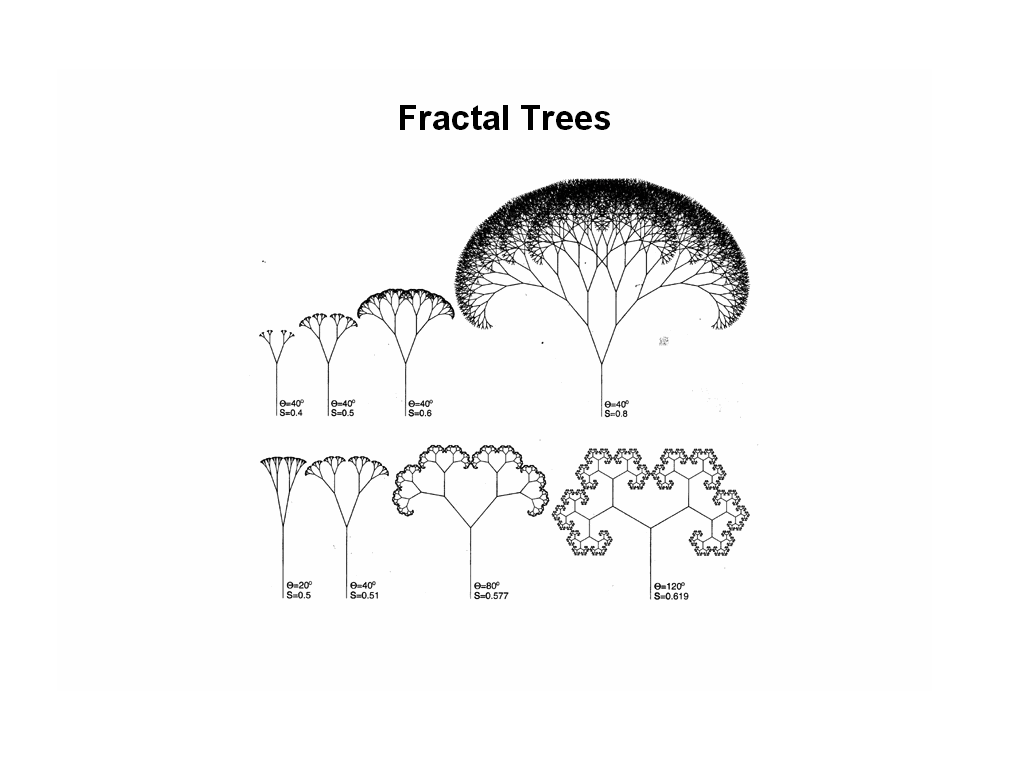
Fractal trees show how chaos and order are linked
Cliche: As we learn more in the Magic of Recluce, and in the various books that follow Towers of Sunset, Modesitt is a cliche buster.  However, the two cliche's most heavily relied upon are: Order and Chaos. As mentioned above, the theory of magic draws heavily on these concepts.  But the cliche of Order and Chaos is normally quite a bit different, usually Chaos is symbolized by the Abyss. Take the Wheel of Time by Robert Jordan, there the Dark One wants to break the wheel of time, and escape his prison, thus destroying the world and returning the universe to darkness. Not so in the Recluce Saga, Order (or The White cliche) is darkness, calm, lack of movement, structure, stasis, Negentropy.  And Chaos, in a word it's opposite, or Entropy.  Order wielders are healers, taking the chaos of infection and bounding it and strengthening the body's normal structures. Chaos wielders live short lives, but are stronger wizards since they can throw fireballs, lightning bolts, etc. There is one last thing that this cliche buster addresses that is IMPORTANT.  I try not to dwell on racism in fantasy, but fantasy undoubtedly uses racists tropes on a regular basis.  Black magic.  No one thinks that black people use black magic, and no one should, but it's definitely an unfortunate and unavoidable connotation with this common trope.  By making black magic, into good magic, Modesitt breaks with this common trope, and, I think sheds a hair more equality in a vastly unequal world (Check out redditor D3athRider on the Wild Savage trope's racism.)

A new one, possibly, let's call it Red Thread of Fate.  This cliche is the idea that two characters are bound together somehow, perhaps by blood, or some soul connection.  The term I've chosen here relates (see the link) to the east asian belief in fate, symbolized by red string.  Sometimes that connection is one of love, as in Elizabeth Hayden's Rhapsody, and other times by hatred as in the connection between Harry Potter and Lord Voldemort, or the connection between Frodo and Golum. It is a useful cliche for writing, as it requires a certain cause and effect on the other character connected.  In this case, Creslin and Megaera are bound together by their forced wedding vow.  This connection wasn't supposed to be supernatural or magical, but owing to the power of both characters, the connection assumed a greater power than it might have otherwise had. And then, this connection between the two becomes a matter of life and death.
Because Storm is hot, and an X-Men
Another new cliche would be the Storm Wizard cliche, throwing lightning and wind is fantasy fodder for thousands of years.  I mean, look at Zeuss, the ultimate god, why? because he's a badass who can throw lightning.  Well, in addition to being an Order-Wizard, Creslin is also a Storm Wizard.  While the mythos of the Recluce books contains knowledge of other storm wizards, apparently, Creslin's great strength (see Maintaining the Balance cliche) is due to the influence of the White Wizards of Candor on the world. So really, Creslin is the strongest Storm Wizard in this world's recent history. But it's bigger than lightning bolts, Creslin can move millions of metric tons of air, change pressure systems, bring massive rain storms, and turn the ocean into a ravenous hurricane.

Nation Building: this is actually a pretty rare cliche, this book is about the founding of a nation, and so it takes place over a large space of time, through several epic battles and wars.  It also contains a good deal of economics (again something I LOVE in fantasy).  This is sort of a meta cliche, and it relates to the third section of this review, "Completion." A lot of fantasy worlds are entirely character driven, and outside of what is strictly necessary to make the plot work, the rest fails to hang together.  But in this case, Modesitt makes a concious decision to set the stones for the entire saga, and it all hangs together, complete to a bumper crop of a bitter brandy called Green Berry, to how Creslin changed the weather patterns to turn Recluce from a desert, to a temperate paradise.
Medieval Trade Routes

Other cliches only mentioned: The book touches a bit on The Am I going Crazy cliche, Creslin and Megaera's connection does begin to inflect seriously on both of their mental states, and indeed the end of the book has a moment where this cliche is addressed head on. Broken Homeland, Creslin is born in a strong matriarchy that is a major power in this verse, by the end of the book, his nation of origin is entirely shattered. I mentioned earlier this book deals with The White cliche, while true, even this is cliche busting.  Usually The White, is good, all good, all clean, industrious, free from decay or corruption.  In this case, The White is exactly the opposite.  But even that is too cliched, because under the Maintaining the Balance cliche, even chaos-entropy is important to life itself.  To wit, the wizards of Candar, evil as they may be, are not evil in the grander sense.  In fact, the book goes through three generations of White Wizard Tyrants, as each is deposed by the younger generation for failing to contain the island of Recluce. Given Creslin's enormous power, he has taken thousands of lives by the book's end, this forces something of a Hero's Redemption cliche on him, though indeed, the weight of his deeds are never truly absolved.
My homeland (NYC), broken

Completeness: The Saga of Recluce is complete in that, in that this enormous number of books (nearly 20!) Modesitt literally tells the entire history of this world, book by book.  He jumps around a bit, the first book started several hundred years after the founding of Recluce, and this book details the start.  There's even a book that (SPOILER) details the original colonists of this world. (SPOILER END).  And Modesitt is very interested in the practical aspects of his world, he's invested in technology, trade routes, benchmark industries, GDP.  If that stuff sounds dry, well, it is perhaps a bit.  But there are plenty of sword fights too (Creslin's mastery with the Blade is without question).  What's really interesting is just how differently Modesitt establishes this completness record from Jordan, or Martin.  The book doesn't use documentary evidence (via epigraphs) or mysterious old ruins, or names and background of long dead nations.  These are ways to establish a complete history that Modesitt eschews, instead, he concentrates on the present and details it excruciatingly.  This is more on a level with Riftwar Saga's author Raymond E. Feist.  I think one difference perhaps, is that to cite another cliche, neither Feist nor Modesitt's worlds are Worlds in Decline.  They are more or less modern, thriving worlds where progress is derailed by war, and strife, but that the great wheel of progress is spinning forward furiously. So there really aren't massive ruins, or formerly great nations to discuss, because the world is full.
Ancient Mayan ruins, because they're cool
My overall recommendation for this book is definite, but qualified, yes!  It is not teen fantasy, or YA, as the industry calls it.  However, it is classic fantasy, published in 1993 when the genre was really starting to grow.  And, with 20 books to this particular world, it's a good series to start if you want something with legs.  I also really appreciate the seriousness of the relationship between the two main characters, something that is really quite seldom seen in traditional or young adult fantasy.  Relationships are hard, and even love at first sight fades after that first sight, so it's rare that genre fiction actually handles the actual difficulties in making relationships work.  Also, it's just a really cool magic system, worth exploring for those of you who like Brandon Sanderson's magic choices.  My other reservation on this book (particularly for a younger audience) is that Modesitt really does enjoy the wonkiness of economic systems.  It's still immensely readable, and a good way to learn about economics, but it might not be your cup of tea.

Wednesday, June 4, 2014

Rhapsody by Elizabeth Haydon

Rhapsody is a book that may technically fall under romance, but the author is female and because it was in my list to review it anyway, I'll bring it to the fore. Both times I've read this novel I've really enjoyed it. Elizabeth Hayden borrowed nearly every fantasy trope and cliche in the book, but as I've written before, the use of cliche is the bread and butter of fiction, and when used well creates a yarn that echoes down to the very deepest recesses of our souls. Aside from the standard fiction and fantasy cliches, Hayden borrows liberally from Greek and Norse myth, which isn't typical in modern fantasy. And while children's novels Percy Jackson gets filed under teen fantasy, it isn't necessarily fantasy since it literally uses the Same Greek pantheon that the actual Greeks used.

One thing to note at the outset: Elizabeth Hayden is just a good writer. Tight phrasing, concise character development, she is a writer from the old school. many modern writers allow so much vernacular or poor phrasing into their stories, thinking of it as a stylistic. All it does is point to the simplicity of their writing. Hayden's story telling is masterful.

No great fanfic of what Rhapsody looks like, this is my guess, Taylor Swift
Character  the first 200 pages or so uses only four characters really, so you get an excellent chance to know them. The Foremost is the book's namesake Rhapsody. Rhapsody's character is truly one to fall in love with, not only is she so essentially good and true and honest, she is also so modest that other characters are constantly bemused by her self effacing and willful blindness to the effect she has on others. She's also ravishing, which never hurts. One cliche breaker in Rhapsody's character is that she is a Fallen Woman, while itself a cliche, Fallen Women are rarely the lead characters of stories. They either get redeemed, get their just deserts, or simply get a measure of pity or empathy from the author. Not so Rhapsody, she was a doxy who sold her body freely and readily. Much later you find out that she had certain standards, but given that one of her return clients was a truly abusive and sadistic prick, you get the sense that even her standards were compromised from time to time. Another interesting thing about the Fallen Woman, and something that probably comes from a uniquely female perspective is that she is never redeemed. Without spoiling, an event leads to a certain physical restoration, but the mental anguish that ruined her never leaves her. This, I am lead to believe, is common among the raped. Such intelligent memes are welcome in New Fantasy, where the world is a complicated place.
Achmed, by MeetmebytheSea, Deviant Art

In fact this can be said of all of her main characters and some of the lesser. Achmed the Snake, her assassin friend is a great example of that, a man who is a cold-blooded killer, who despite our desire to like him, remains a merciless bastard well into the third book in the series where he threatens to murder children. On the other hand he develops a real and abiding affection for Rhapsody and becomes her protector. He also wields a truly neat weapon, an unusual device that is a crossbow/sling that fires off steel discs about the size of your hand at great speed. Unusual or magical weaponry is part of what makes fantasy great! The last character note on Achmed is that a turning point in his character occurs well before the entire story begins, through flashbacks and story telling you learn how he was broken. Not broken to become the bad ass assassin that he is, broken from being that bad ass and starting to flee for his life. Which, is how we first meet him. Hayden accomplishes this very simply in iust a few lines, and it seems utterly horrific. Like I said, tight writing.

There are many great characters, however it deserves mention that at least one of the three main characters is very simplistically drawn, the half ogre Grunthor, who speaks in a cockney accent and "sure loves tha lil' miss". Still he is a character intended to draw your affection, and to anchor you in the story, and he accomplishes both adroitly.

Cliche In doing research for this section (yes, I do research, I ran across a truly excellent website, www.tvtropes.org.  They have an interesting quote on their front page, that I thought I'd reproduce for you:  "Tropes are devices and conventions that a writer can reasonably rely on as being present in the audience members' minds and expectations."  They differentiate them from cliches, which is fine. For my purposes I will continue to call them cliches simply to keep my posting and listing of them, paralleled.   In Rhapsody, I will simply list them to start, as usual, where I haven't mentioned them before I will give them names. The Power of Names, the Broken Homeland, star crossed lovers, Welsh, Dungeons and Dragons, the BFG (or the Shrek), the Fallen Woman, the Bard, A Time to Remember, the Great Tree, The Druids, the sleeping child, the purification, the wise old man, the Greedy dragon. Phew: there are more, but I can't go on forever.

The Power of Names: this cliche is one of the most basic in fantasy, and in its cousin angel/demon/ghost/vampire lit. The concept that to know the name of a thing is to have power over it. This sort of cliche harkens to the Islamic belief of not being pictured or the Indian belief in totems, the Christian belief of not naming the devil, or the Jewish belief of not naming, or writing the name of God. In this case, Rhapsody is a Namer, an invention of Hayden's and it basically means she has the power to rename a thing, thus breaking the yoke of someone else knowing your true name, or healing or protecting someone through the power of knowing their true name. It's a neat concept and it was well done.  A concept Patrick Rothfuss, knowingly, or unknowingly aped in developing his Name of the Wind series.

The Fall of Atlantis, by Gaius31duke at Deviant Art
The Broken Homeland this is a neat one and much more rare: there is a place, in this case an island, where a certain race, group or sect of people, all of great power or technology, came from, and it was destroyed by something great and terrible and inexorable. Some examples: Atlantis from myth, but also from Stephen Lawhead's Merlin series. Valyria, where Martin's Targaeryen's were from. Tolkien's elves are said to have left from their own plane to come to Middle Earth, presumably Upper Earth. The Tiste Andii, of Erikson's world fled mother Dark's wrath and left their home city a smoking ruin. Here the island is named Serendair, and the island was immolated by a giant meteor (arranged by, we learn, the evil F'dor) and though it's people are largely normal, the ocean voyage of the fleeing inhabitants all become immortal as they wander the seas for years crossing untold lengths of ocean.  My research here lead me to this essay from Robert Moss, on Tolkien and Atlantis.

Romeon and Juliet, outside the Papp Theatre in NYC
Star Crossed Lovers is a common cliche in all fiction, and the phrasing of my cute name for the cliche, itself harkens from Romeo and Juliet. It means a pair of lovers chosen by fate to fall completely in love are ripped apart by events out of their control, and wander the world in desperate search of their other half. Plato's Symposium had a good example of this in Aristophanes tale of the four legged, four armed titans, ripped apart by the gods and forever in search if their other half. In this story, Hayden has her characters ripped from completely different time periods, thousands of years apart. They meet, fall in love, and then go back to their own time, with no explanation or parting words. As with Romeo and Juliet, this irrevocably changes the two lovers in dark ways.

Welsh:  While this is more of a theme then a cliche, as fantasy has its roots In western folklore, it's only natural when words, phrasings, names and character types hail from one of those old world tribes. In this case, the folklore of Wales, names like Gwydion abound, double ffs and silent Ls. Lloyd Alexander's chronicles of Prydain used this cliche, and certainly T. H. White's Once and Future King, (though King Arthur was supposedly Welsh to begin with, so perhaps calling it a cliche is unfair.)

Dungeons and Dragons: anyone who has read my reviews know what I'm talking about. Elves, dwarves, ogres, dragons, races and character classes. Hayden has given them new names, but it really wasn't necessary, most of the corollaries are pretty obvious: Lirin are elves, a spiritual race that adores nature, nain are dwarves, the firbolg are ogres. One cliche breaker that Hayden uses here to great effect is that the races are seldom pure, half breeds and mixed bloods abound. And in fact, much like real life evolution, old races die out or evolve to newer or different forms, it isn't until you go back hundreds of thousands (possibly millions) of years that you see the first five progenitor races, which include the dragons, and the devils, the F'dor.

BFG: the Big Friendly Giant reference might be a little dated, and I have no idea if kids still read Roald Dahl in school. The BFG concept is simple: a big scary monster, is actually the sweetest character in the book, supposedly shedding light on how poorly behaved we humans can be. A good example from the Belgarion, was Barack, but even his character has more depth than Grunthor. Who just seems like a really sweet guy.

Lena Headley as Queen Cersei from HBO's #GOT
The Fallen Woman: I've already described this one above, but as a general rule this is not a common fantasy cliche. Even in modern fantasy women are virtuous, clean, as gentle. The one obvious example to this is Steven Erikson, who is really not afraid to drag his female characters through the mud. Both Felisin's come to mind. To be honest, it is probably a male hang up, I know its a personal hang up. The treatment of Felisin in Deadhouse Gates nearly ruined the novel for me. I suppose you could say that Queen Cersei, of Game of Thrones renown, is a fallen woman, but she is never raped, nor is she ever destitute, these are important qualities for the Fallen Woman. It isn't that the poverty is a justification, it's that poverty is its own palpable kind of degradation, one that has nothing to do with the sanctity of the body.  There is much to say on this concept, but I don't want to explore too deeply here.

There were a great many to choose from, but I just liked this image
The Bard: this is a great fantasy sub class. Too often you just see warriors and wizards, or in today's fantasy those who are masters at both, which was a major D&D no no.  You see tons of thieves and scads of assassins. But bards are a class of their own, much more rare. Although, again Patrick Rothfuss seems to have taken a leaf from Hayden's book in making his own main character Kvothe, somewhat Bard like.  The power of a bard is in his voice, in his music, but he can fight, and steal as well. He might even know low ranking magics, the type to get him out of sticky situations. They are scoundrels and wastrels and are just great characters. It's rare when they are the lead character, as Rhapsody is, and tend to be comic, or romantic relief.  Some great bards: Taliesin of Stephen R. Lawhead, Thom Merlyn of Jordan's WoT, Merry and Pippin of LOTR, and now Kvothe from the Name of the Wind. One neat thing about bards are that as a class, they pay homage to the fact that in a pre-industrial world, people can't play an iPod to entertain themselves. Somebody is playing or there is no music. And last it is an opportunity for the author to expound on the history and culture of the world that the author has built.

A Time to Remember:  Time travel is not fantasy specific, in fact, very few fantasy novels use this device at all. When they describe the past, it's through flashbacks or reminiscing.  In this story the central plot point, is caused by the removal of a modern man to several thousand years prior to fall in love with a woman and leave her, after promptly deflowering her. Also, as nearly all the characters in this book are long-lived, some are simply immortal and choose suicide after thousands of years of grief. There are a few other notables from the overall genre that use the cliche, including the DragonLance historian Astinus. The man stands outside of time, and writes the history of the world, but at the same time he maintains a temporal residence on Krynn and people can visit him. Feist's Magician series has the dragonriders whose dragons can see their own deaths and are themselves long lived to the thousands of years.

The Great Tree and Druids:  this is a neat concept, and a very green one. The elvish cliche holds that elves live in the forest, but frequently within those forests live other creatures of the woods, unicorns and dryads and ents, and massive trees the size of mountains. I like this cliche for two reasons, one it's primeval fantasy at work, this mythos reaches back to antiquity, and perhaps because of that, it finds its way into other types of literature. Some examples include Martin's heart trees in the North, Weis and Hickman's brothers Majere lived in Solace, a town built on such massive trees. Several iterations of the Robinhood myth have the Prince of Thieves residing in the trees, and of course Tolkien's forests are primeval to the extreme, featuring giant spiders, massive trees, ents, you name it. In Rhapsody's world, there are two or three such trees and their root system is so massive that they span the entire crust of the planet, reaching almost to the planet's fiery core. There is, on the surface, a group of mixed race Druids who live in the shadows of the great trees and serve its needs.
Because why not add Jean Grey?

The Sleeping Child:  The sleeping child is a very common religious theme, here's how it goes, the Earth is actually a dragon, who settled down for a nap millions of years ago, and hasn't woken up.  One day he shall wake up, and the destruction of the world is assured.  I had difficulty tracing the origins of this particular myth.  I had thought it was Norse because of a review I read last year, but since then I have been unable to dig it up.  That said, it's existence in popular culture is very obvious.  For one, Steven Erikson's Malazan epic, is based on the idea of Burn's Sleep.  Burn is the being at the center of the earth, and it is she that the Crippled God has poisoned, because he wishes to destroy the world.  Another good example would be the Hellfire Club of X-men renown.  The Hellfire Club worship the Phoenix, who they believe has been dormant in the center of the Earth, and will wake up one day, inhabit a young hot red head and "reform" the planet.  In Hayden's world, the F'dor, the demons locked in a gravity well at the center of the Earth, want to wake up the Sleeping Child, in this case an enormous dragon.  The dragon will wake up, shed the earth around it, and raize the rest.  What's kind of cool about Rhapsody, is that you actually get to see part of the dragon and get a sense of its immensity.  Sidebar:  Googling the "sleeping child/dragon at the center of the earth' was an education on just how crazy the internet is, and the Tennessee Valley Authority should never have been brought into existence if it meant these people got electricity, and fifty years later, the internet.  I'm also disappointed to note that I couldn't find a single appropriate image for this motif, which leads me to believe it is not as common as I thought.  Or the internet failed.

The Purification:  This is a common fictional motif, where the hero undergoes some sort of test, some sort of a cleansing, and comes out stronger, more peaceful of mind, and frequently with other powers.  This occurs all over the Malazan epic, when the Bridgeburners gain ascendancy, the Bonehunters survive the conflagration at Y'ghitan, Tattersail dying in the warren of Tellann only to be reborn a soletaken.  Gandalf the Grey, of course, becomes Gandalf the White after falling through the center of the earth and displacing Saruman.  In this case, Rhapsody does just that, passing through the center of the earth.  I like Purification cliches because the transformation from dark to light seems innately pleasing to me.  They also supply ample reasons for what in Malazan terms is ascendancy, the concept of gaining godhood or improved powers. We videogamers live for such moments.
One of my favorite images, the battle between Gandalf and the Balrog, before they plummet through the earth


I'm not going to bother with The Wise Old Man, or the Greedy Dragon Cliche.  This post is too long already, and they seem fairly obvious as cliches.

Scope:  Hayden's world certainly lives and breathes, so from that perspective it is a very successful fantasy novel.  The world does not seemed hurried or vague, and if it borrows perhaps a wee bit much from the most common cliches, having them all together in one world creates a very unique sense of the faerie.  One thing the plot suffers from is that the story is almost entirely told from the perspective of Rhapsody and her companions.  While that isn't necessarily a problem, it sometimes can feel like naught occurs in the world without our single-camera focus.  While there are other events that occur over time, in the next book, and the one thereafter, the details of what occur elsewhere are fairly general and do not provide the greatest depth.

Magic:  Magic in Rhapsody takes many different forms.  Rhapsody herself, through her art of Naming, is the practitioner of one type, the F'dor, shapeshifters also wield fire.  The various races have magic innate to their own races, and of course, dragons and druids have their own forces.  All in all, it's a hodgepodge.  This isn't necessarily a bad thing, it adds to the sense of a bazaar of magic.  And at anyrate, it's hardly alone in classic fantasy.  That said, it does seem to fall victim to Sanderson's rule.  Meaning, it can become a plot device to extricate the author from a sticky situation.  Having rules regarding magic is important, and when done well can lead to very creative fixes.
Korlat and Whiskeyjack, I wish I knew whose art...

Theme:  The last category, always hardest to describe is also where I'll stick some general notes about the book.  As stated in the first paragraph, this book is often described as a romance.  And that is probably the best indicator of theme, the notes of high romance, long-lost love, unbelievably good sex, is omnipresent.  It's also irritating.  Fantasy isn't fantasy to me without a little romance.  I like the guy to get the girl, or vice versa, or whatever, whenever possible.  That said, even George R. R. Martin is a bit shy about the actual act of describing coitus.  The sex is often implied, sometimes spelled out, but it is always brief.  Rhapsody has several love making scenes throughout the series, and they go on just a page too long.  And sex's handmaiden, love is their in spades.  When love is mature, filled with anxiety, and tinged with bitterness, I'm on board, but sometimes the lovemaking can get a little saccharine.  It certainly did in Jim Butcher's Furies series, and it does here as well.  I don't know why it bothers me so.  Is it a failing on my part?  I'd like to believe that it is not.  Afterall, there are times when love in fantasy really does break my heart, as in Whiskeyjack's doomed romance with Korlat.  One last aspect of the theme, which is quite appealing is that the story is often times like a murder mystery.  The story is framed around a love affair that is 2,000 years dead.  And began a war that lasted 500 years.  The details of which take three novels to flesh out.  It's an excellent plot device.

If you haven't read Hayden's Rhapsody series.  You should read the first book at least.  It's a book of many tropes, it's true.  But it is also a very well written book.  That cannot be understated.  And if you've a mind for romance, then this book may be exactly your speed.