Search This Blog

Showing posts with label Kate Novak. Show all posts

Wednesday, January 13, 2016

The Wyvern's Spur by Kate Novak and Jeff Grub

This was one of the best Forgotten Realms novels yet. Not only did it occur within the standard realms, a fortified town in Cormyr, it had some truly loveable characters.

It was not a complex novel by modern standards, but after the sanctimonious and cliched writing of the Ice Wind Dale trilogy it was a great relief. The novel continues the events of the Curse of the Azure Bonds, popularized by the SSI one of the earliest PC games in history.  However it takes as it main character a complete nonentity, as we used to say in the biz an NPC, or non-player-character, a drunk partygoer who mimicked the King and nearly died when Alias tried to kill him. But before we get any further let me state simply and for the record: The Curse of the Wyvern's Spur is a thoroughly enjoyable novel.

Character: so the harmless partygoer is named Giogini Wyvernspur, and he's a delight. Foppish and insecure, but undeniably good natured, he returns from the mission that the King sent him on and his apartments in the city suddenly seem too small. He's been bitten by the adventure bug and for the first time in his life he's doing things for himself. His manservant is astonished! When he comes home, he returns just in time to find out that the Wyvernspur family, of which he is the primary heir, has just lost the magical artifact that gave the family it's name. Meanwhile his Uncle, an old but powerful wizard has a very important message for him. The novel is almost written as a mystery novel, which is a nice twist for fantasy, unusual too.
There are only two other characters of note: and one of them is a mystery. The other is Olive Ruskettle. If you remember Azure Bonds at all, you"ll remember the Halfling bard, Olive Ruskettle, whose desire to create a lasting melody provided the foil for The mystery of the azure bonds and the nature of Alias. In this novel, she finds herself back to her thieving roots, having taken on an apprentice. Her apprentice is Alias! But not really, apparently this area of the realms is chock full of Alias copies. Each a different class, none of whom has any idea of her mysterious parentage or fabricated nature. But back to Olive: she is probably the most interesting Halfling character I've read: in general I find them sort of boring.  Like dwarves, they tend to be very one-sided, in the opposite way. They are carefree, disloyal, low level fighters, or thieves. Olive exhibits these tendencies of course, what good a cliche if it's use is completely dissociative. But she also displays real leadership, particularly in Spur, given Giogini's befuddled nature. She seems to have a genuine history if not particularly well explicated, there is a third volume in the series: which if she plays a part will make the Alias trilogy really the Ruskettle Trilogy. Of course there are disappointments, Olive is "spurred" (haha) to help Giogi because of grief over her apprentice's sudden demise, but that grief, though referenced often enough is just not written convincingly.  In part because we do not know much about her slain friend: which brings us to the third character of note, the Alias look alike.

I don't even remember her name, an indication of how soft this part of the story is. Like so many love interests she is a soft amorphous blob, not saccharine, she displays rare moments of pique, but is just not very interesting. That said, this is often true in narrative fiction so maybe it's unrealistic to expect in pulp fantasy.

Cliche: we've mentioned the Halfling cliche, what's interesting about this is that what really made the Halfling cliche were Tolkien's hobbits. The hobbits of the Shire are really very charming, quaint and amusing details abound them really bring such characters to life. Unfortunately this charm almost never translates to D and D.
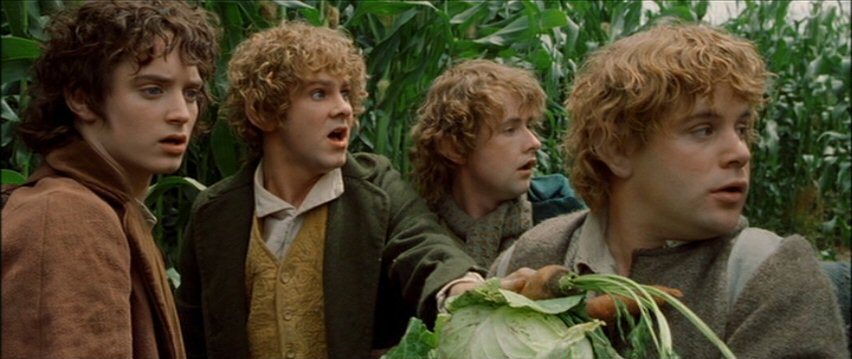
Hobbits everyone knows and loves


The Wyvern cliche is a relatively minor one, possibly not even worth mentioning other than the fact that they are smaller, armless dragons of lower intelligence. They do translate across fantasies, notably Erikson's Malazan epic has a small if memorable place for them.

Obviously all the D and D cliches apply. One cliche that sticks out a bit in this book is the magic-user D and D cliche, including: the mechanics of spell book casting, magical properties of spell components, scrolls, memorization etc.  It reminds me that aside from historical accuracy (relative accuracy) the main reason for such contrivances was to impose limitations on characters that would otherwise be far too powerful in a game setting. Compare that with the sweeping powers of Anomander Rake or Rand al'Thor. The limitations provided an additional layer of strategy. Fighters went forward to cover the firepower of spell casters. Spell casters could exert enormous force on massive monsters or provide a distraction to beleaguered fighters. I still remember the Fall of Pale from Gardens of the Moon and how it shattered my spell casting memes.

Another cliche explored in this novel, a more generalized cliche is the Whose Yer Daddy cliche. Given the preponderance of this cliche in literature I'm sure there must be some more technical name, but I can't resist it: who's your daddy? The cliche for children with mysterious parentage. Rand al 'Thor, Garion from the Belgariad. In this case, Giogi's father was a great adventurer whom the Crown relied on for certain dangerous tasks. Of course, Giogi's Aunt Dorath, herself a colorful, if minor character, hides the secret of Giogi's parentage.

Which brings us to Completeness. This novel is a tightly polished miniature puzzle and all of the pieces fit together extremely well. It has drama, love, high magic, the undead,and best of all a genuine warmth and sense of humor. It is self contained and there is no sense that the third novel in the Alias series will have anything to do with Giogi (more's the pity.).  We did learn a bit more about the Realms, about the nation of Cormyr. King Azoun, part of a long running dynasty is a relatively fair ruler. There is an interesting form of patronage at work: successful adventurers can be given land and title as governors of the land though they are not granted nobility and the title does not pass through the family  line, unless the governor marries into the local nobility.  One nice thing about the story is that since it stays in the same locality a few nice details have time to come about.

So, on the whole, this is a decent novel and might even be with a reread a few years from now. High praise indeed for a Forgotten Realms novel.

Monday, April 9, 2012

Azure Bonds by Kate Novak and Jeff Grubb

Now this is really the beginning of the Forgotten Realms Novels.  You might remember my complaints about Darkwalker on Moonshae. It was a fairly shallow piece of princely do-goodery, that really said nothing about the Realms or their history.

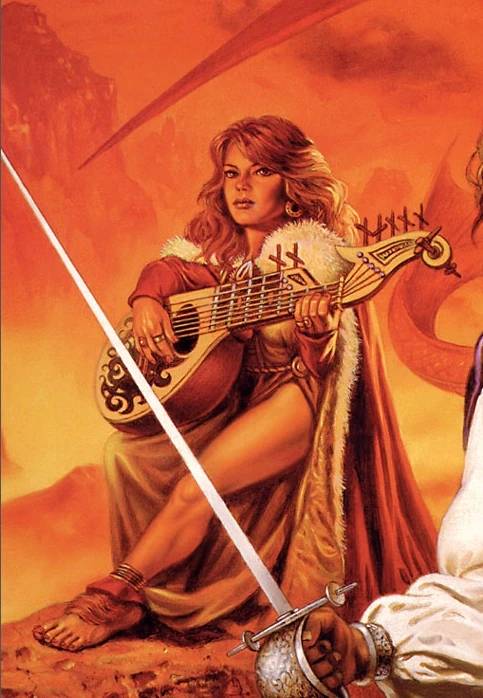
Azure Bonds is everything I hoped for.  It has the beginnings of characters who were well known to me, long before I started reading the Realms, action, adventure, and humor.  If there was no romance, that's ok.  This time.  When I was a young kid, Dungeon & Dragons, attempted to compete with the already-past its prime moment of "Magic the Gathering" with a series of cards called "SpellFire".  Given that TSR, owned the rights to much of the famous Dungeons and Dragon's artwork, they had a ready supply of easily choppable art for these cards.  And they often kept characters more or less intact.  I had the Alias card, the lusty redhead above.  I always thought she was crazy sexy, and so I was curious about who this person was.  Well, now I know.

As a side note, I actually saw people playing Magic the Gathering a few weeks back, in a pizzeria on the Upper East Side.  The guy was actually showing off for a girl.  He had every single card in a thick, clear, possibly bullet proof, plastic container.  Which is crazy.  That's a "back away slowly" kind of dude.  I keep my Spellfire cards under lock and key.  If I showed them to my wife, she'd probably divorce me.
Let's get back to the Fantasy Five, something I've ignored in my ardor over the Malazan Book of the Fallen.

1) Character
2) Cliche
3) Scope
4) Magic
5) Theme

Character:
Azure Bonds is definitely a plot driven story.  But it has some interesting philosophical points, as any fantasy and science fiction novel must, that help define character.  I won't ruin it for anyone who wants to reread this classic, but the nature of the main character is a central dispute of the novel.  Regardless, the main character, a warrior woman named Alias, is an extremely likable character.  She's sarcasic and clever, but at the same time cares for her companions.  Her supporting adventurers are also extremely likable, and somewhat genre breaking, save for the Halfling Thief.  The wizard, though is a what Alias calls, "A Green Grocer" a merchant of magic, and not a true wizard with the long white hair, and the mysterious airs.  The halfling, though stereotypically a thief, is a fun and enjoyable character.  Mostly, characters are skin deep in Azure Bonds.  That said, we do learn some things about Alias, and her father, that provide some interesting character insights.  Unfortunately, I can't talk much about them without spoiling the book.  Of course, the best character, is Elminster, the very essence of quixotic wizard.  And though the character of Elminster is minor, and fairly cliched, you can't help but love the fiercely powerful, irascible old coot.

Cliche:
Azure Bonds takes place in the Dungeons & Dragons, rule-based system, and in the Forgotten Realms Universe, that comes with all of the Dungeons & Dragons cliches.  That said, Novak manages to make the magic and combat systems seem completely natural and not stilted or forced.  Which makes sense, I mean, the original 2nd Edition Rules were supposed to make combat realistic.  If it didn't involve so much THACO and Armor Class shenanigans, it wouldn't have been such a trying game.  Regardless, Forgotten Realms also made several cliche's of its own.  One of the mega villains, a fantastic creation called Moander, a dark God, who is literally a living wall of reanimated detritus, was used by the UbiSoft developers in the Heroes of Might and Magic series of video games.  Used in both Three and Four, here he is reimagined.  Of course, Kate Novak's Moander looks nothing like this undead piece of work, but the developers paid homage in many respects to both D&D, DragonLance, and Forgotten Realms. In terms of character cliche's there are relatively few.  The character of the halfling thief was fairly trite, but she's a non-essential character (though her actions are important). 

Scope:
The scope of Azure Bonds provides a narrowness of focus that gives ample detail about the Forgotten Realms, while not being needlessly compartmentalized as Darkwalker was.  The action starts in the town of Suzail in the nation of Cormyr.  One thing that the Realms reminds us is that the writ of law is only as strong as the nation that rules.  And the Realms are relatively small fiefdoms, with various small time Kings.  There isn't the sense of international politics that there is in Jordan's or Martin's epics.  There are some political upheavals, but so far, things are pretty local.  Sometimes I like that.  It takes an awful lot of memory and concentration to understand the politics of dozens of fictional nations.  I know that Tear sold grain to Illian and Cairhien despite a trade embargo on the one, and civil war on the other.  That's pretty messed up.  I know about as much or more about those three nations as I do Iran, Iraq and Syria.  One thing that bothered me though, was the interplanar warfare that occurs later in the book.  The concept of planes is very neat, and it is central to Ed Greenwoods original concept of what the Realms were--but in this case, it seems like too much of a convenience for a writer to engineer an exciting ending.  I like that the Realms are fairly grounded.  The magic has limits, and even though there is a much more diverse panoply of creatures to choose from, they are all bounded by the rules of a game, making them less.  Boundaries are important in fantasy, you have to adhere to the rules you set.

Magic:
I've covered this in some part.  Spells take time to cast, they use a variety of scrolls and components, they need to be memorized before each use, etc. etc.  The magic is covered by the Dungeons & Dragon's cliches, however, it still comes across as a novel, not the mechanical manifestation of spell casting in video games and in the old paper and pencil method.  But...there are times when the magic wielded does seem to completely bypass the rules altogether.  Given that Novak and Grubbs were writing when fantasy fiction was in its adolescence, this rookie mistake can be glossed over.  It's a genuinely entertaining story.

Theme:
That Azure Bonds qualifies as fantasy fiction is unmistakable.  The themes are all there, companions, loyalty, friendship.  Likewise, the evil triumvirate, greed, pursuit of immortality, and the pursuit of power, plagues the supervillains in this novel.  One theme however, permeates the Realms in a way that other mega epics fail.  The stories of the realms, Azure included, reinvigorate the notion of the quest.  In all the big serialized fantasy worlds, there are a small set of characters who pursue a goal for thousands of pages.  The goals change, but they're all in pursuit of a larger purpose.  The Realms, unlike the world of DragonLance, a war torn world with heroes and an evil goddess, were designed to be episodic, referential without commanding a single story line.  This is a concept that has been lost by modern fantasy.  And it's sad.  Because the quest doesn't always have to be epic, it can sometimes be as hard as a paralyzed man learning to wiggle his toes, or a pair of skinny kids freeing their sister from a den of Orcs.

Overall, I encourage readers to dust off this 1988 special.